
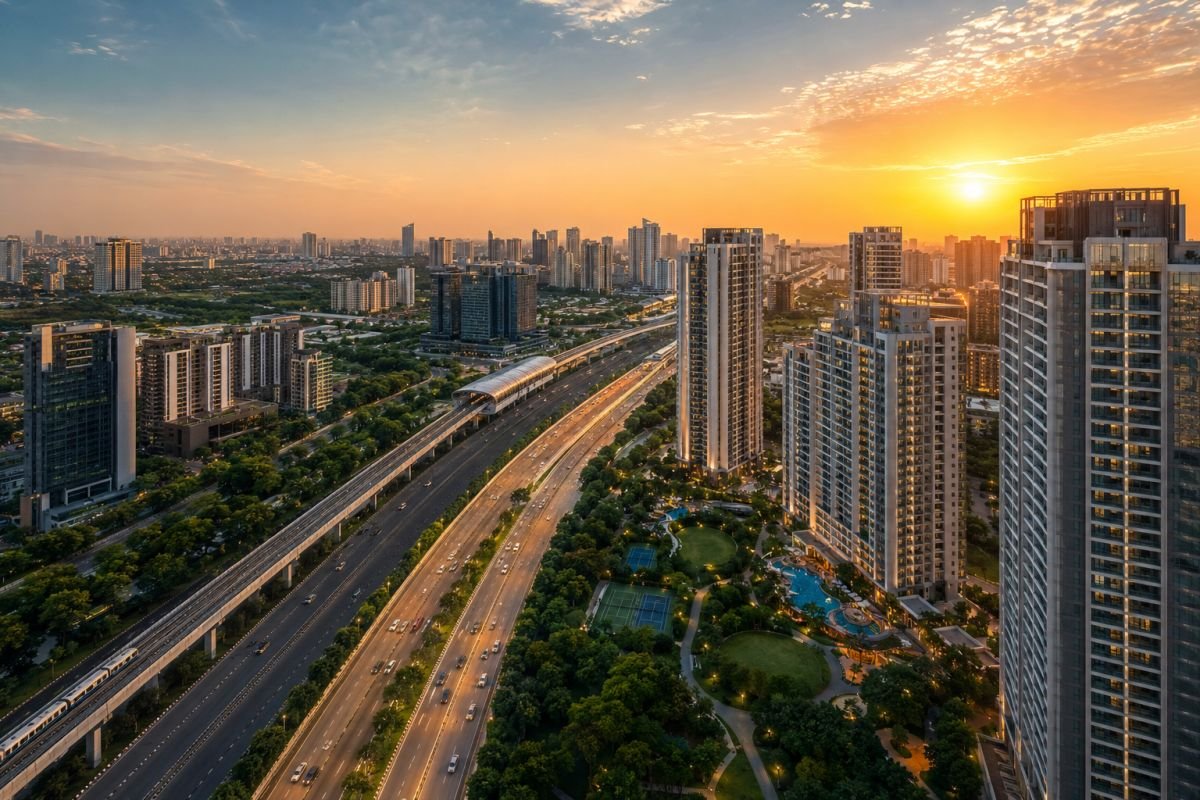
Ten years ago, buying a home in many parts of New Gurgaon required a leap of faith. Areas along what is now the Dwarka Expressway were often dismissed because daily commuting was unpredictable, airport access was inconvenient, and social infrastructure was still developing. Most premium buyers preferred established addresses like Golf Course Road, DLF Phase 5, or MG Road, where connectivity was already proven.
That buyer mindset has changed dramatically.
Today, many homebuyers compare projects in Sectors 106, 111, and 113 with premium developments on Golf Course Extension Road because improved infrastructure has reduced the importance of traditional addresses. Wider roads, better airport connectivity, upcoming metro expansion, and planned commercial districts are reshaping how Gurgaon grows.
This isn’t just another infrastructure story.
It is changing where developers launch projects, where businesses lease offices, where families choose to live, and where investors expect the next wave of capital appreciation.
One trend we’ve consistently noticed while analysing Gurgaon projects is that buyers now spend almost as much time studying Google Maps as they do reviewing floor plans. Travel time, school access, and office connectivity often influence purchasing decisions more than an additional bedroom or a larger clubhouse.
That shift explains why infrastructure has become one of the strongest drivers of Gurgaon’s real estate market.
Quick Answer
How are expressways and metro expansion transforming Gurgaon real estate?
Expressways and metro expansion are making Gurgaon more accessible by reducing travel time, improving airport connectivity, expanding commercial hubs, and creating new residential growth corridors. Infrastructure projects like the Dwarka Expressway, Southern Peripheral Road (SPR), Central Peripheral Road (CPR), Urban Extension Road-II (UER-II), and the proposed metro network are attracting premium residential developments, Grade A office spaces, and organised retail. As connectivity improves, demand is spreading beyond traditional locations, creating new opportunities for both homebuyers and long-term investors.
Key Takeaways
- Dwarka Expressway has become one of Gurgaon’s fastest-growing residential corridors.
- SPR is evolving into a balanced residential and commercial ecosystem.
- Metro expansion is expected to strengthen rental demand in connected sectors.
- Buyers now prioritise commute time over prestigious addresses.
- Infrastructure alone is not enough—social infrastructure and employment growth remain equally important.
Why Infrastructure Matters More Than Ever
Property prices are rarely driven by buildings alone. The surrounding ecosystem often determines whether a location becomes a successful neighbourhood or remains an isolated residential cluster.
This is exactly what Gurgaon has experienced over the past decade.
Golf Course Road became one of the city’s premium addresses because it combined excellent road connectivity, corporate offices, reputed schools, hospitals, shopping destinations, and lifestyle amenities. Buyers weren’t simply purchasing apartments—they were investing in convenience.
The same pattern is now emerging in newer parts of Gurgaon.
As infrastructure improves, sectors that were once considered peripheral are attracting stronger end-user demand because they now offer practical daily living. Better roads reduce commuting stress, while expanding commercial districts create employment closer to residential communities.
This combination of connectivity and economic activity typically supports healthier long-term property appreciation than infrastructure alone.
Gurgaon Is No Longer Growing Around One Business District
For years, Cyber City and Golf Course Road dominated buyer conversations.
That is changing.
Instead of one central growth zone, Gurgaon is developing into multiple interconnected corridors, each serving a different buyer profile.
| Growth Corridor | Why It Matters | Ideal Buyer |
|---|---|---|
| Dwarka Expressway | Airport access, Delhi connectivity, premium residential launches | Investors & Luxury Buyers |
| Southern Peripheral Road (SPR) | Mixed-use development, offices, retail, residences | Families & Professionals |
| Golf Course Extension Road | Mature social infrastructure and premium housing | End Users |
| New Gurgaon | Planned sectors with long-term appreciation potential | Long-Term Investors |
Each corridor has evolved differently.
Golf Course Road represents a mature luxury market.
Dwarka Expressway is still unlocking value through improving connectivity.
SPR is developing into an integrated urban ecosystem where residential, commercial, healthcare, hospitality, and retail projects are growing together.
Understanding these differences helps buyers choose the right location based on their goals rather than simply following market trends.
How Infrastructure Has Changed Gurgaon Since 2018
The city’s transformation has happened gradually rather than overnight.
| Year | Major Development | Impact on Real Estate |
|---|---|---|
| 2018 | Faster progress on Dwarka Expressway | Investor interest shifts towards northern sectors. |
| 2020 | Road upgrades continue despite slower markets | Developers increase land acquisitions. |
| 2022 | Premium launches accelerate | Buyer confidence improves. |
| 2024 | Key sections of Dwarka Expressway become operational | End-user demand strengthens. |
| 2025–2026 | Metro expansion, CPR improvements and Global City planning | Multiple growth corridors emerge. |
Perhaps the biggest change isn’t physical infrastructure.
It’s buyer behaviour.
Earlier, buyers asked whether a project was close to Golf Course Road.
Now they ask how quickly they can reach Cyber City, the airport, or Delhi during peak traffic.
That small change reflects a much bigger shift in how premium housing is evaluated.
Dwarka Expressway: The Corridor That Changed Buyer Perception
Few infrastructure projects have influenced Gurgaon as much as the Dwarka Expressway.

Initially viewed as a long-term bet, it is now attracting significant attention from both end-users and investors because of improved access to Delhi, Indira Gandhi International Airport, and emerging commercial districts.
The corridor has also encouraged leading developers such as DLF, Smartworld, Godrej Properties, M3M, Signature Global, Elan, Hero Homes and Sobha to strengthen their presence through premium residential launches.
Projects like Smartworld One DXP, Godrej Vrikshya, and several luxury developments across Sectors 106, 111 and 113 illustrate how developers are positioning themselves around future infrastructure rather than established markets.
However, one misconception deserves attention.
Not every project located on Dwarka Expressway will automatically deliver strong returns.
Projects with better internal road access, operational schools, healthcare facilities, retail destinations and surrounding residential density are generally better positioned than isolated developments that rely solely on the expressway’s name.
Infrastructure creates opportunity.
Neighbourhood maturity determines long-term performance.
A Closer Look at Key Micro-Markets
Rather than evaluating the corridor as a whole, serious buyers should understand individual sectors.
| Sector | Why Buyers Prefer It | Approximate Buyer Profile |
|---|---|---|
| 102 | Established residential communities with improving infrastructure | Families |
| 103 | Premium housing pipeline and future appreciation | Investors |
| 106 | Integrated townships and luxury developments | HNIs & NRIs |
| 111 | Excellent Delhi and airport connectivity | Professionals |
| 113 | Strategic location near the Diplomatic Enclave | Luxury Buyers |
Sector 106, for instance, has attracted increasing attention because buyers looking for premium homes now see it as an alternative to more expensive mature markets. Large integrated developments, improving road connectivity and proximity to Delhi have significantly strengthened its appeal.
Similarly, Sectors 111 and 113 continue benefiting from their strategic position near the Delhi border and airport corridor, making them attractive to professionals and frequent travellers.
Why Developers Are Investing Before Buyers Fully Arrive
One pattern repeats across almost every successful Gurgaon corridor.
Developers move first.
Homebuyers follow later.
Major developers evaluate infrastructure plans years before the average buyer begins considering a location. They study proposed roads, employment growth, airport access, commercial expansion, and government planning before acquiring land.
That explains why companies such as DLF, M3M, Smartworld, Godrej, ATS, Elan and Signature Global have expanded into emerging corridors ahead of full market maturity.
For buyers, this provides an important lesson.
Instead of asking which project is newest, ask why experienced developers are investing there in the first place.
The answer often lies in infrastructure, employment, and long-term urban planning rather than short-term marketing campaigns.
Why SPR Is Quietly Becoming Gurgaon’s Most Balanced Growth Corridor
While the Dwarka Expressway has captured most of the headlines, the Southern Peripheral Road (SPR) has steadily emerged as one of Gurgaon’s strongest long-term real estate corridors. Unlike the expressway, which primarily benefits from regional connectivity, SPR is evolving into a complete urban ecosystem where people can live, work, shop and access essential services without travelling across the city.

Stretching between Golf Course Extension Road, Sohna Road, NH-48 and the Dwarka Expressway, SPR has become the missing link connecting Gurgaon’s major residential and commercial districts.
One reason investors are optimistic about SPR is that infrastructure and commercial development are progressing together. New office projects, organised retail, premium residential communities and hospitality developments are gradually transforming the corridor into a self-sustaining destination rather than just another residential belt.
Several premium projects from developers like M3M, Signature Global, Smartworld, Whiteland, and DLF have strengthened buyer confidence in this corridor. Luxury launches continue to attract professionals working in Cyber City, Golf Course Road and Udyog Vihar who want better connectivity without paying the premium commanded by older micro-markets.
Unlike some emerging corridors that depend entirely on future promises, SPR is already witnessing visible lifestyle infrastructure, making it attractive to both investors and end-users.
Metro Expansion Could Create the Next Wave of Demand
Road infrastructure transformed Gurgaon’s first phase of growth. Public transport is expected to influence the next one.
The proposed metro expansion is likely to improve connectivity between residential sectors, commercial hubs and business districts, reducing dependence on private vehicles while increasing the attractiveness of several emerging neighbourhoods.
History from Delhi, Bengaluru and Hyderabad shows that residential demand often strengthens around well-connected metro corridors. Gurgaon is expected to follow a similar pattern.

A working couple employed in Cyber City may now consider buying a home in Sector 111 or Sector 106 if improved metro connectivity significantly reduces daily commuting time. That practical lifestyle benefit can be more valuable than choosing an older premium address with limited transport options.
Metro infrastructure also encourages mixed-use development. Retail outlets, cafés, supermarkets, healthcare facilities, co-working spaces and entertainment centres naturally grow around transit stations, creating vibrant neighbourhoods that support long-term residential demand.
Commercial Growth Is No Longer Limited to Cyber City
Cyber City remains Gurgaon’s commercial powerhouse, but it is no longer the only business destination driving housing demand.
Office leasing activity has expanded across Golf Course Extension Road, Sector 74A, SPR, and upcoming developments around Global City. Businesses increasingly prefer locations with efficient access to Delhi, the airport and residential catchments because these factors directly influence employee convenience.
Large commercial developments such as DLF Downtown, along with Grade A office projects across emerging corridors, indicate that employment growth is spreading beyond traditional business districts.
This matters because residential markets rarely perform well in isolation.

Where offices expand, rental demand follows.
Where rental demand grows, organised retail, restaurants, healthcare facilities and schools generally follow.
That sequence has repeated itself across every successful Gurgaon micro-market over the past two decades.
Global City and CPR: Two Projects Worth Watching
While the Dwarka Expressway often dominates discussions, two other infrastructure initiatives deserve equal attention.
The first is Global City, a large mixed-use urban development expected to integrate offices, residential districts, retail, hospitality and convention facilities within one planned ecosystem. If delivered as envisioned, it could become one of Gurgaon’s largest employment and business hubs over the coming decade.
The second is the Central Peripheral Road (CPR).
Unlike expressways that primarily improve regional connectivity, CPR is designed to strengthen internal movement across Gurgaon by linking several residential sectors with major arterial roads. Better east-west connectivity can reduce dependence on older traffic-heavy junctions and improve access between emerging neighbourhoods.
For buyers, these projects may influence daily convenience just as much as the larger expressways.
Gurgaon Still Has Challenges Buyers Should Understand
No market is perfect, and Gurgaon is no exception.
Local buyers know that certain bottlenecks continue to affect daily commuting despite ongoing infrastructure improvements.
Peak-hour congestion around Hero Honda Chowk remains a challenge for many office commuters. Rajiv Chowk continues to handle heavy traffic connecting NH-48 with central Gurgaon, while Badshahpur frequently experiences slow-moving traffic during school and office hours.
Another overlooked factor is internal road quality.
Two projects located on the same expressway can deliver very different living experiences depending on service roads, local access routes and neighbourhood planning.
A practical tip for buyers is to visit shortlisted projects during weekday peak hours rather than relying only on navigation apps. A commute that looks convenient on a Sunday afternoon can feel completely different on a Monday morning.
Infrastructure Doesn’t Guarantee Appreciation
One of the biggest misconceptions in real estate is that every infrastructure project automatically increases property values.
The reality is more nuanced.
We’ve seen projects located just a few kilometres apart perform very differently because one benefits from established schools, hospitals, retail and office demand, while the other still depends on future development.
Infrastructure creates visibility.
Neighbourhood quality creates sustainable demand.
That distinction is important for investors chasing capital appreciation.
Buying simply because a project is located near an expressway can be risky if surrounding social infrastructure takes years to develop.
Where Should You Invest? A Budget-Based View
Every buyer has different priorities, so there is no single “best” location.
Here’s a simplified framework.
| Budget | Suitable Corridors | Ideal Buyer |
|---|---|---|
| ₹1.5–2.5 Crore | Dwarka Expressway, New Gurgaon, selected SPR sectors | First-time buyers & investors |
| ₹2.5–4 Crore | SPR, Golf Course Extension Road, Sector 106 | Upgraders & premium buyers |
| ₹4–7 Crore | Golf Course Road, Sector 111, Sector 113, luxury Dwarka Expressway projects | HNIs & NRIs |
| ₹7 Crore+ | Ultra-luxury projects by DLF, M3M, Elan and Sobha | Ultra-premium buyers |
The right choice depends on whether your priority is capital appreciation, rental income or long-term family living.
Ready-to-Move or Under Construction?
This question has become more relevant as infrastructure improves across Gurgaon.
Ready-to-move projects allow buyers to evaluate the surrounding neighbourhood before making a decision. Schools, hospitals, road quality and commercial activity are already visible.
Under-construction projects may offer stronger appreciation potential if infrastructure continues progressing as planned, but they also involve greater execution risk.
For end-users, certainty often matters more than speculation.
Long-term investors, however, may still benefit from entering emerging corridors before they fully mature.
Five Mistakes Investors Continue to Make
Instead of focusing only on what to buy, it’s equally important to understand what to avoid.
| Common Investment Mistake | Better Approach |
|---|---|
| Buying only because of an expressway | Study the complete neighbourhood ecosystem, including schools, hospitals, commercial hubs, and future infrastructure. |
| Ignoring developer track record | Choose developers with a proven delivery history, strong construction quality, and reliable after-sales support. |
| Chasing attractive launch prices | Evaluate long-term demand drivers such as connectivity, employment growth, and social infrastructure rather than price alone. |
| Overlooking office and commercial growth | Focus on locations where Grade A offices, business parks, and mixed-use developments are expanding to support future rental demand. |
| Assuming every corridor will appreciate equally | Compare individual sectors and micro-markets instead of following broad market headlines or infrastructure announcements. |
Frequently Asked Questions
Which Gurgaon corridor has the highest long-term growth potential?
Emerging sectors along the Dwarka Expressway and selected parts of SPR continue attracting significant buyer interest because infrastructure, commercial activity and residential development are progressing simultaneously. However, buyers should evaluate individual sectors rather than treating an entire corridor as one market.
Is Golf Course Road still a good investment?
Yes. It remains one of Gurgaon’s most prestigious residential locations with established social infrastructure and premium commercial connectivity. While appreciation may be steadier than in emerging corridors, it continues to appeal to end-users and luxury buyers.
Should NRIs buy in Gurgaon now?
For many NRIs, Gurgaon remains one of India’s strongest residential markets because of its corporate ecosystem, international connectivity and premium housing options. Choosing projects from reputed developers in infrastructure-supported corridors can improve long-term value, but every investment should be evaluated based on location, demand and developer credibility.
Conclusion: Infrastructure Will Decide Gurgaon’s Next Winners
Gurgaon has always rewarded buyers who recognised change before it became obvious.
Two decades ago, that opportunity was Cyber City.
Later, it was Golf Course Road.

Today, attention has shifted towards corridors like the Dwarka Expressway, SPR and emerging mixed-use districts supported by better infrastructure and expanding employment.
Yet the biggest lesson from Gurgaon’s evolution is this: not every new road creates a winning investment.
The projects that consistently outperform are those where infrastructure is supported by quality developers, strong commercial activity, established schools and hospitals, organised retail and a growing residential community.
If you’re buying a home, don’t just compare floor plans. Drive through the neighbourhood during rush hour, visit nearby schools, explore the local retail ecosystem and imagine how your daily life will look five years from now.
If you’re investing, ask a different question than most buyers.
Instead of asking, “Which project is launching next?”
Ask, “Which Gurgaon corridor is becoming a better place to live, work and build wealth?”
That answer is far more likely to shape your returns over the next decade.

Join The Discussion