
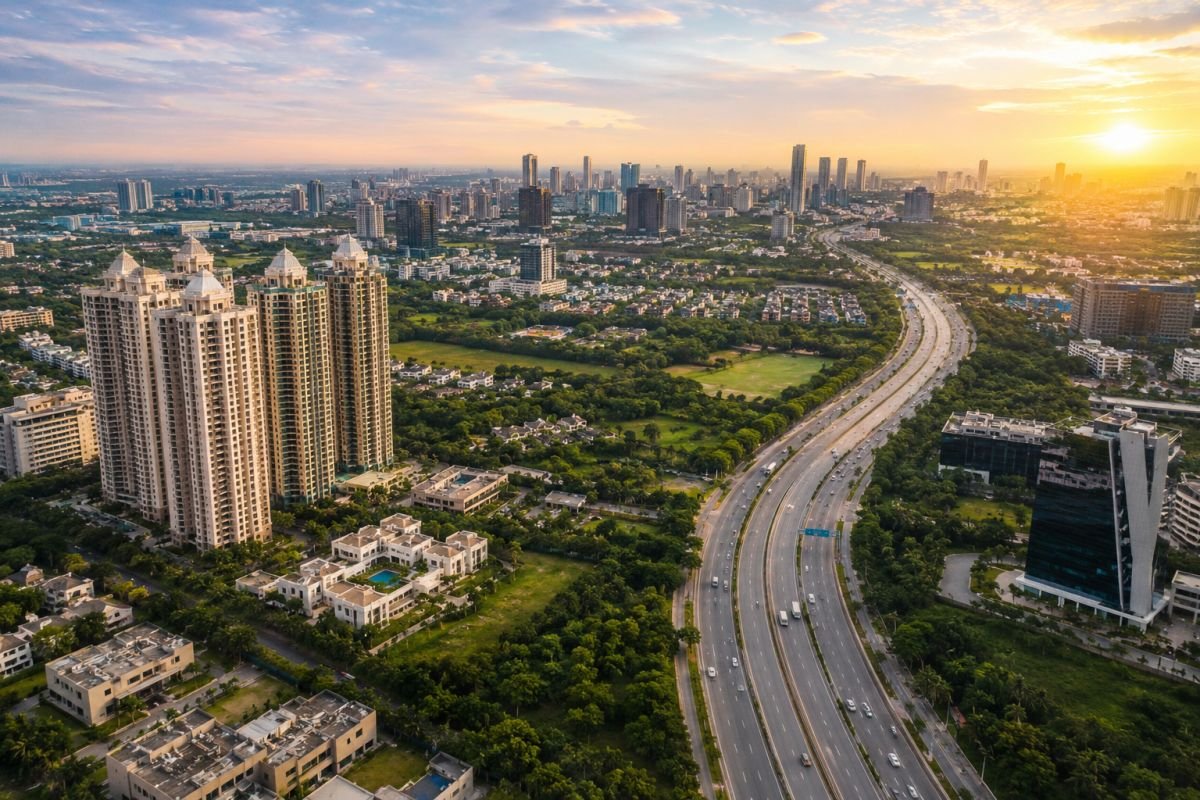
Buying a property is one of the biggest financial decisions most people will ever make. Yet many buyers spend weeks comparing floor plans, amenities, and payment plans while overlooking the one factor that has the greatest influence on long-term returns—location.
The phrase “location, location, location” has been part of the real estate industry for decades, but its meaning has evolved significantly. Today, a prime location isn’t simply an expensive address or a neighbourhood filled with luxury projects. It is a place where connectivity, employment, infrastructure, social amenities and future urban development come together to create consistent demand.
Gurgaon is one of the best examples of this transformation. Over the last two decades, several corridors that were once considered peripheral have become some of the city’s most desirable residential destinations. The growth of Dwarka Expressway, Southern Peripheral Road (SPR), Golf Course Extension Road and New Gurgaon shows how infrastructure and economic development can completely reshape a property’s future value.
For homebuyers, choosing the right location means a better lifestyle, easier commuting and stronger resale potential. For investors, it often determines rental demand and long-term capital appreciation. Understanding how locations evolve is therefore far more important than choosing between two similar apartments.
This guide explains what truly makes a location prime, why some neighbourhoods outperform others, and how buyers can identify high-growth areas before they become expensive.
What Makes a Location Prime?
A prime location is not defined by its current property prices. Instead, it is defined by consistent demand.
People choose to live in certain neighbourhoods because they offer convenient access to workplaces, schools, healthcare, shopping centres, public transport and entertainment. When these factors improve together, demand grows steadily, encouraging further residential and commercial development.

This creates a positive cycle:
- Better infrastructure attracts businesses.
- Businesses create employment.
- Employment increases housing demand.
- Housing demand encourages retail, education and healthcare.
- Improved lifestyle attracts even more residents.
Eventually, the neighbourhood develops into a self-sustaining urban ecosystem where demand remains strong even during slower market conditions.
This is why experienced buyers evaluate the surrounding area before evaluating the apartment itself.
Why Location Matters More Than the Building
Buildings can always be improved.
Apartments can be renovated. Interiors can be modernised. Clubhouses can be upgraded and common areas can be redesigned.
The location, however, remains permanent.
Imagine two luxury apartments built by reputed developers. Both offer spacious layouts, premium amenities and similar pricing. One project is located close to a metro corridor, major office hubs, schools and hospitals. The other sits in an isolated area where infrastructure development has been slow.
After several years, the difference between the two properties is often significant.
The better-connected location usually experiences stronger resale demand, healthier rental occupancy and better capital appreciation because more people want to live there.
This pattern has repeated itself across Gurgaon. Residential sectors supported by expanding infrastructure and employment corridors have generally performed better than projects located in areas where surrounding development remained limited.
The apartment certainly matters, but the neighbourhood largely determines how valuable that apartment becomes over time.
How Cities Create Prime Locations
Prime locations rarely appear overnight. They develop gradually as infrastructure, businesses and residential communities grow together.
Most successful neighbourhoods follow a similar journey.
Initially, governments invest in roads, expressways, metro corridors or other transport infrastructure. Improved accessibility encourages businesses to establish offices and commercial centres. As employment opportunities increase, people begin moving closer to these workplaces, creating demand for housing.
Developers respond by launching residential projects, while schools, hospitals, supermarkets and entertainment destinations follow the growing population. Over time, the neighbourhood evolves into a complete residential ecosystem.
This transformation has been clearly visible across Gurgaon.
Areas that once had limited residential activity now support integrated townships, premium apartments, retail developments and commercial complexes because infrastructure improvements attracted sustained buyer demand.
One important lesson from Gurgaon’s growth is that infrastructure alone does not create a successful market. Long-term appreciation occurs when roads, employment, residential development and social infrastructure progress together.
Understanding Infrastructure-Led Appreciation
Infrastructure is one of the strongest drivers of real estate growth, but appreciation doesn’t happen overnight.
Most infrastructure-led markets pass through three distinct stages.
| Infrastructure Stage | Typical Buyer Sentiment | Investment Perspective |
|---|---|---|
| Announcement | Curiosity mixed with uncertainty as buyers evaluate the project’s feasibility. | High potential for appreciation, but only after verifying official approvals, funding, and execution plans. |
| Construction | Buyer confidence improves as visible work begins on roads, metro corridors, or public infrastructure. | Often considered the ideal entry stage because risk declines while appreciation potential remains significant. |
| Completion & Operations | Demand increases rapidly as infrastructure becomes operational and accessibility improves. | Lower investment risk, although a substantial portion of price appreciation may already be reflected in market values. |
Many first-time buyers enter the market only after roads or metro lines become operational. Experienced investors, however, usually monitor projects during the construction phase after confirming official approvals and visible progress.
One trend repeatedly seen in Gurgaon is that major infrastructure announcements generate excitement, but meaningful price appreciation often begins only when buyers can actually see construction moving forward.
Gurgaon: A Real-World Example of Location Transformation
Few cities demonstrate the impact of infrastructure as effectively as Gurgaon.
Twenty years ago, residential demand was concentrated around a limited number of established sectors. Today, the city has evolved into multiple high-growth micro-markets, each offering different advantages depending on a buyer’s objectives.

Golf Course Road remains one of Gurgaon’s most mature luxury markets, supported by premium residences, commercial developments and established social infrastructure.
Golf Course Extension Road has benefited from its proximity to this mature corridor while continuing to attract luxury housing, retail developments and expanding connectivity.
Dwarka Expressway tells a different story. Once viewed as a long-term infrastructure project, it has gradually become one of NCR’s most active residential destinations as connectivity improved and premium developments entered the market.
Similarly, Southern Peripheral Road (SPR) has evolved from a connecting corridor into one of Gurgaon’s most important mixed-use growth zones, supported by both residential and commercial expansion.
New Gurgaon and the Sohna corridor continue attracting buyers looking for relatively affordable entry points combined with long-term growth potential as infrastructure improves.
Each of these corridors illustrates an important principle. If you’re comparing the top residential sectors in Gurgaon, understanding the growth stage of each micro-market can help you make a more informed investment decision.
Prime locations are created through years of planned development—not through marketing campaigns.
Buy a Neighbourhood, Not Just an Apartment
One of the biggest differences between experienced investors and first-time buyers is the order in which they evaluate a property.
Many homebuyers begin by comparing apartments.
They look at layouts, balconies, amenities, payment plans and finishing specifications.
Professional investors usually begin somewhere else.
They first analyse the neighbourhood.
Questions such as these become more important than the apartment itself:
- Is the area becoming more connected every year?
- Are new businesses moving into the locality?
- Is commercial activity expanding?
- Are reputed schools and hospitals opening nearby?
- Is buyer demand increasing faster than housing supply?
Only after these questions are answered do they compare individual projects.
This approach reduces risk because a well-located property generally performs better over time than a superior apartment in an average location.
As one Gurgaon property consultant puts it, “Projects compete for buyers, but neighbourhoods compete for the future.” Buyers may compare amenities during booking, but years later it is the strength of the surrounding location that usually determines both lifestyle quality and investment performance.
Where Jobs Grow, Housing Demand Follows
Real estate markets don’t grow in isolation. They grow because economies grow.
Employment remains one of the strongest indicators of long-term housing demand. When companies establish offices in a particular area, professionals naturally look for homes nearby. This attracts developers, retailers, schools, hospitals and entertainment venues, gradually creating a complete residential ecosystem.
Gurgaon’s transformation reflects this relationship perfectly. The growth of Cyber City, Udyog Vihar and several commercial districts has significantly influenced nearby residential markets by creating sustained demand from professionals seeking shorter commutes and better lifestyles.
Neighbourhoods supported by multiple employment hubs generally perform more consistently because they are less dependent on a single industry. Even during slower market cycles, diversified employment helps maintain residential demand, making these locations more resilient over the long term.
For buyers, the takeaway is simple: before evaluating the apartment, evaluate the economy that surrounds it. A location with expanding employment opportunities is far more likely to remain attractive for both homeowners and investors.
Why Daily Convenience Matters More Than Luxury Amenities
Luxury amenities certainly add value to a residential project, but they rarely determine whether a neighbourhood becomes successful over the long term. Once families move into a home, daily convenience becomes far more important than an infinity pool or a grand clubhouse.
Parents want reputed schools nearby. Working professionals value shorter commutes. Senior citizens look for quality healthcare, while everyone benefits from supermarkets, restaurants, parks and shopping centres within easy reach.
This is why social infrastructure plays a crucial role in creating a prime location. A neighbourhood with well-developed civic amenities naturally attracts more families, which encourages further investment from retailers, healthcare providers and educational institutions. Over time, this creates a self-sustaining ecosystem where demand continues to grow.
Integrated townships demonstrate this concept particularly well. Instead of depending on future development, they combine residential communities with retail spaces, schools, healthcare and recreational facilities, making everyday life more convenient for residents.
A useful exercise before buying any property is to visit the location on a weekday rather than a weekend. Observe traffic conditions, local markets, schools, office movement and public infrastructure. The experience often provides a far more realistic picture than a project brochure.
Comparing Gurgaon’s Key Growth Corridors
Every Gurgaon micro-market serves a different type of buyer. Some offer established infrastructure and immediate lifestyle benefits, while others provide stronger long-term appreciation potential.
| Growth Corridor | Current Market Profile | Best Suited For |
|---|---|---|
| Golf Course Road | Established luxury destination with premium residential projects, Grade A office spaces, excellent social infrastructure and strong connectivity. | HNIs, luxury homebuyers and buyers seeking a premium lifestyle with stable long-term value. |
| Golf Course Extension Road | Fast-growing luxury residential corridor with improving infrastructure, premium developments and expanding commercial activity. | Luxury end-users and long-term investors looking for appreciation potential. |
| Dwarka Expressway | High-growth infrastructure-led corridor benefiting from improved connectivity, premium housing projects and increasing commercial development. | Investors, premium homebuyers and buyers seeking future capital appreciation. |
| Southern Peripheral Road (SPR) | Emerging mixed-use corridor supported by residential expansion, office developments and enhanced road connectivity. | Families, end-users and investors looking for balanced long-term growth. |
| New Gurgaon | Rapidly developing residential market with improving civic infrastructure, competitive pricing and expanding employment access. | First-time homebuyers and medium to long-term investors. |
| Sohna Corridor | Developing growth corridor driven by highway connectivity, planned infrastructure and long-term urban expansion. | Buyers with longer investment horizons seeking future appreciation. |
There isn’t a single “best” location in Gurgaon. The right choice depends on your budget, lifestyle and investment goals.

If immediate convenience is your priority, mature corridors may be more suitable. If your objective is long-term wealth creation, emerging locations supported by planned infrastructure deserve closer attention.
What Market Trends Tell Us
Property prices don’t increase simply because new apartments are launched. Sustainable appreciation occurs when demand consistently exceeds supply.
Over the last few years, Gurgaon has continued attracting strong residential demand because of expanding employment opportunities and commercial development. Industry reports have consistently ranked Gurugram among India’s leading office markets, with millions of square feet of Grade A office space leased annually. This commercial expansion directly supports housing demand across nearby residential sectors.
Rental yields in premium Gurgaon locations generally range between 2.5% and 4%, depending on the project, location and tenant profile. While residential investors primarily focus on capital appreciation, healthy rental demand improves liquidity and provides a stable secondary income.
Migration has also played a major role in Gurgaon’s growth. Professionals from Delhi, Noida, Faridabad and several other cities continue moving to Gurgaon because of employment opportunities in technology, finance, consulting and manufacturing. As the working population grows, demand for quality housing, schools, healthcare and retail infrastructure continues to strengthen.
These trends explain why infrastructure-led corridors have consistently attracted buyer interest despite changing market conditions.
Infrastructure Changes Buyer Behaviour
Infrastructure influences more than just connectivity—it changes buyer psychology.
When a major expressway, metro corridor or commercial hub is announced, market sentiment usually improves. However, many buyers remain cautious because announcements do not always translate into timely execution.
Confidence grows only when visible construction begins. Roads widen, metro stations take shape and commercial developments start attracting businesses. At this stage, more end-users enter the market because the location’s future becomes easier to visualise.
By the time infrastructure is fully operational, demand typically increases further. Unfortunately, this is also the stage where many buyers realise they may have missed the opportunity to enter at lower prices.

One trend we’ve consistently observed across Gurgaon is that measurable appreciation usually begins during the construction phase rather than after completion. This is why experienced investors monitor infrastructure progress instead of reacting solely to launch announcements.
Prime Doesn’t Always Mean Expensive
Many buyers assume that the highest-priced neighbourhood automatically offers the best investment potential.
In reality, expensive locations often represent mature markets where a significant portion of appreciation has already taken place.
Emerging corridors can sometimes generate stronger percentage returns because infrastructure, employment and social amenities are still improving. The objective should not be buying the cheapest location or the most expensive one. Instead, buyers should identify neighbourhoods where future demand is likely to grow faster than current supply.
Successful investors often focus on locations that combine improving connectivity, expanding commercial activity and strong residential demand. A detailed Gurgaon investment location guide can further help buyers compare emerging corridors with established residential markets before making a long-term investment.
Prime Location vs Premium Project
One of the biggest misconceptions in real estate is treating a premium project and a prime location as the same thing.
They are not.
A premium project is defined by its construction quality, architecture, amenities and developer reputation.
A prime location is defined by the surrounding ecosystem, including connectivity, employment opportunities, infrastructure, social amenities and long-term buyer demand.
| Prime Location | Premium Project |
|---|---|
| Driven by strong neighbourhood fundamentals and long-term demand. | Driven by superior construction quality, design and luxury amenities. |
| Property values are influenced by connectivity, employment hubs and infrastructure. | Property value depends on the developer’s reputation, specifications and project quality. |
| Typically delivers stronger resale potential and sustained buyer demand. | Enhances lifestyle and living experience but cannot compensate for a weak location. |
| Benefits every residential project within the surrounding micro-market. | Benefits only the individual development. |
| Cannot be replicated because location is permanent. | Can be created by any reputed developer through better planning and amenities. |
| Offers higher long-term appreciation when supported by infrastructure and economic growth. | Performs best only when combined with a strategically located neighbourhood. |
The ideal investment combines both—a quality residential project situated within a location that continues attracting residents, businesses and infrastructure investment.
The Biggest Mistakes Buyers Make
Many buyers lose sight of the bigger picture because they focus exclusively on launch offers, luxury specifications or attractive pricing.
The most common mistakes include:
- Buying solely because a project is discounted without evaluating future demand.
- Trusting proposed infrastructure without verifying official approvals.
- Ignoring employment growth and commercial development.
- Choosing amenities over location fundamentals.
- Following market hype instead of conducting independent research.
Successful property buying is rarely about finding the cheapest apartment. It is about choosing the right neighbourhood at the right stage of its growth cycle.
How to Evaluate Any Location Before Buying
Before making a final decision, ask yourself these questions:
| Evaluation Criteria | Importance |
|---|---|
| Connectivity to Office Hubs | |
| Employment Growth | |
| Schools & Hospitals | |
| Future Infrastructure | |
| Rental Demand | |
| Safety & Livability | |
| Commercial Ecosystem |
If a location performs well across these parameters, it is more likely to deliver both a better lifestyle and stronger long-term returns.
A disciplined evaluation process removes emotion from property buying and helps buyers make more confident decisions.
Looking Beyond Today’s Headlines
One of the biggest mistakes buyers make is following headlines instead of understanding market cycles. By the time a location dominates news reports or becomes the talk of the market, a substantial part of its appreciation has often already taken place.
The better approach is to study why demand is increasing rather than simply observing that prices are rising.
Experienced investors typically monitor four indicators before considering a location:
- Infrastructure projects with visible execution.
- Expansion of commercial and employment hubs.
- Entry of reputed developers.
- Improving social infrastructure such as schools, hospitals and retail centres.
When these indicators begin moving together, a neighbourhood usually enters a new phase of growth.
This is exactly how several Gurgaon micro-markets evolved over the past decade.
Emerging Markets vs Mature Markets
Every buyer has different priorities, which is why there is no universally “best” location.
Mature neighbourhoods generally appeal to families seeking immediate convenience. They offer established schools, hospitals, shopping centres, offices and public infrastructure. These areas also provide greater certainty because most civic development is already complete. However, higher prices often mean that appreciation may be relatively moderate compared to emerging locations.
Emerging markets tell a different story. Infrastructure is still improving, commercial activity is expanding and new residential developments continue entering the market. Buyers usually benefit from lower entry prices, although they also accept greater uncertainty while the surrounding ecosystem matures.
The right decision depends on your investment horizon.
If you plan to live in the property immediately, an established micro-market may provide greater comfort and convenience. If your objective is long-term wealth creation, an emerging corridor with strong infrastructure support may present better opportunities.
Beyond Appreciation: Why Livability Matters
Property buying should never be viewed purely as a financial transaction.
While appreciation and rental income remain important, your everyday lifestyle matters just as much.
Imagine living in a neighbourhood where your workplace, your child’s school, a quality hospital, grocery stores, restaurants and weekend entertainment are all within a short drive. That convenience saves hours every week, reduces commuting stress and improves overall quality of life.
This is why the strongest residential locations attract both investors and end-users.
Investors recognise the long-term demand these locations create, while families appreciate the comfort and convenience they offer.
A neighbourhood where people genuinely want to live is far more likely to remain resilient during changing market conditions.
A Practical Checklist Before Buying Property
Before booking any residential property, evaluate the location using this simple checklist.
| Question | Yes | No |
|---|---|---|
| Is the location well connected to major roads and employment hubs? | ☐ | ☐ |
| Are reputed schools, hospitals and retail centres already operational nearby? | ☐ | ☐ |
| Have future infrastructure projects received official approvals? | ☐ | ☐ |
| Is there visible commercial development in the surrounding area? | ☐ | ☐ |
| Does the neighbourhood show healthy rental demand? | ☐ | ☐ |
| Are multiple reputed developers investing in the micro-market? | ☐ | ☐ |
| Is housing demand likely to remain strong over the next decade? | ☐ | ☐ |
| Would you still choose this location if prices remained unchanged for the next three years? | ☐ | ☐ |
If most of these answers are positive, the location is likely supported by strong long-term fundamentals rather than short-term speculation.
Frequently Asked Questions
What makes a location prime in real estate?
A prime location combines strong connectivity, employment opportunities, social infrastructure, commercial development and future growth potential. These factors create consistent demand, leading to better resale value, rental demand and long-term appreciation.
Is an expensive location always a good investment?
No. Many established luxury locations have already experienced substantial appreciation. Emerging corridors supported by infrastructure and employment growth can sometimes offer stronger long-term returns.
Why is connectivity so important?
Good connectivity reduces travel time, improves accessibility to workplaces and encourages businesses to establish offices nearby. This creates sustained residential demand and improves property values over time.
Should homebuyers and investors evaluate locations differently?
Yes.
Homebuyers generally prioritise lifestyle, schools, healthcare and convenience. Investors focus more on employment growth, rental demand, infrastructure and future appreciation. The strongest locations usually satisfy both groups.
Final Thoughts
Choosing the right property begins with choosing the right location.

Luxury specifications, branded developers and attractive amenities certainly improve a project’s appeal, but they cannot replace the long-term advantages of a well-connected, economically vibrant and thoughtfully planned neighbourhood.
Gurgaon’s evolution demonstrates this better than almost any other Indian city. Corridors such as Dwarka Expressway, Southern Peripheral Road (SPR), Golf Course Extension Road, New Gurgaon and the Sohna corridor illustrate how infrastructure, employment and urban planning can reshape entire residential markets over time.
The most successful buyers rarely chase trends. Instead, they study how cities grow, understand what drives demand and identify neighbourhoods that continue improving year after year.
Whether you’re purchasing your first home, upgrading to a luxury apartment or building a long-term investment portfolio, understanding how locations evolve is far more important than choosing between two similar apartments. Buyers planning the complete home buying process in Gurgaon should always evaluate location before comparing individual projects.
Don’t just buy an apartment—invest in the future of the neighbourhood around it.
Years from now, the quality of your interiors may change, amenities may be upgraded and design trends may evolve. The one factor that will continue influencing both your lifestyle and your property’s value is the location.
Making that decision wisely is one of the smartest investments any homebuyer can make.

Join The Discussion