Introduction
Commercial property investment in Gurgaon depends on more than location and construction quality. The real question is whether a property can attract suitable businesses, maintain occupancy and generate rental income after accounting for ownership expenses. AIPL Autograph in Sector 66, along Golf Course Extension Road, deserves this kind of evaluation because its commercial proposition combines corporate office accommodation with supporting retail and dining spaces.
For investors, the opportunity lies in understanding how the surrounding residential market, office occupancy, road visibility and unit configuration influence leasing demand. A ground-floor retail unit and an office space may belong to the same development, but their tenant requirements, vacancy risks and rental economics are considerably different.
This AIPL Autograph Sector 66 Gurgaon review examines the project’s commercial positioning, residential catchment, floor-wise leasing potential, capital values and realistic rental yield considerations. The objective is to assess the investment characteristics of individual units rather than assume that a prominent commercial address automatically produces strong returns.
AIPL Autograph Sector 66 Gurgaon Commercial Overview: Format, Builder & Sector Positioning
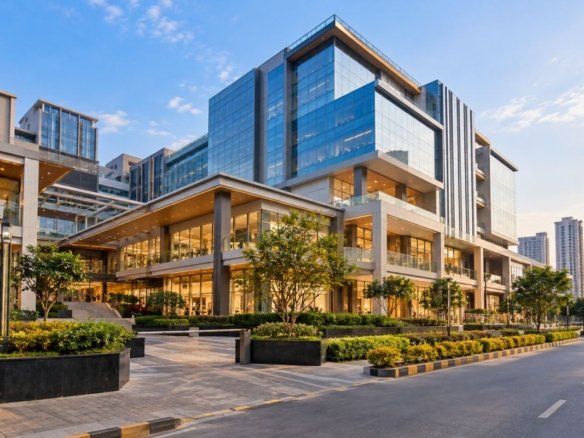
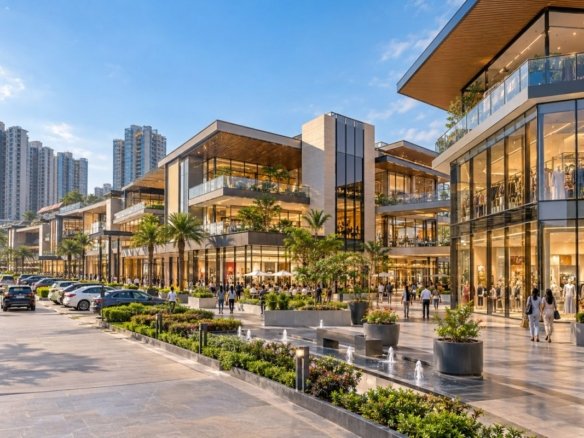
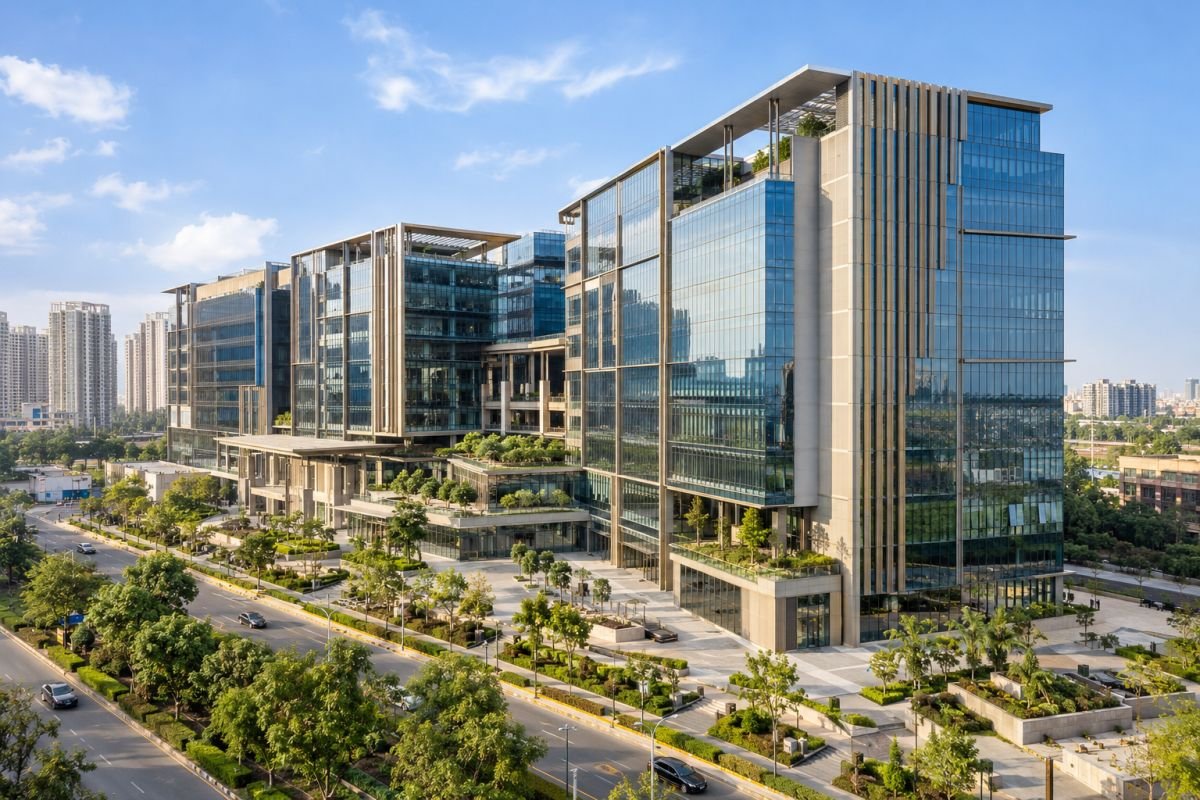
AIPL Autograph is a Grade-A commercial development by Advance India Projects Limited, situated in Sector 66 on Golf Course Extension Road. The development is positioned primarily as a corporate office destination with supporting retail and food-and-beverage facilities. Its commercial planning makes it relevant to businesses seeking office accommodation as well as selected retail operators serving employees and surrounding residential communities.
The published project specifications identify a site area of approximately 6.1375 acres, with office floor plates ranging from approximately 12,000 to 50,000 sq. ft. The development also features a triple-height entrance lobby, four basement parking levels and dedicated office-user access. Its architectural design is attributed to Benoy.
| Particular | Project Information |
|---|---|
| Project | AIPL Autograph |
| Developer | Advance India Projects Limited |
| Location | Sector 66, Golf Course Extension Road |
| Category | Commercial office and supporting retail |
| Published Site Area | Approximately 6.1375 acres |
| Office Floor Plates | Approximately 12,000–50,000 sq. ft. |
| Basement Parking | Four levels |
| Design Architect | Benoy |
| HRERA Registration Recorded | GGM/481/213/2021/49 |
| Occupation Certificate | Phase-specific verification required |
The location connects the development with the wider Golf Course Extension Road commercial corridor and surrounding residential sectors. Access towards Sohna Road, Golf Course Road and Southern Peripheral Road expands its potential employee and customer catchment.
However, location advantages should not be confused with proven rental performance. Investors must compare the actual acquisition price, usable area, maintenance obligations and achievable rent of the individual unit before making a decision.
For current property-level information, investors can explore the AIPL Autograph Sector 66 Gurgaon commercial price list and layout.
3-Km Residential Catchment & Daily Footfall Drivers in Sector 66
The residential catchment surrounding AIPL Autograph is important for evaluating the leasing potential of its retail spaces. Sector 66 and neighbouring parts of Golf Course Extension Road contain high-rise residential developments, established communities and newer housing projects. These households can support demand for restaurants, cafés, grocery stores, pharmacies, fitness services and other everyday businesses.
A 3-km catchment should be treated as a commercial trade area rather than a simple population estimate. Residents living within the immediate 1-km radius are more relevant to convenience-oriented businesses because they can access nearby services more frequently. The wider 1–3 km area offers a broader customer base, particularly for restaurants, specialist services and destination-oriented retail.
| Catchment Radius | Residential Relevance | Potential Commercial Demand |
|---|---|---|
| 0–1 km | Immediate residential communities | Daily convenience and repeat visits |
| 1–2 km | Surrounding occupied societies | Cafés, restaurants and neighbourhood services |
| 2–3 km | Wider residential developments | Destination retail and specialist services |
The distinction between delivered apartments and nearing-possession inventory is particularly important. Occupied homes can generate present-day consumption, whereas under-construction developments represent potential future demand. Counting every announced residential unit as an existing customer would overstate the commercial catchment.
A proper assessment should consider delivered units, actual household occupancy, possession status and road access to the development. A society with substantial residential inventory but low occupancy may contribute considerably less retail demand than an established community with fewer but fully occupied homes.
Footfall also comes from sources other than residential households. Office employees can support weekday demand for food, beverages and convenience retail, while corporate meetings and business visitors may generate additional activity. Destination customers can contribute to specialist retail and restaurants, although their visits depend on the business offering, accessibility and competition.
Road visibility is another consideration. The developer highlights retail visibility and a dedicated office-user driveway, but the commercial value of these features depends on the exact unit. Storefront position, frontage width, signage permissions, pedestrian movement and customer parking should be inspected before purchase.
For a broader location comparison, investors can explore the commercial and residential catchment in Sector 66.
Floor-Wise Layout Analysis: Ground-Floor Frontage vs Upper-Floor Zoning
Floor selection has a direct influence on commercial leasing prospects. Ground-floor retail generally benefits from easier customer access and stronger storefront visibility, making it more suitable for businesses dependent on walk-in traffic. Cafés, restaurants, convenience stores and selected service outlets may find such units attractive.
However, a high acquisition price does not automatically make a ground-floor unit a better investment. Frontage width, unit depth, signage rights and customer accessibility must justify the additional capital commitment.
Upper-floor retail operates differently. Restaurants, specialist clinics, fitness businesses and professional services can work on higher floors when lift access, signage and customer convenience are adequate. These businesses generally depend more on destination visits than spontaneous walk-ins, so tenant suitability becomes particularly important.
Office accommodation has a separate leasing market. AIPL’s published floor plates of approximately 12,000–50,000 sq. ft. are relevant to businesses seeking consolidated workspaces. Corporate tenants generally evaluate usable area, parking, lift capacity, HVAC arrangements, floor efficiency and overall occupancy costs before committing to a lease.
| Commercial Configuration | Main Advantage | Principal Consideration |
|---|---|---|
| Ground-floor retail | Better potential walk-in visibility | Acquisition premium and frontage |
| Upper-floor retail | Destination-oriented business potential | Customer access and tenant suitability |
| Smaller office unit | Potentially broader occupier pool | Permitted subdivision and unit efficiency |
| Large office floor | Corporate leasing potential | Longer tenant search and fit-out requirements |
There is no universally superior floor for investment. The right choice depends on the relationship between purchase price, achievable rent, vacancy risk and eventual resale demand.
2026 Capital Values, Lease Rental Benchmarks & Net Yield Math
Commercial property should be evaluated using the actual acquisition cost and realistic rental income rather than projected returns. One historical office quotation for AIPL Autograph recorded a proposed acquisition of 2,916 sq. ft. of super built-up area, with 1,613 sq. ft. of carpet area, at approximately ₹6.05 crore.
This translates into approximately ₹20,741 per sq. ft. on super built-up area and ₹37,491 per sq. ft. on carpet area. It is a historical quoted value for one proposed acquisition, not a verified October 2026 market price.
| Commercial Category | Available Price Information |
|---|---|
| Ground-floor retail | Current unit-wise price verification required |
| Upper-floor retail | Current floor-wise price verification required |
| Office space | Historical quotation of approximately ₹20,741/sq. ft. on super built-up area |
| Large office floors | Depends on floor, area and configuration |
Advertised office rental indications for AIPL Autograph are approximately ₹110–₹130+ per sq. ft. per month. Nearby M3M IFC asking rents are approximately ₹95–₹150+ per sq. ft. per month, while broader Golf Course Extension Road office listings show considerable variation. These figures should be treated as asking indications rather than confirmed lease transactions.
Retail rental values must be assessed separately because frontage, floor position, customer access and tenant category influence achievable rents.
Gross vs Net Rental Yield (Factoring CAM, Property Tax & Fit-Out Periods)
Gross rental yield measures annual rental income against the acquisition cost. However, it does not account for vacancy, maintenance expenses, property tax, brokerage or rent-free fit-out periods.
Gross rental yield = Annual rent ÷ Acquisition cost × 100
Consider an illustrative office investment using a reference acquisition value of ₹20,741 per sq. ft. and monthly rent between ₹110 and ₹130 per sq. ft.
| Particular | Lower Scenario | Higher Scenario |
|---|---|---|
| Acquisition price/sq. ft. | ₹20,741 | ₹20,741 |
| Monthly rent/sq. ft. | ₹110 | ₹130 |
| Annual gross rent | ₹1,320 | ₹1,560 |
| Gross yield | 6.37% | 7.53% |
| Collection factor | 87.5% | 87.5% |
| Operating expense allowance | 10% | 10% |
| Illustrative net annual income | ₹1,040 | ₹1,229 |
| Illustrative net yield | 5.02% | 5.93% |
These are hypothetical calculations, not actual project rental returns. The collection factor and operating expense allowance are modelling assumptions. Financing, acquisition taxes, fit-out capital expenditure and income tax are excluded.
CAM charges may cover security, housekeeping, common utilities, lifts and facility management. The actual maintenance schedule should establish whether these expenses are recovered from tenants or partly borne by the owner. Property tax must also be checked against the specific unit’s municipal assessment and lease obligations.
Fit-out periods can further reduce first-year income because office tenants may require time to complete interiors before rent commencement. Brokerage, rent-free incentives and tenant improvements should therefore be included when calculating effective returns.
Self-Use Business vs Pure Leasing ROI
An owner-occupier and a rental investor have different financial objectives. A business purchasing its own office may benefit from greater control over its premises and reduced dependence on future rent negotiations. However, the purchase cost should be compared with leasing an equivalent office, including financing expenses and the opportunity cost of invested capital.
A pure leasing investor depends on tenant quality, contractual rent, escalation, vacancy periods and resale liquidity. Avoided rent for an owner-occupier should not be presented as rental income, just as an advertised rent should not be treated as guaranteed income for a leasing investor.
HRERA Compliance, Completion Timeline & Vacancy Risk Assessment
The HRERA registration recorded for AIPL Autograph is GGM/481/213/2021/49, dated 10 September 2021. Investors should match this registration with the original certificate, subsequent amendments and approved building plans before purchasing a unit.
Registration alone does not establish that every tower or commercial unit has received an Occupation Certificate. The current completion and occupation position must be confirmed through phase-specific documents. A definitive OC status should not be assumed from a marketing brochure or possession estimate.
Before completing a purchase, investors should verify the HRERA registration certificate, approved floor plans, applicable building licence, Completion Certificate where relevant, Occupation Certificate, fire safety approvals, environmental clearances, title documents and unit-specific sale documentation. The permitted use of the premises should also match the intended business activity.
Vacancy remains a significant commercial investment risk. Large office floors may require specialised corporate tenants and longer leasing periods, while smaller offices may appeal to a wider occupier base if their configuration and permitted use allow it. Retail units depend more heavily on visibility, accessibility and the commercial suitability of the surrounding customer base.
CAM charges, lock-in periods, rent escalation, security deposits and rent-free fit-out arrangements should be established through the actual lease and maintenance agreements. There is no single universal CAM rate or lock-in period that should be assumed for every commercial unit in Sector 66.
Final Verdict: Who Should Invest in AIPL Autograph Sector 66 Gurgaon?
AIPL Autograph offers a commercial proposition built around corporate office accommodation and supporting retail facilities in Sector 66. Its location, published office floor plates and parking infrastructure make it worth evaluating for corporate occupiers and selected commercial investors.
Office accommodation deserves particular attention from investors seeking corporate leasing opportunities. Retail investors should be more selective, prioritising ground-floor visibility, frontage, customer access and tenant suitability. Upper-floor retail should be considered only after identifying businesses capable of generating destination-driven demand.
The investment decision ultimately depends on three factors: the legal readiness of the specific unit, the relationship between acquisition price and achievable rent, and the likelihood of securing a suitable tenant without prolonged vacancy.
AIPL Autograph should not be purchased solely on projected appreciation or headline rental yields. The stronger investment is the unit whose acquisition cost, leasing potential and recurring expenses produce sustainable economics.
Investors can request the latest available floor plans, unit details and commercial pricing through the AIPL Autograph Sector 66 Gurgaon commercial listing page or consult AssuredGains’ commercial leasing desk.
Frequently Asked Questions
1. What is the realistic rental yield and lease potential of AIPL Autograph Sector 66 Gurgaon in 2026?
Available advertised office rental indications are approximately ₹110–₹130+ per sq. ft. per month. Using a historical acquisition reference of ₹20,741 per super built-up sq. ft., the illustrative gross yield is approximately 6.37–7.53%, while the modelled net yield is approximately 5.02–5.93%. Actual returns depend on negotiated rent, vacancy, CAM, property tax and fit-out expenses.
2. How large is the residential catchment surrounding AIPL Autograph Sector 66 Gurgaon?
A 3-km radius is a useful starting point for evaluating residential demand. However, a verified population figure is not established. Investors should distinguish occupied apartments from delivered but vacant and under-construction inventory before estimating retail demand.
3. Which floor offers the best capital appreciation and leasing liquidity?
Ground-floor retail can benefit from stronger walk-in visibility, while upper-floor retail depends more on destination-oriented businesses. Office units appeal to corporate occupiers based on floor efficiency, parking and infrastructure. There is insufficient verified transaction evidence to declare one floor the best-performing investment.
4. What are the CAM charges, property tax and lock-in norms?
Project-specific CAM rates, property-tax liabilities and lock-in terms require verification. Investors should obtain the latest maintenance schedule, municipal assessment and proposed lease agreement before calculating net income.
5. What HRERA and OC documents should investors check?
Investors should verify the HRERA registration certificate, approved building plans, amendments, applicable Completion Certificate, phase-specific Occupation Certificate, fire safety approvals, relevant statutory clearances and unit-specific title and sale documents. Registration does not independently establish OC status.
6. Is AIPL Autograph suitable for retail investment?
It may suit selected retail businesses, particularly where frontage, visibility and customer access are strong. Retail units should be evaluated using retail-specific lease comparables rather than office rental benchmarks.
7. Is AIPL Autograph suitable for corporate office investment?
Its published office floor plates, basement parking and corporate positioning make it worth evaluating for owner-occupiers and leasing investors. The final decision should depend on acquisition cost, usable area, operating expenses, tenant demand and legal occupation status.