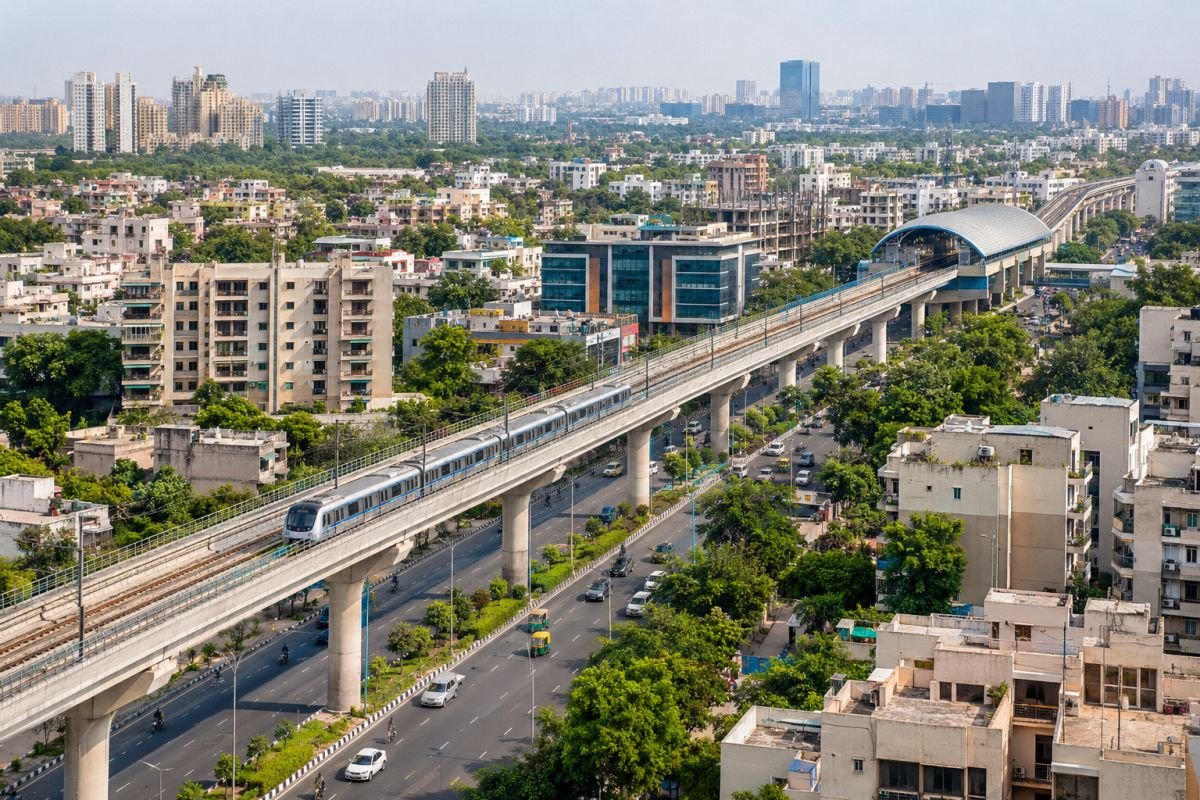
Old Gurgaon is approaching an important infrastructure transition with the development of the Gurugram Metro corridor connecting Millennium City Centre with Cyber City. The project is expected to improve connectivity between established residential neighbourhoods, industrial employment centres and commercial districts that currently depend heavily on road-based transport.
For property buyers, the stations at Basai Village, Sector 9, Sector 7 and Sector 4 deserve particular attention. These locations represent established residential and employment-linked catchments where improved public transport could influence commuting patterns, rental demand and long-term residential preferences.
However, metro connectivity should not be the only consideration when purchasing property. The approved alignment, actual station access, construction progress, land-use permissions and ownership documents all influence whether a property represents a sound investment. This is particularly important for buyers considering independent floors, residential plots and older properties in Old Gurgaon.
Why Old Gurgaon Metro Stations: Sector 4, 7, 9 & Basai Guide Matters for Gurugram Buyers
The Gurugram Metro expansion is designed to address the connectivity gap between Old Gurgaon and the city’s major employment centres. The approved Millennium City Centre–Cyber City corridor covers approximately 28.50 km and includes 27 elevated stations. The project also includes a 1.85 km spur from Basai Village towards Dwarka Expressway.
The corridor connects important locations such as Sector 45, Cyber Park, Subhash Chowk, Sector 48, Hero Honda Chowk, Sector 37, Basai Village, Sector 9, Sector 7, Sector 4, Ashok Vihar, Palam Vihar and Udyog Vihar.
The four Old Gurgaon station locations have different property-market characteristics. Basai Village is relevant to industrial and residential catchments, while Sector 9 and Sector 7 are established residential locations. Sector 4 offers connectivity benefits to an already developed residential neighbourhood.
One important clarification is that the project is a hemicyclic corridor rather than a conventional closed metro loop. Its property-market impact will depend on the final station entrances, pedestrian access and connectivity to surrounding roads.
For buyers comparing established and emerging residential markets, the New Gurgaon vs Old Gurgaon price and ROI comparison provides additional context.
Official Regulatory / Infrastructure Framework (GMDA / DTCP / HRERA / GMRL)
Understanding the metro’s property impact requires examining the responsibilities of different Haryana authorities. Metro infrastructure, land ownership, building approvals and project registration are separate regulatory matters.
Gurugram Metro Rail Limited (GMRL) is responsible for implementing the Millennium City Centre–Cyber City corridor. Its project information covers the approved alignment, station locations, construction activities, land acquisition and infrastructure development. Basai Village, Sector 9, Sector 7 and Sector 4 form part of the approved station alignment.
Physical construction has progressed beyond the planning stage. A significant milestone was achieved on 29 August 2026 with the installation of the first 160-tonne U-girder near Cyber Park. However, civil construction progress should not be confused with completion of the entire corridor or commencement of passenger services. Station construction, depot readiness, signalling, rolling stock and safety approvals remain separate requirements.
The Gurugram Metropolitan Development Authority (GMDA) is equally important when evaluating neighbourhood infrastructure. Water supply, sewerage, stormwater drainage, roads and building-related services influence residential livability. A metro station may improve commuting convenience, but it cannot independently resolve inadequate drainage, water shortages or poor internal road conditions.
The Department of Town and Country Planning, Haryana (DTCP), is particularly relevant for buyers purchasing residential plots, independent floors or properties in mixed-use locations. The applicable Master Plan, sectoral plan, land-use classification, development licence and change-of-land-use permissions determine what can legally be developed on a particular property. Metro proximity does not automatically permit commercial conversion, additional floors or increased development density.
Independent-floor buyers should also examine the evolving legal position concerning Stilt+4-floor permissions in Haryana. Building permissions must be checked against the current applicable policy, court orders and sanctioned plans rather than relying on a developer’s verbal assurance.
For under-construction properties, Haryana RERA (HRERA) provides the framework for checking project registration, promoter disclosures, approved plans, completion details and regulatory complaints. The Real Estate (Regulation and Development) Act, 2016, also establishes important promoter obligations, including provisions relating to conveyance and certain remedies for delayed possession. Registration, however, does not guarantee construction quality or future appreciation.
HSVP records are relevant for government-allotted properties, particularly when checking original allotment documents, transfer permissions, outstanding dues and conveyance documentation. DHBVN should be consulted for electricity connections, sanctioned load and outstanding electricity dues. Where land falls within an industrial estate, HSIIDC allotment conditions and permitted land use also require examination.
These checks are important because a property can be geographically close to a metro station while still having ownership, construction or land-use problems.
Sector-Wise & Corridor-Wise Impact Across Gurugram
The four station catchments offer different advantages depending on the surrounding property market and employment patterns.
Basai Village: Industrial Connectivity and Dwarka Expressway Access
Basai Village has an important position on the approved metro alignment because of its relationship with Sector 37, nearby industrial areas and the Dwarka Expressway spur. Improved public transport could make the surrounding employment locations more accessible for workers and residents.
Residential properties with convenient station access may become more attractive to tenants who commute towards industrial and commercial employment centres. However, the investment case varies considerably between residential plots, industrial properties and agricultural land.
Buyers should establish the actual land-use classification before purchasing. Agricultural or industrial land does not automatically become eligible for residential development simply because a metro station is nearby.
Sector 9: Established Residential Demand and Metro Accessibility
Sector 9 is an established residential catchment where improved metro connectivity could reduce dependence on private vehicles for certain journeys. Its potential advantage comes from connecting existing neighbourhoods with the wider Gurugram employment network.
For end-users, the practical benefit will depend on the distance to the station entrance, pedestrian routes and availability of connecting roads. Investors should examine whether the property offers genuine rental advantages compared with competing residential locations.
The existing neighbourhood infrastructure, property condition and purchase price remain important. Improved connectivity alone does not establish that registered property prices will increase.
Sector 7: Residential Catchment and End-User Convenience
Sector 7 could benefit from improved access to commercial and industrial employment locations along the wider metro corridor. For residents, reliable public transport may offer an alternative to daily road commuting.
Rental demand, however, will continue to depend on property configuration, parking, maintenance, nearby schools, daily-use retail and monthly rent. A property located close to a station but separated by difficult road crossings may offer less practical convenience than one with a safer pedestrian connection.
Sector 4: Mature Residential Market and Central Connectivity
Sector 4 represents an established residential location where metro connectivity could strengthen accessibility rather than create an entirely new residential market.
Buyers considering older properties should pay particular attention to ownership history, sanctioned building plans, occupation certificates, structural condition and parking rights. Independent floors require additional checks concerning permitted construction and floor-wise ownership.
The metro may improve the convenience of an otherwise suitable property, but it cannot correct unauthorised construction or defective ownership documentation.
Sector 4–5 and Railway Connectivity
The wider metro project also considers integration with existing transport infrastructure, including the Indian Railways network. However, buyers should distinguish between planned multimodal integration and a confirmed station entrance or direct interchange.
The actual walking route, pedestrian access and interchange arrangement should be established before assigning additional value to a property marketed as being near the railway station or metro interchange.
Sector 4, 7 and 9 Gurgaon Property Prices: What Should Buyers Compare?
A fixed metro-related price premium cannot be reliably assigned to these sectors without comparable registered transaction data. Buyers should compare similar properties based on configuration, plot size, building age, ownership structure and actual distance from the station entrance.
Advertised asking prices are not necessarily completed transaction values. Rental demand, vacancy, maintenance costs and legal compliance should also influence the final purchase decision.
For a wider understanding of transit-led property valuation, read our Gurgaon metro expansion property price analysis. Buyers comparing mature residential locations can also explore properties in Old Gurgaon Sector 14.
Step-by-Step Verification Checklist for Homebuyers & Investors
A metro-linked property purchase requires two separate investigations: confirmation of the infrastructure alignment and verification of the property’s legal status.
Official Government Portals & Documents to Inspect
Begin by examining the approved GMRL station alignment and available construction information. Compare the proposed station location with the property’s actual address rather than relying on promotional maps or estimated walking distances.
Next, examine the applicable Gurugram Master Plan and sectoral plan through DTCP Haryana. Confirm whether the land is designated for residential, commercial, industrial or agricultural use. For plotted developments, verify the relevant development licence, approved layout and change-of-land-use permission wherever applicable.
Ownership verification should include the registered title deed, previous sale deeds, latest Jamabandi, mutation history and relevant revenue records. These documents should be examined together because a mutation entry alone does not establish an undisputed legal title.
For projects covered by RERA, check the HRERA registration, promoter details, approved plans, completion disclosures and relevant regulatory orders. Buyers should also request the sanctioned building plan, applicable occupation certificate and completion-related documentation.
Finally, check outstanding HSVP or other authority dues, electricity connections through DHBVN, and water and sewerage arrangements through the relevant civic authority. An independent property lawyer should review the complete documentation before registration.
Common Red Flags & Financial/Legal Risks to Avoid
One common problem is treating an approved metro station as an operational station. Buyers should distinguish between project approval, civil construction, system testing and passenger operations.
Another risk involves purchasing agricultural or industrial land based on assumed future residential permissions. Land-use conversion requires the applicable statutory approvals and cannot be assumed from infrastructure development.
Independent floors also require careful examination of sanctioned construction, applicable floor permissions, ownership rights and occupancy status. Similarly, missing title documents, inheritance disputes, mortgages and outstanding authority dues can create financial and legal complications.
Most importantly, avoid paying an inflated metro premium based entirely on a broker’s appreciation forecast. Infrastructure may improve accessibility, but the final investment outcome depends on the purchase price, property condition, local supply, rental demand and legal certainty.
2026–2031 Market & Livability Outlook
The 2026–2031 period could be important for Old Gurgaon as the metro project moves through physical construction and subsequent infrastructure integration.
During 2026, construction visibility provides buyers with an opportunity to examine actual alignment, station locations and road access. The reported U-girder installation demonstrates physical progress, but it does not establish a confirmed passenger-service commencement date.
Between 2027 and 2028, the market will need to monitor station construction, utility shifting, depot development and system integration. The practical value of the project will depend on how effectively metro stations connect with internal roads, feeder transport and surrounding residential neighbourhoods.
By 2029–2031, if reliable passenger services become operational, established residential locations could experience improvements in commuting convenience and tenant accessibility. This may support rental interest and property liquidity, particularly for legally compliant homes with practical station access.
The potential benefit will not be identical across property types. Established homes may gain from improved daily commuting, while independent floors will remain sensitive to construction legality and maintenance. Residential plots will depend heavily on title and land-use permissions. Industrial properties may benefit from improved employee mobility, while commercial developments will require appropriate zoning and occupancy approvals.
For investors, four considerations should guide the purchase: actual station accessibility, clear ownership and development permissions, reliable civic infrastructure, and a purchase price supported by comparable market transactions.
A legally compliant property with established end-user demand is generally a more defensible investment than an unauthorised property marketed primarily on future metro appreciation.
Frequently Asked Questions
1. How do Old Gurgaon Metro stations impact property buyers and investors in Gurugram in 2026?
The approved corridor includes Basai Village, Sector 9, Sector 7 and Sector 4. Improved connectivity could make established residential neighbourhoods more accessible to employment centres, supporting commuting convenience and potentially improving rental demand. However, actual property appreciation will depend on station access, operational progress, local infrastructure and purchase valuation.
2. Which official Haryana portal should buyers use to verify property records?
Different portals serve different purposes. GMDA is relevant for civic infrastructure and applicable building-related services; TCP Haryana covers development plans and land-use permissions; HRERA verifies covered real-estate projects; Jamabandi provides revenue records; and HSVP is relevant to authority-allotted properties and transfer documentation. No single portal replaces an independent legal title investigation.
3. Which Gurugram sectors and corridors are most affected by this infrastructure project?
The main Old Gurgaon station catchments are Basai Village, Sector 9, Sector 7 and Sector 4. The wider corridor also connects locations such as Sector 37, Sector 10, Sector 5, Sector 3, Ashok Vihar, Palam Vihar and Udyog Vihar.
4. What legal or financial risks arise if a buyer ignores property verification?
Buyers may face disputed ownership, unauthorised construction, incorrect land-use classification, missing building approvals, unpaid authority dues, mortgages and delayed possession. Metro-related marketing claims provide no protection against these risks.
5. What documents should be requested from the developer or seller before registration?
Request the registered title deed, previous ownership documents, relevant Jamabandi and mutation records, approved building plans, occupation certificate where applicable, RERA registration if required, agreement for sale, payment receipts, applicable transfer permissions, land-use approvals and authority or utility no-dues documentation. Plotted developments additionally require examination of the approved layout and development licence.
6. Is the Old Gurgaon Metro corridor operational in 2026?
The project had progressed into physical construction, including a reported U-girder installation milestone in August 2026. This should not be interpreted as confirmation of passenger operations. Buyers should distinguish construction progress from commissioning and operational readiness.
7. Is buying property near Basai Metro Station a good investment?
Basai Village has potential connectivity advantages because of its relationship with nearby industrial and residential locations. However, the property’s actual land-use classification, ownership, purchase price and infrastructure conditions should determine the investment decision. Metro proximity does not create automatic residential development rights.
8. Will Sector 4, Sector 7 and Sector 9 property prices increase by 2031?
No guaranteed appreciation percentage can be assigned to these sectors. Better connectivity could support buyer interest and rental demand, but actual values will depend on supply, economic conditions, neighbourhood development and the price paid at entry. Registered transactions provide a stronger basis for valuation than speculative forecasts.