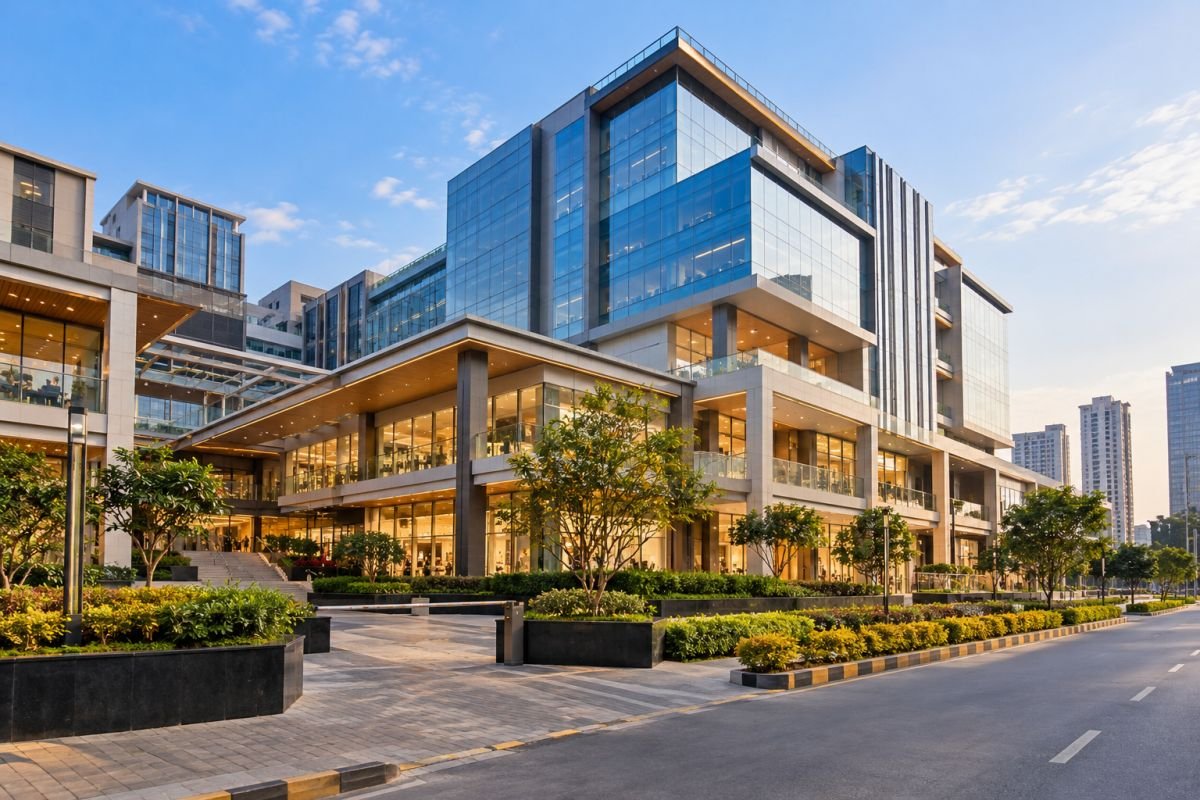
Pioneer Urban Square is an established commercial development in Sector 62, Gurgaon, along the Golf Course Extension Road corridor. Its combination of office and retail space makes it relevant to commercial investors, business owners and retail brands evaluating the area’s residential demand and business accessibility.
However, a commercial property’s investment potential cannot be assessed from its location alone. The purchase price, floor, frontage, tenant profile, vacancy period, maintenance obligations and legal status of the specific unit determine whether its rental income justifies the capital invested.
This Pioneer Urban Square Sector 62 Gurgaon review examines its commercial positioning, residential catchment, floor-wise leasing potential, rental-yield calculations and due-diligence requirements. Where current evidence is insufficient, the analysis identifies what investors should verify rather than treating estimates as confirmed market facts.
Investment perspective: Pioneer Urban Square deserves unit-level evaluation as an established commercial asset, but investors should base their decisions on achievable rent after expenses, verified documentation and realistic vacancy assumptions—not projected appreciation or headline rental yields.
Pioneer Urban Square Gurgaon Commercial Overview: Format, Builder & Sector Positioning
Pioneer Urban Square is associated with Pioneer Urban Land and Infrastructure Limited and offers commercial office and retail inventory in Sector 62. Its location connects the development with the wider Golf Course Extension Road commercial and residential corridor.
The existing AssuredGains property record reports a development area of approximately 10.33 acres, four commercial towers, office units of approximately 550–2,400 sq. ft. and retail units of approximately 700–5,950 sq. ft. These specifications require confirmation against current inventory and sanctioned project documents before being treated as definitive.
The project’s commercial proposition is its potential to serve both nearby residents and businesses operating across adjoining neighbourhoods. Retailers may benefit from repeat local consumption, while offices can attract professional firms and service businesses that value accessibility and usable workspace.
Nevertheless, location-level demand does not guarantee occupancy. Two units in the same development can achieve different rents because of floor position, visibility, configuration, furnishing, access and maintenance costs. Investors should therefore compare the specific unit’s total acquisition cost with its realistic leasing potential.
3-Km Residential Catchment and Daily Footfall Drivers in Sector 62
A 3-km catchment provides a useful starting point for evaluating retail demand around Pioneer Urban Square. Its commercial value depends on the number of occupied households, nearby employment, accessibility and the extent to which competing destinations capture local spending.

The catchment should distinguish between delivered and occupied residential developments, completed but partially occupied housing, and under-construction projects approaching possession. Existing residents can generate current demand, whereas future housing supply represents a potential source of additional customers rather than established footfall.
A verified, deduplicated population estimate for the 3-km catchment is not available in the evidence reviewed for this article. Publishing an exact population figure without reconciling project inventories and occupancy would create false precision. Before publication, AssuredGains should map nearby residential developments, record delivered and occupied units, establish their distances from the property, and avoid counting the same households more than once.
Residential population is only one component of retail demand. Office employees can support weekday food and convenience spending, while nearby residents may generate recurring demand for pharmacies, cafés, salons, groceries, clinics and other everyday services. The value of these customer groups depends on the tenant category and its trading hours.
Actual footfall must be measured rather than inferred from a map. Investors should observe the site on weekdays and weekends, across morning, afternoon and evening periods, recording pedestrian movement, occupied shopfronts, parking turnover, customer access and visible vacancies.
Road frontage and visibility also require unit-level assessment. A shop facing a prominent approach road may benefit from signage and walk-in discovery, but an inward-facing unit with restricted access may not capture the same demand. Parking, pedestrian routes, turning access and competing retail destinations can materially affect the outcome.
For offices, street-level visibility is usually less important than lift access, parking, usable floor area, building services and total occupancy costs. A frontage premium should therefore be justified by the intended tenant’s actual business requirements.
Floor-Wise Layout Analysis: Ground-Floor Frontage vs Upper-Floor Zoning
Ground-floor retail and upper-floor commercial space serve different occupier requirements. Ground-floor units can be attractive to convenience retailers, pharmacies, selected food and beverage businesses and customer-facing services that depend on direct access, signage and spontaneous visits.

However, superior visibility does not automatically produce superior investment returns. If a ground-floor unit costs substantially more than an upper-floor unit, its additional rental income must justify that premium. Poor pedestrian circulation, inconvenient parking or competing shopfronts can also reduce its leasing advantage.
Upper-floor units may suit professional offices, consulting firms, training centres, back-office operations and appointment-based businesses. Their leasing potential depends more heavily on efficient layouts, lift accessibility, natural light where available, power backup, washrooms, parking and the cost of fitting out the premises.
For retail brands, the decision should reflect the customer journey and sales model. For office investors, usable area and occupancy economics may be more important than street frontage. The best floor is therefore the one that offers the strongest relationship between acquisition cost, achievable rent and tenant demand.
Leasing liquidity should be assessed using comparable evidence, including time taken to lease similar units, vacancy duration, achieved rents and resale enquiries. Ground-floor retail may attract premium-paying tenants in some circumstances, while appropriately configured office space may appeal to a different pool of occupiers. Neither category is universally more liquid.
2026 Capital Values, Lease Rental Benchmarks and Net Yield
A reliable Pioneer Urban Square Sector 62 Gurgaon price list must specify the individual unit, floor, area basis, furnishing condition, ownership terms and additional charges. Third-party advertisements can help identify asking-price expectations, but they are not proof of completed transactions or current availability.

The same distinction applies to rental benchmarks. Advertised rents can vary significantly according to furnishing, unit size, maintenance arrangements and whether the quoted area is carpet, covered or super built-up. Before using a comparable, investors should confirm the monthly rent, area definition, tenant obligations and whether the premises are actually leased.
Current unit-specific capital values and an independently verified prevailing lease rate have not been established here. Investors should obtain a dated quotation and compare it with relevant rental evidence before calculating the expected return.
Gross vs Net Rental Yield: CAM, Property Tax and Fit-Out Periods
Gross rental yield measures annual potential rent against acquisition cost. Net operating yield is more useful for commercial underwriting because it accounts for vacancy, rent-free periods and recurring expenses paid by the owner.
The calculations are:
Gross yield = Annual rent ÷ Total acquisition cost × 100
Net operating yield = Annual rent after vacancy and operating expenses ÷ Total acquisition cost × 100
Consider an illustrative investment with a total acquisition cost of ₹1 crore and contracted rent of ₹70,000 per month. Potential annual rent would be ₹8.4 lakh, equivalent to a gross yield of 8.4%.
Assume an 8% allowance for vacancy and rent-free periods, annual landlord-paid CAM of ₹60,000, and property tax plus other owner expenses of ₹30,000. Annual rent after the vacancy allowance would be ₹7,72,800. After deducting the stated expenses, net operating income would be ₹6,82,800, producing an illustrative net operating yield of approximately 6.83%.
These figures demonstrate the calculation; they are not actual Pioneer Urban Square rental performance or a forecast. They exclude financing costs, income tax and additional capital expenditure. A separate fit-out period could reduce first-year income further.
CAM requires particular attention. Depending on the agreement, common area maintenance may cover security, housekeeping, lifts, common-area electricity and other building services. Investors must establish which charges are payable by the owner and which can be recovered from the tenant. Property tax should be checked against the applicable assessment and latest bill.
Commercial lease lock-in periods are contract-specific. The executed agreement should be reviewed for lock-in, notice period, security deposit, rent escalation, fit-out period, maintenance allocation and early-termination provisions. These terms affect both income stability and the ability to replace a tenant.
Self-Use Business vs Pure Leasing ROI
A business owner evaluating self-use should compare the total cost of ownership with the cost of leasing an equivalent premises. The calculation should include acquisition expenses, maintenance, financing where applicable and the opportunity cost of capital tied up in the property.
A pure leasing investor should focus on contracted rent, net operating income, tenant creditworthiness, vacancy risk and resale liquidity. Capital appreciation may contribute to total returns, but it is uncertain and should not be presented as guaranteed income.
HRERA Compliance, Completion Timeline and Vacancy Risk Assessment
Legal verification is essential before committing funds. Historical Haryana RERA material refers to a commercial project described as Pioneer GUR-62 CIR and concerns regarding completion or occupation documentation at the time of the relevant proceeding. This warrants further investigation, but it does not by itself establish the current legal status of every unit marketed under Pioneer Urban Square.

Investors should check the exact project and land parcel through Haryana RERA and reconcile the findings with the developer’s records and the applicable sanctioned plans. A registration belonging to another Pioneer Urban project must not be treated as proof of compliance for these commercial premises.
Before purchase, verify the registered title and ownership chain, seller’s authority to transfer the unit, project licence and sanctioned layout, applicable HRERA registration or documented exemption, relevant authority orders, and the applicable completion or occupation certificate. Confirm that the intended commercial use is permitted and that relevant fire-safety approvals and other statutory permissions are in place.
The financial review should also cover outstanding CAM, property tax, utilities, transfer charges and other liabilities. If a tenant occupies the unit, examine the executed lease, rent receipts, security deposit, escalation clauses, lock-in, termination rights and any arrears. A broker’s assurance or an online listing is not a substitute for primary documents.
Vacancy is another major determinant of commercial returns. An investor should test how income changes if the property remains vacant for several months, requires fit-out spending or needs rent concessions to secure a tenant. Smaller, efficiently configured units may serve a different tenant pool from large retail spaces, while high occupancy costs can weaken demand even in a well-connected location.
Competition from nearby commercial developments, building maintenance, parking constraints and tenant concentration can also affect leasing performance. A prudent assessment should model a base case, a downside case and a prolonged-vacancy case instead of relying on a single projected rent.
Final Verdict: Who Should Invest in Pioneer Urban Square Sector 62 Gurgaon?
Pioneer Urban Square may merit consideration for investors and business owners seeking commercial premises in Sector 62, provided the selected unit’s legal position, purchase price and leasing prospects are independently verified.
It is most relevant to income-focused investors who can assess net yield and tolerate vacancy, business owners comparing ownership with leasing, and experienced commercial buyers who understand floor-specific tenant demand and resale liquidity. It may be unsuitable for buyers who require immediate passive income, cannot maintain a vacancy reserve or depend on guaranteed appreciation.
Before making an offer, compare similar units, confirm the area basis and total acquisition cost, obtain current lease evidence, and reconcile maintenance obligations with the draft agreement. Do not commit capital until the relevant title, approval and occupation documents have been reviewed.
For broader commercial investment context, read the Grade A office spaces in Gurgaon rental yield guide and explore the commercial and residential catchment in Sector 62.
Next step: Visit the Pioneer Urban Square Sector 62 Gurgaon commercial price list and layout page to request current unit availability, floor plans and written pricing. Ask AssuredGains’ commercial leasing desk to clarify comparable rents, CAM obligations and documentation for the exact premises. No rental rate, occupancy level or investment return should be treated as assured.
Frequently Asked Questions
1. What is the realistic rental yield and lease potential of Pioneer Urban Square Sector 62 Gurgaon in 2026?
The yield depends on the unit’s purchase price, floor, condition, tenant and operating expenses. Public asking rents alone cannot establish one reliable project-wide yield. Calculate gross and net yield using a verified acquisition cost, achievable rent, vacancy allowance, CAM and property tax.
2. How large is the residential catchment surrounding Pioneer Urban Square?
A 3-km radius is a useful starting point, but an accurate population estimate requires a deduplicated inventory of delivered, occupied and nearing-possession housing. Without verified occupancy data, an exact population figure would be speculative.
3. Which floor offers the best capital appreciation and leasing liquidity?
Ground-floor retail may benefit from frontage and walk-in visibility, while upper-floor offices can suit businesses prioritising usable area and occupancy costs. The better investment depends on the unit’s purchase premium, tenant demand, lease history and resale market.
4. What are the CAM charges, property tax and lock-in norms?
These depend on the unit, building and lease. Obtain current CAM invoices, the applicable property-tax assessment and the executed lease terms. Confirm lock-in, notice, escalation, deposit and fit-out provisions rather than assuming a universal Sector 62 standard.
5. Which HRERA and OC documents should buyers verify?
Check the exact project’s applicable HRERA position, title documents, sanctioned plans, completion or occupation certificates, permitted commercial use, relevant fire-safety approvals and outstanding dues. Ensure that the documents correspond to the actual land parcel and unit.
6. Is Pioneer Urban Square suitable for a first-time commercial investor?
It may be suitable if the investor can verify legal compliance, pricing, tenant demand and operating costs. Maintain a vacancy reserve and avoid relying solely on projected rent or appreciation claims.
7. What should buyers request before paying a booking amount?
Request a unit-specific quotation, floor plan, area statement, title and approval documents, applicable occupation documentation, maintenance schedule, outstanding-dues statement and draft sale agreement. For leased units, verify the executed lease and rent receipts.