
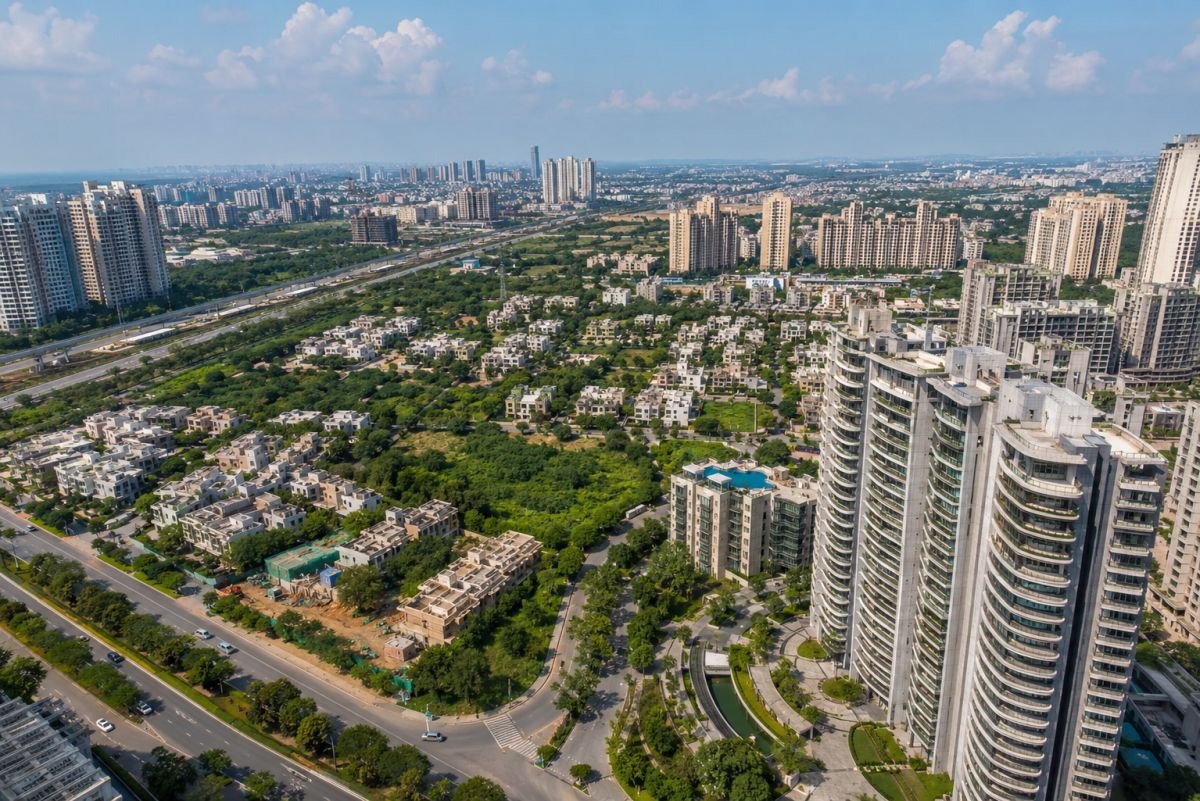
Is Sector 111 the New Billionaire’s Address of NCR? The short answer: it is rapidly becoming one. With the launch of India’s first Elie Saab branded residences, the 250-acre Smart City Delhi Airport (SCDA) township, and price points crossing ₹33,000 per sq. ft., Sector 111 on Dwarka Expressway has shifted from an emerging corridor to a serious contender for Delhi-NCR’s most exclusive address.
This article provides a full analysis of SCDA & branded residences, examining what makes Sector 111 different from other luxury pockets, whether the fundamentals justify the premium, and what investors should realistically expect. All prices referenced are indicative asking rates compiled from current market data as of August 2026, not guaranteed transaction values or returns.
Key Takeaways
- Sector 111 is currently listing at ₹15,700–₹16,175 per sq. ft. on average, with new launch premiums reaching ₹33,150 per sq. ft. for branded inventory — a spread that reflects differing project grades and ready-vs-under-construction mix.
- M3M Elie Saab, India’s first fashion-branded residence by Elie Saab Maison, offers 336 ultra-luxury 4 BHK apartments (4,205–4,655 sq. ft.) priced between ₹14.22 crore and ₹14.69 crore, with possession scheduled for September 2032.
- Smart City Delhi Airport (SCDA) is a 250-acre mixed-use township spanning Sectors 111 and 113, conceptualised with global town-planning expertise and offering luxury residences, A-grade offices, high-street retail, and hospitality.
- Branded residences in India command a 30–40% premium over traditional luxury homes, with India ranking 6th globally in active branded residential projects.
- Sector 111 has appreciated approximately 95% over the last 5 years, though recent quarterly trends show stabilization as the market absorbs new ultra-luxury supply.
What Is Smart City Delhi Airport (SCDA) and Why Does It Matter?
Smart City Delhi Airport, commonly referred to as SCDA, is a 250-acre integrated township developed by M3M India, positioned at the Delhi-Gurgaon border along Dwarka Expressway. The master plan envisions a self-contained district combining luxury residences, A-grade commercial offices, high-street retail, premium hospitality, and extensive green spaces.
Why this matters for Sector 111: SCDA is not a single project — it is a district-scale redevelopment that fundamentally changes the land-use profile of the area. Spanning both Sector 111 and Sector 113, the township is designed with pedestrian-friendly internal roads, dedicated cycling lanes, and shaded pathways. It incorporates community spaces, sports facilities, educational and healthcare infrastructure, and tech-based solutions to reduce carbon emissions.

The development is located 0 km from Delhi, approximately 3 minutes from Urban Extension Road II, 5 minutes from Yashobhoomi metro station, 7 minutes from IGI Airport, and 15 minutes from the New Diplomatic Zone. This proximity to critical infrastructure — particularly the airport and metro connectivity — is what separates SCDA from standalone luxury projects elsewhere in Gurgaon.
For investors, SCDA represents a de-risking factor. Instead of betting on a single tower, you are buying into a 250-acre ecosystem with planned commercial, retail, and social infrastructure. The mixed-use nature means future rental demand could be supported by on-site office workers and retail footfall, not just residential tenants.
How does SCDA compare to other integrated townships in NCR? Unlike older developments that added commercial phases as an afterthought, SCDA’s master plan was conceptualised with inputs from global town-planning experts. The emphasis on walkability, internal connectivity, and generational living spaces suggests a longer-term vision than typical residential-only projects.
The Rise of Branded Residences in India
Branded residences — luxury homes designed and serviced in collaboration with global hospitality or lifestyle brands — are no longer a niche segment in India. According to industry reports, India now ranks 6th globally in active branded residential projects and accounts for roughly 4% of global supply.
What makes branded residences different? These projects combine premium real estate with hotel-style services, turnkey interiors, and professional property management. Buyers pay a 30–40% premium over comparable non-branded luxury homes for the brand association, design pedigree, and perceived long-term value.
Delhi-NCR, particularly Gurugram and Noida, has emerged as the epicentre of this trend. While Mumbai traditionally dominated India’s luxury housing market, the availability of large land parcels along corridors like Dwarka Expressway and Noida Expressway, combined with proximity to corporate hubs, has made NCR attractive for ultra-premium developments.
The SCDA enclave itself includes what developers have termed the “Billionaire’s Block” — a curated zone within the township where multiple globally branded residences are planned. M3M Elie Saab is the first fashion-house-branded residential project in India, marking a shift from hospitality-branded residences (like Trump or Westin) to lifestyle and fashion brands.
Are branded residences worth the premium? Early evidence suggests strong demand. Trump Residences in Gurugram sold out ₹3,250 crore in allotments on launch day. Westin Residences on Dwarka Expressway has projected a ₹15,000 crore topline across 1,700 homes. The key question for investors is whether the brand premium translates into superior resale liquidity and appreciation — or whether it simply inflates the entry price.
M3M Elie Saab: A Closer Look at Sector 111’s Flagship Project
M3M Elie Saab, launched in October 2025, is India’s first residential collaboration with Elie Saab Maison, the Lebanese fashion house known for haute couture. Located within SCDA in Sector 111, the project represents the uppermost tier of branded luxury currently available in NCR.

Project specifications at a glance:
- Configuration: 4 BHK + Utility apartments
- Unit sizes: 4,205 to 4,655 sq. ft.
- Total units: 336 across a low-density layout
- Price range: ₹14.22 crore to ₹14.69 crore
- Average price: Approximately ₹33,150 per sq. ft.
- Possession: September 2032
- RERA registration: GGM/992/724/2025/95 dated 16.10.2025
What makes it architecturally distinct? The project features one apartment per core, ensuring complete privacy with private lift lobbies for each residence. Ceiling heights of 12 feet, floor-to-ceiling glass facades, and private 10-foot decks with pool areas are standard. Interiors are curated by Elie Saab Maison, featuring Italian flooring and wardrobes, German kitchens, branded bathrooms, and smart-home integration.
The 75,000 sq. ft. exclusive clubhouse is also designed with Elie Saab’s aesthetic vision, including swimming pools, a gym, yoga studio, theatre, and billiards facilities. The low-density planning — 336 units across a generously sized plot — prioritises exclusivity over maximising saleable area.

Is the pricing justified? At ₹33,150 per sq. ft., M3M Elie Saab sits well above Sector 111’s average asking rate of ₹16,175 per sq. ft. This premium is comparable to branded residences in Dubai, Miami, and London, where 25–35% premiums over non-branded luxury are standard. For buyers, the calculation depends on whether they value the brand association, design pedigree, and privacy enough to justify the entry cost.
Sector 111 vs. Established Luxury Corridors: A Price & Fundamentals Comparison
Sector 111’s emergence as a luxury address invites direct comparison with Gurgaon’s established premium corridors: Golf Course Road, Golf Course Extension Road, and Southern Peripheral Road.
Price positioning: As of August 2026, Sector 111’s average apartment rate stands at approximately ₹16,175 per sq. ft., with ready-to-move inventory averaging ₹14,200 per sq. ft. and under-construction projects at ₹17,350 per sq. ft. In contrast, Golf Course Road commands an average of ₹23,688 per sq. ft., with premium projects like DLF The Camellias listing at significantly higher rates.
However, the gap narrows when comparing new launches. M3M Elie Saab at ₹33,150 per sq. ft. is priced in the same band as ultra-luxury projects on Golf Course Road. The difference is that Sector 111 offers larger unit sizes (4,200+ sq. ft.) at these price points, whereas Golf Course Road premiums often reflect location scarcity rather than unit scale.
Infrastructure maturity: Golf Course Road benefits from established metro connectivity, operational commercial hubs, and decades of social infrastructure development. Sector 111, while physically closer to IGI Airport and Delhi, is still building out its ecosystem. The upcoming metro extension along Dwarka Expressway and the 1,000-acre Global City business district will be critical levellers over the next 5–7 years.
Tenant profile: Golf Course Road attracts senior executives, expatriates, and CXOs working in Cyber City and MG Road. Sector 111’s tenant base is currently thinner but is expected to evolve as SCDA’s commercial phases come online and airport-proximity demand grows.
Which corridor suits which investor? Golf Course Road offers capital preservation and tight price discovery — it is liquid, established, and lower risk. Sector 111 offers capital growth potential driven by infrastructure completion and brand-led scarcity, but with higher execution risk and a longer holding period.
Connectivity & Infrastructure: The Real Drivers of Long-Term Value
Sector 111’s investment case rests heavily on infrastructure that is either recently completed or under active development.
Dwarka Expressway (NH 248-BB): The 16-lane, largely elevated, access-controlled corridor connects Mahipalpur in Delhi to Kherki Daula in Gurgaon. A dedicated tunnel section near the Delhi end provides signal-free access to IGI Airport Terminal 3, a major draw for sectors closest to the Delhi border.
Metro connectivity: The existing Yashobhoomi Dwarka Sector 25 metro station is approximately 5 minutes from SCDA. A proposed metro extension running parallel to Dwarka Expressway is under construction, aimed at linking the corridor to the wider Delhi and Gurgaon metro network. The Palam Vihar metro station is anticipated to be the closest to Sector 111 once operational.
Global City: A 1,000-acre central business district being developed between Dwarka Expressway and NH-48 by HSIIDC. Planned as a mixed-use hub with an internal metro loop, Global City could significantly boost employment density and rental demand along the expressway corridor.
Interstate Bus Terminal (ISBT): A new ISBT is planned in Sector 36, intended to strengthen public transport access for the region.
Proximity landmarks: UER II (3 minutes), Yashobhoomi (5 minutes), IGI Airport (7 minutes), Dwarka Golf Course (10 minutes), Bharat Vandana Park (10 minutes), and New Diplomatic Zone (15 minutes).

The bottom line: Sector 111 is not yet as connected as Golf Course Road, but the infrastructure pipeline is arguably deeper. For investors with a 7–10 year horizon, the completion of these projects could compress the premium gap between Dwarka Expressway and established corridors.
Investment Analysis: ROI, Rental Yield & Risk Factors
Capital appreciation context: Sector 111 has seen approximately 95% price appreciation over the last 5 years, reflecting the corridor’s rapid evolution from farmland to premium residential. However, recent quarterly data shows some stabilization — a natural correction as the market digests new ultra-luxury supply.
Rental yield expectations: The average rental yield in Sector 111 is currently around 1.78–2% for apartments, with 4 BHK units commanding monthly rents of ₹68,450 on average. This is lower than mature Gurgaon corridors like Sector 57 or Golf Course Extension Road, where yields of 4–5% are achievable.
Why the yield compression? Ultra-luxury properties above ₹5–6 crore typically rent to a smaller tenant pool — expatriates, corporate CEOs, or diplomats. The absolute rents are high, but the yield percentage compresses because capital values have risen faster than rental growth. As SCDA’s commercial and retail infrastructure matures, rental demand should broaden beyond pure residential tenants.
ROI illustration (not a promise): If an investor purchases a 4 BHK at ₹14.5 crore and the property appreciates at 10% annually over 7 years (until possession and initial resale market formation), the indicative value at exit could be approximately ₹28.3 crore. This is purely illustrative — actual returns depend on execution quality, market conditions, and infrastructure completion timelines.

Key risk factors to consider:
- Execution risk: Possession is scheduled for 2032 — a 6-year construction timeline. Delays could impact both rental income plans and capital appreciation.
- Market absorption: At ₹14+ crore per unit, the buyer pool is narrow. Resale liquidity may take time to develop.
- Infrastructure dependency: Much of the investment thesis relies on metro completion, Global City development, and expressway maturity. Slippage in any of these could moderate growth.
- Brand sustainability: The Elie Saab brand association is a key differentiator, but long-term value depends on the durability of the brand licensing agreement and service standards.
Data Comparison: Sector 111 vs. Sector 113 vs. Golf Course Road
| Parameter | Sector 111 | Sector 113 | Golf Course Road |
|---|---|---|---|
| Avg. Price (Aug 2026) | ₹16,175/sq. ft. | ₹15,750/sq. ft. | ₹23,688/sq. ft. |
| New Launch Premium | ₹33,150/sq. ft. (M3M Elie Saab) | On request (M3M St. Andrews) | ₹80,000–₹1,18,000/sq. ft. (DLF Camellias) |
| Typical 4 BHK Price | ₹4.1–14.7 Cr | ₹2.1–4.5 Cr | ₹7–183 Cr |
| Rental Yield (2026) | ~1.8–2% | ~2–2.5% | ~2.5–3.5% |
| IGI Airport Distance | ~7 min | ~7 min | ~20–25 min |
| Metro Status | Under construction (extension) | Under construction (extension) | Operational (Rapid Metro) |
| Commercial Ecosystem | SCDA township (planned) | SCDA township (planned) | Established (Cyber City, MG Road) |
| Possession Timeline | 2028–2032 | 2028–2032 | Ready to move |
| Investment Profile | High growth, higher risk | Growth-oriented, mid-premium | Capital preservation, liquid |
Prices are indicative asking rates from current market data as of August 2026. Rental yields are gross estimates based on current listings.
Who Should Consider Sector 111 — and Who Should Wait?
Sector 111 suits investors who:
- Have a 7–10 year investment horizon and can hold through construction and initial market formation
- Value airport proximity and Delhi-border location over immediate metro access
- Believe in the branded residence premium thesis and are comfortable with ₹14+ crore ticket sizes
- Want exposure to Dwarka Expressway’s infrastructure pipeline rather than paying full price for already-mature corridors
Investors who should wait or look elsewhere:
- Those seeking immediate rental income or high yields (mature corridors like Sector 57 or Sohna Road offer better cash flow)
- Buyers uncomfortable with 6-year possession timelines and construction-phase risk
- Investors with shorter 3–5 year horizons who need liquidity
- Those who prefer established social infrastructure (schools, hospitals, retail) over planned township models
Frequently Asked Question
Q: Is Sector 111 the New Billionaire’s Address of NCR?
A: It is becoming one. With SCDA’s 250-acre township, India’s first Elie Saab branded residences, and price points crossing ₹33,000 per sq. ft., Sector 111 has the ingredients of an ultra-luxury address. However, it is still 5–7 years away from full infrastructure maturity. The “billionaire’s address” tag will solidify as the metro, Global City, and commercial phases come online.
Q: What is the price per sq. ft. in Sector 111 Gurgaon?
A: As of August 2026, average apartment rates in Sector 111 range from ₹15,700 to ₹16,175 per sq. ft. for standard inventory. New launch ultra-luxury projects like M3M Elie Saab command premiums of ₹33,150 per sq. ft. The spread reflects differing project grades, configurations, and construction status.
Q: What is Smart City Delhi Airport (SCDA)?
A: SCDA is a 250-acre integrated township by M3M India spanning Sectors 111 and 113 along Dwarka Expressway. It includes luxury residences, A-grade offices, high-street retail, hospitality, and extensive green spaces. The master plan emphasises pedestrian-friendly design, internal connectivity, and sustainability.
Q: When will M3M Elie Saab be ready for possession?
A: The project is scheduled for possession in September 2032. It is RERA-registered under ID GGM/992/724/2025/95 dated 16.10.2025. Buyers should factor in a 6-year construction timeline when planning their investment horizon.
Q: Are branded residences a good investment in Gurgaon?
A: Branded residences command 30–40% premiums over traditional luxury homes and have shown strong initial absorption (e.g., Trump Residences sold out on launch day). However, the investment case depends on brand durability, service standards, and resale liquidity. They suit buyers who value design pedigree and exclusivity, not just financial returns.
Q: How does Sector 111 compare to Golf Course Road for investment?
A: Golf Course Road offers established infrastructure, immediate rental demand, and capital preservation. Sector 111 offers higher growth potential driven by infrastructure completion and lower entry prices relative to ultra-luxury inventory, but with higher execution risk. Golf Course Road is lower risk; Sector 111 is higher reward potential over a longer horizon.
Q: What infrastructure is coming to Dwarka Expressway?
A: Key projects include the metro extension parallel to the corridor, the 1,000-acre Global City business district, a planned ISBT in Sector 36, and the fully operational 16-lane expressway with signal-free airport access. These are expected to mature over the next 5–7 years.
Q: What is the rental yield in Sector 111?
A: Current gross rental yields in Sector 111 average 1.8–2% for apartments, with 4 BHK units renting at approximately ₹68,450 per month. Yields are lower than mature Gurgaon corridors but should improve as commercial infrastructure and metro connectivity mature.
Conclusion
Sector 111 is not yet the finished article — and that is precisely where its opportunity lies. The combination of SCDA’s district-scale planning, India’s first Elie Saab branded residences, and Dwarka Expressway’s deepening infrastructure creates a compelling long-term case for investors who can hold through the construction cycle.
The price premiums are real, the risks are measurable, and the timeline is defined. Whether it becomes NCR’s definitive billionaire’s address depends on execution — of the township, the metro, and the commercial phases. For now, it is one of the most closely watched luxury corridors in Delhi-NCR.
If you are considering an investment in Dwarka Expressway properties or want to explore new launch projects in Gurgaon, our advisors can help you evaluate options against your timeline and risk appetite. Talk to an AssuredGains advisor for a personalised analysis.



Join The Discussion