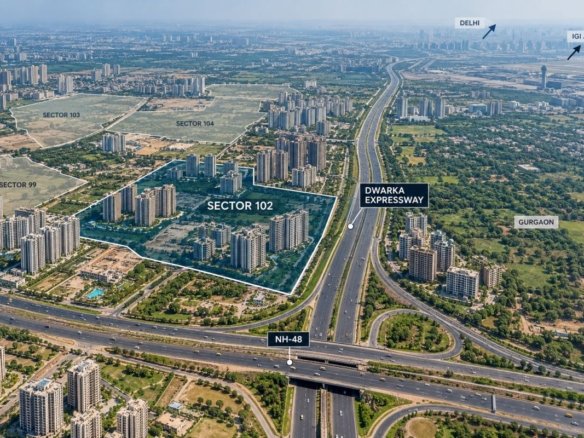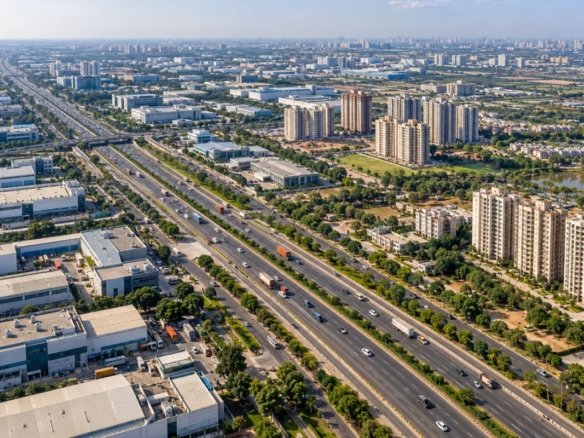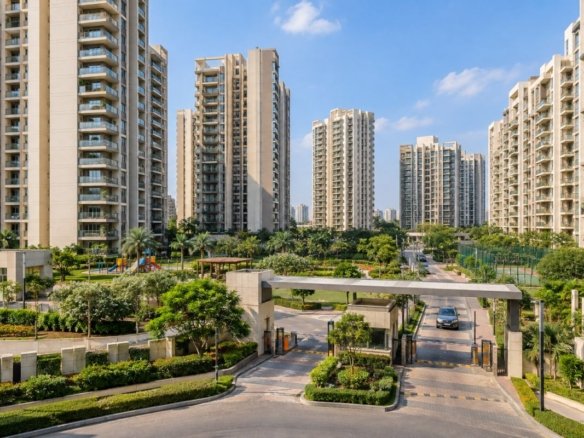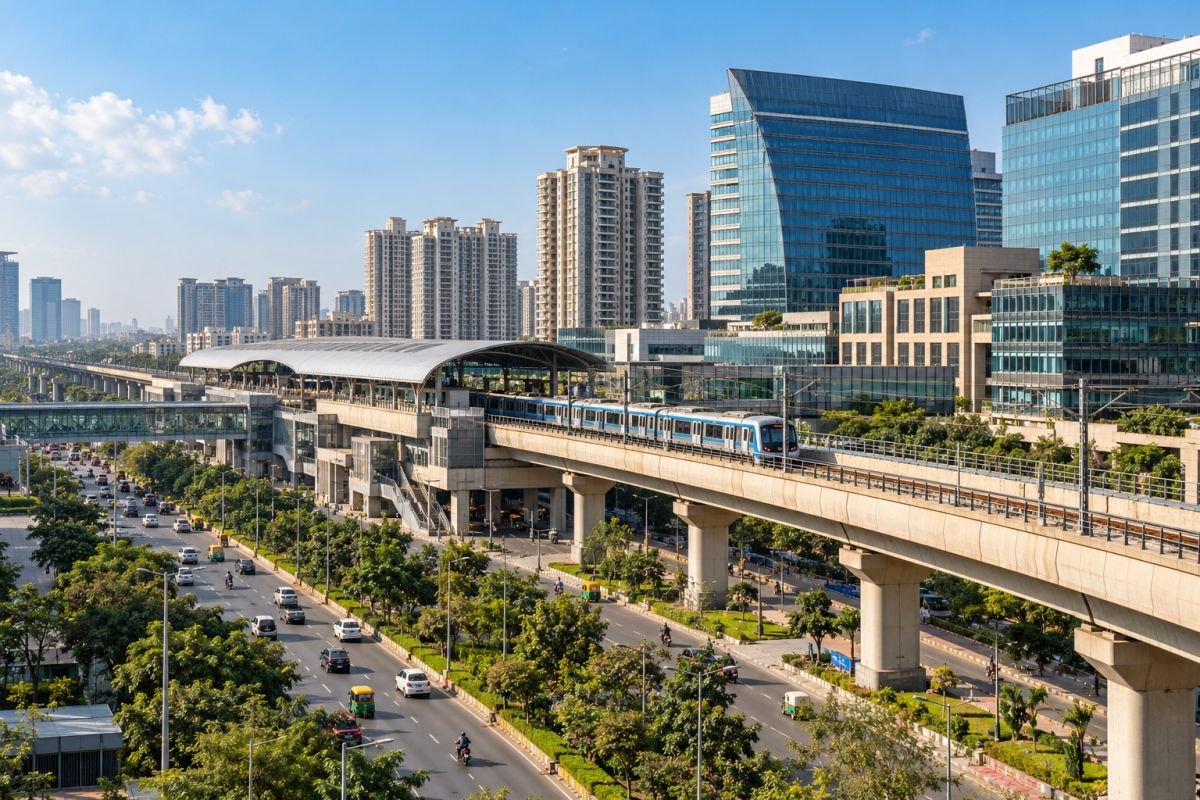
Gurugram’s proposed metro expansion is an important infrastructure development for homebuyers, plotted land investors and commercial property owners. By extending public transport across residential neighbourhoods, commercial districts and employment centres, the project could improve access to parts of the city that currently depend heavily on road transport.
However, infrastructure announcements and actual property benefits are not the same thing. A proposed station does not establish that a particular property will be within walking distance, that its market value will increase, or that construction and passenger services will begin on a particular date.
This guide examines the gurugram metro phase 1 stations, the proposed route from Millennium City Centre through Subhash Chowk and Hero Honda Chowk, the potential effects on surrounding property markets, and the official records buyers should verify before committing capital.
Editorial scope note: Gurugram Metro Rail Limited (GMRL) publishes the broader Millennium City Centre–Cyber City corridor and its proposed station list. Construction packages are identified separately on its tender portal. Buyers should verify the latest official phase boundaries and construction status rather than assume that the full corridor is one completed or operational phase.
Executive Overview: Why Gurugram Metro Phase 1 Stations & Property Impact (2026) Matters for Gurugram Buyers
The Gurugram Metro project is intended to improve connectivity between older and newer parts of the city, linking residential, institutional and commercial areas with employment centres such as Udyog Vihar and Cyber City. GMRL describes the broader corridor as approximately 28.5 km, with 27 elevated stations and a depot, including a spur towards Dwarka Expressway.
The proposed route begins at Millennium City Centre and includes stations around Sector 45, Cyber Park, Sector 47, Subhash Chowk, Sector 48, Sector 72A and Hero Honda Chowk. The broader published station list continues through industrial and residential areas towards Cyber City.
These stations matter to property buyers because reliable public transport can change the practical cost of commuting. Reduced dependence on private vehicles may improve the attractiveness of neighbourhoods for employees, tenants and businesses. The eventual effect depends on station access, service frequency, pedestrian infrastructure, interchange quality and the availability of supporting civic amenities.
What the proposed route means for property decisions
Three distinctions are particularly important.
First, announced connectivity is not operational connectivity. A proposed station can influence expectations before trains begin running, but buyers should distinguish planning documents, tenders, construction, testing and commercial operations.
Second, sector-level proximity is not property-level proximity. A property marketed as being near Subhash Chowk or Hero Honda Chowk may still require a substantial road journey to reach the proposed station. The actual route, entry point, barriers, crossings and pedestrian access all matter.
Third, metro connectivity does not override property law. A favourable location cannot compensate for an unclear title, unauthorised construction, missing approvals or an invalid development licence.
For a wider explanation of the relationship between transport investment and real estate demand, read AssuredGains’ Metro expansion impact on Gurgaon property prices.
Proposed Gurugram Metro stations: Millennium City Centre to Hero Honda Chowk
GMRL’s published corridor list identifies the following proposed stations in this section:
| Sequence | Proposed station | Property-market relevance |
|---|---|---|
| 1 | Millennium City Centre (interchange) | Existing transport connections and access to established residential and commercial catchments. |
| 2 | Sector 45 | Residential access and last-mile connectivity. |
| 3 | Cyber Park | Potential access to employment and commercial destinations. |
| 4 | Sector 47 | Residential neighbourhoods and local commercial activity. |
| 5 | Subhash Chowk | Access to the Sohna Road-side catchment and adjoining residential areas. |
| 6 | Sector 48 | Residential and commercial destinations in the surrounding corridor. |
| 7 | Sector 72A | Access to adjoining development areas, subject to the final alignment. |
| 8 | Hero Honda Chowk (interchange) | A strategic connection point in the proposed wider network. |
Status of the list: These are proposed corridor stations, not a list of stations confirmed to be open to passengers. The final alignment, station access and construction status should be checked on the official GMRL portal before publication or purchase.
Why the distinction matters in 2026
The official GMRL website publishes the broader corridor and DPR documents, while its civil-tender page separately identifies construction work for the section from Sector 9 to Cyber City. These records show why buyers should not use a single generic “Phase 1 completion” claim to assess the status of every station.
Before paying a location premium, establish three facts: whether the station is included in the latest approved alignment, what the latest official construction record says about that section, and how the specific property connects to the station.
Official Regulatory / Infrastructure Framework (GMDA / DTCP / HRERA / GMRL)
Gurugram property purchases involve several separate checks. No single portal confirms the complete legal and commercial safety of a property.
GMRL: Corridor alignment and project status
Gurugram Metro Rail Limited is the primary starting point for information about the metro project. Its official website provides the corridor description, proposed station list, DPR documents and tender information.
Use these records to check:
- Whether the station appears in the published corridor documentation.
- Whether the proposed alignment has been revised.
- Which construction package covers the relevant section.
- Whether a tender is proposed, under evaluation, awarded or otherwise updated in official records.
- Whether a stated completion or commissioning date appears in a current official document.
A tender notice is not proof that the contract has been awarded. An awarded contract is not proof that construction is complete, and physical construction is not proof that passenger services have commenced.
Do not treat a developer’s marketing map as a substitute for GMRL’s latest alignment documentation.
GMDA: Civic infrastructure and last-mile access
The Gurugram Metropolitan Development Authority is relevant to infrastructure such as roads, drainage and water supply where those facilities fall within its jurisdiction.
For a property near Subhash Chowk, Sector 48 or Hero Honda Chowk, metro proximity should be assessed alongside road access, drainage, water availability and the condition of connecting streets.

Ask whether the approach road is publicly accessible, whether it is shown in the relevant approved layout and which agency is responsible for its maintenance. Check for drainage problems, road bottlenecks and infrastructure works that may affect practical access.
A proposed metro station does not guarantee that surrounding roads, footpaths or utility networks will be upgraded on the same timetable.
DTCP / TCP Haryana: Land use and planning permissions
The Department of Town and Country Planning Haryana is an important source for development-plan and licensing information. Buyers should identify the applicable notified development plan and land-use designation for the specific parcel.
For plotted developments and licensed colonies, verify the applicable licence, approved layout plan and permitted use. For an individual plot, confirm whether the land is legally capable of the intended residential, commercial or other use.
Do not assume that proximity to a metro station creates additional construction rights, higher permissible density or automatic eligibility for transit-oriented development. Such rights must arise from applicable planning provisions and valid approvals.
Where a property is affected by a proposed road, public facility, acquisition or other planned infrastructure, obtain the relevant official plan and seek a property-specific interpretation before purchasing.
HRERA Gurugram: Project registration and promoter disclosures
For a covered real estate project, search the Haryana RERA portal and select the appropriate authority and project record. Check the registration details, promoter identity, disclosed completion timeline, extensions, quarterly progress reports and applicable orders.
The registration number printed in a brochure should match the official record. Also compare the project’s approved plans and declared specifications with the unit or plot being offered.
An HRERA registration is not a substitute for title verification, land-use compliance, an occupation certificate or confirmation that the particular unit can legally be conveyed and occupied.
HSVP, HSIIDC, NCRTC and DHBVN: Supporting records
Different agencies have different responsibilities. HSVP and HSIIDC records may be relevant to particular estates, layouts, industrial areas or properties under their administration. NCRTC is relevant when verifying a separate regional rapid-transit proposal or connection; it should not be confused with GMRL’s metro corridor.
DHBVN records may help establish applicable electricity connection details and outstanding dues. The exact authority to approach depends on the property, the infrastructure asset and the nature of the question.
For a comprehensive view of the city’s infrastructure catalysts, see the Gurgaon infrastructure projects 2026 guide.
Sector-Wise & Corridor-Wise Impact Across Gurugram
The likely effect of the metro will vary by catchment. The following assessment is qualitative; it is not a forecast of property prices or an assertion that every listed locality has a confirmed station within walking distance.
Millennium City Centre and Sector 45
Millennium City Centre is identified by GMRL as an interchange station. This makes the surrounding catchment relevant to buyers who value connections with the existing metro network and established city destinations.

Sector 45 may benefit from improved access if the proposed station and pedestrian connections are delivered as planned. Buyers should compare properties on actual travel time to the station, existing road connectivity, building quality and current market evidence.
An established neighbourhood may already reflect some expectations of future infrastructure in asking prices. The investment question is not simply whether connectivity will improve, but whether the purchase price reasonably compensates for remaining delivery and execution risks.
Cyber Park and Sector 47
The Cyber Park and Sector 47 stations could improve access for residents travelling towards employment and commercial destinations. Their potential benefits depend on the final station locations and whether workers can reach offices and homes without difficult last-mile journeys.
For rental investors, assess tenant demand from actual employment catchments, the quality of the residential stock, competing supply and current achieved rents. A projected transport benefit should be treated as one input into a rental assessment, not a guaranteed source of higher occupancy.
Subhash Chowk: A key decision point for the Sohna Road-side catchment
Subhash Chowk is an important reference point for buyers considering residential and commercial property along the adjoining corridor.
The proposed station could improve access for suitable properties in the surrounding area. However, the size of the catchment will depend on the final station entrance, road crossings, feeder transport and walking conditions.
Before buying a flat or plot marketed as being near the subhash chowk metro station, measure the practical route rather than relying on a radius drawn on a sales map. Check whether the route crosses major roads, whether footpaths are continuous and whether the property has lawful access.
For residential investments, compare the asking price with comparable properties that have similar building age, amenities, maintenance standards and current access. For commercial property, evaluate visibility, parking, frontage, permitted use and actual tenant demand.
Sector 48: Residential and commercial catchments
Sector 48 appears on the official proposed station list. This supports treating the area as a relevant corridor for further property-level investigation, but it does not prove that every project in the sector will enjoy equivalent connectivity.
Compare residential projects on the basis of approved plans, occupancy status, maintenance, access roads and the actual distance to the proposed station. For commercial units, verify the sanctioned use, access and parking arrangements before attributing a transport premium to the property.
The strongest evidence of an investment opportunity is a combination of defensible entry pricing, lawful development, usable access and demonstrated end-user demand.
Sector 72A and Hero Honda Chowk
Sector 72A and Hero Honda Chowk are included in GMRL’s proposed station list. Hero Honda Chowk is identified as an interchange station in the broader published corridor.
The proposed connectivity could be relevant to residential communities, commercial properties and employment-related travel around the corridor. But the effect on any specific asset will depend on its distance from the station, approach-road quality, traffic conditions and the delivery of connecting infrastructure.
The hero honda chowk metro impact should therefore be evaluated at the property level. Buyers should not assume that every project around the junction will experience the same increase in demand or value.
Where road access, congestion, noise or construction disruption affect the property, those disadvantages must be included in the decision.
Sector 31, Sector 39 and Sector 46: Verify before assuming direct station access
The phrase “sector 31 39 46 metro connectivity” can be useful as a search query, but it should not be interpreted as confirmation that each sector has a named station on this section of the published route.
GMRL’s published list includes Sector 45, Sector 47, Subhash Chowk and Sector 48 in the relevant part of the corridor. It does not list Sector 31, Sector 39 or Sector 46 as separate station names in that sequence.
Properties in these sectors may still be relevant to the wider network depending on their precise location and transport connections. However, a buyer should confirm the nearest proposed station, actual travel route and any interchange requirement before paying a connectivity premium.
Industrial and employment corridors beyond Hero Honda Chowk
The broader corridor includes Udyog Vihar Phase 6, Sector 10, Sector 37 and Basai Village, followed by additional proposed stations and a spur. These areas illustrate the project’s intended role in linking residential districts with industrial and commercial employment locations.
Improved access could make selected locations more practical for workers and businesses. The investment implications will differ between residential units, industrial premises and commercial assets, each of which has separate planning, occupancy and demand considerations.
Do not extend conclusions about the Millennium City Centre–Hero Honda Chowk section to every property along the broader route without checking the applicable station and construction records.
Step-by-Step Verification Checklist for Homebuyers & Investors
A metro-linked purchase should combine infrastructure research with legal, physical and financial due diligence. The checks below are especially important for plotted land, under-construction homes and properties marketed around future stations.

Official Government Portals & Documents to Inspect
Step 1: Verify the metro alignment
Open the GMRL corridor and DPR pages. Compare the latest official station list and alignment with the location shown by the seller. Save the relevant document and record its date or version.
If the property is advertised as being near a particular station, request a location plan that identifies the actual plot or building and the station entrance. Do not accept an unscaled promotional map as definitive evidence.
Step 2: Check the applicable development plan
Use TCP Haryana records to identify the notified development plan and land-use designation applicable to the parcel. Compare the land use with the intended purchase: residential, commercial, industrial or another permitted use.
For plotted developments, verify the applicable licence and approved layout. Where there is uncertainty about a parcel’s status or proposed acquisition, obtain professional advice based on the relevant official records.
Step 3: Search HRERA Gurugram
Search the project by its name, promoter or registration details. Match the official record with the documents supplied by the seller.
Review the declared completion date, registration validity, extension orders, quarterly progress reports, approved plans and relevant complaints or regulatory orders where available. Confirm whether the particular phase or component being purchased is covered by the record.
Step 4: Verify ownership and encumbrances
Obtain the title documents and review the chain of ownership through a qualified property lawyer. Cross-check the applicable Jamabandi and mutation entries, the seller’s identity, property description and any recorded encumbrances.
Where relevant, check for mortgages, charges, litigation, acquisition notices, easements and restrictions on transfer. A mutation entry is not, by itself, conclusive proof of title.
Step 5: Verify occupancy and completion documents
For a completed building, request the applicable occupation certificate (OC), completion certificate where required, approved building plans and evidence that the actual construction conforms to the permitted plans.
For an under-construction property, check the applicable approvals, the promoter’s disclosed delivery timeline and the current progress record. Do not treat a proposed possession date as proof that lawful occupation is already permitted.
Step 6: Check infrastructure and utility arrangements
Confirm the legal status and practical usability of approach roads, water supply, drainage, sewerage and electricity connections with the relevant authorities. Where a colony or project has shared infrastructure, check who is responsible for completion, maintenance and handover.
Step 7: Compare the investment case with current evidence
Obtain recent comparable transaction or listing evidence and assess differences in property size, building age, floor, condition, legal status and access. Where available, compare achieved rents rather than relying exclusively on advertised rental expectations.
Model the purchase price, stamp duty and registration charges, financing cost, maintenance, vacancy risk and resale liquidity. Do not build the financial case around a single assumed metro-driven appreciation figure.
Common Red Flags & Financial/Legal Risks to Avoid
Unverified station-distance claims. A seller may describe a property as “walking distance” from a future station without showing the actual pedestrian route. Verify the route, entrance and crossing conditions.
Unconfirmed completion dates. A brochure, news report or agent’s message may contain an outdated target. Check current official construction and commissioning records.
Invalid or mismatched project registration. The project name, promoter, phase or registration number may not match the official HRERA record. Resolve discrepancies before paying.
Unclear land use or title. A metro announcement does not regularise unauthorised construction, establish ownership or remove transfer restrictions.
Unsupported appreciation claims. Statements that prices will rise by a fixed percentage should be supported by credible, dated evidence. Otherwise, treat them as sales claims.
Missing completion or occupation documents. A completed-looking building may not have the approvals required for lawful occupation. Obtain and verify the applicable certificates.
Hidden infrastructure costs. Approach roads, drainage, utilities and maintenance arrangements can materially affect the cost and usability of a property. Confirm responsibilities rather than assuming the government or developer will complete every facility.
Ignoring construction disruption. Noise, diversions, dust, traffic congestion and temporary access problems can affect current living conditions and commercial activity.
The consequences of skipping due diligence can include delayed possession, financing complications, disputes, unexpected costs, restricted use, lower resale liquidity and difficulty recovering an advance or deposit. The exact exposure depends on the facts and the contractual documents.
Documents to Request Before Registration
Request and review the documents applicable to the property:
- Title deed and the relevant chain of ownership.
- Current revenue records and mutation details, where applicable.
- Encumbrance and litigation checks appropriate to the property.
- HRERA registration details and current project disclosures, where applicable.
- Development licence, approved layout and sanctioned building plans, as applicable.
- Occupation certificate and completion documents, where applicable.
- Agreement for sale, allotment letter, payment schedule and written statement of outstanding dues.
- Property-specific identity and area details, including the relevant plot or unit number.
- Mortgage release or lender consent documents, if required.
- Evidence of lawful access and relevant utility connections.
- Latest official metro alignment documents if the investment thesis depends on a proposed station.
- Any acquisition notice, road-widening proposal or land-use restriction affecting the parcel.
This is a due-diligence starting point, not a universal list of documents required in every transaction. The final requirements depend on whether the asset is a plot, resale flat, new apartment, commercial unit or property in a licensed colony.
2026–2031 Market & Livability Outlook
Between 2026 and 2031, the potential property impact of the Gurugram Metro corridor should be evaluated through the progress of infrastructure delivery, local housing demand and the quality of surrounding urban development.

Three scenarios are useful for investment planning.
Scenario 1: Construction progresses and connectivity improves
If the relevant sections are delivered, stations become operational and last-mile connections work well, some nearby locations may become more convenient for residents and employees.
Possible benefits include a wider tenant catchment, reduced dependence on private vehicles and better access to employment centres. The extent to which these benefits translate into rent or resale value will depend on supply, affordability, competing transport options and the price already paid by the investor.
Scenario 2: Delivery is delayed or access remains weak
If construction or commissioning takes longer than expected, buyers may have to wait for the promised connectivity benefit. Even after a station opens, poor pedestrian access, traffic bottlenecks or inadequate feeder services may limit its practical value.
In this scenario, properties purchased at a substantial speculative premium could underperform assets supported by established demand and existing transport links.
Scenario 3: Infrastructure improves but local supply rises
A corridor can attract new residential and commercial supply. If competing projects expand faster than end-user demand, better connectivity may not translate into stronger rents or higher resale prices for every asset.
Investors should therefore evaluate vacancy, absorption, delivered supply, rental evidence and project quality alongside infrastructure progress.
What buyers should monitor through 2031
Review the official GMRL tender and construction updates periodically. Monitor changes to the published alignment, relevant planning documents, civic infrastructure delivery and HRERA disclosures for the project being considered.
For each property, maintain a simple record of the latest official station status, actual road and pedestrian access, legal approvals, comparable prices, achievable rents and total ownership costs.
The most defensible investment is not necessarily the property closest to a proposed station. It is the property whose purchase price, legal status, existing demand and likely future connectivity make sense together under both optimistic and delayed-delivery scenarios.
Frequently Asked Questions
1. How do gurugram metro phase 1 stations impact property buyers and investors in Gurugram in 2026?
The proposed stations could improve access to employment centres and residential neighbourhoods, potentially supporting tenant demand and property marketability in well-connected locations. However, the impact depends on actual station access, project delivery, local supply and the price paid. No fixed appreciation rate or completion date should be assumed without current evidence.
2. Which official Haryana portal should buyers use to verify records?
Use the portal that matches the question. GMRL is the primary source for metro alignment, proposed stations, DPR and tenders. TCP Haryana is relevant to land use, development plans and licences. HRERA Gurugram is relevant to covered real estate projects and promoter disclosures. Jamabandi provides relevant revenue records, while HSVP records may apply to properties within its estates or schemes. No single portal verifies every aspect of a purchase.
3. Which Gurugram sectors and corridors are most affected by the project?
The most directly relevant proposed stations on the Millennium City Centre–Hero Honda Chowk section are Sector 45, Cyber Park, Sector 47, Subhash Chowk, Sector 48, Sector 72A and Hero Honda Chowk, alongside Millennium City Centre. The wider published corridor also includes industrial and residential locations such as Udyog Vihar Phase 6, Sector 10, Sector 37 and Basai Village. Actual property-level impact requires verification of the alignment and access.
4. What legal or financial risks arise if a buyer ignores verification?
The buyer may pay a premium for connectivity that is delayed, inaccurately described or inconvenient to access. Separate risks include unclear title, incompatible land use, missing approvals, invalid or mismatched project registration, possession delays, outstanding dues and difficulty reselling the asset. Metro proximity does not cure these legal or financial defects.
5. What documents should be requested from the developer or seller before registration?
Request the applicable title documents, ownership chain, revenue records, encumbrance checks, HRERA details where applicable, approved plans, development licence where required, agreement for sale, payment and dues statements, and the occupation or completion certificates where applicable. If metro access is central to the purchase, also retain the latest official alignment document and verify the actual route from the property to the proposed station.
Final assessment
The proposed Gurugram Metro corridor is a relevant infrastructure factor for property decisions, particularly around Subhash Chowk, Sector 48 and Hero Honda Chowk. But a credible investment assessment must distinguish proposed connectivity from operational service and must evaluate the property itself, not merely its sector name.
Buyers should verify the official alignment, legal approvals, title, project disclosures and actual access before assigning a financial premium to the metro.
Need help verifying RERA approvals, OC status, or infrastructure alignment before buying in Gurugram? Book a complimentary due-diligence call with AssuredGains.