

Plotted developments in NCR are no longer a side story—they are steadily becoming one of the most serious investment segments in real estate. What’s different this time is not just demand, but the quality of that demand.
To understand where DDJAY fits in the long-term market cycle, this DDJAY plots investment future Gurgaon explains its strategic importance in 2026.
Over the last few years, select Gurgaon sectors have delivered 15–25% appreciation, driven not by speculation but by actual infrastructure progress. A clear example is Sector 99A, where prices moved from around ₹90K to ₹1.6L per sq yd within roughly three years. That kind of movement typically follows execution, not marketing.
We’ve seen similar cycles before. Sohna, for instance, remained under the radar for years until connectivity and livability started improving—after which price movement accelerated quickly. Many investors either entered too early and got stuck, or waited too long and missed the strongest growth phase. The current NCR plotted market sits somewhere in between those two extremes.
What’s Driving the NCR Plotted Boom Right Now
End-User Demand Is Now Real

The biggest shift is that plotted demand is no longer purely investor-led. Buyers today are actively looking for space, flexibility, and long-term control over their homes. This is especially visible in Gurgaon, where plotted townships are attracting families planning independent floors rather than high-rise living.
Apartment Prices Are Redirecting Demand
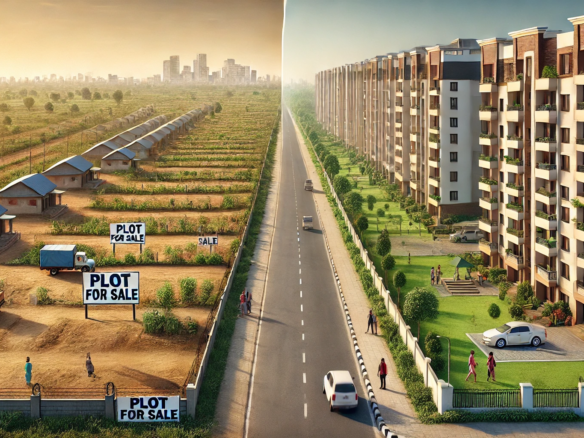
In many parts of Gurgaon, a standard 3BHK apartment now ranges between ₹2–4 Cr, with ongoing maintenance costs adding to the long-term burden. Plots, in comparison, allow phased construction, eliminate recurring maintenance, and retain intrinsic land value without depreciation.
Branded Developers Are Reshaping the Segment
A major credibility shift has come from the entry of organized developers like DLF, M3M, Signature Global, and Godrej Properties. Their involvement has improved planning standards, infrastructure delivery, and overall trust in plotted developments, making them far more investable than they were a decade ago.
For a structured approach to long-term returns, this plot investment strategy long term wealth will help you align entry and holding decisions.

Prices, Ticket Size & Market Reality (2025)
The NCR plotted market is no longer unstructured. Pricing varies sharply based on location maturity and infrastructure readiness:
| Location | Price (₹ / sq yd) | Typical Investment |
|---|---|---|
| Sohna (Sectors 33–36) | ₹65K–₹90K | ₹70L–₹1.2 Cr |
| Dwarka Expressway (99A, 102) | ₹1.2L–₹2L | ₹1.5 Cr–₹3.5 Cr |
| New Gurgaon (95–99) | ₹90K–₹1.4L | ₹1 Cr–₹2.2 Cr |
| Yamuna Expressway | ₹25K–₹45K | ₹40L–₹90L |
At a broader level, three trends define the current market:
- Supply remains controlled due to land aggregation and regulatory constraints
- Absorption is significantly faster in infrastructure-ready sectors
- Developers are launching plotted projects in phases to maintain pricing power
This is not a supply-heavy market; it is selective, and that selectivity is what supports long-term appreciation.
Where Smart Investors Are Buying (Micro-Market Breakdown)
Sohna (Sectors 33–36) — Early Growth, Still Accessible
Sohna continues to offer one of the last meaningful entry points in NCR. Connectivity improvements driven by the Delhi-Mumbai Expressway and surrounding development are gradually changing perception. Investors who overlooked Sohna earlier are now re-entering at higher levels, which typically indicates a transitioning market.
This zone suits buyers in the ₹70L–₹1.2 Cr range, particularly those willing to hold for 5–7 years.
Dwarka Expressway (Sectors 99A, 102) — Active Growth Phase

With the Dwarka Expressway nearing completion, this corridor has shifted from expectation to execution. End-user movement has increased, resale activity is becoming more consistent, and price discovery is actively underway.
If you want to identify upcoming hotspots early, this emerging growth locations in Gurgaon NCR will help you track undervalued sectors.
This is no longer an early-stage market. It has already entered a momentum phase, making it suitable for investors in the ₹1.5–₹3.5 Cr range, including HNIs and NRIs.
New Gurgaon (Sector 95–102) — Stability Over Hype
New Gurgaon offers a balanced profile—reasonable pricing, improving livability, and steady absorption. It may not deliver sharp spikes, but it provides consistency, which many investors underestimate.
Yamuna Expressway — Long-Term, High-Patience Play
The Yamuna Expressway story is driven largely by the upcoming airport and future infrastructure potential. However, timing is critical here. Many investors enter too early and face extended holding periods before meaningful appreciation begins.
This is best suited for long-term investors with a 7–10 year horizon.
Best Plotted Investments by Budget (2025 Guide)

- Under ₹1 Cr: Sohna entry sectors and select Yamuna pockets (higher upside, longer wait)
- ₹1 Cr – ₹2.5 Cr: New Gurgaon and mid-entry Dwarka Expressway options (balanced strategy)
- ₹2 Cr – ₹5 Cr: Prime Dwarka Expressway sectors and branded plotted townships (stronger liquidity and demand)
NRI Perspective
NRIs are increasingly shifting toward plotted investments due to lower maintenance, easier long-term holding, and clearer capital appreciation potential. Most NRI-driven demand is currently concentrated in Dwarka Expressway and developer-led township projects.
ROI Reality: Plots vs Apartments
| Factor | Plots | Apartments |
|---|---|---|
| Appreciation | 12–18% CAGR | 6–10% CAGR |
| Rental Yield | Low | Moderate |
| Depreciation | None (Land-backed) | Yes (Building ages) |
| Flexibility | High (Custom construction) | Limited |
| Liquidity | Improves post infrastructure | Relatively stable |
One important nuance: liquidity in plotted developments typically improves after infrastructure becomes visible. Entering too early can delay exit, while entering at the right stage often improves resale timelines significantly.A Real Example: Why Execution Drives Returns
Sector 99A illustrates how timing and infrastructure intersect:
- ~₹90K/sq yd (2021)
- ~₹1.6L+/sq yd (2024–25)
The trigger was not marketing cycles but execution—road connectivity, developer activity, and increasing livability. This pattern tends to repeat across NCR corridors once infrastructure reaches a certain threshold.
Common Mistakes Investors Still Make
Despite better awareness, several patterns continue to repeat:
- Prioritizing low entry price over location quality
- Investing in areas dependent purely on future announcements
- Ignoring developer credibility and project structure
- Expecting short-term resale in early-stage markets
Cheap land can often become inactive capital if the surrounding ecosystem does not develop as expected.
A Contrarian but Proven Insight
A common belief is that entering early guarantees maximum returns. In NCR plotted markets, that isn’t always true.
In many cases, entering slightly later—when infrastructure visibility improves—delivers better outcomes than early entry into uncertain zones. Both Sohna and Dwarka Expressway followed this trajectory, where delayed execution initially slowed growth, but eventual completion triggered rapid price movement.
Where Should You Focus Right Now (2025)
Current high-focus zones include Sohna for early-stage growth, Dwarka Expressway for ongoing momentum, and New Gurgaon for stability. Investors tracking emerging hubs like Southern Peripheral Road (SPR) and upcoming developments such as Global City Gurgaon should also monitor nearby plotted supply, as these ecosystems tend to influence land value significantly once operational.
Future Outlook (2025–2030)
Over the next decade, plotted developments in NCR are expected to become more structured, with tighter supply due to land constraints and stronger participation from end-users and NRIs. Rather than a sudden boom, the segment is likely to see steady, sustained growth aligned with infrastructure progress.
For a deeper macro perspective, this real estate market outlook Gurgaon 2026 explains how the market is expected to evolve.
Expert Take
Plotted development offers strong potential, but the difference between a good investment and a poor one is substantial. Outcomes depend heavily on location maturity, infrastructure visibility, and developer credibility.
Investors who approach this segment with a clear understanding of cycles and timelines tend to benefit the most.
FAQs
Q: What is the ideal investment size for plots in NCR?
A: Most investments fall between ₹80L and ₹2.5 Cr depending on location and plot size.
Q: Which locations are relatively safer right now?
A: Dwarka Expressway and New Gurgaon offer better visibility due to ongoing infrastructure development.
Q: What is the typical holding period?
A: Around 5–7 years for meaningful appreciation.
Q: Do plots generate rental income?
A: Only after construction; otherwise, returns are appreciation-driven.

Final Thought
Every Gurgaon cycle has followed a familiar pattern—Golf Course Road, SPR, Sohna—each phase rewarded investors who aligned with infrastructure, not speculation.
Plotted development is entering that same phase now. The opportunity exists, but it is becoming increasingly selective. Choosing the right location at the right stage will matter far more than simply entering early.

Join The Discussion