
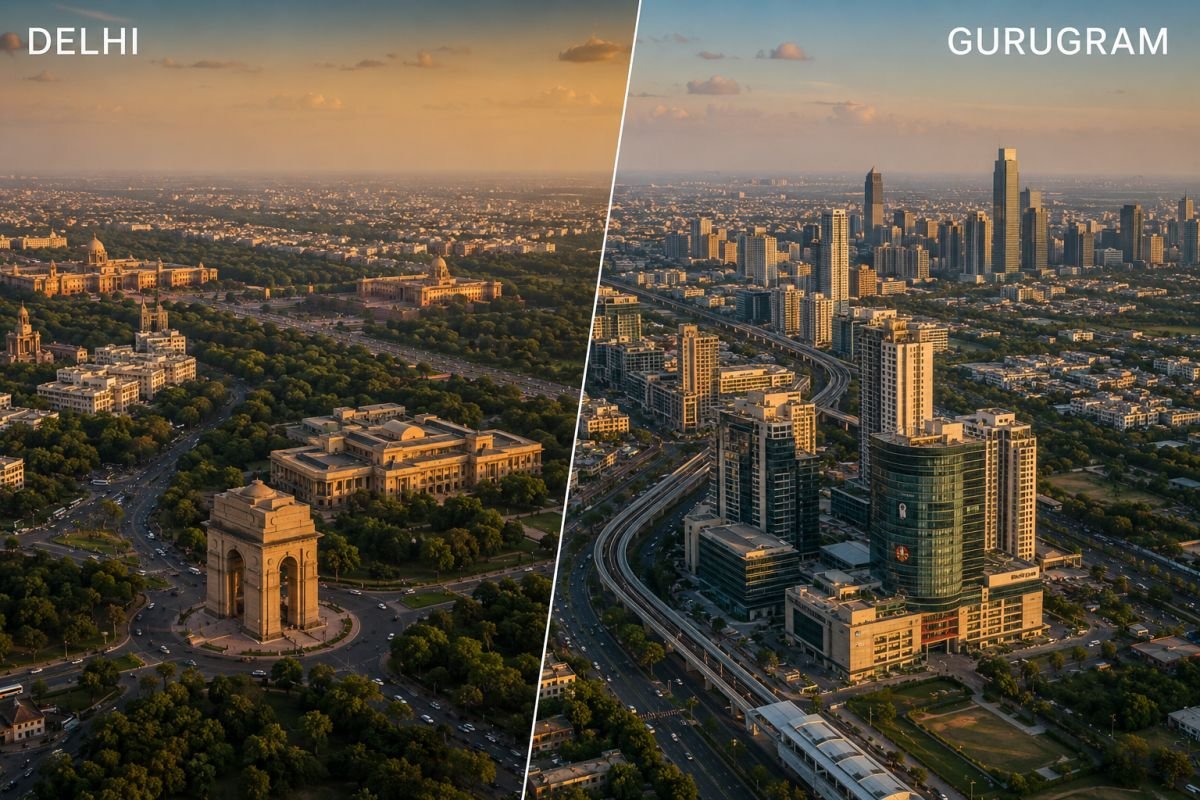
If you’re evaluating delhi vs gurgaon property investment opportunities in 2026, you’re not alone. As property values across the National Capital Region (NCR) continue to evolve, investors are increasingly comparing the stability of Delhi with the rapid expansion of Gurgaon before making their next purchase.
The reality is that there is no universal winner. Delhi and Gurgaon serve different investor profiles, offer different growth drivers, and carry different risks. Delhi remains attractive for buyers seeking established neighbourhoods and limited land supply, while Gurgaon continues to benefit from infrastructure expansion, corporate demand, and large-scale premium developments.
This guide compares both markets across appreciation potential, rental demand, infrastructure, affordability, liquidity, and long-term investment outlook so you can decide which city aligns best with your financial goals.
Delhi vs Gurgaon: Understanding Two Very Different Property Markets
Although Delhi and Gurgaon belong to the same NCR ecosystem, they have developed very differently over the past two decades. Delhi has evolved into a mature metropolitan market where land is scarce, redevelopment opportunities are limited, and residential neighbourhoods have long-established social infrastructure. Buyers here typically value stability, prestige, and long-term wealth preservation.
Gurgaon, by contrast, represents one of India’s fastest-growing real estate markets. The city has transformed into a global business destination, attracting multinational corporations, technology firms, startups, and premium developers. Continuous infrastructure expansion and the creation of new residential corridors have made it one of the most dynamic property markets in the NCR.
For investors, these contrasting characteristics create two very different investment propositions.
| Factor | Delhi | Gurgaon |
|---|---|---|
| Market maturity | Highly mature | Rapidly expanding |
| New project supply | Limited | High |
| Luxury launches | Select locations | Extensive |
| Corporate employment | Strong | Extremely strong |
| Infrastructure growth | Incremental | Significant ongoing expansion |
| Investment style | Capital preservation | Capital growth + rental income |
Why Delhi Still Appeals to Property Investors
Delhi remains a preferred destination for buyers who prioritise stability over rapid growth. Since most established localities have little vacant land available for large-scale development, property values are largely supported by scarcity rather than fresh supply. This creates a relatively resilient market, particularly in premium neighbourhoods.

Locations such as South Delhi, West Delhi, Dwarka, Rohini, Mayur Vihar, and Civil Lines continue to attract both end-users and long-term investors because of their established social infrastructure, quality educational institutions, healthcare facilities, and excellent metro connectivity.
However, investors should also recognise the limitations of Delhi’s market. Entry prices are considerably higher in prime locations, redevelopment can be complex, and opportunities to purchase newly launched premium projects are comparatively limited.
Why Gurgaon Continues to Outperform for Growth
When discussing delhi vs gurgaon property investment, Gurgaon stands apart because it continues to create entirely new investment destinations rather than depending solely on land scarcity. The city’s growth has been driven by expanding corporate employment, large-scale infrastructure projects, and a steady pipeline of residential launches across emerging sectors.
Growth corridors such as Dwarka Expressway, Golf Course Road, Golf Course Extension Road, Southern Peripheral Road (SPR), New Gurgaon, and Sohna Road have attracted domestic buyers, NRIs, and institutional investors alike. These locations offer modern integrated townships where residential towers are complemented by office spaces, retail centres, schools, healthcare facilities, and lifestyle amenities.

This planned urban development allows buyers to invest not only in existing demand but also in the long-term growth potential of these emerging corridors.
Infrastructure Comparison: Delhi vs Gurgaon
Infrastructure remains one of the strongest indicators of future property appreciation.
Delhi benefits from decades of planned urban development. It already has an extensive Metro network, well-established arterial roads, mature civic infrastructure, renowned educational institutions, and leading healthcare facilities. Future improvements are likely to enhance an already developed ecosystem rather than fundamentally change it.
Gurgaon, meanwhile, continues to experience transformational infrastructure growth. Projects such as the Dwarka Expressway, upgrades to NH-48, Rapid Metro connectivity, improvements along Southern Peripheral Road, and proposed Metro expansions [verify: latest approved route] are steadily improving connectivity across the city. In addition, proximity to IGI Airport and future regional connectivity through the upcoming Jewar Airport continue to strengthen the city’s long-term investment appeal.

For investors with a medium- to long-term investment horizon, these infrastructure upgrades remain one of Gurgaon’s biggest competitive advantages.
Property Prices: Delhi vs Gurgaon
Property prices vary significantly depending on locality, developer, project age, and available amenities. While Delhi generally commands higher entry prices in established neighbourhoods, Gurgaon offers a much broader range of investment opportunities across multiple price segments.
The comparison below reflects broad market positioning rather than current transaction values.
| Parameter | Delhi | Gurgaon |
|---|---|---|
| Entry price | High in established areas | Wider range across micro-markets |
| Luxury apartments | Very limited new supply | Large premium inventory |
| Independent floors | Strong demand | Growing demand |
| Villas | Limited availability | Available in select integrated townships |
| Appreciation potential | Moderate in mature areas | Higher in emerging corridors |
Note: Property prices change frequently. Verify current market rates before making any investment decision.
Rental Yield Comparison
Rental income has become an increasingly important consideration for property investors.
Delhi continues to offer stable rental demand, particularly in established residential neighbourhoods that attract long-term family tenants. Vacancy levels are generally lower in mature localities, although rental yields may be relatively modest in several premium areas due to high acquisition costs and an ageing housing stock.
Gurgaon benefits from a completely different demand profile. The city’s thriving corporate ecosystem attracts professionals, expatriates, startup founders, senior executives, and employees of Global Capability Centres (GCCs). As a result, residential projects located close to major business districts often enjoy stronger rental demand and competitive rental yields.
Since rental performance differs considerably across sectors and projects, investors should verify prevailing rental data before making a purchase.
Commercial Development Drives Residential Growth
One of the biggest reasons many analysts favour Gurgaon in the delhi vs gurgaon comparison is the close relationship between commercial expansion and residential demand.
Business hubs such as Cyber City, Golf Course Road, Udyog Vihar, Sohna Road, Sector 74A, and the SPR corridor continue to generate consistent housing demand from professionals seeking shorter commuting times. As office leasing activity expands, nearby residential communities often experience stronger occupancy levels, improving both rental demand and long-term appreciation prospects.
This employment-led growth model has become one of Gurgaon’s defining investment strengths.
Emerging Investment Corridors in Gurgaon
Several Gurgaon corridors deserve particular attention in 2026 because they combine infrastructure improvements, premium residential launches, and expanding commercial activity.
The Dwarka Expressway has emerged as one of the city’s most promising investment destinations, benefiting from improved connectivity between Delhi and Gurgaon while attracting large integrated townships and branded residential developments.

Golf Course Extension Road has matured rapidly into a premium residential corridor supported by excellent schools, healthcare facilities, retail destinations, and corporate offices. It continues to attract affluent end-users and HNI buyers seeking quality urban living.
Similarly, Southern Peripheral Road (SPR) is steadily evolving into another high-growth location due to improved connectivity with Golf Course Road, Sohna Road, and NH-48. Meanwhile, New Gurgaon continues to appeal to investors seeking comparatively lower entry prices while benefiting from improving infrastructure and expanding employment hubs.
Risks Investors Should Consider
Every property investment involves a degree of risk, regardless of the city.
Delhi investors should consider factors such as limited new inventory, redevelopment complexities, higher acquisition costs, and relatively slower appreciation in mature localities. In Gurgaon, investors need to evaluate the performance of individual micro-markets carefully, as supply levels, infrastructure timelines, and developer quality can vary significantly.
Before purchasing any property, always verify:
- HARERA registration on the official Haryana RERA portal.
- Project approvals.
- Construction progress.
- Builder delivery track record.
- Legal title.
- Maintenance structure.
Who Should Invest in Delhi?
Delhi is generally better suited for investors who:
- Prefer established neighbourhoods.
- Prioritise long-term capital preservation.
- Want relatively stable market conditions.
- Plan to purchase primarily for self-use.
Who Should Invest in Gurgaon?
Gurgaon may be the stronger choice for buyers who:
- Seek higher appreciation potential.
- Want modern gated communities.
- Value stronger corporate-driven rental demand.
- Have a long-term investment horizon of seven to fifteen years.
Delhi vs Gurgaon Property Investment: Which Offers Better Returns?
There is no universal answer because investment outcomes depend on individual objectives and the quality of the chosen property.
Delhi continues to offer dependable long-term value for investors seeking stability and limited market volatility. Gurgaon, however, provides stronger growth potential through expanding infrastructure, premium residential developments, and sustained corporate demand. Corridors such as Golf Course Extension Road, Dwarka Expressway, SPR, and New Gurgaon continue attracting institutional capital alongside end-user demand, supporting long-term appreciation.
Ultimately, successful investing depends less on choosing between Delhi and Gurgaon and more on selecting the right location, reputable developer, and suitable purchase timing.
Final Verdict
The delhi vs gurgaon property investment debate is ultimately about matching your investment goals with the strengths of each market.

If capital preservation, mature neighbourhoods, and established infrastructure are your priorities, Delhi remains an excellent choice. However, if you’re looking for infrastructure-led appreciation, stronger rental demand, premium developments, and long-term growth potential, Gurgaon currently offers a more compelling investment story.
Whichever market you choose, focus on location quality, developer credibility, legal due diligence, and future infrastructure rather than short-term market sentiment. If you’re comparing opportunities across Gurgaon’s fastest-growing corridors, explore the relevant sector guides on AssuredGains or speak with our advisory team for a personalised, data-driven investment assessment.
Frequently Asked Questions
Is Delhi or Gurgaon better for property investment in 2026?
It depends on your objectives. Delhi generally suits investors seeking established neighbourhoods and long-term capital preservation, while Gurgaon offers stronger infrastructure-led growth, newer inventory, and potentially higher appreciation in emerging corridors.
How does Delhi vs Gurgaon compare for rental income?
In many corporate-driven micro-markets, Gurgaon often delivers stronger rental demand due to multinational companies, Global Capability Centres (GCCs), and a large professional workforce. Rental performance, however, varies by project and location.
Is Gurgaon the best option for NCR property investment?
Gurgaon is one of the strongest destinations for NCR property investment, particularly in corridors such as Dwarka Expressway, Golf Course Extension Road, SPR, and New Gurgaon. Investors should still evaluate developer quality, infrastructure progress, and legal compliance before purchasing.
Which city has better long-term capital appreciation?
Well-located properties in both cities can appreciate over time. Delhi benefits from limited land supply, whereas Gurgaon benefits from infrastructure expansion and employment growth. The better investment depends on the specific micro-market rather than the city alone.
What should investors verify before buying property in Gurgaon?
Investors should verify HARERA registration on the official Haryana RERA portal, review legal approvals, assess the developer’s delivery history, confirm project timelines, and independently verify current pricing and possession schedules before making an investment decision.



Join The Discussion