
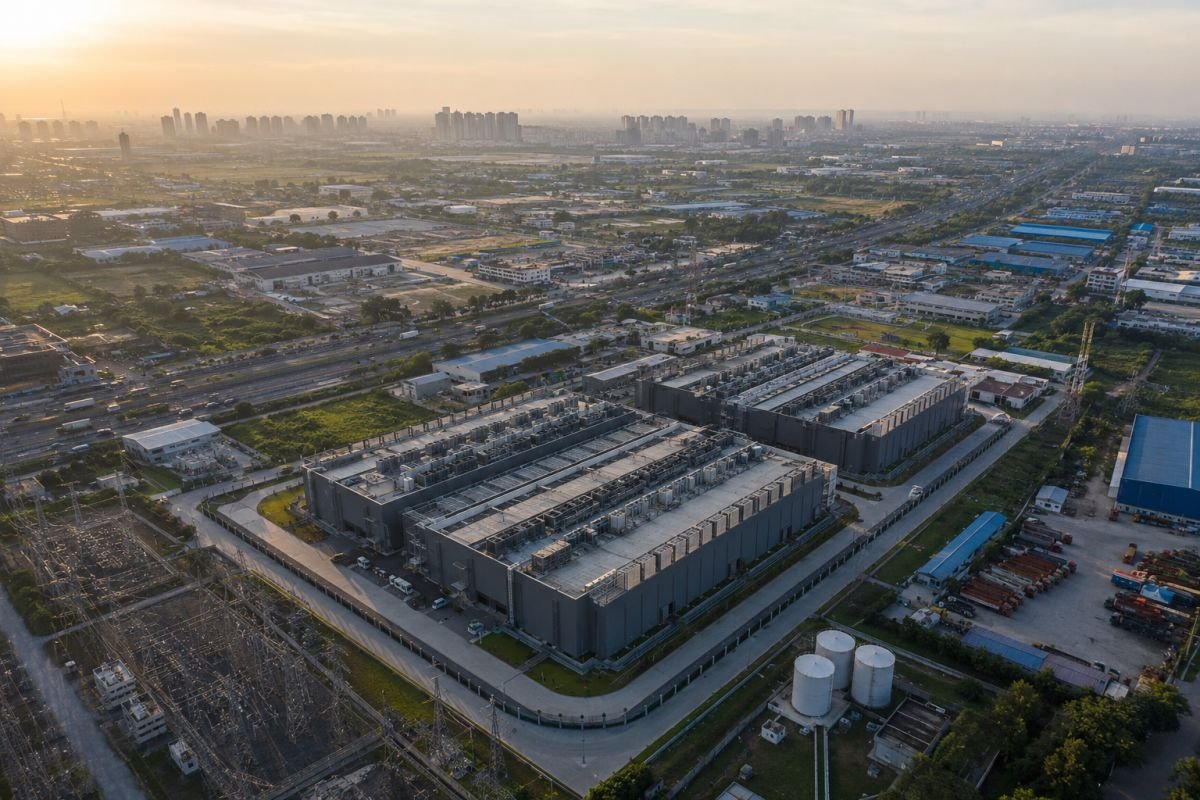
India’s digital economy is no longer a projection—it is the present. With cloud adoption, AI workloads, and 5G rollouts accelerating nationwide demand for hyperscale infrastructure, the country’s data center capacity is expanding at an unprecedented pace. Within this macro trend, the National Capital Region (NCR) has emerged as one of the top three data center clusters in India, alongside Mumbai and Chennai. And within NCR, the Gurgaon investment corridors are witnessing a quiet but decisive shift: the rise of data center real estate Gurgaon as a distinct asset class, with the Manesar belt positioned at its epicentre.
For commercial real estate investors accustomed to tracking office vacancies and retail footfalls, data centers represent a different paradigm—one driven by power availability, fiber latency, land parcels, and policy clarity rather than traditional demand-supply metrics. This guide breaks down what is happening around the Gurgaon-Manesar node, why it matters, and how it intersects with broader commercial property trends in the region.
Why India’s Data Center Sector is Accelerating
India’s data center market is projected to grow from approximately 950 MW of operational capacity in 2023 to over 1,700 MW by 2026 [verify: latest MW capacity figure from Ministry of Electronics and IT or industry report]. Three structural forces are driving this:

- Digital public infrastructure: The expansion of UPI, ONDC, and government cloud mandates is creating baseline demand that is both sticky and regulated.
- Hyperscaler entry: Global cloud providers and domestic conglomerates are racing to establish India-centric regions, each requiring tens of megawatts of IT load.
- Data localisation norms: Regulatory requirements around data storage within national borders have turned India from an outsourcing destination into a primary market for infrastructure deployment.
For investors exploring data center investment India opportunities, the critical insight is that this is not a speculative tech play. Data centers generate long-term, contracted rental streams—often with 10- to 15-year leases—backed by investment-grade tenants. The real estate component, however, is highly specialised. It requires large contiguous land parcels (typically 5–20 acres for a hyperscale facility), robust power substations, dual fiber routes, and proximity to both enterprise demand centres and interconnection hubs.
The Gurgaon-Manesar Corridor: Strategic Geography for Data Center Real Estate
The Gurgaon-Manesar belt offers a convergence of factors that data center operators find difficult to replicate elsewhere in NCR. While Noida and Greater Noida have attracted significant capacity, the western corridor—anchored by NH-48, the Dwarka Expressway, and the Southern Peripheral Road (SPR) corridor—provides distinct logistical and connectivity advantages.

Proximity to IGI Airport and NH-48
Indira Gandhi International Airport is less than 30 kilometres from the Manesar industrial hub, a distance that matters for two reasons. First, international hyperscalers and their equipment vendors prioritise locations with efficient air freight access for server hardware imports. Second, the airport zone functions as a de facto interconnection point for subsea and terrestrial fiber cables entering Delhi-NCR. The Manesar data center cluster can therefore tap into low-latency routes without bearing the premium land costs of central Delhi or Aerocity.
NH-48, which runs directly through the corridor, ensures last-mile connectivity for both personnel and heavy equipment. For facilities requiring diesel generator backups and frequent hardware refreshes, highway access is not a convenience—it is an operational necessity.
Power and Fiber Connectivity
Haryana’s industrial power grid is comparatively robust in the Manesar-Bawal belt, with dedicated 132 kV and 220 kV substations serving the existing industrial base [verify: exact substation capacity and availability]. Data centers are power-intensive; a 20 MW facility can consume as much electricity as a small town. The availability of high-tension industrial power—rather than repurposed residential supply—reduces both capex and operational risk for operators.

Fiber connectivity is equally critical. The corridor sits on the Delhi-Jaipur-Ahmedabad-Mumbai fiber route, one of India’s densest terrestrial backbones. Multiple telecom infrastructure providers have established presence along NH-48, enabling the redundant fiber paths that Tier III and Tier IV data centers require.
Key Data Center Investment India Drivers Around Manesar
Several project announcements and policy developments have validated the Gurgaon-Manesar corridor as a data center destination:
- State incentives: Haryana’s IT and electronics policy offers stamp duty exemptions, electricity duty waivers, and subsidised land for data center projects [verify: exact policy provisions and applicability]. While implementation timelines vary, the policy signal has encouraged both domestic operators and joint ventures with global players to scout land in the region.
- Land banking by industrial developers: Prominent real estate developers with land holdings in New Gurgaon and Manesar have begun carving out parcels specifically for data center operators. These are typically located in sectors with industrial zoning rather than residential master plans, avoiding the land-use conflicts that have delayed projects in other NCR pockets.
- Enterprise demand proximity: Gurugram’s status as India’s de facto corporate headquarters hub—hosting Fortune 500 back offices, fintech operations, and consulting firms—creates natural demand for edge and colocation facilities. A data center in Manesar can serve Gurugram enterprises with sub-10 millisecond latency while avoiding the city’s congestion and land scarcity.
Manesar Data Center Landscape: Current Supply and Pipeline
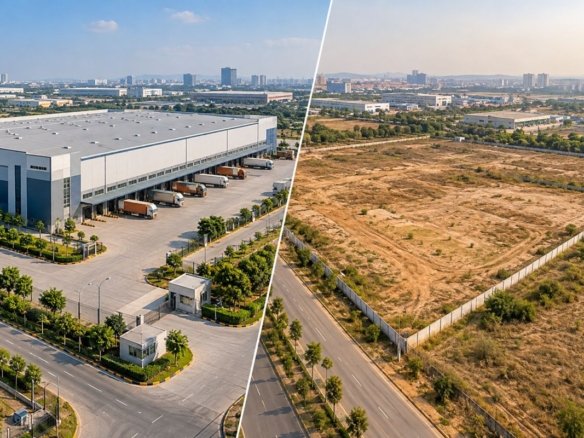
As of 2024–2025, the Manesar data center market is in a pre-buildout phase rather than a mature operational phase [verify: exact operational MW capacity in Manesar]. Several operators have announced intentions or acquired land, but deliverable inventory remains limited compared to Noida’s Greater Noida Expressway cluster. This creates a first-mover dynamic for land investors and development partners.
The table below compares key attributes of the Manesar data center corridor against other NCR alternatives:
| Attribute | Manesar-Gurgaon Corridor | Noida-Greater Noida | Delhi-Aerocity |
|---|---|---|---|
| Land availability | Large contiguous industrial parcels available | Moderate; competing residential demand | Extremely scarce |
| Power infrastructure | Industrial-grade 132/220 kV grid access | Good; dedicated power corridors planned | Constrained; urban load |
| Fiber latency to Delhi | <5 ms | <3 ms | <1 ms |
| Land cost per acre | ₹15–25 crore (market average) | ₹12–20 crore (market average) | ₹100+ crore (commercial premium) |
| Zoning clarity | Industrial; fewer conflicts | Mixed; occasional disputes | Commercial; premium |
| Proximity to airport | ~25–30 km to IGI | ~35–40 km to IGI | Adjacent |
For investors, the table reveals Manesar’s value proposition: it trades marginal fiber latency for land scalability and cost efficiency. For non-mission-critical workloads, disaster recovery sites, and batch processing facilities, this trade-off is commercially optimal.
How Data Center Growth Impacts Surrounding Commercial Real Estate
The emergence of data center real estate Gurgaon does not occur in isolation. It creates ripple effects across adjacent commercial property segments that conventional investors can access more directly.
Office and Warehousing Spillover
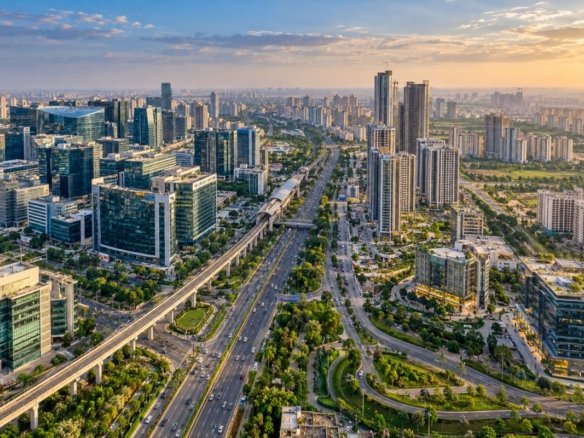
Data center campuses require supporting office space for network operations centres (NOCs), security, and engineering teams. While these are typically built within the campus, the broader ecosystem—vendor offices, contractor facilities, and temporary project management spaces—generates demand for flex office and small-format commercial space in nearby sectors. The Golf Course Extension Road and Sohna Road micro-markets, already established as office destinations, are likely beneficiaries of this ancillary demand.

More significantly, data center construction and ongoing hardware refresh cycles drive demand for specialised warehousing—particularly for server storage, spare parts, and cooling equipment. The Manesar-Bilaspur belt, with its existing logistics park infrastructure, is well-positioned to capture this.
Land and Plot Values
For investors in commercial real estate investment in Gurgaon who prefer land or plotted development, the data center narrative adds a structural demand driver to the Manesar periphery. Industrial plots near announced or operational data center sites have seen renewed institutional interest [verify: specific price appreciation data for industrial plots near Manesar data center zones]. Unlike residential land, which is sensitive to metro alignments and school catchments, industrial land value here is increasingly tied to power adequacy, highway access, and fiber density.
Risk Assessment for Data Center Real Estate Investors
Despite the bullish macro narrative, data center investment India is not without risks specific to the Gurgaon-Manesar corridor:
- Power consistency: While industrial grid access exists, Haryana has experienced seasonal power shortages during peak summer months. Data centers require uninterrupted supply backed by multi-megawatt diesel or gas generator sets. Any delay in power infrastructure augmentation can push back project timelines.
- Regulatory fragmentation: Data centers fall under multiple regulatory umbrellas—state IT policies, electricity boards, environmental clearances, and telecom licensing. Investors should verify that any specific parcel has clearances for non-polluting industrial use and that height restrictions do not impede cooling tower placement. For RERA-related queries on mixed-use developments, verification on the official Haryana RERA (HARERA) portal is essential.
- Fiber redundancy: Not all sectors in the Manesar belt have dual fiber entry paths. A single-route dependency creates operational risk for Tier III+ facilities and can affect lease valuations.
- Liquidity constraints: Unlike Grade A office space, data center real estate has a narrower resale and lease market. Exit options are typically limited to strategic sales to operators or infrastructure funds rather than fragmented secondary market transactions.
Future Outlook: What Investors Should Watch
Over the next 36 months, the Manesar data center corridor will likely transition from land acquisition and announcement phases to active construction. Investors should monitor three indicators:

- Power allocation announcements: Specific MW allocations by DHBVN (Dakshin Haryana Bijli Vitran Nigam) to data center projects will signal execution certainty [verify: exact DHBVN allocation announcements].
- Hyperscaler commitments: Public announcements by global cloud providers of India regions hosted in the Gurgaon-Manesar belt would validate the corridor at the highest tenant grade.
- Jewar Airport connectivity: The upcoming Noida International Airport at Jewar, approximately 60–70 km from Manesar, will create a dual-airport logistics advantage for the broader NCR west. Improved expressway connectivity between Jewar and Gurgaon could further enhance the corridor’s appeal for disaster recovery and backup facilities.
For those already holding commercial assets or industrial land in the corridor, the data center wave offers a demand overlay that was not priced into acquisitions made five years ago. For new entrants, the window for land accumulation at pre-infrastructure valuations may be narrowing.
Conclusion
Data center real estate Gurgaon is moving from niche infrastructure talk to a tangible investment narrative anchored in the Manesar belt. The convergence of power, fiber, highway connectivity, and enterprise demand proximity gives this corridor a defensible position within India’s data centre growth story. It is not a market for speculative retail investors—capital requirements, technical complexity, and liquidity constraints demand institutional-grade due diligence. But for commercial real estate participants with the patience to hold through the construction cycle, the asset class offers contracted yields, long-duration tenancies, and structural tailwinds that traditional office or retail formats struggle to match.
If you are evaluating land parcels, industrial assets, or development partnerships in the Gurgaon-Manesar corridor, the advisory team at AssuredGains can provide location-specific feasibility analysis, connectivity verification, and transaction support. Explore our corridor guides or schedule a consultation to map your investment strategy against the actual supply pipeline—before the infrastructure premium is fully priced in.
Frequently Asked Questions
Q1: What is driving data center investment India around the Gurgaon-Manesar corridor?
Data center investment India is accelerating due to digital public infrastructure expansion, hyperscaler entry, and data localisation regulations. The Gurgaon-Manesar corridor specifically benefits from industrial-grade power, NH-48 connectivity, proximity to IGI Airport, and dense fiber networks—factors that lower both construction and operational costs for operators.
Q2: Is Manesar data center real estate suitable for individual retail investors?
Manesar data center real estate is generally not suitable for retail investors due to high capital requirements, technical complexity, and limited liquidity. The asset class is better suited to institutional investors, developers, or HNIs with long holding periods and access to specialised due diligence on power, zoning, and tenant contracts.
Q3: How does data center growth affect commercial property values near Golf Course Extension Road and SPR?
Data center campuses create ancillary demand for office space, logistics warehousing, and vendor facilities. This spillover demand can support rental yields and capital values in nearby commercial micro-markets such as Golf Course Extension Road and the Southern Peripheral Road corridor, though the effect is gradual and tied to actual operational deployment rather than announcements alone.
Q4: What risks should investors verify before acquiring land for data center development near Manesar?
Key risks include power consistency and allocation certainty, dual fiber path availability, environmental and height clearances, and industrial zoning conflicts. All RERA-related claims should be verified on the official Haryana RERA (HARERA) portal. Investors should also confirm that land parcels are free from litigation and suitable for non-polluting heavy infrastructure use.
Q5: How does the upcoming Jewar Airport impact the Manesar data center corridor outlook?
The Noida International Airport at Jewar will create a dual-airport advantage for NCR west. If expressway connectivity between Jewar and Gurgaon improves, the Manesar data center corridor could become more attractive for backup and disaster recovery facilities that require geographic separation from primary Delhi-Noida nodes, potentially expanding tenant demand beyond the current local enterprise base.

Join The Discussion