
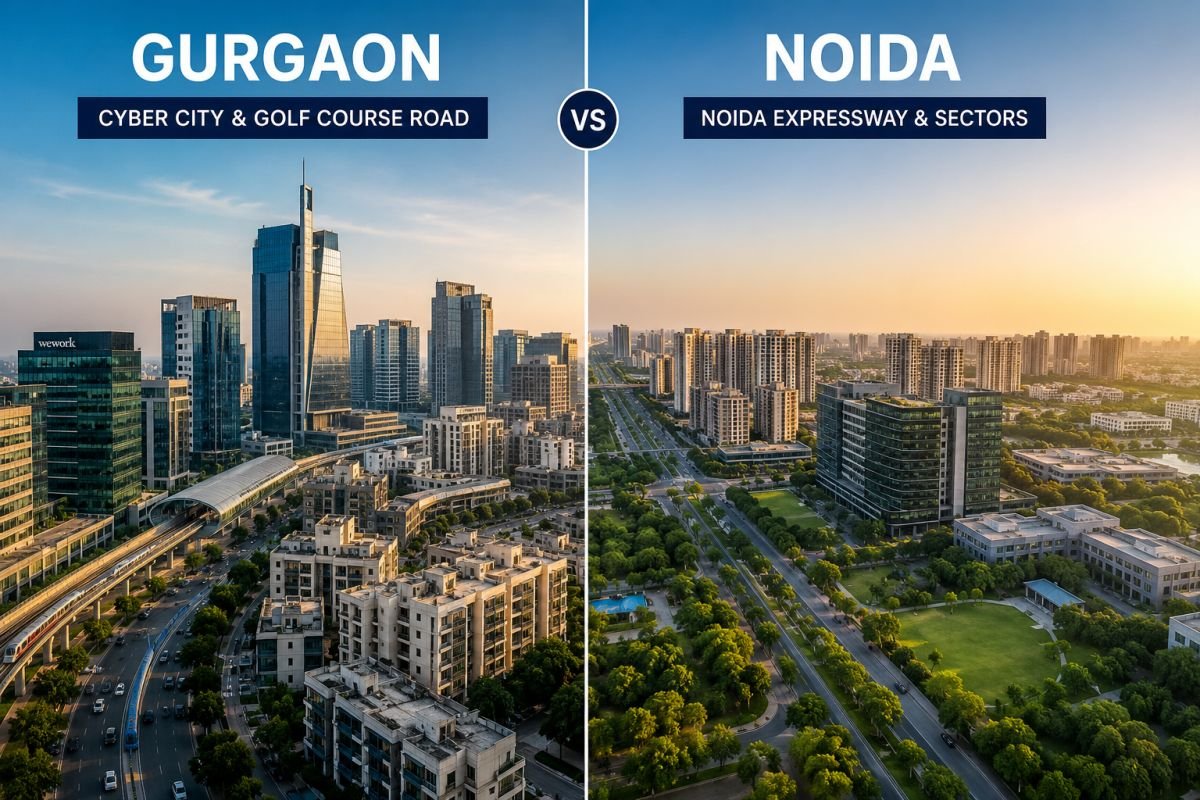
If you’re evaluating noida vs gurgaon investment opportunities in 2026, you’re asking one of the most important questions in the NCR property market today. Both cities have evolved into economic powerhouses, but they are driven by different growth engines. Gurgaon has built its reputation as India’s leading corporate and luxury real estate destination, while Noida has steadily emerged as an infrastructure-led growth market supported by planned urban development and large-scale public investment.
The choice between these two cities is no longer simply about buying where prices are lower. Investors today are comparing rental demand, future infrastructure, employment generation, supply dynamics, and long-term appreciation before making decisions. Depending on your investment horizon and financial goals, either market can outperform the other.
This NCR real estate comparison examines how Gurgaon and Noida differ across key investment parameters such as pricing, connectivity, infrastructure, rental potential, and future growth. Rather than promoting one market over another, the goal is to help investors understand which city aligns better with their objectives in 2026.
Why the Noida vs Gurgaon Investment Debate Matters in 2026
The National Capital Region has become India’s largest integrated real estate market. While Delhi continues to function as the administrative centre, investment activity has increasingly shifted towards Gurgaon and Noida because of better land availability, expanding infrastructure, and stronger commercial development. Over the past decade, both cities have attracted significant public and private investment, creating two distinctly different but equally important property markets.

Several infrastructure initiatives continue to shape investment sentiment across NCR, including:
- Dwarka Expressway connectivity improvements
- Delhi-Mumbai Expressway integration
- Metro network expansion
- Growth of Grade A office developments
- Noida International Airport (Jewar)
- Regional road connectivity across Delhi, Haryana and Uttar Pradesh
Although these developments benefit the broader NCR, Gurgaon and Noida respond differently to these growth drivers.
Gurgaon has established itself as a mature employment-led market where multinational corporations, Global Capability Centres (GCCs), financial institutions, consulting firms, and technology companies generate sustained residential demand. This corporate ecosystem has created a relatively stable market supported by both end-users and investors.
Noida, in contrast, has been shaped by planned urban expansion and infrastructure investment. Large residential sectors, industrial development, electronics manufacturing, logistics hubs, and the upcoming Jewar Airport have strengthened its long-term growth story. Investors who compare noida vs gurgaon should therefore focus less on current pricing alone and more on the quality of future demand that each city is likely to generate.
NCR Real Estate Comparison: Gurgaon vs Noida at a Glance
| Factor | Gurgaon | Noida |
|---|---|---|
| Primary Growth Driver | Corporate employment | Infrastructure & manufacturing |
| Residential Segment | Premium & luxury | Mid-income to premium |
| Office Market | Mature Grade A hub | Growing rapidly |
| Rental Demand | Very strong | Moderate to strong |
| Entry Price | Higher | Lower |
| Luxury Housing | Highly developed | Growing |
| Commercial Activity | Established | Expanding |
| Future Growth Catalyst | Dwarka Expressway, SPR, New Gurgaon | Jewar Airport, Yamuna Expressway |
| Investor Profile | Rental & appreciation focused | Long-term appreciation focused |
The table provides a useful overview, but investment decisions require a deeper understanding of each market. Pricing alone rarely determines returns. Factors such as employment generation, infrastructure execution, rental demand, future housing supply, and project quality ultimately influence long-term performance.
Gurgaon Real Estate in 2026: A Mature Investment Market
Over the past two decades, Gurgaon has transformed from a suburban extension of Delhi into one of India’s most significant commercial and residential destinations. Today it hosts thousands of multinational companies, Fortune 500 businesses, technology firms, financial institutions, consulting organisations, and rapidly expanding Global Capability Centres. This concentration of employment has created one of the country’s strongest residential demand ecosystems.

Unlike emerging markets that often depend on speculative buying, Gurgaon has gradually shifted towards genuine end-user demand. This change has helped improve market stability and supported healthier long-term price appreciation.
Why Gurgaon Continues to Attract Investors
One of Gurgaon’s biggest strengths is its ability to generate consistent housing demand through employment. Unlike cities that rely heavily on speculative investment, Gurgaon benefits from a continuous inflow of professionals working across technology, finance, consulting, healthcare, banking, start-ups, and multinational corporations. Every expansion of commercial office space creates additional demand for both home ownership and rental accommodation, making the residential market more resilient.
Rental performance is another important reason investors continue to favour Gurgaon. Areas located close to major employment hubs generally experience relatively lower vacancy rates because professionals prefer shorter commuting distances. Premium residential communities also benefit from demand generated by senior executives, expatriates, and corporate lease agreements.
Another defining characteristic of Gurgaon is the continued launch of premium and luxury residential developments. Leading national developers have introduced projects offering larger residences, wellness-focused amenities, integrated retail spaces, branded residences, advanced security systems, and smart home technology. These projects appeal not only to affluent end-users but also to long-term investors seeking capital preservation alongside appreciation. Investors evaluating luxury opportunities may also consider Golf Course Extension Road, where premium residential communities continue to reshape the city’s high-end housing market.
Areas Driving Gurgaon’s Next Growth Cycle
Although Gurgaon has matured considerably, several corridors continue to offer attractive opportunities for long-term investors. Rather than focusing only on established luxury neighbourhoods, many buyers are now evaluating emerging growth corridors that combine improving infrastructure with future commercial expansion.
Dwarka Expressway
Dwarka Expressway has evolved from being viewed as a speculative corridor into one of Gurgaon’s most actively developing residential markets. As infrastructure has become operational, the corridor has witnessed increasing residential occupancy, commercial activity, and improved connectivity to Delhi and IGI Airport. Premium housing launches, mixed-use developments, and expanding social infrastructure have strengthened its investment appeal.
Southern Peripheral Road (SPR) has rapidly emerged as another major growth corridor. Connecting Golf Course Extension Road with NH-48, SPR is attracting both residential and commercial investment due to improving road infrastructure and increasing office development. Several integrated townships and premium residential communities are expected to benefit from this connectivity, although investors should continue to monitor infrastructure execution and project delivery timelines.
New Gurgaon
New Gurgaon continues to appeal to buyers looking for relatively better value compared with central Gurgaon. The corridor has seen expanding residential communities, improving social infrastructure, wider roads, and growing commercial activity. Proposed metro connectivity could further enhance accessibility in the coming years. While appreciation may vary across sectors, New Gurgaon remains relevant for investors seeking long-term growth without entering the city’s highest-priced micro-markets.
Noida Real Estate in 2026: Infrastructure-Led Growth Story
If Gurgaon’s growth has largely been driven by corporate employment and premium residential demand, Noida’s evolution tells a different story. The city has benefited from planned urban development, large-scale infrastructure investment, industrial expansion, and government-backed economic initiatives that continue to attract both businesses and residents.
Over the past decade, Noida has expanded well beyond its established residential sectors. The Noida-Greater Noida Expressway and Yamuna Expressway corridors have emerged as important investment destinations supported by electronics manufacturing, logistics parks, industrial development, and the upcoming Noida International Airport at Jewar. These developments have strengthened investor confidence, particularly among buyers with medium- to long-term investment horizons.

Compared with Gurgaon, Noida generally offers lower entry prices across several residential categories. This affordability allows first-time investors and portfolio diversifiers to access the NCR property market with comparatively lower capital requirements. However, investment decisions should not be based solely on purchase price. Sustainable appreciation depends on the successful execution of infrastructure projects, employment generation, commercial activity, and genuine end-user demand rather than speculative buying.
What Is Driving Noida’s Growth in 2026?
Noida’s investment story is fundamentally different from Gurgaon’s. While Gurgaon derives much of its strength from an established corporate ecosystem, Noida’s growth is closely linked to infrastructure development, industrial expansion, and long-term urban planning. This difference makes the city particularly attractive to investors who are comfortable holding property for a longer period in anticipation of future appreciation.
One of the biggest catalysts is the upcoming Noida International Airport at Jewar. Once fully operational, the airport is expected to strengthen the region’s connectivity while encouraging commercial development, logistics, hospitality, warehousing, and residential demand across the Yamuna Expressway belt. However, investors should remember that airport-led appreciation usually unfolds over several years rather than immediately after project announcements. The pace of returns will ultimately depend on employment generation and supporting infrastructure.
Another important growth driver is Noida’s expanding industrial ecosystem. The city has attracted significant investment in electronics manufacturing, semiconductor-related industries, data centres, and industrial parks through various state and central government initiatives. Unlike markets dependent on a single employment sector, this diversified economic base has the potential to create sustained housing demand over the long term.
Planned urban development also distinguishes Noida from many other NCR markets. Wider roads, organised sector planning, dedicated institutional areas, and integrated infrastructure have contributed to better urban planning across many parts of the city. While execution standards naturally differ between localities, this structured development approach continues to attract both end-users and investors.
Finally, affordability remains one of Noida’s biggest advantages. Compared with several premium Gurgaon locations, investors can often enter the market at a significantly lower capital outlay. This makes Noida particularly appealing to first-time investors, young professionals, and buyers seeking to diversify their portfolios without allocating premium-level budgets.
Noida vs Gurgaon Investment: Capital Appreciation Potential
Capital appreciation remains one of the most important considerations for property investors, but it is influenced by far more than current pricing. Infrastructure completion, employment generation, future housing supply, developer quality, and end-user demand collectively determine long-term returns.
Gurgaon has already experienced substantial appreciation across mature micro-markets such as Golf Course Road and Golf Course Extension Road. As these locations become increasingly established, future appreciation is expected to be more selective rather than broad-based. Emerging corridors such as Dwarka Expressway, Southern Peripheral Road (SPR), and New Gurgaon are likely to remain key growth areas because of improving infrastructure, limited premium land availability, and continuing commercial expansion. Investors purchasing quality projects in these locations may benefit from both capital appreciation and sustained rental demand over the coming years.
Noida presents a different appreciation story. Growth is closely linked to the successful implementation of infrastructure projects and industrial expansion. Areas surrounding the Noida-Greater Noida Expressway, Yamuna Expressway, and Jewar Airport are widely viewed as long-term growth corridors. As commercial activity, employment hubs, and supporting civic infrastructure continue to develop, these locations may experience meaningful appreciation. Nevertheless, investors should also assess future housing supply carefully, as excessive inventory in some micro-markets can moderate price growth despite positive infrastructure developments.
Rental Yield Analysis: Which City Performs Better?
Rental income is often the deciding factor for investors looking to generate regular cash flow alongside capital appreciation. In this respect, Gurgaon generally enjoys an advantage because of its mature corporate ecosystem and concentration of multinational employers.
| Parameter | Gurgaon | Noida |
|---|---|---|
| Corporate Rental Demand | High | Moderate to High |
| Luxury Rental Market | Strong | Developing |
| Tenant Profile | MNC professionals, expatriates, senior executives | IT professionals, manufacturing employees, families |
| Vacancy Risk | Lower in established corridors | Varies by location |
| Rental Yield Outlook | Generally stronger in premium employment hubs [verify: current yields] | Competitive in select sectors [verify: current yields] |
Professionals working in Cyber City, Golf Course Road, Udyog Vihar, and surrounding business districts continue to generate healthy rental demand for residential properties in Gurgaon. This relatively stable tenant base often results in lower vacancy periods and stronger rental growth over time. Investors seeking dependable rental income frequently prioritise locations close to major employment centres rather than simply choosing lower-priced assets.

Noida’s rental market is steadily improving, particularly in sectors located near IT parks, institutional hubs, and industrial clusters. Although rental demand may not yet match Gurgaon’s mature corporate ecosystem across all micro-markets, certain locations have shown encouraging growth as employment opportunities continue to expand.
For investors focused primarily on rental returns, the following summary may help:
Choose Gurgaon if:
- Rental income is your primary objective.
- You prefer lower vacancy risk.
- You are investing in premium or luxury residential projects.
Choose Noida if:
- You have a longer investment horizon.
- You are willing to wait for infrastructure-led demand to mature.
- Your priority is long-term capital appreciation rather than immediate rental income.
Investment Risks to Consider
Every property market carries its own opportunities and risks, and understanding these risks is essential before committing capital.
Gurgaon’s biggest challenge is affordability. Property prices in established luxury corridors have increased substantially over the years, resulting in higher acquisition costs for investors. In mature micro-markets, appreciation may also moderate compared with emerging locations because pricing has already captured much of the earlier growth. In addition, increasing competition among premium residential projects means buyers should carefully compare developer reputation, project specifications, and long-term maintenance quality before investing.
Noida faces a different set of challenges. Much of its investment narrative depends on timely infrastructure execution, industrial expansion, and sustained employment generation. Delays in major infrastructure projects or slower-than-expected commercial development could affect appreciation timelines. Investors should also examine future housing supply within individual sectors, as excessive inventory may reduce pricing power even in otherwise promising locations.
Which Type of Investor Should Choose Gurgaon?
Gurgaon is generally better suited to investors seeking stability, premium residential assets, and stronger rental performance. Buyers looking for established infrastructure, high-quality social amenities, and consistent corporate demand often find the city more aligned with their long-term objectives.
Investors evaluating opportunities across Gurgaon should also explore best sectors in Gurgaon to understand how different corridors cater to varying budgets, rental expectations, and appreciation potential. Rather than treating Gurgaon as a single market, analysing each micro-market individually often leads to better investment decisions.
Which Type of Investor Should Choose Noida?
Noida is often better suited to buyers entering the NCR property market for the first time or investors who prefer lower entry prices with the expectation of long-term appreciation. The city’s infrastructure-led development model offers attractive opportunities for those who are comfortable holding investments through multiple market cycles.
Patience remains particularly important in infrastructure-driven markets. While large public projects such as airports and expressways can significantly improve long-term prospects, meaningful appreciation generally occurs only after supporting commercial activity and end-user demand develop around them.
Gurgaon vs Noida: Key Decision Factors
| Investment Goal | Better Choice |
|---|---|
| Higher rental demand | Gurgaon |
| Luxury residential investment | Gurgaon |
| Lower entry price | Noida |
| Long-term infrastructure story | Noida |
| Established commercial ecosystem | Gurgaon |
| Premium office-driven demand | Gurgaon |
| Airport-led appreciation potential | Noida |
| Portfolio diversification | Depends on investment horizon |
This comparison demonstrates that the better investment depends entirely on individual objectives. Investors seeking immediate rental performance may find Gurgaon more attractive, whereas those focused on future infrastructure-led growth may see greater value in selected Noida micro-markets.
Verdict: Which NCR Market Offers Better Returns in 2026?
The noida vs gurgaon investment debate does not produce a universal winner because both markets occupy different positions within the NCR real estate ecosystem.
Gurgaon continues to lead in terms of corporate employment, premium residential developments, rental demand, and established infrastructure. Investors looking for relatively predictable rental income, mature commercial activity, and long-term wealth preservation are likely to find Gurgaon better aligned with their objectives.

Noida, on the other hand, presents an attractive opportunity for investors willing to adopt a longer investment horizon. Planned infrastructure, industrial expansion, and the development of Jewar Airport provide a compelling growth narrative, particularly for buyers entering the market at comparatively lower price points.
Explore Your Next Investment with AssuredGains
Choosing between Gurgaon and Noida requires more than comparing property prices. Successful real estate investing depends on understanding demand drivers, infrastructure execution, developer credibility, rental performance, and long-term market cycles.
If you’re exploring opportunities in Gurgaon, start with our Gurgaon investment location guide to understand the city’s leading growth corridors, or speak with the AssuredGains advisory team for data-driven, unbiased guidance tailored to your investment goals.
Frequently Asked Questions
1. Noida vs Gurgaon: Which city offers better property investment opportunities in 2026?
Both cities offer attractive opportunities, but the right choice depends on your investment objective. Gurgaon generally performs better for rental income and premium residential investments, while Noida is better suited for investors seeking lower entry prices and infrastructure-led appreciation over the long term.
2. Is Gurgaon still a good investment despite higher property prices?
Yes. Gurgaon continues to attract strong end-user and rental demand because of its established corporate ecosystem, premium housing market, and expanding infrastructure. However, returns vary across micro-markets, so investors should evaluate individual projects rather than relying solely on city-wide trends.
3. Which city offers better rental yields in this NCR real estate comparison?
Historically, Gurgaon has demonstrated stronger rental demand due to its concentration of multinational companies and business districts. Rental yields, however, differ by location and property type, so investors should always [verify: latest market data] before making a purchase.
4. Will Jewar Airport make Noida a better investment than Gurgaon?
Jewar Airport is expected to be a significant long-term growth catalyst for Noida, but appreciation will also depend on supporting infrastructure, commercial development, and employment generation. Airport-related investments should therefore be evaluated with a long-term perspective.
5. Should first-time investors choose Noida or Gurgaon?
First-time investors should consider their budget, investment horizon, and financial goals. Buyers seeking relatively lower entry prices may prefer Noida, while those prioritising rental income and an established property market may find Gurgaon more suitable. Consulting a trusted advisor before investing can help identify the most appropriate location and project.



Join The Discussion