
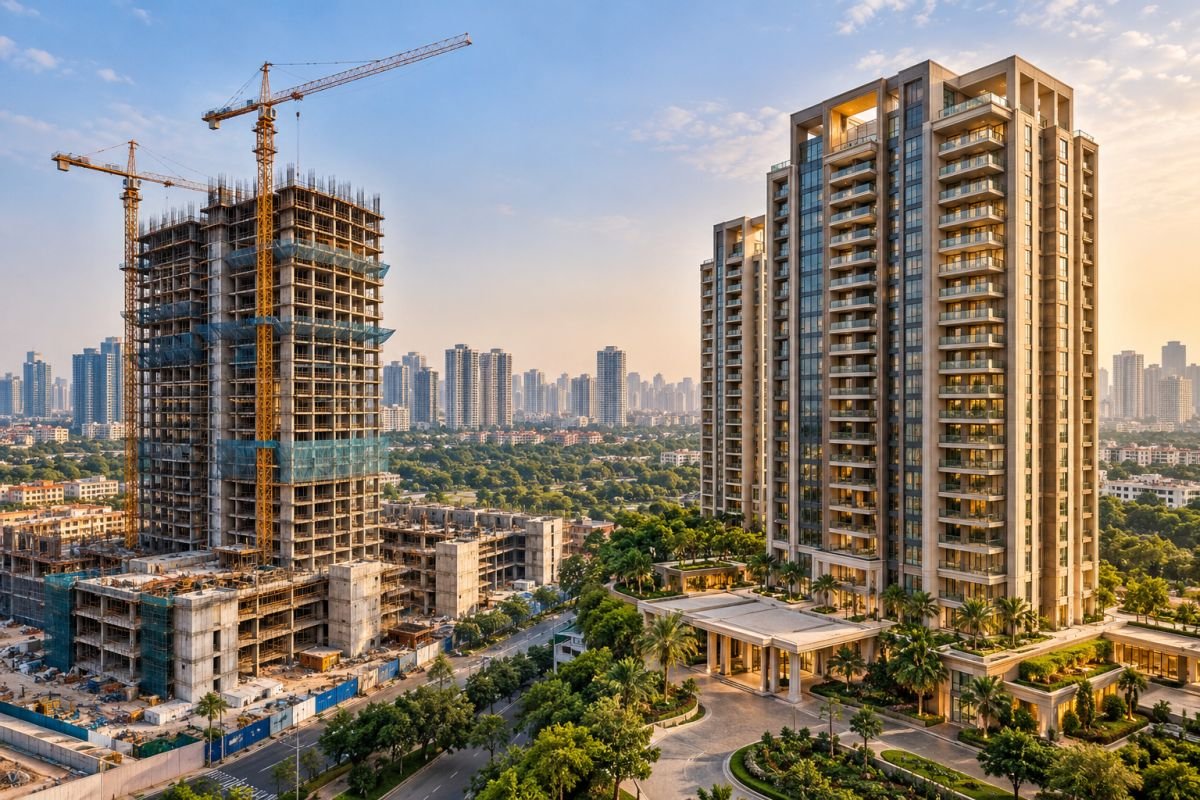
Buying a home in Gurgaon involves more than comparing the quoted apartment price. The biggest tax distinction is straightforward: an eligible under-construction apartment generally attracts GST, while a completed property sold after the relevant completion certificate or first occupation generally does not attract GST on the building sale. TDS under Section 194-IA can apply to both when the threshold is met. That makes under construction vs ready to move tax Gurgaon an important calculation before comparing two otherwise similar apartments. This guide separates GST, TDS, stamp duty and registration costs so buyers can understand the actual cash outflow rather than relying only on the headline property price. The article follows the decision-focused brief for AssuredGains.com.
Data currency disclaimer: Tax rates and rules discussed here reflect the applicable framework checked for 2026. Property prices, where used as illustrations, are indicative asking/listing figures rather than guaranteed transaction values or returns. They are not attributed to any single third-party listing platform.
Key Takeaways
- Under-construction residential apartments: the standard effective GST rate is generally 5% for non-affordable residential apartments and 1% for qualifying affordable residential apartments, subject to the applicable conditions.
- Ready-to-move property: when the entire consideration is received after the required completion certificate or first occupation, whichever is earlier, the sale of the building is generally outside GST.
- TDS: Section 194-IA generally requires 1% TDS where the consideration and/or stamp-duty-value threshold is met, with the current rule applying where both are not below ₹50 lakh.
- Gurgaon example: on a ₹2 crore non-affordable under-construction apartment, 5% GST would mean ₹10 lakh of GST, whereas a qualifying ready-to-move sale after completion/first occupation generally has no GST on the building sale. TDS is a separate compliance item.
- Stamp duty and registration are not substitutes for GST: Haryana’s official guidance states that sale/conveyance stamp duty is 7% in urban areas, while the actual registration charges and applicable valuation should be checked through the registration system for the specific transaction.
Under Construction vs Ready to Move Tax Gurgaon: What Changes?
The main tax difference is GST, not TDS. For a qualifying under-construction residential apartment, GST is charged on the construction service at the applicable concessional rate; after completion certificate or first occupation, the sale of the completed building is generally outside GST.
The distinction matters particularly in Gurgaon because many buyers compare new launches and under-construction projects in corridors such as Dwarka Expressway, New Gurgaon and Golf Course Extension Road against completed inventory in established sectors.

Under the current real-estate GST framework, the effective rate for a non-affordable residential apartment is generally 5% without input tax credit, while qualifying affordable housing can attract 1%. The GST Council’s framework also makes the completion-certificate/first-occupation point central to determining whether construction service is being supplied to the buyer.
Is GST charged on every property purchase in Gurgaon?
No. GST depends on the nature and stage of the transaction. A qualifying under-construction apartment sold by a promoter can attract GST, while a completed building sold after the relevant completion certificate or first occupation generally does not attract GST on the building sale. Resale transactions and other property types require their own tax analysis.
For buyers evaluating Property in Gurgaon, this means the advertised apartment price should not be compared in isolation. A lower base price for an under-construction unit can partly or substantially disappear once applicable GST and other acquisition costs are added.
How Much GST Do You Pay on an Under-Construction Property?
For a standard non-affordable residential apartment under the current concessional regime, the effective GST rate is generally 5% without input tax credit. Qualifying affordable residential apartments can attract an effective 1% rate, subject to the prescribed conditions.
For example, consider a hypothetical Gurgaon apartment with a basic consideration of ₹2 crore:
| Cost Component | Under-Construction ₹2 Crore Apartment | Ready-to-Move ₹2 Crore Apartment* |
|---|---|---|
| Base Property Consideration | ₹2,00,00,000 | ₹2,00,00,000 |
| GST on Building Sale | ₹10,00,000 at 5% | Generally ₹0 after relevant completion/first occupation |
| Section 194-IA TDS | Generally ₹2,00,000, subject to applicable threshold and calculation | Generally ₹2,00,000, subject to applicable threshold and calculation |
| Illustrative Consideration + GST | ₹2,10,00,000 | ₹2,00,00,000 |
| Stamp Duty / Registration | Applicable separately | Applicable separately |
*Illustration assumes the ready-to-move sale meets the GST conditions relating to completion certificate/first occupation. TDS is not an additional purchase price in the same economic sense; it is tax deducted from the seller’s consideration and deposited with the government.

This ₹10 lakh difference illustrates why a buyer should calculate the all-in acquisition cost. GST is particularly significant in premium Gurgaon apartments because even a 5% rate on a ₹3 crore consideration represents ₹15 lakh.
How much GST is payable on a ₹2 crore non-affordable under-construction flat?
At a 5% effective GST rate, the illustrative GST is ₹10 lakh. A qualifying affordable apartment can have a different treatment at the 1% effective rate. The exact GST base and applicability should be confirmed from the developer’s tax invoice and transaction structure before payment.
Buyers should also examine whether quoted prices already include GST. A developer’s price sheet can distinguish basic sale consideration, GST, development charges, preferential-location charges, parking and other components. Do not assume that a headline “starting price” represents the final payable amount.
TDS on Gurgaon Property: Does It Apply to Both?
TDS is different from GST and can apply to both under-construction and completed property transactions. Under Section 194-IA, a buyer purchasing immovable property other than qualifying rural agricultural land from a resident seller generally deducts 1% where the consideration and stamp-duty-value conditions trigger the provision.
The law also states that the consideration can include incidental charges such as club membership, parking, electricity or water facilities, maintenance and advance fees when they are connected with the transfer. From 1 October 2024, the threshold test uses the aggregate consideration where there are multiple transferors or transferees.
The practical distinction is therefore:
- GST: primarily a question of whether the transaction involves taxable construction service and whether the completion/occupation condition has been met.
- TDS: a buyer-side income-tax compliance requirement on qualifying property transfers.
- Stamp duty: a state-level transaction cost payable for registration of the conveyance/sale instrument.
Does ready-to-move property avoid TDS?
Not automatically. GST exemption after completion does not eliminate Section 194-IA. If the property transaction meets the TDS conditions, the buyer may still need to deduct 1% and complete the prescribed reporting and certificate process.
For high-value Gurgaon transactions, buyers should therefore avoid using “no GST” as shorthand for “no tax.”
Stamp Duty and Registration: The Cost That Applies Separately
Stamp duty and registration should be calculated independently from GST. Haryana’s Revenue and Disaster Management Department states that the purchaser pays stamp duty on sale/conveyance deeds and currently lists sale/conveyance stamp duty at 7% in urban areas and 5% in rural areas, with separate treatment for certain transactions.

Gurgaon is an urban property market, but the exact amount payable for an individual transaction should be checked against the applicable valuation, collector rate and registration requirements. Haryana’s official registration guidance states that the registration system determines stamp duty, registration fee and service charges, and provides access to Gurugram collector-rate information.
This cost generally does not disappear simply because the apartment is ready to move. The important comparison is therefore not “GST versus stamp duty”; these are separate components.
A buyer considering an apartment on Dwarka Expressway, for example, should build a purchase worksheet containing the basic consideration, applicable GST, TDS treatment, stamp duty, registration charges and developer-specific charges before deciding between an under-construction and completed unit.
For broader location-level analysis, buyers can also review Gurgaon investment location guide and current Dwarka Expressway properties.
Which cost is often overlooked when comparing Gurgaon apartments?
Buyers frequently focus on GST but overlook the combined effect of stamp duty, registration, TDS mechanics, parking, maintenance deposits and other transaction-specific charges. The correct comparison is the final acquisition outflow, not simply the developer’s quoted base price.
When Can a Ready-to-Move Property Be More Tax-Efficient?
A ready-to-move apartment can have a lower immediate tax burden because the building sale generally falls outside GST once the relevant completion certificate has been issued or first occupation has occurred, whichever is earlier, provided the transaction meets the applicable conditions.
That does not automatically make a completed property cheaper overall. The ready unit may carry a higher negotiated price because it offers immediate possession, established amenities and lower construction-stage uncertainty. The buyer needs to compare the final price after all applicable costs.
For an investor, the comparison can also involve holding-period economics. A ready apartment may allow immediate occupation or rental, while an under-construction property may require waiting for possession. Any rental yield or appreciation calculation should be treated as an illustration based on assumptions, not a guaranteed return.
This is particularly relevant across Gurgaon because the decision can differ between established markets such as Central Gurgaon and newer development corridors such as New Gurgaon.
AssuredGains’ New Gurgaon property listings and Central Gurgaon properties can be used as starting points for comparing available inventory.
Is a ready-to-move property always cheaper after tax?
No. Avoid treating GST savings as an automatic saving on the overall investment. A ready property can command a higher purchase price, while an under-construction property can offer a different payment schedule. Compare the complete acquisition cost and the value of immediate possession before deciding.
A Practical Tax Checklist Before Booking
The tax calculation becomes much easier when the buyer asks for the right documents before signing the agreement. For a Gurgaon apartment, the following checks are particularly useful:
- Confirm whether the unit is legally being sold as an under-construction apartment or as a completed building.
- Ask for the relevant completion certificate or evidence of first occupation where the seller is claiming that GST does not apply.
- Obtain a written breakup of basic consideration, GST and all additional charges.
- Check whether Section 194-IA applies and whether the transaction crosses the ₹50 lakh threshold under the current rules.
- Confirm the applicable Haryana stamp duty, registration fee and valuation basis before executing the sale deed.
- For a project purchase, verify the project’s RERA/HRERA registration and the contractual possession provisions.

The final tax position can change depending on the exact transaction structure, seller status, property type and documents. For a high-value purchase, the buyer should have the agreement and cost sheet reviewed by a qualified tax or legal professional rather than relying solely on a sales quotation.
Frequently Asked Questions: Under-Construction vs Ready-to-Move Property in Gurgaon
Q: Is GST applicable on a ready-to-move flat in Gurgaon?
A: Generally, no GST is payable on the sale of a completed building when the entire consideration is received after the required completion certificate or after first occupation, whichever is earlier. The exact documents and transaction timing should be verified.
Q: What is the GST rate on an under-construction flat in Gurgaon in 2026?
A: The effective rate is generally 5% for non-affordable residential apartments and 1% for qualifying affordable residential apartments under the applicable concessional regime, subject to its conditions.
Q: Is 1% TDS applicable when buying property above ₹50 lakh?
A: Section 194-IA generally requires 1% TDS when the statutory conditions are met. The current rule considers both consideration and stamp-duty value for the ₹50 lakh threshold, with the provision applying when they are not both below ₹50 lakh.
Q: Do I pay stamp duty on a ready-to-move property in Gurgaon?
A: Stamp duty is separate from GST and is payable on the applicable sale/conveyance instrument. Haryana’s official guidance currently lists 7% stamp duty for sale/conveyance in urban areas, subject to the applicable rules and valuation.
Q: Can a ready-to-move apartment still have TDS even when GST is zero?
A: Yes. GST treatment and Section 194-IA TDS are separate provisions. A completed property can be outside GST while still requiring TDS if the transaction meets the Section 194-IA conditions.
Q: What should I compare before buying an under-construction property?
A: Compare the complete acquisition cost, including base consideration, applicable GST, TDS compliance, stamp duty, registration, developer charges and financing/holding costs. Then compare possession timing and the property’s intended use rather than choosing solely on the advertised base price.
Conclusion
For a Gurgaon buyer in 2026, the central Under-Construction vs Ready-to-Move tax distinction is GST. A qualifying non-affordable under-construction residential apartment generally carries 5% effective GST, while a completed building sold after the relevant completion certificate or first occupation can generally be sold without GST on the building transaction. TDS and Haryana stamp duty remain separate considerations.
The right comparison is therefore the all-in acquisition cost plus possession timeline, not simply the quoted apartment price. GST savings on a ready unit can be meaningful, but they should be weighed against the property’s actual price, location, condition and investment objective.
For buyers comparing Gurgaon micro-markets and property types, AssuredGains also maintains guides covering best sectors in Gurgaon and commercial property investment in Gurgaon. For a transaction-specific tax position, obtain professional tax/legal advice before executing the agreement or making a substantial payment.




Join The Discussion