
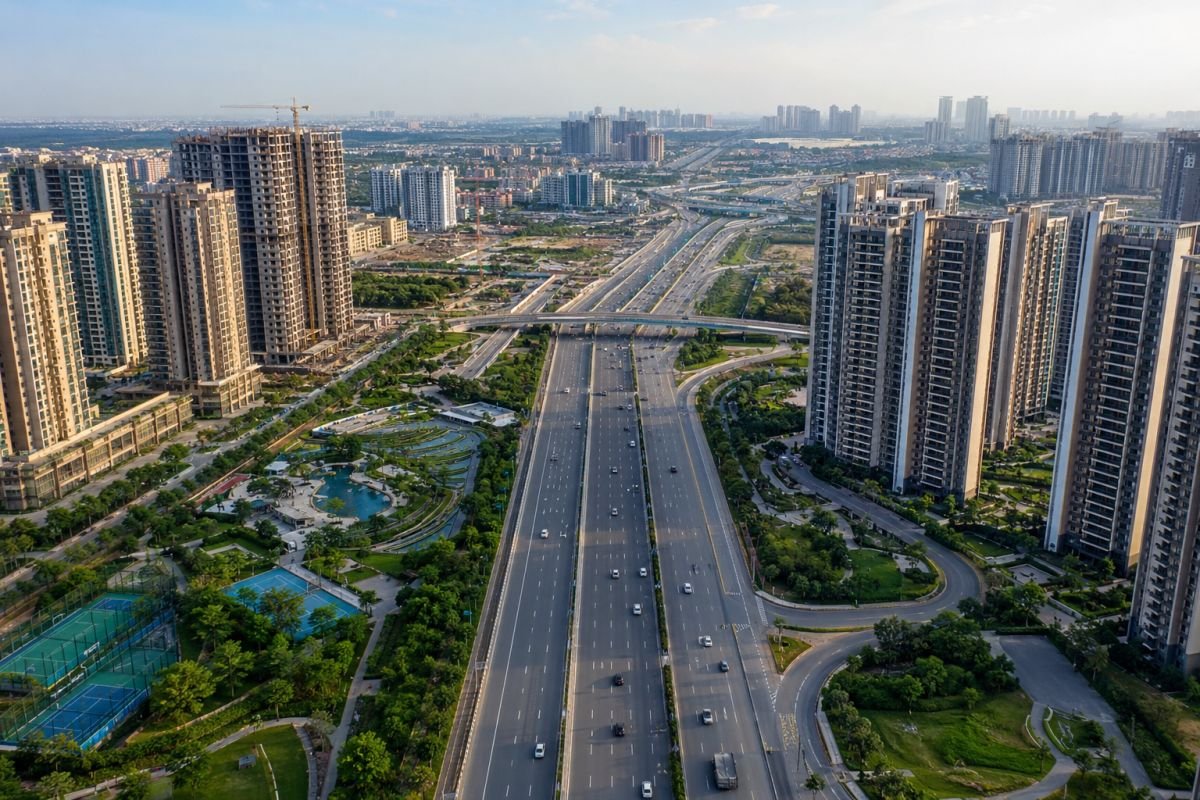
Dwarka Expressway Real Estate has moved into a different phase of its development story. The corridor is no longer being valued only on the promise of future infrastructure; the Haryana section was inaugurated in March 2024, while the Delhi section followed in August 2025, turning a long-awaited connectivity project into an operational regional link.
For investors, Sectors 111, 112 and 113 deserve particular attention because they sit close to the Delhi side of the corridor and combine expressway access with proximity to IGI Airport, established Delhi neighbourhoods and planned mass-transit improvements. The investment case is therefore less about a single infrastructure announcement and more about the gradual conversion of connectivity into residential demand, liquidity and end-user acceptance.
Data currency disclaimer: Price figures in this article are indicative asking/listing rates compiled from current 2026 market data. They are not guaranteed transaction values, future returns or investment outcomes, and are not attributed to any single named platform.
Key Takeaways
- Sector 111: Current 2026 asking-price data places the market at roughly ₹16,150 per sq. ft., making it one of the stronger-priced locations among the three sectors.
- Sector 112: Current 2026 asking-price data indicates roughly ₹15,950 per sq. ft., giving investors a slightly lower entry point while retaining the Delhi-border and expressway advantages.
- Sector 113: Current 2026 asking-price data is around ₹15,750 per sq. ft., with the sector benefiting from its position close to the Delhi side of Dwarka Expressway.
- The 19-km Haryana section of the eight-lane expressway was inaugurated in March 2024, while the 10.1-km Delhi section was inaugurated in August 2025, completing a major missing piece of the corridor’s road-connectivity story.
- The approved Gurugram Metro corridor includes a 1.85-km spur from Basai Village to Dwarka Expressway, with Sector 101 identified on the spur, while the Delhi-Gurugram-SNB RRTS remains a longer-term regional connectivity proposal rather than a currently operational service.
Why Dwarka Expressway Real Estate Has Entered a New Phase
The biggest change for the corridor is that the expressway has moved from an infrastructure promise to an operating road. The Haryana section opened in March 2024 and covers 19 km of the eight-lane corridor, connecting the Delhi-Haryana border through Basai towards Kherki Daula. Government information states that the project was designed to improve traffic flow between Delhi and Gurugram and provide direct connectivity towards IGI Airport and the Gurugram Bypass.

The Delhi side subsequently became operational as well. The 10.1-km Delhi section, inaugurated in August 2025, connects Shiv Murti with the Delhi-Haryana border and integrates with UER-II. It also provides multimodal connections towards Yashobhoomi, Dwarka Sector 21, the Blue and Orange metro corridors and the upcoming Bijwasan railway station.
That matters for Sectors 111, 112 and 113 because real estate values tend to respond differently when infrastructure becomes usable rather than merely proposed. A buyer can now evaluate the corridor as part of an existing road network instead of making a decision entirely around a future completion date.
Is Dwarka Expressway still an infrastructure-led investment story?
Yes, but the character of the story has changed. The expressway itself is now operational, so investors are increasingly assessing actual accessibility, project quality, possession status, rental demand and surrounding development. Future metro and regional rail improvements can add another layer of value, but they should be treated as potential upside rather than guaranteed appreciation.
For investors exploring the wider corridor, AssuredGains’ Dwarka Expressway properties provide a useful starting point for comparing available residential and commercial opportunities.
Sector 111: A Premium Position Close to the Delhi Side
Sector 111 has developed into one of the more closely watched residential locations along this part of Dwarka Expressway. Current 2026 asking-price data places the sector at approximately ₹16,150 per sq. ft., although individual projects can vary significantly according to age, developer positioning, floor, view, possession status and specifications.
The sector’s investment logic is strongly connected to location. It sits close to the Delhi side of the expressway and benefits from the broader connectivity improvement created by the completed corridor. For an end-user working between Delhi and Gurgaon, that access can be more meaningful than a headline appreciation percentage.

The important distinction is between corridor appreciation and property-specific performance. A well-located project with strong construction quality, credible RERA compliance and practical apartment layouts may behave differently from an older or less competitive development in the same sector.
Sector 111 also illustrates why investors should not simply buy the cheapest available square foot. A lower entry rate can be attractive, but the resale market ultimately depends on project visibility, maintenance, occupancy, amenities and the depth of genuine end-user demand.
What makes Sector 111 attractive to property investors?
Sector 111 combines proximity to Delhi with direct access to the operational Dwarka Expressway and a relatively premium residential positioning. Its appeal is strongest for investors who want exposure to the Delhi-facing end of the corridor but are willing to evaluate projects individually rather than treating the entire sector as one homogeneous market.
For buyers focused on residential assets, AssuredGains’ residential properties section can be used alongside project-level due diligence.
Sector 112: The Middle Ground Between Price and Location
Sector 112 presents an interesting proposition because it sits between the premium pricing of some Delhi-facing developments and the more speculative parts of emerging Gurgaon. Current 2026 asking-price data places the sector at around ₹15,950 per sq. ft., broadly in the same pricing band as Sectors 111 and 113.
The sector’s strongest advantage is its combination of accessibility and relative pricing. Investors who find premium inventory in Sector 111 expensive can examine Sector 112 without moving too far away from the core infrastructure story. At the same time, the sector remains dependent on the continued maturation of surrounding residential and social infrastructure.

The current price level also demonstrates why investors should be cautious with simplistic year-on-year comparisons. Asking prices can move because of changes in project mix, new launches, ready-to-move inventory and premium project launches. A quoted sector average is therefore a screening tool, not a substitute for comparing actual apartments.
Is Sector 112 a better buy than Sector 111?
Not automatically. Sector 112 can offer a useful entry point when the specific property is priced below a comparable Sector 111 option, but the decision should consider project quality, possession timeline, maintenance, resale liquidity and exact distance from the expressway. A small price difference is less important if the underlying asset is materially weaker.
This is also where investors should separate location selection from project selection. The sector may have a favourable macro story, but the final investment outcome will still depend on the property purchased.
Sector 113: Delhi Proximity Becomes the Core Advantage
Sector 113 has one of the clearest location narratives in this micro-market. Positioned close to the Delhi side of Dwarka Expressway, it benefits from the corridor’s improved road connectivity while remaining part of Gurgaon’s expanding residential market.
Current 2026 asking-price data places Sector 113 at roughly ₹15,750 per sq. ft. The number should be read as an indicative sector-level benchmark rather than a uniform market rate because luxury projects, larger apartments and ready inventory can command substantially different values.
The sector’s long-term appeal is closely tied to its ability to serve buyers who value Delhi access but want the newer residential environment of Gurgaon. That creates a broader potential end-user pool than a purely speculative peripheral location.
There is also a strategic reason to watch the area: infrastructure around the Delhi-Gurgaon interface is becoming more integrated. The completed expressway, airport-access improvements and future metro connectivity can reinforce the sector’s position, although investors should price future infrastructure carefully rather than assuming every proposed project will generate immediate capital appreciation.
Why are investors watching Sector 113 so closely?
Sector 113 offers a combination of Delhi proximity, expressway access and premium residential development. Its strongest investment case is for medium- to long-term buyers who believe improved connectivity will deepen end-user demand. The opportunity is attractive, but current pricing means investors should focus on project fundamentals rather than expecting easy infrastructure-led gains.
Metro and RRTS: What Could Add the Next Layer of Value?
Road connectivity is already a reality, but the next potential catalyst is mass transit. The approved Gurugram Metro corridor from Millennium City Centre to Cyber City is planned at 28.5 km with 27 stations, including a 1.85-km spur from Basai Village to Dwarka Expressway. GMRL currently identifies Sector 101 on that spur.
The alignment also includes Bajghera Road and other established parts of Gurgaon, creating a potential connection between Old Gurgaon, New Gurgaon, Cyber City and the Dwarka Expressway corridor. That is strategically relevant because a residential market becomes more resilient when its residents have more than one practical commuting option.
The RRTS story requires more caution. The proposed Delhi-Gurugram-SNB corridor is part of the wider Delhi-Gurugram-Rewari-Alwar regional rapid transit concept. However, a 2025 parliamentary committee document noted that revised proposals submitted in March 2025 were still under examination and that the Delhi-SNB and Delhi-Panipat-Karnal RRTS corridors were not then sanctioned projects of the Government of India.

That distinction matters for investors. Metro and RRTS should be categorised separately from completed road infrastructure. A completed road can be incorporated into current accessibility calculations; an unsanctioned or future rail project should be treated as optional upside rather than a guaranteed component of today’s valuation.
Could metro connectivity materially change property values in Sectors 111–113?
Potentially, but the effect will depend on the final alignment, station access, construction timeline and actual commuter adoption. Metro connectivity generally becomes more valuable when residents can reach stations conveniently and use them for daily travel. Investors should therefore avoid assigning a fixed appreciation premium to a proposed station before the infrastructure is physically delivered.
How IGI Airport and New Delhi Connectivity Strengthen the Investment Case
Airport connectivity is one of the more defensible advantages of the corridor because it is supported by completed road infrastructure rather than only future proposals. The Haryana section of Dwarka Expressway was officially described as providing direct connectivity to IGI Airport, while the Delhi section adds further integration between the expressway, Dwarka and airport-access routes.
This is particularly relevant for Sectors 111, 112 and 113 because their location near the Delhi end of the expressway gives them a different demand profile from purely interior Gurgaon locations. Frequent airport users, senior corporate professionals and buyers with family or professional connections in Delhi can place a measurable premium on travel convenience.
A further road catalyst was approved in July 2026: the Union Cabinet cleared an 8.1-km, six-lane tunnel connection between Dwarka Expressway and Nelson Mandela Marg in Vasant Kunj, with an estimated project cost of ₹6,969.67 crore. The government says the corridor is intended to improve connections between the expressway, Vasant Kunj, IGI Airport and South Delhi.
That is a future infrastructure benefit, however, not a completed asset. Investors should distinguish between what is usable today and what could improve accessibility several years from now.
Does proximity to IGI Airport guarantee better returns?
No. Airport proximity can improve a location’s strategic appeal, but returns depend on entry valuation, property quality, supply, rental demand, possession and the broader market cycle. The airport should be treated as one part of the investment thesis rather than a standalone reason to buy.
Sector 111 vs Sector 112 vs Sector 113: Where Does the Value Sit?
At current 2026 asking levels, the three sectors occupy a relatively narrow pricing band. Sector 111 is around ₹16,150 per sq. ft., Sector 112 around ₹15,950 per sq. ft. and Sector 113 around ₹15,750 per sq. ft. The small spread means that choosing between them should be driven more by the individual property and its micro-location than by a ₹200–₹400 per sq. ft. difference alone.
| Sector | Indicative 2026 Asking Price | Core Investment Advantage | Key Consideration |
|---|---|---|---|
| Sector 111 | ~₹16,150/sq. ft. | Delhi-facing location and expressway access | Premium entry valuation |
| Sector 112 | ~₹15,950/sq. ft. | Balance between price and corridor access | Project-level variation |
| Sector 113 | ~₹15,750/sq. ft. | Delhi proximity and premium residential positioning | Future infrastructure must be priced carefully |
Price figures are indicative 2026 asking/listing benchmarks and can vary by project, configuration, possession status and inventory mix.
Which sector is better for a long-term investor?
There is no universal winner. Sector 111 suits buyers prioritising a stronger Delhi-facing location, Sector 112 can work for investors seeking a middle-ground entry point, while Sector 113 is compelling for those prioritising Delhi proximity and premium residential development. In all three cases, project-level due diligence should come before sector-level conviction.
For a broader investment framework, AssuredGains’ Investment Strategy & ROI resources can help put location selection into a larger portfolio context.
What Investors Should Check Before Buying
The infrastructure story is strong, but that does not eliminate property risk. The completion of an expressway can lift an entire corridor while individual projects still underperform because of construction delays, weak maintenance, poor layouts, oversupply or unrealistic asking prices.

A disciplined investor should examine the asset at three levels: sector, project and unit. The sector determines the macro connectivity story; the project determines execution and community quality; and the individual unit determines the eventual resale proposition.
Before committing capital, check:
- Current RERA/HRERA registration and project status.
- Promised versus actual possession timeline.
- Construction progress and developer execution history.
- Maintenance standards and existing occupancy where applicable.
- Floor, view, orientation and unit efficiency.
- Parking allocation and recurring maintenance costs.
- Comparable asking prices for similar units.
- Actual resale liquidity rather than only launch pricing.
- Total acquisition cost, including applicable taxes, duties and registration expenses.
Any appreciation or ROI calculation should be treated as an illustration, not a promise. A property purchased at an attractive price can still produce weak returns if holding costs are high or the resale market becomes oversupplied.
What is the biggest risk in buying Dwarka Expressway property now?
The biggest risk is assuming that completed infrastructure automatically guarantees future appreciation. Much of the corridor’s easy infrastructure repricing may already be reflected in asking values. The next phase of returns will depend more heavily on end-user absorption, project execution, rental demand, supply discipline and the price paid at entry.
Frequently Asked Question
Q: Is Dwarka Expressway a good area for property investment in 2026?
A: It can be attractive for medium- to long-term investors because the road corridor is operational and connectivity to Delhi and IGI Airport has improved materially. However, investment quality varies by sector, project and entry price, so infrastructure alone should not determine the purchase.
Q: Which is better for investment, Sector 111 or Sector 113?
A: Sector 111 currently commands a slightly higher indicative asking level, while Sector 113 offers a strong Delhi-proximity narrative. The better choice depends on the specific project, possession status, unit pricing, amenities and expected resale demand rather than the sector number alone.
Q: What is the current property price in Sector 112 Gurgaon?
A: Current 2026 asking-price data places Sector 112 at approximately ₹15,950 per sq. ft. as a sector-level benchmark. Individual apartments can differ considerably depending on project, configuration, floor, construction status and inventory mix.
Q: Is metro connectivity coming to Dwarka Expressway?
A: An approved Gurugram Metro corridor includes a 1.85-km spur from Basai Village to Dwarka Expressway, with Sector 101 identified on the spur. GMRL also lists Bajghera Road among the proposed stations on the wider 28.5-km corridor.
Q: Will the Delhi-Gurugram RRTS increase property prices?
A: The Delhi-Gurugram-SNB RRTS remains a future regional connectivity proposition rather than an operational service. Official parliamentary information in 2025 stated that revised proposals were under examination, so investors should treat any future property impact as potential upside rather than a guaranteed price catalyst.
Q: Is Sector 113 Gurgaon good for end-users as well as investors?
A: Sector 113 can suit both groups because its Delhi-facing location and expressway access are relevant to daily commuters as well as investors. End-users should focus on commute practicality, schools, healthcare, retail and project occupancy, while investors should add resale liquidity and entry valuation to that assessment.
Conclusion
The Dwarka Expressway Real Estate story is becoming more mature. Sectors 111, 112 and 113 are no longer being evaluated solely on the hope that a major road will eventually arrive; the expressway is operational, Delhi-side connectivity has improved, and further transport infrastructure is being planned or developed around the corridor.
For investors, the strongest opportunity may now lie in being selective rather than simply early. Sector 111 offers a premium Delhi-facing position, Sector 112 provides a comparatively balanced entry point, and Sector 113 combines Delhi proximity with an increasingly established residential ecosystem.
The practical question is therefore not simply “Will Dwarka Expressway prices rise?” It is “Which project, at what price, with what possession and resale prospects, gives the best risk-adjusted opportunity?” That is where project-level analysis matters.
You can compare current opportunities through AssuredGains’ Dwarka Expressway residential projects or, if you want property selection evaluated against your budget and investment horizon, talk to an AssuredGains advisor.
Sources and current-data references: government infrastructure releases, GMRL project information and current 2026 market/listing data. Infrastructure status should be rechecked before making an investment decision because project timelines and approvals can change.

Join The Discussion