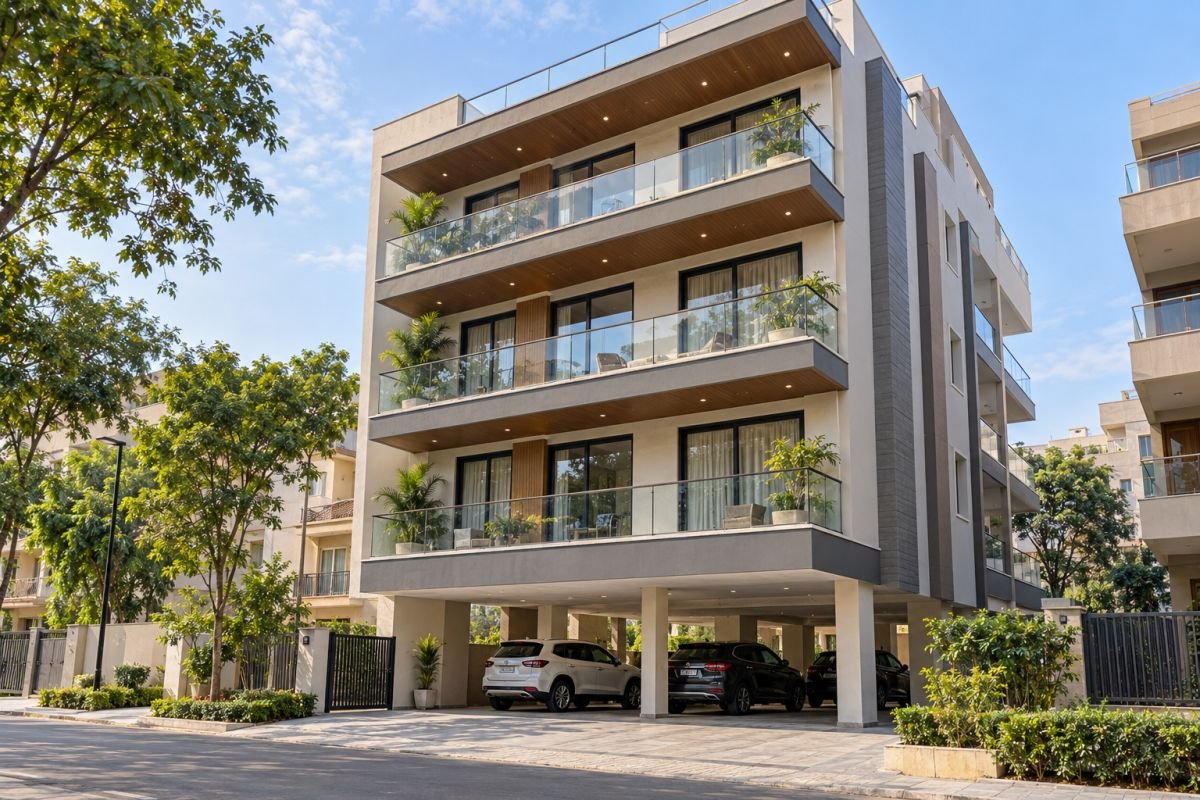
The Deen Dayal Jan Awas Yojana (DDJAY) supports plotted residential development in eligible licensed colonies in Haryana. Independent builder floors appeal to buyers seeking low-rise living, but purchasing a floor involves more than checking its layout and price. Buyers must verify construction permission, permissible Floor Area Ratio (FAR), registration eligibility and their legal rights over the underlying land.
In 2026, these checks are particularly important because Haryana’s DDJAY Stilt Plus 4 policy has faced judicial restrictions. HRERA Gurugram proceedings record a High Court interim order dated 2 April 2026 and subsequent directions affecting relevant approvals and independent-floor registration. Buyers must verify the latest court orders and departmental instructions before proceeding.
Why DDJAY Stilt Plus 4 Floor Registry & FAR Rules in Haryana (2026) Matters for Gurugram Buyers
Four issues should be examined separately: whether the plot qualifies for the proposed construction, whether the building plan is valid, whether the floor can be independently registered, and whether the sale deed transfers the intended land interest.
The frequently quoted FAR range of 2.0–2.64 should not be treated as a universal entitlement. Permissible FAR depends on the applicable planning provisions, plot eligibility and sanctioned plans. The legal permission to construct additional floors does not automatically establish a right to register each floor independently.
For homebuyers and investors, the practical priority is documentary verification. A developer’s brochure, an earlier approval or an existing transaction is not sufficient evidence that a proposed building can lawfully proceed under the current rules.
Official Regulatory / Infrastructure Framework (GMDA / DTCP / HRERA / GMRL)
DTCP Haryana: Construction policy and approvals
The Department of Town and Country Planning Haryana is the primary authority to consult for colony licences, approved layouts, zoning, service plans and applicable building-control requirements.

The DTCP policy dated 2 July 2024 addressed Stilt+4 construction in specified circumstances, including certain licensed DDJAY colonies whose service plans met the relevant conditions. However, the policy became subject to the High Court’s interim order of 2 April 2026, and subsequent departmental directions placed relevant approvals on hold.
Consequently, buyers should obtain written clarification from the competent authority before relying on the policy for a new purchase or proposed construction.
HRERA Gurugram: Registration and compliance
HRERA records help buyers examine project registration, promoter disclosures, proceedings, complaints and relevant orders. A building-plan sanction and RERA registration serve different purposes: one concerns permitted construction, while the other concerns regulatory obligations where registration applies.
Neither document independently proves every ownership right promised under a floor sale deed. Check the exact project record and current registration status rather than relying on an old certificate or verbal assurances.
FAR, sanctioned plans and structural compliance
FAR measures the relationship between permissible floor area and plot area, subject to applicable rules and exclusions. It must be considered alongside setbacks, ground coverage, height limits, parking, structural requirements and approved drawings.

Request the sanctioned building plan and compare it with the actual structure. Verify the approved number of floors, permitted stilt use and relevant completion or occupation certificate, where applicable. Do not assume that FAR of 2.0–2.64 applies to every DDJAY plot.
GMDA, HSVP, DHBVN and transport agencies
Planning approval does not guarantee adequate infrastructure for additional dwelling units. Buyers should examine water supply, sewerage, stormwater drainage, road access, parking and electricity.
- GMDA: Check relevant infrastructure information and OneMap Gurugram. A mapped utility does not establish a property’s lawful connection or available capacity.
- HSVP: Consult its records where its jurisdiction applies.
- DHBVN: Verify electricity connection requirements and sanctioned load.
- GMRL and NCRTC: Consult official project information where relevant to the location. Proposed transport infrastructure should not be presented as operational or guaranteed to increase property values.
Sector-Wise & Corridor-Wise Impact Across Gurugram
The policy’s practical impact depends on the property’s approvals, colony status and applicable jurisdiction.
| Location or corridor | Key verification |
|---|---|
| DLF Phase I and Sector 28 | Existing building approvals, lawful stilt use, road access and property-specific restrictions. |
| Licensed DDJAY colonies across Gurugram | Colony licence, approved service plan, plot eligibility and current construction permission. |
| New Gurugram and Dwarka Expressway belt | Colony-specific approvals, utility capacity, drainage and actual infrastructure completion. |
| Sohna Road and southern Gurugram | Applicable development controls, service connections, road capacity and plotted-development status. |
| Manesar and other Haryana districts | Relevant authority and jurisdiction; do not assume every district is governed identically by a Gurugram-specific order. |

HRERA proceedings have discussed the scope of the 2 April 2026 order in relation to Gurugram district, while the underlying policy remained subject to the outcome of the wider legal proceedings. Buyers should confirm the latest position rather than extrapolating from an individual order.
Infrastructure benefits and construction rights must be assessed separately. Better road access or proximity to transport does not establish eligibility for additional floors. For an investment-format comparison, read plots vs builder floors in Gurgaon investment strategy.
Step-by-Step Verification Checklist for Homebuyers & Investors
Official Government Portals & Documents to Inspect
1. Verify the colony and plot. Obtain the DDJAY licence details, approved layout and zoning plans, plot number, dimensions and applicable service plan. Match the documents with the actual property.
2. Confirm current construction permission. Ask DTCP or the competent authority to clarify whether the proposed Stilt+4 configuration is permissible under the latest court orders and departmental instructions.
3. Inspect building approvals. Request the sanctioned building plan, revisions, structural documentation and applicable completion or occupation certificate. Check whether the actual construction matches the approved drawings.
4. Check HRERA records. Verify project registration, validity, orders, complaints, extensions and required disclosures. Establish whether the transaction is covered by registration or a legally applicable exemption.
5. Verify ownership and encumbrances. Request registered title deeds, the ownership chain, relevant revenue records, encumbrance information and collaboration or development agreements where applicable. Jamabandi can help verify available land records, but an online entry alone is not a complete title opinion.
6. Review the sale deed and land share. Confirm the floor being transferred, undivided share of land (UDS), common-area rights, access, parking and maintenance obligations. Have a property lawyer verify that the deed matches the seller’s title and the intended transaction.
7. Check essential services. Verify water, sewerage, drainage, electricity, road access and parking. Request documentary support for claims about completed infrastructure.

Common Red Flags & Financial/Legal Risks to Avoid
Treat automatic Stilt+4 permission claims as a warning sign. Other red flags include missing sanctioned plans, discrepancies between approved and actual construction, unclear land-share provisions, pending title disputes and missing completion documentation.
An application awaiting approval or registration is not equivalent to a granted approval. Depending on the circumstances, unresolved issues can cause transaction delays, financing difficulties, additional compliance expenses, enforcement proceedings, resale problems or disputes over ownership rights.
Do not assume every existing Stilt+4 building is illegal. The position depends on the applicable rules, approval dates, approval terms and operative court directions. Seek a qualified legal opinion where these issues affect the purchase.
For more on title and maintenance differences, see builder floor vs apartment registry and maintenance differences.
2026–2031 Market & Livability Outlook
The outlook for DDJAY builder floors will depend on regulatory clarity, infrastructure capacity and property-level compliance.
Regulatory clarity: The outcome of the Stilt+4 proceedings will influence buyer confidence. Do not assume future clarification will automatically validate earlier deviations or resolve title defects. Check official updates before committing funds.
Infrastructure capacity: Additional residential units can increase demand for water, sewerage, parking and road space. Evaluate existing services and drainage conditions instead of relying on proposed infrastructure timelines.
Investment quality: Independent floors can suit end-users seeking privacy and low-rise living, but investment decisions should account for total acquisition costs, maintenance, rental demand, resale liquidity and legal certainty. A lower asking price does not necessarily mean better value if compliance remains unresolved.
Buyers assessing the broader plotted-development market can also consult the DDJAY plots in Gurgaon complete investment guide.
Frequently Asked Questions
1. How do DDJAY Stilt+4 floor registry rules affect buyers in Gurugram in 2026?
Judicial restrictions make current approval status essential. Buyers must distinguish between existing sanctioned construction, proposed additional floors and independent-floor registration. Verify the latest court orders, DTCP instructions, building approvals and HRERA records.
2. Which official portal should buyers use?
Use DTCP Haryana for planning approvals, HRERA for applicable project registration and proceedings, Jamabandi for available revenue records, GMDA for infrastructure information and HSVP where its jurisdiction applies. Supplement these checks with registered deeds and a professional title search.
3. Which sectors and corridors are affected?
The issue is relevant to eligible plotted developments across Gurugram, including DLF Phase I, Sector 28 and licensed DDJAY colonies elsewhere in the city. The actual impact depends on the property’s approval history and applicable legal restrictions.
4. What risks arise if verification is ignored?
Potential risks include approval delays, construction-compliance disputes, title defects, financing difficulties, enforcement action and reduced resale liquidity. Unclear land-share provisions may also complicate transfers and common-area management.
5. What documents should buyers request before registration?
Request the colony licence, approved layout and zoning plans, applicable service plan, sanctioned building plan and revisions, relevant completion or occupation certificate, title deeds, ownership-chain records, encumbrance information, collaboration agreement where applicable, proposed sale deed and documents specifying the land share. Obtain the current HRERA record and written clarification of construction-policy status.
6. Is FAR of 2.0–2.64 allowed for every DDJAY plot?
No universal entitlement should be assumed. Verify permissible FAR, exclusions and other development controls under the applicable planning provisions and sanctioned plan.