
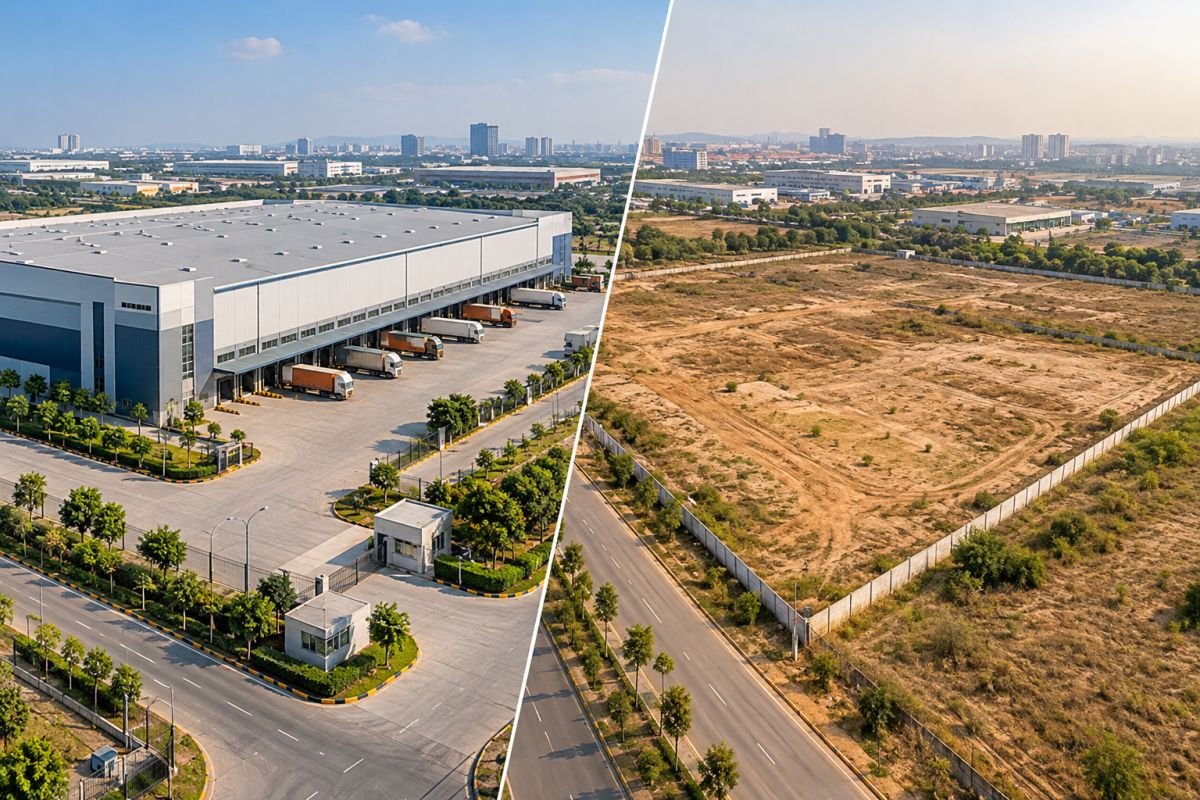
For investors looking at the Gurgaon-Manesar corridor, warehousing REIT vs direct land investment Gurgaon is less a question of which asset will appreciate more and more a question of what type of risk you are willing to own. REIT-style exposure offers liquidity, diversification and professional management, while direct industrial land gives greater control and potentially stronger upside from land appreciation—but with far more execution, title and liquidity risk.
There is one important distinction before comparing the two: as of 2026, India does not have a mainstream listed REIT dedicated exclusively to warehousing. Listed REIT exposure remains concentrated largely in office and retail assets, while institutional logistics and industrial warehousing exposure is also being built through private platforms and structures such as InvITs. That makes the REIT side of this comparison a listed real-estate-income proxy, rather than a pure-play Gurgaon warehouse REIT.
Data currency disclaimer: Land figures below use current 2026-27 benchmarks and market asking/listing trends where relevant. They are indicative, not guaranteed transaction values, rental receipts or investment returns, and are not attributed to any single named listing platform.
Key Takeaways
- IMT Manesar industrial land: the 2026-27 collector-rate benchmark for industrial plots in IMT Manesar is about ₹38,000 per sq. yd.; actual transaction or asking values can differ materially by sector, plot size, road frontage, title and permitted use.
- Warehousing demand remains substantial: industrial and warehousing leasing across India’s top eight markets reached about 11 million sq. ft. in Q2 2026, with Delhi NCR contributing more than 25% of quarterly demand.
- Listed REIT benchmark: a large Indian listed office REIT was guiding to a 6.3% FY2027 distribution yield as of June 2026. This illustrates the income characteristics of listed REITs, but it is not a warehouse-specific yield.
- Direct land wins on control: an investor can influence development, leasing and eventual asset use, but must personally absorb title, zoning, construction, tenant and exit risks.
- REIT-style exposure wins on simplicity: smaller ticket sizes, tradability and professional management make it more suitable for investors prioritising liquidity over direct control.
Investment figures in this article are illustrations based on market data and stated guidance, not promises of future appreciation, rental yield or total returns.
Warehousing & Logistics REITs vs Direct Land Investment in Gurgaon: What Are You Actually Buying?
The two investments provide exposure to the same broad economic theme—commercial logistics demand—but the ownership structure is completely different. A REIT investor owns listed units representing an interest in a professionally managed real-estate portfolio; a direct land investor owns a specific physical asset with concentrated exposure to one location.
For Gurgaon-Manesar, that distinction matters because warehousing performance depends on more than land prices. Tenant quality, warehouse specifications, access, loading infrastructure, power availability, development permissions and lease terms all affect the income-producing value of an industrial property.
India’s warehousing market has been institutionalising rapidly. In Q1 2026, industrial and warehousing leasing across the top eight cities reached 11 million sq. ft., up 22% year on year, with Delhi NCR accounting for 28%. By Q2 2026, Delhi NCR still represented more than one-quarter of quarterly demand.
Which is safer: a warehouse REIT or Gurgaon industrial land?
A diversified REIT generally has lower asset-specific risk because investors are exposed to multiple properties and tenants rather than one plot. Direct land can have greater long-term upside, but a defective title, unsuitable zoning, weak access or an illiquid micro-market can disproportionately damage the investment.
A critical correction for investors
Calling every institutional warehousing vehicle a “REIT” can create the wrong expectation. A listed REIT must operate within the SEBI framework, including requirements around income-generating real estate and portfolio structure. SEBI’s regulations were amended again in April 2026.
There are also logistics-focused institutional structures outside conventional listed REITs. For example, a currently listed infrastructure trust reports industrial warehouse leasing as its business segment. That is an InvIT, not a REIT, and the distinction matters for investors comparing regulation, distributions and asset exposure.
Why Gurgaon-Manesar Makes Direct Land More Interesting in 2026
Direct land investment becomes more compelling when an investor believes that the underlying location will benefit from sustained industrial and logistics activity over a long holding period. Manesar is particularly relevant because it sits within the broader Delhi NCR industrial and logistics ecosystem rather than functioning only as a residential land market.

Current market research identifies NH-48 and the wider Delhi NCR logistics belt among India’s active industrial and warehousing clusters. Demand has been supported by 3PL operators, e-commerce, engineering and automobile-related occupiers, while large-format transactions continue to influence Grade A warehousing demand.
For an investor evaluating Manesar plots, the key question is therefore not simply, “Will land prices rise?” It is whether the specific plot can legally and commercially participate in the industrial ecosystem around it.
Is Manesar industrial land worth considering for a long-term investor?
It can be, particularly for investors with a seven-to-ten-year horizon, sufficient capital and the ability to conduct detailed title and zoning due diligence. The investment case is stronger when the plot has appropriate industrial use, reliable access, clean documentation and a credible future leasing or development strategy.
The 2026-27 industrial collector benchmark of approximately ₹38,000 per sq. yd. in IMT Manesar provides a useful registry reference, but it should not be treated as a market-sale price. Actual value can vary significantly according to the individual plot and its legal and physical characteristics.
This is also where direct land differs sharply from buying conventional commercial properties in Gurgaon. A warehouse-oriented land purchase requires much deeper attention to industrial use, access, permissible development and future tenant suitability.
Income, Appreciation and Liquidity: Where the Risk Profiles Separate
The most important difference between the two strategies is the source and timing of returns. REIT-style investing is primarily designed around income distributions and changes in unit value, whereas bare industrial land generally produces no income until it is developed or leased.
A direct land investor may therefore experience several years of capital outflow with no cash yield. In contrast, an income-producing real-estate vehicle can distribute cash generated from its underlying properties, although distributions can fluctuate and market prices can fall even when property income remains stable.
As a real-world 2026 benchmark, one major listed Indian office REIT reported ₹6.31 per unit of distribution for Q1 FY2027 and indicated a 6.3% distribution yield at the midpoint of its FY2027 guidance. Its portfolio had 90% occupancy and an 8.4-year weighted average lease expiry as of June 30, 2026.
That is useful for understanding the mechanics of listed REIT income—but it should not be presented as the expected return from a Gurgaon warehousing REIT.
Which investment gives better returns, REITs or direct land?
Neither has a universally superior return profile. REITs can provide recurring distributions and easier exits, while direct land can generate stronger capital appreciation if the chosen location and development thesis are correct. The trade-off is that land requires more capital, patience and execution, while listed REITs expose investors to stock-market volatility.
For direct land, an investor should model at least three return components separately:
- Land appreciation.
- Rental or development income, if the site is subsequently developed.
- Transaction and holding costs, including taxes, registration, financing and development expenditure.
A return calculation that ignores the third category can make industrial land appear more attractive than it actually is.
Warehousing REIT vs Direct Land Investment Gurgaon: A Practical Risk Comparison
The decision becomes clearer when the investor’s risk profile is mapped against the asset’s characteristics.

| Factor | Listed REIT / Logistics-Linked Vehicle | Direct Industrial Land in Gurgaon-Manesar |
|---|---|---|
| Entry Capital | Relatively low; units can be accumulated progressively | Usually high; plot acquisition requires substantial capital |
| Income | Potential recurring distributions from underlying assets | Usually zero until developed or leased |
| Liquidity | Generally high for listed units, subject to market conditions | Low; finding the right buyer can take time |
| Diversification | Portfolio-level exposure across assets and tenants | Concentrated exposure to one plot |
| Control | Limited | High |
| Title Risk | Mostly embedded within professional asset ownership and governance | Directly borne by investor |
| Zoning / Use Risk | Managed at portfolio level | Critical to the individual investment |
| Development Risk | Professional manager bears operational responsibility | Investor bears construction/development execution |
| Tenant Risk | Spread across portfolio | Can become concentrated in one tenant |
| Price Volatility | Market-linked and visible daily | Less transparent; valuation changes are slower to observe |
| Upside Potential | Income growth plus unit-price appreciation | Land appreciation plus potential development/lease value |
| Investor Skill Required | Lower | High |
| Suitable Horizon | Medium to long term | Generally long term |
| Best Suited To | Liquidity-focused, passive investors | High-conviction, control-oriented investors |
The table also explains why comparing only “expected appreciation” is inadequate. Direct land may appear superior on paper because investors often focus on the potential change in land value. But the REIT investor is buying liquidity, diversification and professional asset management alongside the underlying real-estate exposure.
What Direct Land Investors Must Check Before Buying in Manesar
The strongest direct-land thesis can still fail if the legal or development fundamentals are weak. Industrial land should therefore be evaluated as a legal and operational asset, not merely as a piece of land near a major road.

At minimum, the buyer should verify:
- Complete title chain and encumbrance status.
- Current land-use and zoning classification.
- Whether the intended warehouse or industrial use is permissible.
- Approved layout and demarcation documents.
- Road access and right of way.
- Development and construction permissions.
- Applicable infrastructure and external development charges.
- Existing mortgage, litigation or acquisition issues.
- Utility availability and connection feasibility.
- Transfer restrictions where the land originates from an industrial authority or licensed development.
- Applicable RERA/HRERA status where the transaction forms part of a registered plotted or development project.
HRERA records show that industrial and plotted developments can fall within registered real-estate projects, and Haryana’s rules specifically require disclosures concerning title documentation and plot demarcation for applicable plotted developments. The regulatory position should therefore be checked for the specific project and transaction structure, rather than assuming that every land transaction is automatically outside RERA.
For investors studying the broader corridor, AssuredGains’ analysis of Manesar plots and the impact of industrial growth provides useful context, while the Manesar investment guide can be used to assess the area’s wider investment dynamics.
What should I verify before buying industrial land in Manesar?
Start with title, zoning, permitted use and access before discussing appreciation. Then verify the sanctioned layout, development permissions, infrastructure obligations, transfer conditions and litigation status. A cheap plot with unclear industrial use or weak access is not necessarily cheaper; it may simply carry a larger legal and execution discount.
Which Strategy Fits Your Risk Profile?
For a conservative investor, a listed REIT or diversified real-estate vehicle is usually the cleaner structure. The investor avoids the operational burden of acquiring, developing and leasing a physical warehouse site and can normally exit through the market rather than negotiating a private property sale.
A moderate-risk investor can consider a blended approach. Listed real-estate exposure can provide liquidity and income potential, while a smaller allocation to carefully selected industrial land can provide direct exposure to the Gurgaon-Manesar growth thesis. The exact allocation should depend on overall portfolio concentration and liquidity requirements.
An aggressive, high-conviction investor may prefer direct land when they have the capital, patience and expertise to undertake detailed diligence. This profile is better suited to an investor who understands that the real opportunity may come several years later through development, leasing or sale to a larger industrial user.
The wider Gurgaon property outlook should also be considered before concentrating capital in Manesar. A long-horizon investor can compare the corridor with other areas using AssuredGains’ five-year Gurgaon, Sohna and Manesar property outlook.
Should a first-time investor buy Manesar land instead of REIT units?
Usually not without professional due diligence. A first-time investor who values liquidity and has limited experience with land documentation may find listed real-estate exposure easier to manage. Direct Manesar land becomes more appropriate when the investor understands zoning, title, development economics and the longer exit cycle.
The Bottom Line: Income vs Control
For most investors, the choice can be reduced to one fundamental trade-off: REIT-style exposure offers financial simplicity; direct land offers control.
The Gurgaon-Manesar warehousing story has credible fundamentals. Delhi NCR remained one of India’s strongest industrial and warehousing markets in 2026, while institutional capital continued moving into logistics assets. In October 2026, a major institutional transaction involving 10.5 million sq. ft. of logistics assets across several Indian markets further illustrated the scale at which professional capital is entering the sector.
But that institutional confidence does not automatically mean that every Manesar plot will outperform. A direct investor must buy the right land, not merely land in Manesar.
For investors who want passive exposure, liquidity and diversification, REITs are generally the more practical route. For investors willing to lock capital for years, undertake detailed legal diligence and potentially develop or lease the asset, direct industrial land can provide a more controllable—and potentially more rewarding—investment thesis.

The sensible approach is to compare the two against your own liquidity requirement, investment horizon, debt capacity and ability to manage property risk rather than choosing purely on headline return expectations. Investors can also review AssuredGains’ broader guide to commercial property investment in Gurgaon before making an allocation decision.
Frequently Asked Questions
Q: Is there a pure-play warehousing REIT in India?
A: As of 2026, there is no mainstream listed Indian REIT offering straightforward pure-play exposure to Gurgaon-Manesar warehousing. Listed REITs are concentrated largely in office and retail assets, while logistics exposure is also available through private institutional platforms and infrastructure-trust structures.
Q: What is the current industrial land rate in Manesar?
A: The 2026-27 collector-rate benchmark for industrial plots in IMT Manesar is approximately ₹38,000 per sq. yd. This is a registry benchmark, not a guaranteed market transaction price; actual values vary with location, plot size, frontage, title and permitted use.
Q: Is direct land more profitable than a REIT?
A: It can be, but there is no reliable rule that direct land will outperform. Land can deliver substantial capital appreciation when the location and development thesis work, whereas REITs can provide recurring distributions and liquidity. Both outcomes depend on entry valuation, holding period and market conditions.
Q: What is the main risk of buying industrial land in Manesar?
A: The biggest risks are asset-specific: unclear title, unsuitable zoning, restricted use, weak access, development constraints, litigation and difficulty finding a buyer at the desired price. These risks are much more concentrated than in a diversified listed real-estate portfolio.
Q: Can HRERA apply to an industrial plotted project?
A: It can, depending on the project’s structure and applicability of the law. Haryana’s regulatory records include registered industrial and plotted developments, and HRERA rules require relevant title and plot-demarcation disclosures for registered plotted developments. Investors should verify the specific project’s registration status rather than relying on a general assumption.
Q: Who should choose direct land over REITs?
A: Direct land is better suited to investors with substantial capital, a long holding period, high tolerance for illiquidity and the ability to perform detailed legal and development due diligence. Investors prioritising liquidity, diversification and passive income exposure will generally find listed REITs easier to manage.



Join The Discussion