
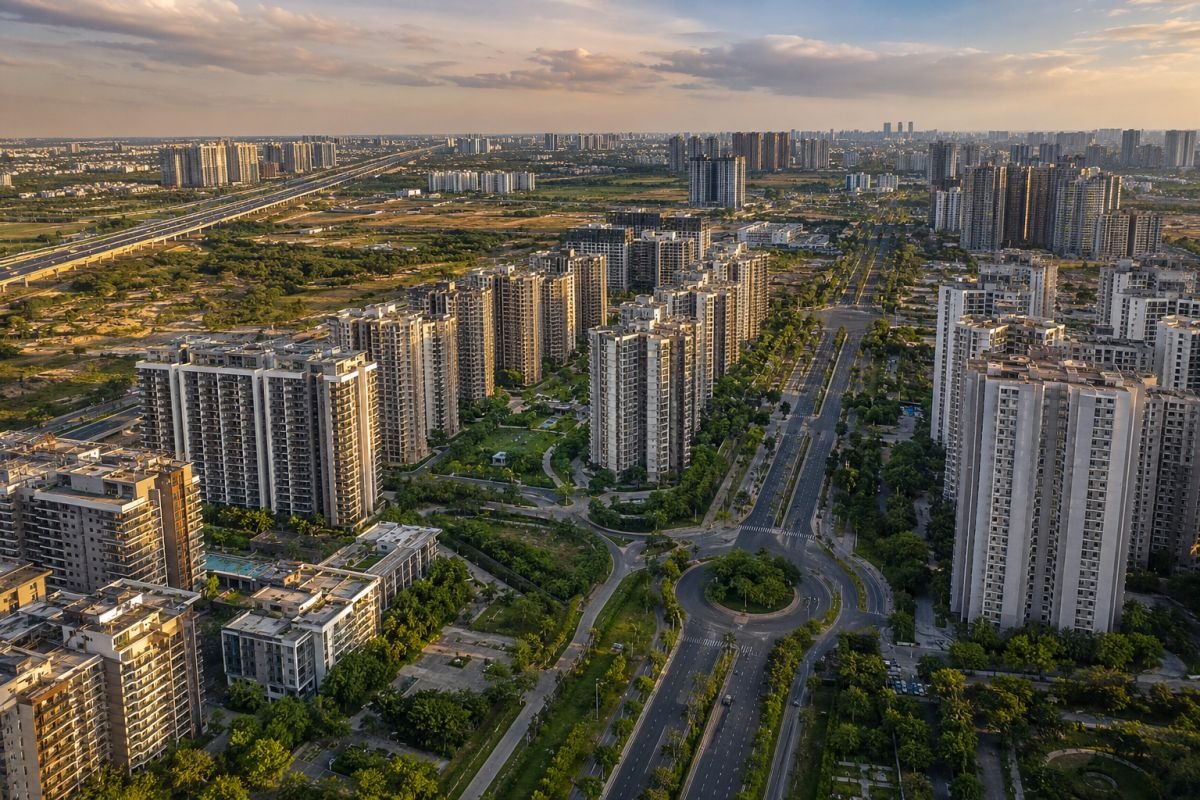
Sector 113 vs Sector 111 vs Sector 112 is not simply a choice between three neighbouring Gurgaon sectors. It is a choice between three different investment profiles: Sector 113 for growth and newer development, Sector 112 for established luxury and relative depth, and Sector 111 for premium positioning close to the Delhi side of Dwarka Expressway.
For a 2026 investor, our preference is Sector 113 for the best balance of future appreciation and marketability, while Sector 112 suits investors who prioritise an established premium ecosystem and Sector 111 works better for high-budget buyers targeting luxury residential assets. Current asking-price data also shows a meaningful difference between the three markets, although project-level pricing varies considerably.
Data note: Property prices mentioned in this article are indicative asking/listing trends available during 2026 and should not be treated as guaranteed transaction values or future returns. Actual pricing depends on project, tower, floor, view, construction status, payment plan, PLC and resale liquidity.
Key Takeaways
- Sector 113: Best overall pick for investors seeking a combination of Delhi proximity, newer projects and medium-to-long-term appreciation potential.
- Sector 112: Strong choice for established luxury housing, particularly around projects such as Experion Windchants, with ready-to-move inventory offering lower possession risk.
- Sector 111: Premium, Delhi-facing micro-market with strong luxury positioning, but several new projects have long possession timelines and higher entry tickets.
- Price positioning: 2026 asking-rate data places Sector 113 around ₹17,200/sq. ft., Sector 112 around ₹16,000–₹16,200/sq. ft. and Sector 111 around ₹15,500–₹16,150/sq. ft., depending on the data source and property segment.
- Investment verdict: Sector 113 leads for balanced growth potential; Sector 112 is the safer established-luxury option; Sector 111 is better suited to high-ticket luxury investors with a longer holding period.
Sector 113 vs Sector 111 vs Sector 112: What Is the Difference?
Sector 113 is the most growth-oriented of the three, Sector 112 is the most established luxury-oriented market, and Sector 111 combines premium housing with strong Delhi-side positioning. The difference matters because investors should not compare these sectors only on today’s quoted rate per square foot.
Sector 113 sits close to the Delhi border and has benefited from the broader transformation of the Dwarka Expressway corridor. Its residential inventory includes projects such as M3M Capital, Smartworld One DXP and M3M Mansion, giving investors a mix of premium and ultra-luxury options. Current MagicBricks data puts the average apartment asking price in Sector 113 at approximately ₹17,232 per sq. ft.
Sector 112 has a different character. It has an established premium residential identity, anchored by projects such as Experion Windchants, including apartments, villaments and villas. Experion’s own project information describes Windchants as a 23-acre development in Sector 112, while current listing data shows a broad price range because ready luxury inventory and different configurations coexist in the sector.

Sector 111 is increasingly becoming a high-ticket luxury address. Projects such as Puri Diplomatic Residences are pushing the premium end of the market, with large-format 3 and 4 BHK residences and a long-term luxury positioning. Housing.com currently places the sector’s average price around ₹15,581 per sq. ft., while Square Yards reports around ₹16,150 per sq. ft.; the variation demonstrates why sector averages should be used as a benchmark rather than a final buying price.
2026 Price Comparison: Which Sector Offers the Better Entry Point?
Sector 112 currently offers the lower broad sector-level asking rate, while Sector 113 commands a premium because of its project mix and Delhi-facing location. Sector 111 sits between the two on many market datasets, although individual luxury projects can be substantially more expensive. The key is to compare like-for-like apartments rather than taking the cheapest sector-wide quote.
| Investment Factor | Sector 113 | Sector 112 | Sector 111 |
|---|---|---|---|
| Indicative 2026 apartment rate | ~₹17,200/sq. ft. | ~₹16,000–₹16,200/sq. ft. | ~₹15,500–₹16,150/sq. ft. |
| Market character | Growth + premium | Established luxury | Premium / Delhi-side |
| Representative projects | M3M Capital, Smartworld One DXP, M3M Mansion | Experion Windchants | Puri Diplomatic Residences |
| Ready inventory | Available | Strong | Available in selected projects |
| New-project activity | High | Moderate | High in luxury segment |
| Entry profile | Premium | Premium | Premium to ultra-luxury |
| Appreciation potential | High | Moderate–High | Moderate–High |
| Possession risk | Project dependent | Lower in ready inventory | Higher for some new launches |
| Best suited for | Growth investor | Lower-risk luxury investor | High-ticket long-term investor |
| 2026 verdict | Best overall | Best established option | Best premium niche |
MagicBricks reported Sector 113 at ₹17,232 per sq. ft. in , up 0.4% quarter-on-quarter. Sector 112 was reported at ₹16,172 per sq. ft., up 2% QoQ, while Sector 111 was around ₹16,150 per sq. ft. in Square Yards’ June 2026 data. Housing.com’s datasets produce different averages, which is normal because portals use different listing pools and methodologies.

This is where an investor needs to be careful. A ₹1,000–₹2,000 per sq. ft. difference does not automatically make one sector cheaper in practical terms. A high-floor apartment with a better view, established occupancy and stronger resale demand can be a better investment than a cheaper unit in a project still several years away from possession.
Connectivity: Why the Delhi Side of Dwarka Expressway Matters
Sector 113 has the strongest investment story when connectivity to Delhi and the airport is a primary consideration, while Sectors 111 and 112 also benefit directly from the Dwarka Expressway ecosystem. Their proximity to Delhi gives these sectors a different demand profile from many deeper Gurgaon locations.
For an investor, the practical advantage is not simply the existence of an expressway. The real value comes from reducing travel friction between residential neighbourhoods, Delhi, IGI Airport, employment hubs and the wider NCR network.
Sector 113 has a particularly interesting position because it sits close to the Delhi side of the corridor. The sector’s investment case is therefore supported by both Gurgaon expansion and Delhi-facing demand. This can matter for tenants and resale buyers who work in areas such as Dwarka, Aerocity, airport-linked business districts or Gurgaon employment centres.
Sector 111 also benefits from the same Delhi-side positioning. Puri Diplomatic Residences, for example, is listed approximately 0.5 km from Dwarka Expressway, with Old Delhi Gurgaon Road around 6 km away according to current project-location data.
Sector 112’s advantage is slightly different. It combines expressway access with an already established premium residential ecosystem. Experion Windchants is a major example, with a large 23-acre development and multiple residential formats. The presence of completed and occupied luxury housing gives the sector a stronger liveability base than a purely emerging location.

For investors comparing the broader corridor, AssuredGains’ Dwarka Expressway properties provide a useful way to assess these sectors against neighbouring markets rather than analysing each sector in isolation.
Sector 113 Investment Case: Highest Growth Potential?
Sector 113 is our preferred sector for investors who want a balance between current market strength and future upside. Its combination of Delhi proximity, premium residential developments and continuing transformation gives it a stronger growth narrative than simply buying the lowest-priced property.
The sector is already priced at a premium relative to several surrounding Dwarka Expressway locations. That means investors should not expect the same percentage gains that an early investor might have achieved before the corridor matured. The opportunity in 2026 is more selective: buying the right project at a sensible entry price rather than assuming the entire sector will appreciate equally.
M3M Capital is one example of the sector’s premium positioning. Current listing data places its average rate around ₹16,571 per sq. ft. for , with listed residential prices broadly ranging from around ₹2.11 crore to ₹4.50 crore depending on configuration and unit.
Smartworld One DXP is another relevant benchmark. MagicBricks reports approximately ₹17,589 per sq. ft. for the project in, compared with approximately ₹17,231 per sq. ft. for Sector 113 overall.
This tells investors something useful: the sector’s premium is not being driven by one isolated project. Several branded developments are establishing a relatively high pricing band.

The risk is equally clear. If an investor buys at a substantial premium simply because a project has a famous developer or luxury positioning, future returns can become dependent on another round of market-wide price expansion. For a 2026 entry, project selection and negotiated acquisition price matter more than the sector label.
Investors looking at new inventory can also compare available options through AssuredGains’ new launch projects in Gurgaon section.
Sector 112 Investment Case: Is Established Luxury Safer?
Sector 112 is arguably the better choice for investors who value established luxury housing over maximum speculative upside. Its strongest advantage is the presence of mature premium developments, particularly the Experion Windchants ecosystem, which provides completed residential inventory alongside newer offerings.
Experion Windchants demonstrates the sector’s positioning particularly well. The developer describes the project as spanning more than 23 acres, with apartments, duplex villaments, penthouses and villas. Current listing data shows prices across a wide band, reflecting the different product types within the development.
The ready-to-move component can be especially valuable for investors. A completed home can generate rental income immediately, while an under-construction property may require several years of capital deployment before possession.
Sector 112 also has a more diversified luxury product mix than a sector dominated solely by new apartment launches. That can help resale positioning because buyers have multiple reasons to consider the location: established communities, larger homes, premium amenities and connectivity.
The trade-off is that the sector has already experienced substantial repricing. Housing.com’s 2026 data shows Sector 112 around ₹14,683 per sq. ft. with a reported 12.49% year-on-year decline in that particular dataset, while reports ₹16,172 per sq. ft.
Sector 111 Investment Case: Premium, But Is the Entry Ticket Too High?
Sector 111 is best viewed as a premium long-term investment rather than a short-term appreciation play. Its Delhi-facing location and growing luxury residential stock are attractive, but some of the newest projects involve substantial capital commitments and long possession timelines.
Puri Diplomatic Residences is a useful example of the market’s direction. Current data places the project at approximately ₹18,500–₹20,000 per sq. ft., with 3 and 4 BHK configurations and a reported possession timeline beginning in March 2032. The project is RERA registered under GGM/787/519/2024/14.
The long possession timeline changes the investment calculation. An investor purchasing a new unit in 2026 may need to carry capital for several years before the property becomes a mature, income-producing asset. That can work for a high-net-worth investor who is primarily targeting capital appreciation, but it is less attractive for someone seeking near-term rental yield.
Sector 111 does have a positive resale and premium-demand story. Current data shows Puri Diplomatic Residences around ₹19,129 per sq. ft., while the broader Sector 111 average was approximately ₹16,175 per sq. ft. during the same period.
That premium illustrates both the opportunity and the risk. A well-selected luxury project can outperform the sector average, but paying a substantial project premium leaves less room for valuation expansion.
For investors who want to compare this corridor with other Gurgaon markets before committing capital, AssuredGains’ Investment Strategy & ROI category is a useful reference point.
Which Sector Has the Best ROI Potential in 2026?
Sector 113 has the strongest risk-adjusted appreciation potential of the three, but no sector can guarantee a particular ROI. Sector 112 is better positioned for investors who value established occupancy and ready inventory, while Sector 111 has the strongest appeal for high-ticket luxury buyers willing to hold for several years.
The right way to estimate returns is to separate capital appreciation, rental income and holding costs. A property appreciating 8% annually but requiring substantial interest, maintenance and transaction costs may produce a weaker net return than a slightly slower-growing property that generates rental income earlier.
For a simple illustration, suppose a property is purchased for ₹3 crore and appreciates at an assumed 7% annually. After five years, the theoretical gross value would be approximately ₹4.21 crore. At 9%, it would be around ₹4.62 crore. Those figures are illustrations, not forecasts, and they exclude stamp duty, registration, taxes, brokerage, maintenance, financing costs and eventual selling costs.
This is why Sector 113’s current premium should be assessed carefully. If two comparable properties are available at materially different entry prices, the cheaper property can offer better percentage returns even if both ultimately appreciate by the same rupee amount.
Rental yield also deserves attention. Luxury apartments in all three sectors can have relatively modest rental yields compared with their capital values. Investors therefore need to treat rent as a supporting return rather than assume rental income alone will justify a premium purchase.
Risks Investors Should Check Before Buying
The biggest risk in Sectors 111, 112 and 113 is not the location itself but overpaying for a project, misunderstanding possession timelines or assuming infrastructure-led appreciation will continue at the same pace. The Dwarka Expressway story has already been capitalised into property prices, so 2026 buyers need more disciplined underwriting.
A buyer should verify the project’s RERA registration and current status through the official Haryana RERA records, particularly when purchasing under-construction inventory. The RERA number, promoter details, sanctioned plans, promised possession date and project disclosures should match the documents provided by the seller.
For resale properties, the due-diligence checklist should include title documents, previous sale deeds, outstanding dues, maintenance records, occupancy/possession documentation where applicable and the exact carpet/saleable area being offered.
The second issue is price comparison. Do not compare a ready-to-move 3 BHK in Sector 112 directly with a 2031–2032 possession 3 BHK in Sector 111 without adjusting for the time value of money, GST applicability, rental income and construction risk.
The third issue is liquidity. A ₹6 crore luxury apartment may look attractive on paper, but its buyer pool is much smaller than that of a ₹2–3 crore apartment. For investors planning to exit within three to five years, resale liquidity can matter as much as headline appreciation.
Finally, investors should remember that Gurgaon is a project-driven market. Sector averages can hide enormous differences between towers, developers, floor levels and construction stages. The best property in Sector 111 can outperform a weakly positioned property in Sector 113.
Sector 113 vs Sector 111 vs Sector 112: Final Verdict for 2026
If the objective is maximum balance between growth potential, connectivity and resale demand, Sector 113 gets our first preference in 2026. It is already a premium market, but its Delhi-side location and concentration of newer branded developments give it a strong medium-to-long-term investment case.

Sector 112 comes second for investors who want established luxury. The presence of mature developments such as Experion Windchants, along with ready-to-move inventory, makes it particularly attractive to buyers who do not want to wait several years for possession.
Sector 111 is the specialist luxury play. Its appeal is strongest for investors with a higher budget and a longer holding horizon. Projects such as Puri Diplomatic Residences demonstrate how the sector is moving towards a premium, large-format residential market, but long possession timelines can make the investment less suitable for investors seeking immediate rental income.
For a practical 2026 ranking:
- Sector 113 — Best overall investment
- Sector 112 — Best established luxury investment
- Sector 111 — Best high-ticket long-term luxury play
That ranking should not be interpreted as a blanket recommendation to buy any property in Sector 113. The project, entry price, payment schedule, possession risk and exit strategy can change the investment equation completely.
If you are comparing actual properties rather than just sectors, AssuredGains’ residential properties in Gurgaon can help narrow the search by location and property type. For a more specific assessment of budget, project and holding period, investors can also talk to an AssuredGains property advisor before making a purchase decision.
Frequently Asked Questions
Q: Which is better for investment, Sector 113 or Sector 112?
A: Sector 113 is better for investors prioritising future growth and newer premium development. Sector 112 is better for buyers who prefer established luxury communities and ready-to-move options. The final decision should depend on project-level pricing, possession status and the intended holding period.
Q: Is Sector 111 more expensive than Sector 112?
A: At the sector-average level, the two can be relatively close, depending on the property portal and measurement period. However, premium projects in Sector 111 can command substantially higher rates; Puri Diplomatic Residences, for example, is currently quoted around ₹18,500–₹20,000 per sq. ft.
Q: Which sector is closest to Delhi and IGI Airport?
A: Sectors 111, 112 and 113 all benefit from their Delhi-facing position along the Dwarka Expressway corridor. Sector 113 has a particularly strong Delhi-border investment narrative, while Sector 111 and Sector 112 also offer direct access to the wider expressway and airport-linked network.
Q: Is Sector 112 Gurgaon good for rental investment?
A: Sector 112 can work for rental investment because it has established premium communities and ready-to-move inventory, particularly around developments such as Experion Windchants. However, luxury property yields should be calculated against the actual acquisition cost rather than assuming that a premium address automatically produces high rental returns.
Q: What is the expected appreciation in Sector 113 by 2030?
A: No responsible advisor can guarantee a 2030 appreciation figure. Sector 113 has strong structural factors, including Delhi proximity and premium development, but future returns will depend on broader Gurgaon demand, interest rates, supply, project execution and the price paid in 2026.
Q: Should I buy a ready-to-move or under-construction property in these sectors?
A: Ready-to-move property generally offers lower possession risk and the possibility of immediate rental income, while under-construction property can provide access to newer projects and different payment structures. In Sectors 111 and 113, buyers considering long-possession projects should price the waiting period and construction risk into their expected return.




Join The Discussion