
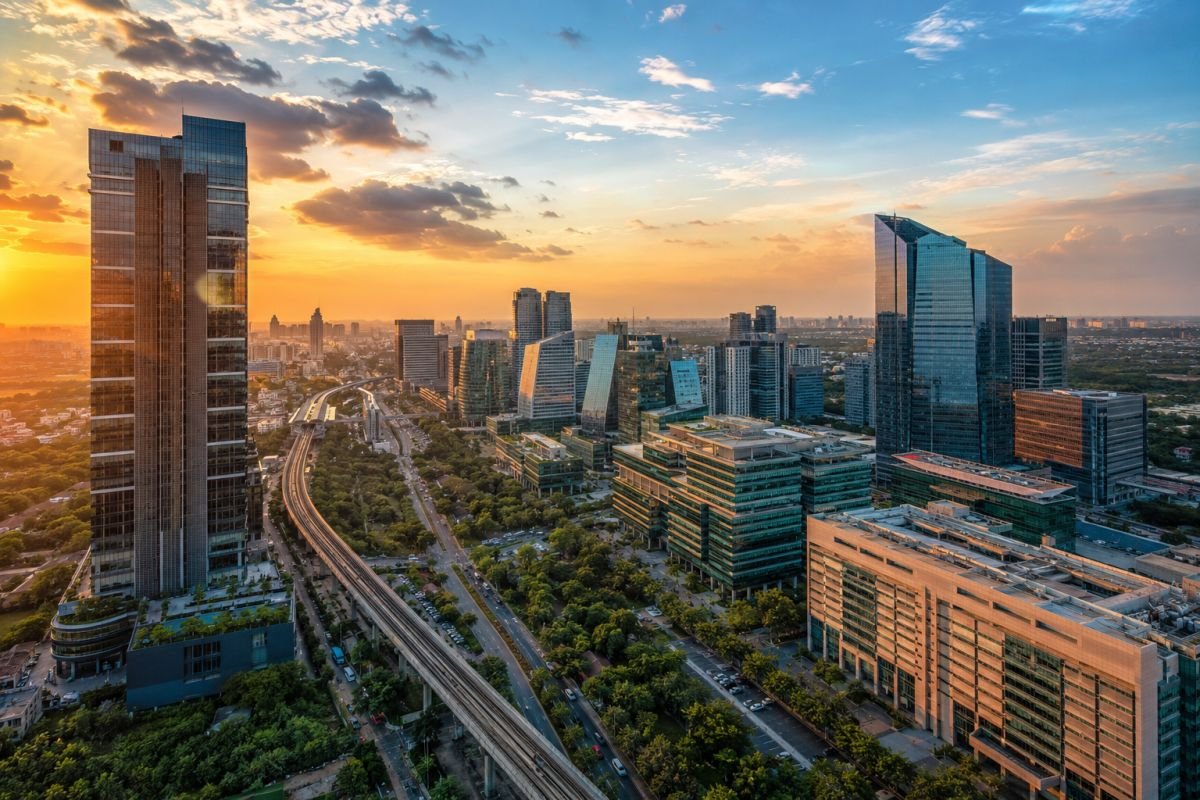
Gurgaon’s office market has entered a new phase in 2026. After years of post-pandemic adjustment, demand hasn’t just recovered — it has become more selective, more concentrated, and increasingly driven by a specific set of occupiers who know exactly what they want. Understanding office leasing trends in India’s National Capital Region is essential before making any investment or leasing decision.
In 2025, Delhi NCR recorded approximately 15.8 million square feet of office leasing, a 24% year-over-year increase and the highest annual volume on record. Gurugram alone captured 54% of all office leasing in the NCR region, cementing its position as the region’s undisputed commercial capital. But the headline numbers only tell part of the story. Beneath them lies a sharp divergence between corridors that are thriving and those that are still finding their footing.
This guide breaks down the 2026 Gurgaon office leasing landscape by occupier type, corridor, and investment implication — with data, not hype.
The State of Gurgaon’s Office Market in 2026
The Gurgaon office market in 2026 is defined by three characteristics: consolidation, quality bias, and corridor-specific demand.
Consolidation is the most visible trend. Companies are no longer spreading operations across multiple smaller offices. Instead, they are consolidating into fewer, larger, better-located buildings. This has concentrated leasing activity into a handful of premium corridors while leaving secondary locations with higher vacancies. The result is a two-tier market where prime assets command premium rents and near-full occupancy, while older stock faces longer leasing cycles.
Quality bias is equally pronounced. Grade A office spaces — those with large floor plates, advanced HVAC, 24/7 power backup, high-speed connectivity, and smart building systems — are absorbing the bulk of demand. Older buildings, even at lower rents, are struggling to compete. Green-certified buildings have become the default choice, accounting for 76–97% of leasing across major Indian cities in early 2026. For global occupiers with ESG mandates, certification is no longer a preference; it is a prerequisite.
Vacancy rates tell the story clearly. In prime corridors like Golf Course Road, vacancy has compressed to below 5%, while in emerging zones like the Dwarka Expressway corridor, supply still outpaces immediate demand. This gap between prime and secondary assets is where the real investment risk — and opportunity — sits. Infrastructure remains a key differentiator: the Rapid Metro, NH-48 connectivity, and proximity to IGI Airport strengthen established hubs, while planned metro extensions and the upcoming Jewar Airport are expected to gradually reshape peripheral corridors.
Office Leasing Trends: Who’s Driving Office Space Demand Gurgaon?
Understanding who is renting is as important as knowing where. In 2025–2026, Gurgaon’s tenant profile has shifted decisively toward three dominant categories.
Global Capability Centres — The Dominant Force in Commercial Leasing Gurgaon
Global Capability Centres have become the single largest driver of office demand in Gurgaon. In 2025, GCCs and managed workspaces together accounted for approximately 66% of total office demand in the city. These offshore centres — established by multinational corporations to manage technology, finance, data analytics, engineering, and customer support — are expanding rapidly across India. Gurgaon’s deep talent pool, direct airport connectivity, and mature corporate ecosystem make it a preferred destination.

GCCs typically sign long-term leases exceeding 100,000 square feet, often in campus-style developments. This creates stable, predictable rental income for landlords — but also means they are highly selective about building quality and scalability. Corridors like Golf Course Extension Road and the Southern Peripheral Road (SPR) corridor are seeing increased GCC interest due to availability of large floor plates at costs roughly 30% lower than Cyber City, combined with improving infrastructure.
IT/ITeS and BFSI — The Established Pillars
Information technology and IT-enabled services continue to form the backbone of Gurgaon’s office economy, contributing over 70% of the city’s economic activity. In Q1 2026, IT/ITeS accounted for approximately 29% of sectoral office demand across India, followed by BFSI at 16%. Technology firms alone leased nearly 22 million sq ft of conventional office space nationwide in 2025, creating sustained demand for high-density power and employee-centric amenities.
These sectors favour locations with established infrastructure and proximity to talent pools. Cyber City, Udyog Vihar, and MG Road remain their preferred addresses. However, as rentals in core locations have risen — Cyber City now commands ₹140–₹180 per sq ft per month — some mid-size IT and BFSI firms are exploring Golf Course Extension Road and Sohna Road for cost optimisation without compromising on Grade A specifications.
Flexible Workspace Operators — The Fastest-Growing Segment
Flexible workspaces have emerged as one of the defining trends of 2026. In Q1 2026, flexible workspace operators represented 32.9% of leasing activity in Delhi NCR. Nationwide, flex operators leased 5.56 million sq ft in Q1 2026, surpassing the quarterly average of the previous year. This marks a structural shift rather than a temporary pandemic response.
This surge reflects a fundamental change in how companies manage real estate. Rather than committing to long-term leases for fixed headcounts, businesses are using managed offices and co-working spaces as a strategic lever for portfolio agility. In Gurgaon, this has created strong demand for buildings that can accommodate plug-and-play formats, shared amenities, and scalable seat counts.
Where Are Companies Leasing? Corridor-Wise Breakdown

Gurgaon’s office market is not expanding evenly. Leasing activity is heavily corridor-driven, with distinct demand profiles emerging across micro-markets.
Gurgaon Office Leasing Trends 2026
Corridor-wise rental ranges, vacancy levels, tenant profiles, and investment outlook for commercial real estate in Gurugram.
| Corridor | Rental Range | Vacancy Level | Dominant Tenant Profile | Investment Outlook |
|---|---|---|---|---|
| Cyber City (DLF Phase 2–3) | ₹140–₹180 / sq ft / mo | Low (<5%) | MNCs, GCCs, IT majors | Highest stability, premium entry, strong liquidity |
| Golf Course Road | ₹120–₹160 / sq ft / mo | Low–Moderate (~5%) | Consulting, BFSI, corporates | Balanced returns with appreciation potential |
| Golf Course Extension Road | ₹80–₹120 / sq ft / mo | Moderate | Mid-size firms, growing GCCs | Growth corridor; careful asset selection needed |
| Sohna Road | ₹60–₹100 / sq ft / mo | Moderate–High | Startups, SMEs, back offices | Lower entry cost, higher tenant churn risk |
| Dwarka Expressway | Early stage | High | Future commercial demand | Long-term appreciation play, not immediate yield |
| New Gurgaon / SPR | ₹55–₹140 / sq ft / mo | Moderate–High | GCC campuses, logistics | Emerging; infrastructure-dependent |
Cyber City & Golf Course Road — The Prestige Markets
Cyber City and Golf Course Road remain Gurgaon's most coveted office addresses. With vacancy rates below 5% and rentals ranging from ₹120 to ₹180 per sq ft per month, these corridors offer the highest tenant stability and exit liquidity. Over 250 Fortune 500 companies have established offices in Gurgaon, and a significant concentration sits in this belt. Once companies move here, they rarely relocate, creating a sticky tenant base.
The trade-off is a high entry price. Grade A office investments here typically require budgets of ₹3 crore and above. For institutional investors and HNIs seeking capital preservation with steady yield, this remains the benchmark location. Liquidity is highest in core locations like Cyber City, where institutional buyers remain active — a critical factor when planning exit.
Golf Course Extension Road — The Value-Appreciation Corridor
Golf Course Extension Road has emerged as the bridge between prestige and affordability. Rentals here range from ₹80 to ₹120 per sq ft per month, roughly 30% lower than Cyber City, while offering comparable connectivity via NH-48. This corridor is attracting mid-size firms and GCCs looking for scalable space at better value.

For investors with budgets between ₹1 crore and ₹3 crore, carefully selected assets here offer a compelling risk-reward balance. The key caveat is asset selection: supply is increasing alongside demand, so not every building will perform equally. Focus on projects with established tenant traction and proximity to metro connectivity.
Sohna Road & SPR — The Emerging Hubs
Sohna Road and the Southern Peripheral Road (SPR) corridor represent Gurgaon's next wave of commercial expansion. Current rentals of ₹60–₹100 per sq ft per month attract cost-sensitive tenants — startups, SMEs, and back-office operations. However, tenant churn is higher here, and leasing cycles can be longer.
The SPR corridor is seeing interest from GCCs planning large campuses due to land availability and lower land costs. But immediate rental yields remain subdued compared to prime locations. Investors entering here should have a 5–7 year horizon and tolerance for initial vacancy risk.
Dwarka Expressway & New Gurgaon — The Future Play
The Dwarka Expressway corridor and New Gurgaon are still in early-stage commercial development. While residential activity has picked up significantly, Grade A office supply remains limited and demand is nascent. This makes these corridors more suited to long-term capital appreciation plays rather than immediate rental income strategies.
As metro connectivity expands and the Jewar Airport project progresses, commercial demand is expected to follow — but patience and precise asset selection are essential. For investors with a 7–10 year horizon, these corridors offer the highest capital appreciation potential.
Rental Yields, Vacancy & Investment Outlook
For investors evaluating office space investment opportunities in Gurgaon, the relationship between rental yield and vacancy risk is the critical metric.
Grade A office spaces in prime corridors currently generate annual rental yields of 6% to 8%. Secondary assets may advertise higher nominal yields, but frequent vacancy cycles and tenant turnover often erode effective returns. A stable 6–7% yield in Cyber City or Golf Course Road typically outperforms a volatile 8%+ yield in a location where leasing consistency is weak.

The market is also witnessing a pronounced "flight to quality." Green-certified assets, smart building technology, and flexible floor plates are no longer optional — they are prerequisites for attracting quality tenants. Buildings that lack these features face accelerated obsolescence risk.
Pre-leased commercial properties have gained significant traction among investors who prioritise predictable income. A pre-leased asset with a blue-chip tenant on a 5+ year lease offers both yield certainty and easier exit liquidity. In recent deals, there is a clear shift toward pre-leased assets: investors prefer predictable rental income over speculative appreciation.
What This Means for Office Investors in 2026
The Gurgaon office market in 2026 rewards precision and punishes generalisation. Here are the key implications:
- Demand is concentrated, not broad. Leasing activity is flowing into fewer, stronger buildings. Buying based on price alone — without verifying actual tenant demand — is the most common mistake.
- Corridor selection matters more than ever. Cyber City and Golf Course Road offer stability; Golf Course Extension Road offers growth; Dwarka Expressway and SPR offer long-term appreciation but require a longer holding period.
- Tenant quality drives returns. A single GCC or multinational tenant on a long lease provides more value than multiple small tenants with short tenures, even if the headline rent appears similar.
- ESG compliance is becoming mandatory. Green certification and smart building systems are increasingly required by global occupiers. Assets without these features will face rental discounts.
- Flex space is reshaping supply. Buildings with flexible floor plates and managed office compatibility are commanding rental premiums and lower vacancy rates.
Key Takeaways & Next Steps
Gurgaon's office leasing trends in 2026 paint a clear picture: the market is healthy, but selectively so. GCCs, IT/ITeS firms, and flexible workspace operators are driving record demand, but they are channelling that demand into specific corridors and building types. For investors, the opportunity lies in matching capital to the right micro-market and asset quality — not in chasing the lowest entry price.
If you are considering buying commercial property in Gurgaon or evaluating pre-leased commercial properties in Gurgaon, start with a corridor-level demand assessment. Understand who is renting, what they are paying, and how long they are staying. The data exists — and at AssuredGains, we track it continuously.

Speak with our advisory team to explore verified office investment opportunities across Cyber City, Golf Course Road, Golf Course Extension Road, and emerging corridors. Every listing we recommend is evaluated for tenant profile, lease structure, and location strength — so you invest with clarity, not guesswork.
Frequently Asked Questions
Q1: What is driving office space demand in Gurgaon in 2026?
Global Capability Centres (GCCs) are the dominant force, accounting for approximately 66% of demand alongside managed workspaces. IT/ITeS, BFSI, and flexible workspace operators are the other major drivers. GCCs favour Gurgaon for its talent pool, airport connectivity, and mature corporate ecosystem.
Q2: How is commercial leasing in Gurgaon changing in 2026?
Commercial leasing is becoming more selective and corridor-concentrated. Companies are consolidating into fewer, larger, Grade A buildings with green certification and smart infrastructure. Flexible workspaces now represent over 30% of Delhi NCR leasing, reflecting a structural shift toward agile portfolio strategies.
Q3: What are the current office leasing trends in Gurgaon?
The key trends are: (1) flight to quality with Grade A and green-certified buildings capturing most demand; (2) GCC-led large-format leasing; (3) rapid flex-space expansion; (4) vacancy compression in prime corridors like Golf Course Road; and (5) emerging demand in Golf Course Extension Road and SPR.
Q4: Which corridor offers the best rental yield for office investment in Gurgaon?
Cyber City and Golf Course Road offer the most stable 6–8% yields with lowest vacancy risk. Golf Course Extension Road offers a balance of yield and appreciation. Dwarka Expressway and SPR are long-term appreciation plays rather than immediate yield generators.
Q5: Is pre-leased office space a safe investment in Gurgaon?
Pre-leased office space is generally safer than speculative purchases because it provides immediate rental income and reduces vacancy risk. The safety increases further when the tenant is a blue-chip GCC or multinational with a long-term lease. Always verify lease terms, escalation clauses, and building compliance before investing.

Join The Discussion