

Gurgaon has evolved into one of India’s most structured and data-driven real estate markets. Unlike speculative Tier-2 cities, price movement here is shaped by corporate leasing, infrastructure delivery, rental absorption, and micro-market supply cycles.
Yet investors remain divided:
Should you hold property long term for steady appreciation and rental income, or attempt short-term gains through launches and infrastructure announcements?
The answer in 2026 is no longer theoretical. It depends on sector selection, entry pricing, holding power, and rental yield alignment.
This guide breaks down what actually works in Gurgaon — based on micro-market behavior, not generic pros and cons.
Understanding Gurgaon’s Real Estate DNA Before Choosing a Strategy
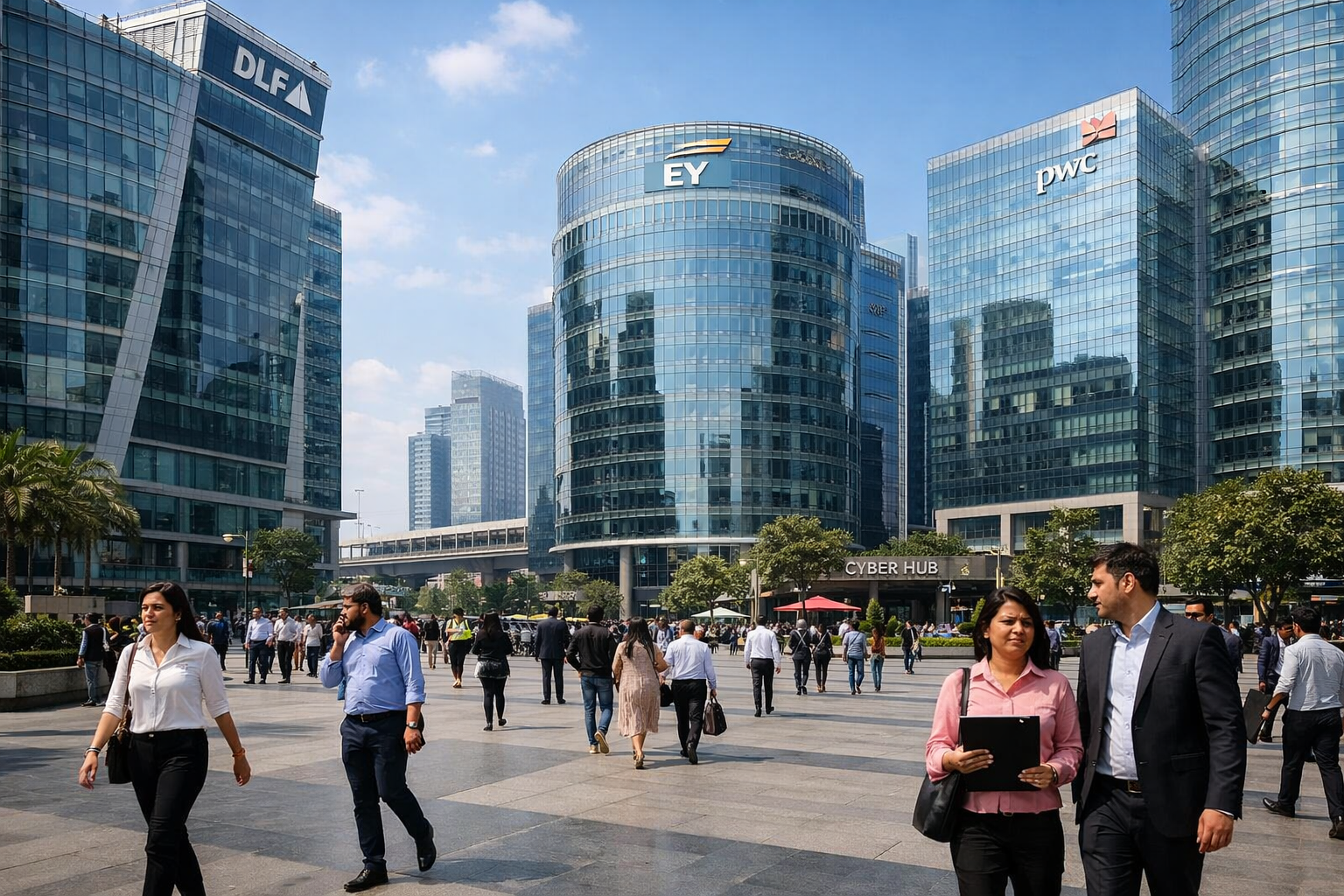
Gurgaon is employment-driven, not population-driven.
Price stability depends on:
- Office absorption
- Corporate hiring cycles
- Infrastructure execution (not announcements)
- Tenant demand sustainability
That’s why long-term wealth creation has historically outperformed short-term speculation across most corridors.
During previous slowdowns (2013–2018), investors who held quality assets in established zones recovered strongly once commercial leasing revived. Short-term flippers, however, struggled with liquidity and exit friction.
Understanding this structural difference is critical before committing capital.
What Long-Term Property Investment Means in Gurgaon
Long-term investment typically involves holding property for 7–15 years, focusing on:
- Capital appreciation
- Rental income stability
- Wealth preservation
- Lower transaction friction
In Gurgaon, this strategy works best in corridors with sustained tenant demand and strong social infrastructure.
Established zones like Golf Course Road, rental-heavy pockets near Sector 54, and mature segments of Sohna Road have historically delivered resilient price growth.
On Golf Course Extension Road, mid-premium belts around Sector 67 and 63A continue to show steady ROI driven by livability, connectivity, and corporate proximity.
In New Gurgaon, sectors such as 82 and 83 benefit from gradual absorption and improving infrastructure, making them suitable for patient capital.
Advantages of Long-Term Property Investment in Gurgaon
1. Risk Mitigation Across Cycles
Long-term investors ride through market slowdowns. Gurgaon’s appreciation is rarely explosive — but when infrastructure and leasing cycles align, growth becomes meaningful.
2. Rental Yield Cushion
In 2026, average rental yield in Gurgaon ranges between 2.8% to 4.2%, depending on segment and location.
Mid-premium sectors such as 65 and 62 often generate stronger rental returns compared to ultra-luxury assets on Golf Course Road, where capital appreciation dominates over yield.
This rental income improves EMI servicing capacity and reduces exit pressure.
3. Tax Efficiency
Long-term capital gains taxation with indexation significantly improves post-tax ROI compared to short-term resale.
4. Reduced Exit Pressure
You are not dependent on perfect timing. Wealth builds gradually.
Limitations of Long-Term Investing (What Most Investors Ignore)
Long-term investing is not automatically safe.
Poor project selection, oversupply in specific pockets, or weak developer execution can suppress returns for years.
For example, sectors with heavy launch concentration but slow absorption can underperform despite infrastructure headlines.
Success depends on:
- Micro-location strength
- Rental demand sustainability
- Developer credibility
- Supply discipline
Holding alone does not guarantee growth. Holding the right asset does.
What Short-Term Property Investment Looks Like in Gurgaon

Short-term investment typically involves 1–3 year holding periods, targeting gains from:
- Pre-launch discounts
- Early-launch entry pricing
- Infrastructure visibility
- Sentiment-driven demand
This strategy requires precision.
In corridors like Dwarka Expressway, particularly sectors such as 102 and 37D, short-term gains have historically depended more on construction progress and connectivity milestones than on announcement-driven hype.
Investors who entered during early stages in 2023–2024 saw appreciation only after visible road completion and possession clarity — not merely after project marketing campaigns.
Why Short-Term Property Investment Is Risky in Gurgaon
Unlike stock markets, real estate lacks daily liquidity.
Short-term investors face:
- Limited buyer availability
- High transaction costs (stamp duty, brokerage, taxation)
- Possession delays
- Market absorption uncertainty
Infrastructure-led appreciation in Gurgaon takes time. Metro extensions, commercial leasing growth, and expressway completion do not convert into immediate price spikes.
If your strategy depends on quick resale to generate profit, you are exposed to liquidity risk.
When Short-Term Property Investment Can Work
Short-term investing is not impossible — but highly selective.
It may work if:
- Entry pricing at pre-launch offers an 8–12% advantage over possession-stage inventory within the same micro-market
- The project is nearing completion with visible demand
- New supply pipeline is limited
Pre-launch investment in Gurgaon can create upside when pricing inefficiencies exist — but it requires deep market access and risk tolerance.
It is not suitable for first-time investors dependent on leverage.
Rental Income: The Deciding Factor Most Investors Ignore
One of the biggest differences between long-term and short-term strategies is rental cushioning.
Long-term investors benefit from sustained tenant demand driven by:
- Corporate professionals
- Proximity to office corridors
- Social infrastructure depth
Short-term investors rarely rely on rental income. Their returns depend almost entirely on capital appreciation.
In a market like Gurgaon, where price movement is gradual and liquidity selective, ignoring rental yield increases portfolio risk.
Best Sectors for Long-Term Investment in Gurgaon (2026 View)
Certain micro-markets structurally favor long holding:
Sector 54 – Premium stability with mature rental ecosystem
Sector 67 & 63A – Mid-premium growth with improving connectivity
Sector 82 & 83 – Strong rental absorption in New Gurgaon
Sector 37D & 102 (Dwarka Expressway) – Infra-led long-hold thesis as connectivity strengthens
These sectors combine tenant demand, infrastructure visibility, and absorption depth — the three pillars of sustainable appreciation.
Long-Term vs Short-Term: Which Strategy Fits You?
Long-Term Investment Suits:
- Salaried professionals
- First-time investors
- Buyers seeking stable wealth creation
- Investors relying on rental income
Short-Term Investment Suits:
- High-risk investors
- Those with surplus capital
- Investors who can absorb illiquidity and delays
- Market participants with early access to pricing stages
Most investors overestimate their risk appetite and underestimate market friction.
Why Long-Term Investment Continues to Win in Gurgaon
Historically, Gurgaon has rewarded patient capital more than speculative capital.
From Golf Course Road’s maturity cycle to the gradual rise of Golf Course Extension Road and now the structural build-out of Dwarka Expressway, appreciation has followed:
- Infrastructure execution
- Commercial leasing growth
- Rental demand stability
Not hype.
Wealth in Gurgaon is built quietly — through holding quality assets across multiple cycles.
How to Choose the Right Strategy
Your decision should depend on:
- Investment horizon
- Income stability
- Ability to service EMIs without rental dependency
- Risk tolerance
- Liquidity needs
If profitability depends on selling quickly, short-term strategy carries elevated risk.
If you can hold through cycles and benefit from rental cushioning, long-term investment offers stronger probability-adjusted returns.
For deeper corridor-level insights, explore our detailed Dwarka Expressway sector-wise price analysis including 3BHK entry rates and investment outlook for 2026.
Final Verdict: Long-Term vs Short-Term Property Investment in Gurgaon
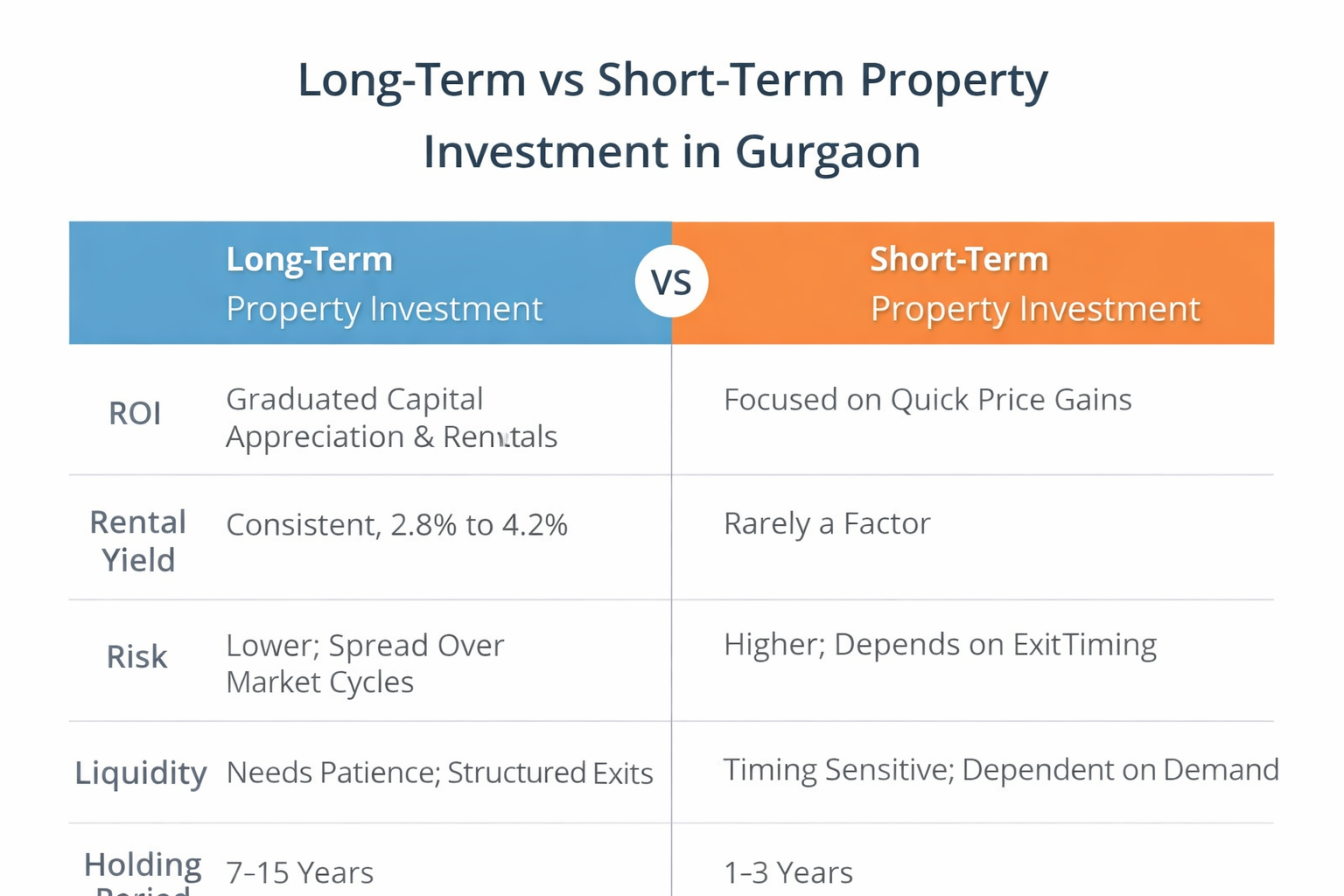
For most investors in 2026, long-term property investment in Gurgaon remains the smarter, more resilient strategy.
Short-term investing can work in narrow windows where entry pricing inefficiencies exist — but it requires experience, capital flexibility, and risk acceptance.
Gurgaon is not a market of overnight spikes.
It is a market of structured growth, rental depth, and infrastructure-backed appreciation.
And in such a market, patience compounds better than speculation.
FAQs: Long-Term vs Short-Term Property Investment in Gurgaon (2026)
Is long-term property investment still profitable in Gurgaon in 2026?
Yes, long-term property investment in Gurgaon continues to remain profitable in 2026, especially in sectors with sustained rental demand and infrastructure maturity. Unlike speculative cycles of the past, price growth in Gurgaon now follows commercial absorption and connectivity improvements. Investors holding quality assets in established corridors such as Golf Course Extension Road, Sector 65, and parts of New Gurgaon have seen gradual but stable appreciation combined with rental income support. Profitability depends more on micro-market strength and holding capacity than on timing the market.
Can you realistically make short-term profit from property in Gurgaon?
Short-term profit in Gurgaon is possible but highly selective. Gains typically occur when investors enter at early-launch pricing and exit closer to possession, provided infrastructure progress and buyer demand are visible. However, the market does not move rapidly like equities, and transaction costs reduce margins. In sectors along Dwarka Expressway such as 102 and 37D, appreciation has historically aligned with construction progress rather than announcements. Without pricing advantage and liquidity planning, short-term investing carries significant risk.
What is the average rental yield in Gurgaon and which areas perform better?
In 2026, average rental yield in Gurgaon typically ranges between 2.8% and 4.2%, depending on property type and location. Mid-premium sectors such as 65, 62, and 82 generally produce stronger rental returns compared to ultra-luxury projects on Golf Course Road, where appreciation potential often outweighs yield percentage. Investors focusing on rental income should evaluate tenant demand depth, corporate proximity, and inventory supply rather than headline price growth alone.
Is Dwarka Expressway better suited for long-term or short-term investment?
Dwarka Expressway is structurally more suited for long-term holding, although selective short-term opportunities may arise during early pricing stages. Appreciation in sectors like 102 and 37D has historically depended on infrastructure execution, metro connectivity, and possession timelines rather than marketing-driven sentiment. Investors entering with a multi-year horizon aligned with infrastructure delivery cycles are generally better positioned than those targeting rapid resale.
How do I decide between long-term and short-term property investment in Gurgaon?
The decision should depend on investment horizon, income stability, risk tolerance, and liquidity needs. If you require predictable rental income and can hold property through market cycles, long-term investment typically offers stronger probability-adjusted returns. If you have surplus capital, early access to launch pricing, and the ability to absorb delays or exit friction, short-term investing may be considered. Most investors benefit more from stable holding strategies than from attempting to time micro-cycles.




Join The Discussion