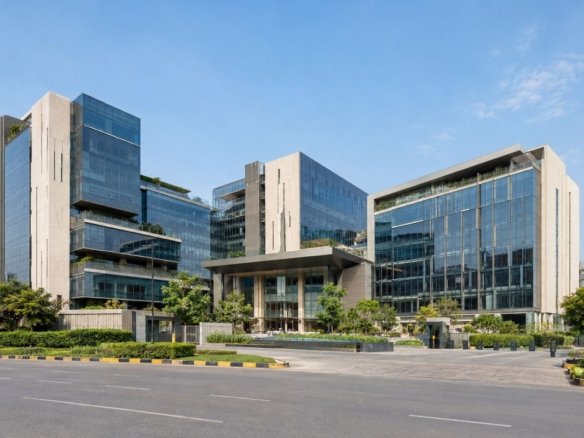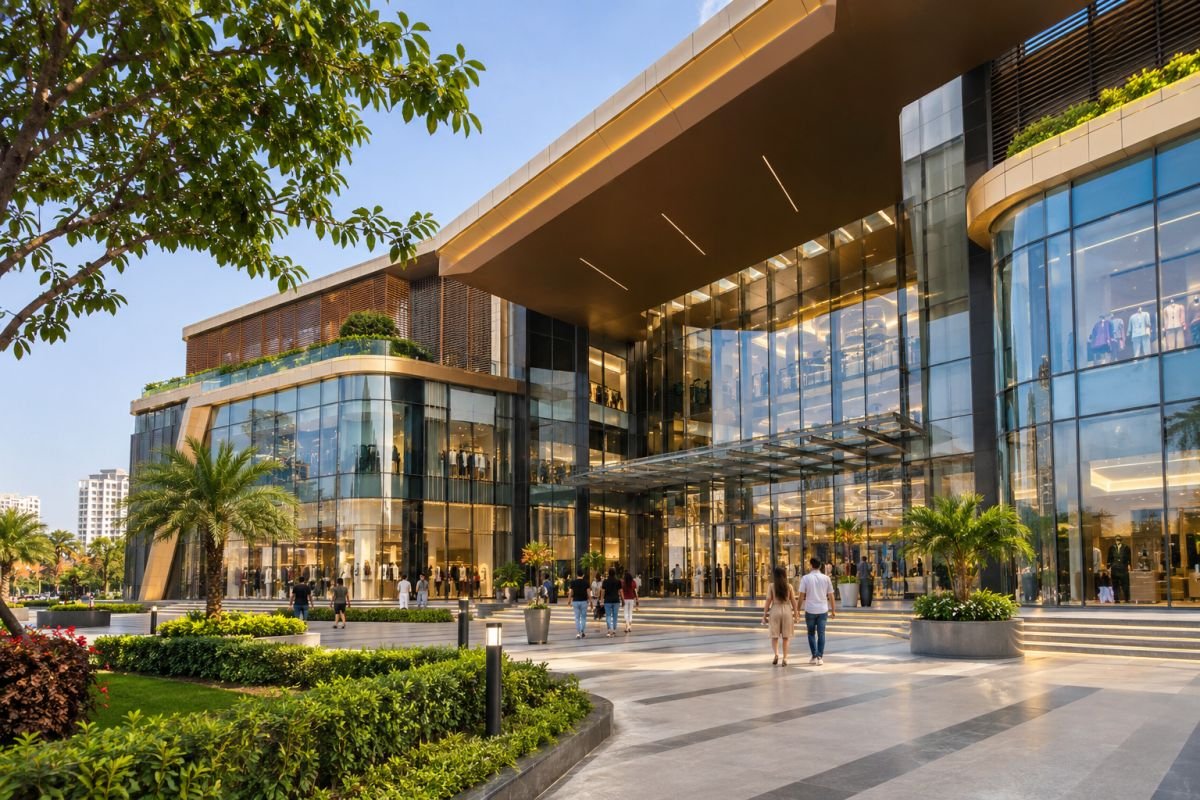
Elan Imperial is a large-format commercial development spread across approximately 7.6499 acres in Sector 82, Gurgaon. Developed by Elan Imperial Pvt. Ltd., the project is positioned as an organised retail and entertainment destination for New Gurgaon. Its proposed commercial mix includes retail spaces, food and beverage outlets, restaurants, entertainment and hospitality-oriented facilities.
The project’s investment proposition is different from that of a conventional neighbourhood shopping complex. A mall-based development depends on a combination of residential demand, destination visits, anchor tenants, internal circulation and professional property management. A large development area alone does not guarantee strong customer footfall or rental income.
Elan Imperial is registered under HRERA number GGM/788/520/2024/15, with project ID RERA-GRG-1508-2023. Its registration was approved on 21 February 2024, and the declared completion date is 31 December 2028. The registered land area is 7.6499 acres, with three basement levels and proposed parking provision of 1,610 equivalent car spaces.
| Project detail | Information |
|---|---|
| Project | Elan Imperial |
| Developer | Elan Imperial Pvt. Ltd. |
| Location | Sector 82, Gurgaon, Haryana |
| Development type | Commercial / mall-oriented development |
| Registered land area | 7.6499 acres |
| HRERA number | GGM/788/520/2024/15 |
| Project ID | RERA-GRG-1508-2023 |
| Registration date | 21 February 2024 |
| Declared completion | 31 December 2028 |
| Basement levels | Three |
| Proposed parking | 1,610 ECS |
The sanctioned development records an achieved FAR of 175%. The proposed parking provision is relevant for a destination-oriented retail property, although buyers should verify the final parking arrangement and applicable building approvals before purchasing.
Elan Imperial is better understood as a mall-led commercial investment than as a high-street retail project. Its performance will depend on the quality of its tenant mix, the presence of anchor businesses, accessibility and the ability to attract customers beyond the immediate neighbourhood.
3-Km Residential Catchment & Daily Footfall Drivers in Sector 82
The commercial potential of Elan Imperial depends partly on the residential population living around Sector 82 and adjoining sectors. Nearby communities can generate demand for grocery stores, pharmacies, cafés, restaurants, personal-care services and other retail businesses. However, the total number of residential units in a locality should not be confused with its active customer base.
Residential developments in the surrounding ecosystem include Vatika The Seven Lamps, Vatika Signature Two, Vatika Signature Villas, Vatika Lifestyle Homes, Vatika City Homes, Mapsko Casa Bella and Universal Aura. Their actual contribution to the project’s catchment depends on road connectivity, distance, occupancy and the availability of competing retail options. Not every development should automatically be counted within a precise three-kilometre radius.
For commercial investment analysis, delivered and occupied apartments are more important than the total number of sanctioned units. A completed apartment with an active household can generate recurring consumption, whereas an under-construction or vacant unit contributes little to current retail demand. A reliable catchment estimate therefore requires society-wise occupancy information and a road-based location assessment.
The immediate residential catchment is most relevant to convenience retail and daily services. The wider two-to-three-kilometre trade area may support restaurants, specialist retail and destination-oriented businesses, provided that the project offers a reason for customers to visit.
Footfall will also depend on the type of business operating inside the development. A pharmacy or convenience store relies on repeat local purchases, while a restaurant or entertainment operator may attract customers from a wider area. Employment-related movement through the broader NH-48 and Manesar corridor could add weekday demand, but the extent of that demand will depend on accessibility and competing commercial destinations.
The important distinction is between potential catchment and actual footfall. Residential density creates an opportunity; tenant mix, accessibility, competition and customer experience determine whether that opportunity translates into sustainable retail sales.
Floor-Wise Layout Analysis: Ground-Floor Frontage vs Upper-Floor Zoning
Floor selection is one of the most important decisions for a commercial property investor. Ground-floor units generally have an advantage in visibility and direct customer access, while upper-floor spaces depend more on destination visits, vertical circulation and the type of businesses operating within the mall.
Elan Imperial’s advertised configuration includes retail-oriented lower-ground and upper retail levels, with food court, restaurant and entertainment uses positioned on higher floors. These uses should be checked against the latest sanctioned plans and the permitted use of the specific unit before purchase.
| Floor | Advertised positioning | Main investment consideration |
|---|---|---|
| Lower ground | Retail | Access and internal circulation |
| Ground | Triple-height retail | Frontage and visibility |
| First floor | Retail | Escalator and lift access |
| Second floor | Retail | Tenant mix and customer movement |
| Third floor | Food court | Dining demand and seating |
| Fourth floor | Restaurants | Destination dining |
| Fifth floor | Entertainment | Anchor tenants and visitor traffic |
Ground-floor units are generally more suitable for conventional retail categories such as fashion, convenience stores, showrooms, cafés and selected service businesses. Their leasing prospects improve when they have visible frontage, practical shop dimensions, convenient access and good positioning along customer movement routes. However, a ground-floor label does not automatically make every unit equally valuable. An internally located shop with poor visibility may perform differently from a unit facing a prominent entrance or circulation area.
Upper-floor units require a more specific leasing strategy. Customers are less likely to visit them through spontaneous browsing, so businesses need a clear reason to attract visitors. Restaurants, food outlets, specialist retailers and entertainment operators may work on these floors when the overall mall experience supports their customer requirements.
For investors, the right comparison is not simply ground floor versus upper floor. It is the relationship between the unit’s purchase price, visibility, permitted use, access, likely tenant profile and expected lease-up period. A discounted upper-floor unit may be worth considering, but only if the price compensates for its potentially narrower tenant pool and higher vacancy risk.
2026 Capital Values, Lease Rental Benchmarks & Net Yield Math
The financial case for Elan Imperial should be evaluated using the all-in acquisition cost and realistic contractual rent. A confirmed floor-wise price list and verified executed lease rates are necessary before calculating a project-specific rental yield. Advertised entry prices or projected returns should not be treated as evidence of achievable income.
Commercial units can differ significantly in price because of their floor, frontage, size, configuration and location within the development. A buyer should compare the basic sale price with the carpet area, chargeable area, preferential location charges, parking costs, taxes, stamp duty, registration and maintenance deposits. The total amount invested—not just the quoted base price—should be used in the yield calculation.
Gross vs Net Rental Yield
Gross rental yield measures annual contractual rent against the total acquisition cost. Net rental yield accounts for expenses and income losses that reduce the amount actually received by the owner. These can include owner-borne common area maintenance (CAM), property tax, vacancy, brokerage, repairs and rent-free fit-out periods.
Consider a hypothetical 500 sq. ft. commercial unit purchased at an all-in cost of ₹1.50 crore. The following model illustrates how different monthly rent assumptions affect its gross and net yield. These rental figures are modelling inputs, not verified Elan Imperial lease rates.
| Monthly rent assumption | Annual gross rent | Gross yield |
|---|---|---|
| ₹60 per sq. ft. | ₹3,60,000 | 2.40% |
| ₹80 per sq. ft. | ₹4,80,000 | 3.20% |
| ₹100 per sq. ft. | ₹6,00,000 | 4.00% |
If owner-borne expenses, vacancy and leasing allowances together consume an illustrative 15% of gross rent, the estimated net yields become 2.04%, 2.72% and 3.40%, respectively. This deduction is only a modelling assumption, not a confirmed expense ratio for the project. The calculation also excludes financing costs and income tax.
CAM deserves particular attention because it may include security, housekeeping, common utilities, lift maintenance and facility management. Buyers should confirm the applicable rate, the area on which it is charged, whether tenants pay it separately and who bears the expense when a unit is vacant. Property tax should also be checked against the unit’s applicable commercial classification and the relevant municipal assessment.
Fit-out periods can delay rental income even after a lease is signed. The possession date, tenant’s fit-out commencement date and contractual rent commencement date are three separate milestones. Investors should account for this period when estimating their first-year cash flow.
Self-Use Business vs Pure Leasing ROI
A business owner and a rental investor evaluate commercial property differently. A business owner may value location control, operational convenience and the ability to avoid paying rent to another landlord. A pure leasing investor is more concerned with contractual income, vacancy, operating costs and resale liquidity.
Buying may suit a business expecting to operate from the same location for several years and having sufficient capital. Leasing may be more practical for businesses that need flexibility or want to test demand in a new market. For a passive investor, avoided rent should not be counted as rental income. The decision must be based on the actual net operating income generated by the property relative to the capital invested.
HRERA Compliance, Completion Timeline & Vacancy Risk Assessment
Elan Imperial is registered under HRERA number GGM/788/520/2024/15, with a declared completion date of 31 December 2028. Registration establishes the project’s regulatory identity; it does not mean construction is complete, possession has been granted or an Occupation Certificate has been issued.
Before purchasing, investors should verify the latest registration details, amendments, sanctioned building plans, construction progress and the permitted use of the selected unit. The applicable Occupation Certificate, Completion Certificate, fire approvals and other statutory permissions should be checked before taking possession or commencing business operations.
Mortgage-related disclosures also make lender documentation important. Buyers should obtain written clarification of any existing security over project land or receivables and confirm whether a lender NOC or unit-specific release document is required. Title, conveyance, maintenance and transfer conditions should be reviewed before making substantial payments.
Vacancy is another material consideration. If surrounding residential projects take longer to reach meaningful occupancy, initial retail demand may remain below expectations. Competition from other commercial developments can divide customer spending and make tenant acquisition more difficult. Upper-floor units may face additional leasing pressure if anchor tenants or destination businesses fail to generate consistent visitor movement.
Construction and operational execution also matter. Parking, common areas, lifts, security, maintenance, signage and internal circulation all influence the experience of customers and tenants. Investors should model a gradual leasing scenario and an extended-vacancy scenario rather than relying exclusively on optimistic rental projections.
Final Verdict: Who Should Invest in Elan Imperial Sector 82 Gurgaon?
Elan Imperial is worth evaluating for buyers seeking exposure to organised commercial retail in New Gurgaon, particularly those comfortable with mall-based leasing and a medium-to-long-term holding period. Its registered development area, residential surroundings and proposed retail, dining and entertainment mix create a commercial proposition. However, these factors do not establish a guaranteed level of footfall, rental income or capital appreciation.
The project may suit long-term commercial investors who can tolerate construction and lease-up risk, retail businesses looking for a physical presence in Sector 82, and HNI buyers comparing commercial assets across New Gurgaon. Ground-floor units with strong frontage may be more suitable for conventional retail leasing, while upper-floor units require closer examination of tenant demand and destination traffic.
Investors who need immediate rental income, depend on advertised return schemes or are stretching their budgets based on assumed appreciation should exercise caution. The purchase decision should be based on the specific unit’s all-in cost, permitted use, location, likely tenant profile, operating expenses and realistic vacancy assumptions.
| Investment factor | Assessment |
|---|---|
| Location | New Gurgaon residential-commercial corridor |
| Registered land area | 7.6499 acres |
| Residential catchment | Potential demand; exact occupied population unverified |
| Ground-floor leasing | Depends on frontage and visibility |
| Upper-floor leasing | Depends on destination demand and tenant mix |
| Project-specific rental yield | Not independently established |
| Declared completion | 31 December 2028 |
| Occupation Certificate | Requires verification |
| Vacancy risk | Relevant during construction and lease-up |
The key investment question is whether the selected unit can generate sustainable net rental income at a price that adequately compensates for construction, vacancy and operational risks. A large commercial development is not automatically a strong investment; the unit-level economics matter more than the project headline.
For a project-specific evaluation, buyers should request the latest floor plans, written unit pricing, CAM schedule, availability details and applicable regulatory documents before committing capital.
Frequently Asked Questions
1. What is the realistic rental yield of Elan Imperial Sector 82 Gurgaon in 2026?
A verified project-specific rental yield has not been established. Investors should calculate gross and net yield using the actual purchase quotation, comparable contractual rents, CAM, property tax, vacancy and fit-out costs. Ground-floor visibility may support leasing prospects, but no rental rate or return is guaranteed.
2. How large is the residential catchment around Elan Imperial?
The surrounding residential ecosystem includes communities associated with Vatika, Mapsko and other developments in the adjoining sectors. However, a verified occupied-population count within an exact three-kilometre radius is unavailable. A society-wise occupancy and accessibility assessment is needed before assigning a population figure.
3. Which floor is best for investment in Elan Imperial?
Ground-floor units with prominent frontage and convenient customer access generally have an advantage for conventional retail leasing. Upper floors may suit restaurants, specialist retailers and entertainment businesses, but their performance depends more heavily on destination footfall and the tenant mix.
4. What are the CAM charges, property tax and lock-in terms?
The exact CAM schedule and unit-specific property-tax liability need confirmation. Commercial lease lock-in periods are negotiated between landlords and tenants; there is no single universal term for Sector 82. Buyers should review the lease agreement, rent escalation, security deposit, rent-free period and maintenance responsibilities.
5. Which documents should investors verify before buying?
Buyers should check HRERA registration GGM/788/520/2024/15, the latest amended registration, sanctioned building plans, applicable Occupation and Completion Certificates, fire approvals, title documents, mortgage disclosures and lender NOCs or unit-release conditions.
6. What is the declared completion date of Elan Imperial?
The declared completion date recorded for the project is 31 December 2028. This is a registered project timeline, not proof of actual completion or permission to occupy. Buyers should verify the relevant approvals before taking possession or starting operations.