
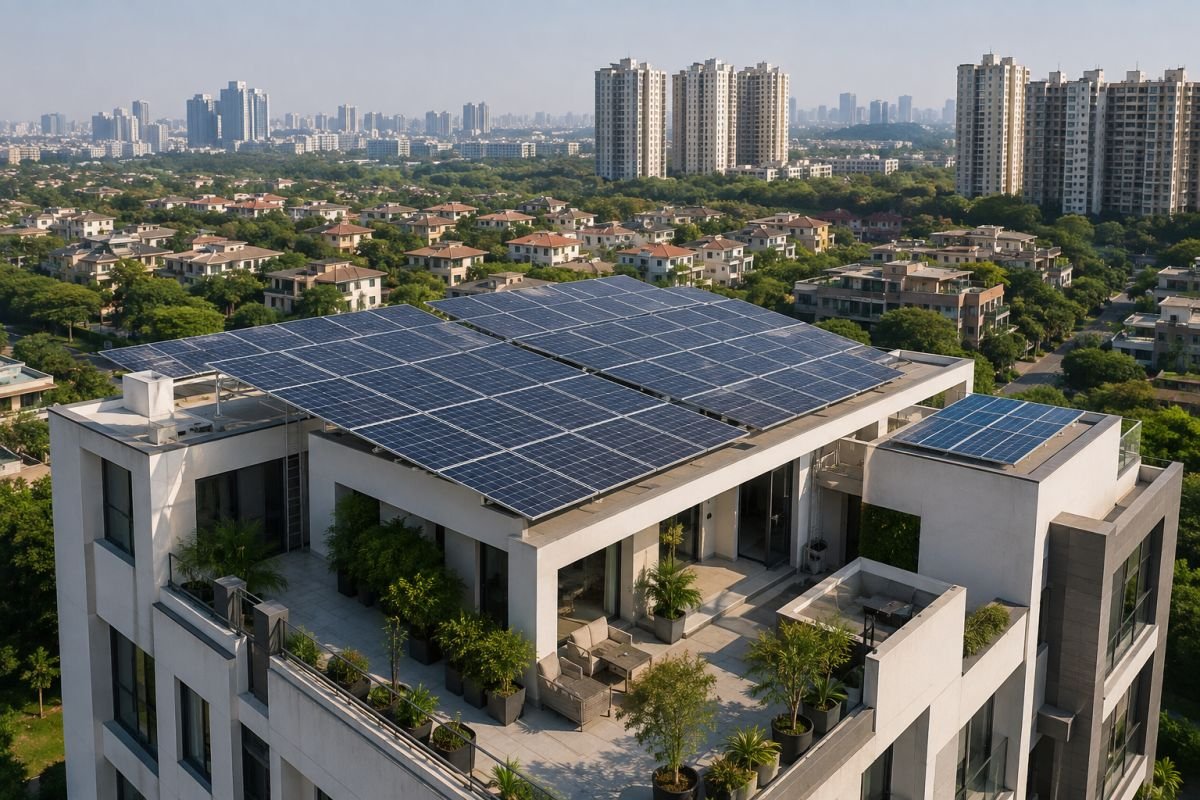
Gurgaon’s relentless summer sun and spiralling electricity tariffs have made solar rooftop Gurgaon installations one of the most practical upgrades for homeowners across the city’s premium corridors. Whether you own a 4BHK overlooking the Aravallis on Golf Course Extension Road or a family apartment near the Dwarka Expressway, adding photovoltaic panels to your terrace is no longer just an environmental statement—it is a calculated financial move.
In this guide, we break down real numbers. You will learn what a solar panel home cost India benchmark looks like for Gurugram properties, how much you can expect to save on monthly bills, and how to calculate the true return on investment. No inflated claims, no greenwashing—just the data you need to decide whether solar fits your property strategy.
Why Gurgaon’s Climate and Policy Favour Rooftop Solar
Solar Irradiance and Weather Patterns
The National Capital Region receives some of the highest solar irradiance in North India, with Gurugram averaging roughly 5.4 to 5.7 peak sun hours daily. That translates into reliable generation for eleven months of the year, with only the monsoon weeks causing a significant dip. For properties on the Golf Course Extension Road or along SPR, where rooftop shadowing from neighbouring towers is often minimal, this resource is especially accessible.

Net Metering and Regulatory Support
Haryana’s net-metering regulations allow residential consumers to export surplus power back to the grid and receive adjusted credits on their electricity bills [verify: current HERC net metering tariff order]. For owners in gated communities, this means a properly sized system can zero out a ₹5,000–₹8,000 monthly bill during peak summer, while banking credits for winter months when air-conditioning load drops.
Subsidy Landscape
The Haryana Renewable Energy Development Agency (HAREDA) processes subsidy claims for grid-connected rooftop systems under the MNRE scheme [verify: current MNRE CFA rates and eligibility]. These incentives, combined with falling module prices over the last five years, have narrowed the payback window to four to six years for most mid-size residential installations.
Solar Rooftop Gurgaon: System Sizing and Upfront Investment
System pricing depends on panel grade (mono-perc vs. polycrystalline), inverter type (string vs. hybrid with battery backup), mounting structure height, and vendor credentials. The table below gives a realistic range for turnkey installations in the best sectors in Gurgaon as of 2026 [verify: current market rates from local installers].
| System Size | Approx. Cost (₹) | Monthly Generation* | Ideal For |
|---|---|---|---|
| 3 kW | ₹1,20,000 – ₹1,50,000 | 360–420 units | 2–3 BHK, low AC usage |
| 5 kW | ₹1,90,000 – ₹2,40,000 | 600–700 units | 3–4 BHK, moderate AC |
| 8 kW | ₹3,00,000 – ₹3,60,000 | 960–1,100 units | Large 4 BHK, home office |
| 10 kW | ₹3,70,000 – ₹4,50,000 | 1,200–1,400 units | Villa, penthouse, EV charging |
*Based on 4.5–5.5 equivalent peak sun hours in Gurugram; actual output varies by roof orientation and shading [verify: exact irradiance data for Gurgaon district].
Solar Panel Home Cost India: Factors That Move the Needle
While the table above captures turnkey averages, several variables shift the final quote. Mono-perc modules with higher efficiency ratings cost 10–15 percent more but require less roof area, a critical constraint in high-rise apartments. Hybrid inverters with battery backup add ₹60,000–₹1,20,000 depending on storage capacity, yet they provide continuity during grid outages—a frequent concern in developing sectors along the New Gurgaon corridor.

Subsidies can reduce the upfront outlay by up to 40 percent on the first 3 kW and 20 percent on capacity between 3 kW and 10 kW under the current MNRE residential rooftop scheme. However, many premium installers in sectors like 63A, 65, or 79 offer Tier-1 mono-perc modules that fall outside the empanelled vendor list. If you prioritise efficiency and warranty over subsidy capture, budget an additional 15–20 percent for top-tier hardware.
Rooftop Solar Savings: Real Numbers for Gurugram Residences
The financial case rests on two pillars: avoided Discom payments and net-metering credits. Dakshin Haryana Bijli Vitran Nigam (DHBVN) residential tariffs in Gurgaon operate on a rising slab structure, with rates crossing ₹7.5 per unit for consumption above 800 units monthly [verify: current DHBVN tariff schedule]. This means the marginal benefit of solar is highest for large homes that routinely breach the higher slabs.

Consider a 5 kW system generating 650 units monthly:
- Self-consumption: 450 units (offset at ₹7.5/unit) = ₹3,375 saved
- Export to grid: 200 units (credited at ₹3.5–₹4.5/unit) [verify: current DHBVN net metering credit rate] = ₹700–₹900 adjusted
- Total monthly benefit: ₹4,100–₹4,300
- Annual benefit: ₹49,000–₹51,600
Over a 25-year panel lifespan, cumulative savings can exceed ₹12–14 lakh, even after accounting for inverter replacement in year 10–12 and gradual efficiency degradation of 0.5–0.8 percent annually. For villas or penthouses running 10 kW systems with EV charging loads, rooftop solar savings can approach ₹8,000–₹10,000 per month during summer.
ROI, Payback, and Property Value Impact
Simple Payback and IRR
A standard 5 kW installation costing ₹2.2 lakh and delivering ₹50,000 in annual savings achieves simple payback in roughly 4.4 years. From year five onward, the system generates effectively free electricity, yielding an internal rate of return (IRR) in the range of 18–22 percent—far superior to most fixed-income instruments and comparable to long-term equity averages, but with lower volatility.
Impact on Capital Appreciation
A solar-ready roof is increasingly becoming a differentiator in resale conversations, particularly in the luxury segment. Buyers comparing two identical apartments will favour the one with pre-installed net metering and reduced operating costs. While quantifying the exact premium requires transaction-level data, the trend suggests solar adds to the overall capital appreciation outlook of well-maintained properties in high-visibility corridors.

Rental Yield Considerations
For investors, solar offers a subtle but meaningful edge in rental yield analysis. Tenants in the ₹40,000-plus monthly rent bracket often negotiate inclusive maintenance or power clauses. A landlord with near-zero grid dependence can absorb minor rent negotiations without eroding net operating income. In competitive micro-markets along SPR or the Dwarka Expressway, this operational efficiency protects yield during vacancies or tenant transitions.
Technical and Compliance Checklist
Roof Orientation and Structural Load
Concrete roofs in most Gurugram high-rises can easily support aluminium railing-mounted panels (15–20 kg/m²). However, older low-rise constructions should undergo a structural assessment before adding ballasted systems [verify: standard structural load criteria for residential rooftops]. South-facing roofs with a tilt angle of 25–30 degrees deliver optimal generation; east or west orientations suffer only a 10–15 percent efficiency loss, which larger system sizes can offset.
RERA and Society Bylaws
If you are buying a luxury home in Gurgaon in a new RERA-registered project, check whether the builder has pre-provisioned conduit paths or terrace rights for solar. For existing societies, general body approval and NOC from the RWA are typically required. Always verify any claim regarding mandatory solar provisions on the official Haryana RERA (HARERA) portal, as some developers market “solar-ready” infrastructure that may not translate into actual net-metering approval.
Vendor Credentials and Warranty
Insist on a vendor empanelled under the MNRE or HAREDA scheme for subsidy eligibility, but independently verify module efficiency certificates and inverter warranty terms. A 25-year performance warranty on panels and a 5–10 year warranty on inverters should be non-negotiable. Request a detailed shadow analysis using PV simulation software before signing the contract.
Installation Timeline and Process
The end-to-end process for a residential solar project typically spans four to eight weeks:
- Site survey and shadow analysis (3–5 days)
- System design and DHBVN net-metering application (7–10 days)
- Installation of panels, inverter, and bi-directional meter (2–3 days)
- Inspection and commissioning by Discom officials (10–15 days)
- Subsidy disbursement (60–90 days post-commissioning, if applicable)

Delays usually occur at the net-metering approval stage, so choose an installer with established relationships with DHBVN Gurgaon circle offices.
Final Verdict: Should You Go Solar?
If you plan to hold your property for more than five years—and especially if you are an end-user with consistent AC and appliance load—solar is among the highest-utility upgrades you can make. The upfront capital is recovered quickly, the asset requires minimal maintenance, and the hedge against tariff inflation grows more valuable every year.
For investors, solar should be viewed as an operational enhancement rather than a primary value driver. It supports the rental yield analysis and strengthens the capital appreciation outlook, but location, builder credibility, and RERA compliance remain the dominant price determinants.
Ready to explore how utility upgrades and location choice interact? Browse our detailed corridor reports or speak with the AssuredGains advisory team for a personalised assessment of your property’s solar viability and resale trajectory.
Frequently Asked Questions
Q1: What is the typical solar panel home cost India for a 3BHK in Gurgaon?
A turnkey 3–5 kW system suitable for a 3BHK typically ranges between ₹1.2 lakh and ₹2.4 lakh before subsidies [verify: current market rates]. With MNRE subsidies, the net cost can drop by 20–40 percent depending on system size and empanelled vendor eligibility.
Q2: How much can I expect in rooftop solar savings each month?
For a 5 kW system in Gurgaon, monthly savings usually fall between ₹4,000 and ₹6,000 during summer, depending on your consumption pattern and DHBVN tariff slab. Larger 8–10 kW systems for villas can save ₹8,000–₹10,000 monthly [verify: exact tariff rates].
Q3: Does installing solar improve my property’s resale value?
While exact premiums vary by sector and project, solar reduces operating costs for future buyers and supports a stronger capital appreciation outlook over the long term, particularly in luxury corridors like Golf Course Road and Golf Course Extension Road.
Q4: Is net metering available for all residential societies in Gurgaon?
Net metering is technically available across Haryana, but practical approval depends on your Discom division’s processing capacity and your society’s transformer capacity. Always verify society bylaws and obtain RWA NOC before installation.
Q5: What is the payback period for a solar rooftop Gurgaon system?
Most residential systems achieve simple payback in 4 to 6 years. After this period, the electricity generated is effectively free for the remaining 20-plus years of the panel’s lifespan, delivering an IRR of 18–22 percent.




Join The Discussion