
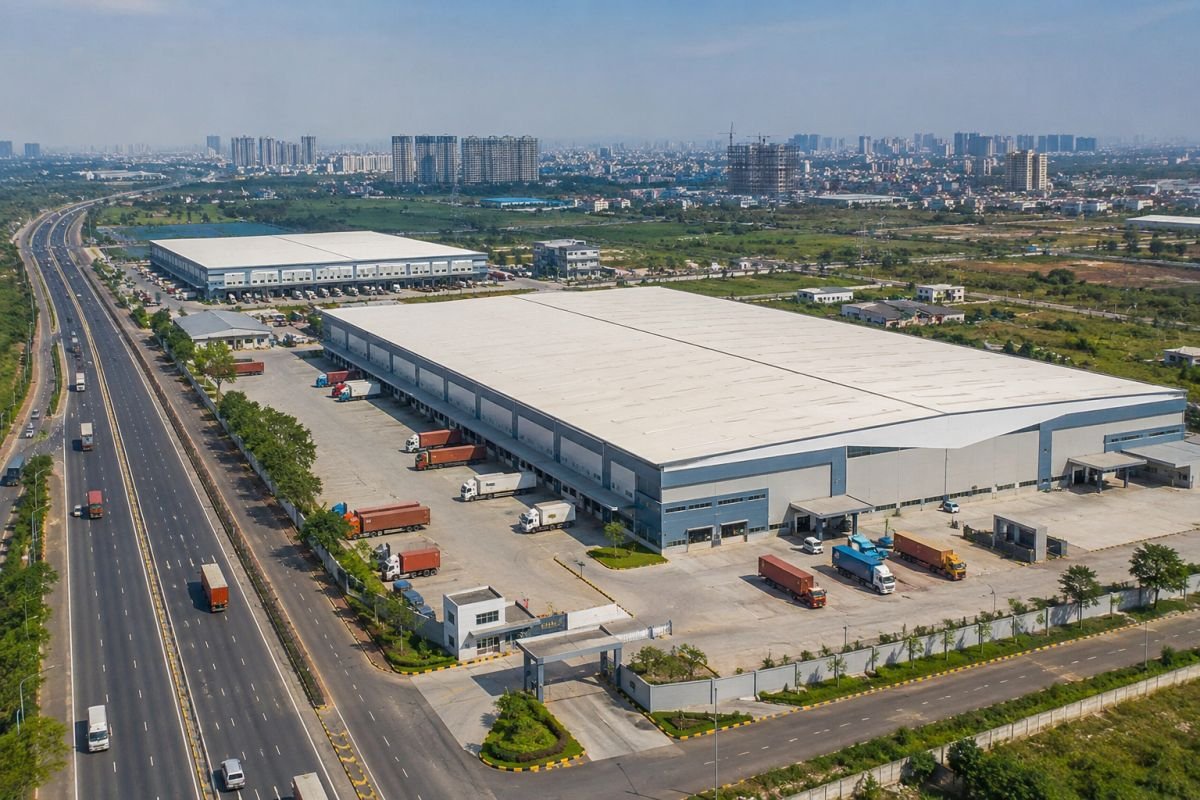
Gurgaon’s skyline is synonymous with glass-clad office towers and luxury residential condominiums. Headline transactions in Cyber Hub and Golf Course Road routinely capture media attention, drawing retail investors toward commercial office assets and premium apartments. Yet beneath this visibility lies a quieter, more resilient segment: warehousing real estate in Gurgaon. While individual investors chase residential pre-launch appreciation, institutional funds and seasoned family offices have been steadily accumulating logistics assets across the city’s industrial periphery.
This is not speculative construction driven by aspirational marketing. It is demand-backed infrastructure serving the National Capital Region’s consumption engine, e-commerce fulfilment networks, and third-party logistics providers. The asset class remains under-owned by retail participants largely because it lacks the glossy brochures of residential projects. That opacity, however, is precisely what creates the opportunity. Entry prices are more rational, tenant demand is measurable, and the yield premium over traditional commercial real estate is structurally significant.
Why Warehousing Real Estate in Gurgaon Deserves a Second Look
The National Capital Region is India’s largest consumption cluster, accounting for a disproportionate share of organised retail and online gross merchandise value. Gurgaon sits at the geographic heart of this cluster, connected to Delhi, Uttar Pradesh, and Rajasthan through a radial highway network anchored by NH-8, the KMP Expressway, and the Southern Peripheral Road. Over the past five years, two structural forces have reshaped the landscape. First, the pandemic-induced acceleration of e-commerce forced retailers to hold larger inventory buffers closer to demand centres. Second, the consolidation of fragmented godown stock into modern, compliant Grade A facilities created a visible quality gap.
For investors, the asset class offers three distinct advantages. Ticket sizes are materially lower; a strata-titled warehouse unit can start from [verify: current minimum investment ticket for Grade A warehousing in Gurgaon] versus the multi-crore commitments required for office floorplates. Lease structures typically include annual escalations of 3–5 percent with tenures of five to nine years, providing cash-flow visibility that rivals commercial office assets. Finally, the capital appreciation outlook for well-located logistics facilities remains robust, underpinned by land scarcity along approved industrial corridors and rising replacement costs.
The Anatomy of Logistics Real Estate India: How Gurgaon Fits In
To understand Gurgaon’s position within logistics real estate India, it helps to distinguish between asset subclasses. At the top of the quality pyramid are Grade A fulfilment centres—PEB or concrete structures with clear heights of [verify: standard clear height in metres for Grade A warehouses], fire-rated cladding, dock levellers, and 24/7 power backup. These command the highest rents and attract multinational e-commerce operators, auto component manufacturers, and cold-chain pharmaceutical distributors.

Below this sits Grade B stock: older, single-storey godowns with lower specifications, often owner-occupied or leased to small and medium enterprises. Gurgaon’s Grade B inventory is concentrated in legacy industrial areas such as [verify: specific sectors or industrial areas with legacy warehousing stock]. The real investment story, however, is the rapid formalisation of Grade A supply. According to [verify: source for Gurgaon warehousing supply data], the Gurgaon-Sohna-Manesar triangle added approximately [verify: square footage added in last 24 months] of fresh logistics stock in the last 24 months, with vacancy rates in prime micro-markets compressing to single digits.
Mapping Gurgaon’s Industrial and Logistics Corridors
Unlike residential real estate, where location is judged by social infrastructure, industrial real estate gurgaon is dictated by highway access, load-bearing road capacity, and statutory approvals. Four corridors dominate the landscape, each with distinct risk-return characteristics.
NH-8 and the IMT Manesar Belt
The Delhi-Jaipur highway remains the arterial spine of Gurgaon’s logistics ecosystem. The IMT Manesar stretch—encompassing Sectors 1-8 and adjoining villages—hosts established automotive ancillaries, electronics manufacturers, and third-party logistics operators. Warehousing rents here typically range from ₹[verify: per sq ft per month rent for IMT Manesar Grade A warehouses] depending on specifications and land use clarity. The corridor benefits from direct connectivity to IGI Airport (approximately [verify: distance in km] km) and the Delhi border, making it the preferred choice for time-sensitive cargo. Land scarcity within the notified industrial township has pushed acquisition costs upward, which supports replacement-value pricing for existing assets.
Dwarka Expressway and New Gurugram
The emerging Northern Peripheral Road and Dwarka Expressway corridor is transitioning from a residential story to a mixed-use logistics hub. Parcels in New Gurgaon—particularly around Sectors [verify: specific sector numbers for logistics parks in New Gurugram]—are seeing developer-led logistics park launches targeting e-commerce last-mile delivery and bulk storage. The area’s advantage lies in wider road widths, fewer urban density restrictions than central Gurgaon, and proximity to upcoming infrastructure expansion. For investors tracking capital appreciation outlook, this corridor offers entry pricing that is approximately [verify: percentage] percent below established NH-8 benchmarks.

Southern Peripheral Road and Sohna
The SPR corridor and the extension toward Sohna Road serve as Gurgaon’s southern logistics gateway. With the KMP Expressway intersecting SPR, this belt offers seamless east-west connectivity to Faridabad, Palwal, and the Mumbai-bound freight corridor. Several developer consortiums have acquired land banks here for future-ready logistics parks. Infrastructure maturity, however, remains uneven; power availability has improved, but water supply and storm-water drainage in certain sectors require augmentation. Investors must scrutinise land titles carefully, as not all parcels carry industrial zoning approval from the Department of Town and Country Planning, Haryana.

The Northern Hinterland: Pataudi Road and Beyond
Further west, the Pataudi Road belt is attracting bulk storage and non-time-sensitive inventory due to significantly lower land costs. This is not a last-mile play. It is a land-banking and long-term yield strategy for operators with tenant relationships in FMCG and building materials. Accessibility improves with each phase of highway widening, but current last-mile connectivity remains patchy, particularly during monsoon months.
Demand Drivers: What Is Fuelling the Warehouse Boom?
Several structural tailwinds support warehousing real estate in Gurgaon beyond the cyclical e-commerce narrative.
- Consumption Density: The NCR generates a disproportionate share of India’s online retail gross merchandise value. Gurgaon’s per-capita income ranks among the highest nationally, creating dense delivery catchments that reduce logistics costs per unit.
- Manufacturing Reshoring: The Production Linked Incentive schemes across electronics, pharmaceuticals, and auto components have prompted contract manufacturers to establish NCR fulfilment nodes. Gurgaon’s existing vendor ecosystem makes it a natural beneficiary.
- Inventory Centralisation: Small and medium enterprises are moving away from fragmented, unorganised godowns toward compliant, insured facilities with CCTV surveillance and fire safety certification. This shift from Grade C to Grade A stock is irreversible.
- Multi-Modal Connectivity: The region’s integration with the Dedicated Freight Corridor, IGI Airport’s cargo expansion, and the Delhi-Mumbai Industrial Corridor node near [verify: nearest DMIC node to Gurgaon] will deepen Gurgaon’s logistics moat.
Investment Mechanics: Yields, Ticket Sizes, and Tenures
Before committing capital, investors must understand how warehousing differs from office or retail assets.
| Parameter | Grade A Warehousing (Gurgaon) | Grade A Office (Gurgaon CBD) |
|---|---|---|
| Entry Ticket Size | ₹5.00 – ₹100.00+ crore | ₹10.00 – ₹50.00+ crore |
| Gross Rental Yield | 8% – 10% | 6% – 9% |
| Typical Lease Tenure | 5 – 9 years | 3 – 9 years |
| Annual Rent Escalation | 3% – 5% (or 12%–15% every 3 yrs) | 3% – 5% (or 12%–15% every 3 yrs) |
| Capital Appreciation (5-yr CAGR) | 8% – 12% | 8% – 10% |
| Operating Expense Pass-Through | Higher (CAM, security, power) | Moderate |
| Vacancy Risk | Lower in prime corridors | Higher in secondary stock |

The yield premium is the headline attraction. A well-leased warehouse on NH-8 can generate [verify: basis points] basis points of additional annual return compared to an equivalent office investment. However, this comes with higher operational intensity. Warehouses consume more power, require rigorous maintenance of dock equipment and fire suppression systems, and face tenant default risks from cyclical industries. Capital expenditure reserves typically run at 1.5–2.5 percent of gross rental income annually, nearly double the office standard.
Risks and Constraints: The Other Side of the Ledger
No honest commercial review can ignore the friction points.
Land Title Complexity: Industrial land in Haryana often carries agricultural past records, collector-rate discrepancies, and conversion approval lags. Due diligence must verify CLU status and whether the plot falls under the Lal Dora classification.
Infrastructure Gaps: Beyond the main highways, internal roads in emerging logistics zones frequently lack storm-water drainage and street lighting. This affects operational efficiency and insurance premiums.
Tenant Concentration: Unlike office buildings with 10-15 tenants, a warehouse may have 2-3 anchor lessees. The departure of a major e-commerce operator can leave a facility half-vacant for months.
Regulatory Shifts: The Haryana government’s industrial policy and any future restrictions on e-commerce warehousing in agricultural zones could impact supply pipelines. [verify: any recent Haryana government policy affecting warehousing]
Who Should Consider Industrial Real Estate Gurgaon?
This asset class is not for everyone. It suits:
- High-net-worth individuals and family offices seeking yield-focused alternatives to fixed income, with holding periods of at least seven to ten years.
- Corporate investors looking to optimise supply-chain costs by owning rather than leasing their distribution infrastructure.
- Real estate funds with in-house asset management capabilities to handle tenant negotiations, CAM reconciliations, and statutory compliance.
- NRIs targeting rupee-denominated income streams backed by physical Indian assets with lower correlation to residential price cycles.
It does NOT suit speculators seeking quick pre-launch flips. Warehousing lacks the liquidity and retail buyer depth of residential apartments. Exit options are typically institutional sales or REIT consolidation, both of which require patient capital.
The Verdict: A Strategic Addition, Not a Core Bet
Warehousing real estate in Gurgaon occupies a compelling niche. It offers superior rental yields, long-lease stability, and exposure to India’s consumption and manufacturing growth vectors. Yet it demands institutional-grade due diligence, longer lock-ins, and active operational oversight. For investors with the risk appetite and time horizon, allocating 10–15 percent of a commercial real estate investment portfolio to logistics assets in Gurgaon makes strategic sense. The capital appreciation outlook for prime corridor land remains intact, but the primary return driver is sustainable rental income compounded over a decade.

If you are evaluating logistics assets along NH-8, Dwarka Expressway, or the Southern Peripheral Road corridor, the advisory team at AssetBulls can provide micro-market feasibility reports, comparable lease transactions, and title due-diligence support. Explore our corridor-specific research or schedule a consultation to map these opportunities against your portfolio objectives.
Frequently Asked Questions
What is the typical rental yield for warehousing real estate in Gurgaon?
Grade A warehousing assets in prime Gurgaon corridors typically generate gross rental yields of 8–10 percent [verify: current range], which is approximately 150–200 basis points higher than comparable office assets in the CBD. Net yields depend on operating expense structures and tenant credit quality.
How does logistics real estate India differ from standard commercial office investment?
Logistics real estate India is operationally intensive, with longer lease tenures (5–9 years), higher CAM and power pass-throughs, and lower liquidity than office assets. The tenant base is concentrated among e-commerce operators, 3PL providers, and manufacturers rather than white-collar service firms.
Which corridor offers the best capital appreciation outlook for industrial real estate Gurgaon?
New Gurugram along the Dwarka Expressway corridor currently offers the most attractive capital appreciation outlook due to entry pricing discounts relative to NH-8, combined with improving infrastructure and e-commerce tenant migration. However, this comes with higher execution risk than established belts like IMT Manesar.
Is warehousing in Gurgaon suitable for first-time commercial real estate investors?
Generally, no. Industrial real estate Gurgaon requires sophisticated due diligence on land titles, CLU approvals, and tenant credit. First-time investors are better served by gaining experience in residential or office assets before deploying capital into logistics, unless investing through a managed fund or REIT structure.
What is the minimum ticket size for commercial real estate investment in Gurgaon warehousing?
Strata-titled warehouse units in approved logistics parks can start from ₹[verify: current minimum investment ticket] crore, though institutional-grade standalone facilities typically require ₹[verify: amount] crore or more. This is materially lower than office floorplates in Cyber City or Golf Course Road, but still requires meaningful capital commitment.

Join The Discussion