
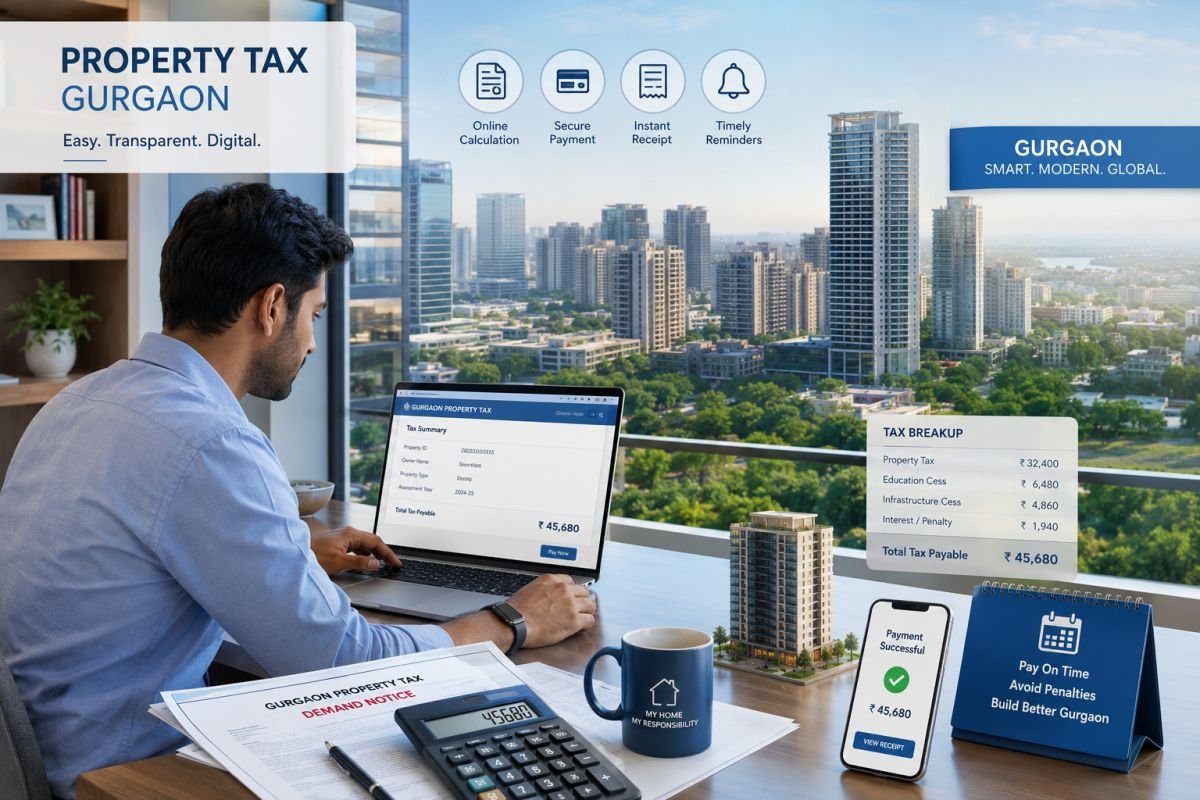
Buying a home is only the beginning of your financial responsibilities as a property owner. One of the most important recurring obligations is property tax Gurgaon, a municipal tax that funds essential civic infrastructure such as roads, sanitation, street lighting, parks, drainage, and waste management.
Whether you own an apartment in Dwarka Expressway property market, a villa along Golf Course Road, an independent house in New Gurgaon, or a commercial property on Southern Peripheral Road (SPR), understanding your annual tax liability helps you avoid penalties and maintain compliant ownership records.
In this guide, you’ll learn how property tax Gurgaon is calculated, who is required to pay it, the rebates and exemptions available, late payment penalties, and the complete process for paying MCG property tax online in 2026.
Important: Property tax rates, rebate schemes, and municipal rules are subject to change. Always verify the latest notifications published by the Municipal Corporation Gurugram (MCG) before making a payment.
What is Property Tax in Gurgaon?
Property tax is an annual municipal levy collected by the Municipal Corporation Gurugram (MCG) from owners of residential, commercial, industrial, and institutional properties falling within its jurisdiction. Unlike stamp duty or registration charges that are paid only once during the purchase of a property, gurgaon house tax is a recurring annual obligation for every property owner.
The revenue generated through property tax plays an important role in maintaining and improving public infrastructure across Gurgaon. It helps fund road repairs, street lighting, drainage systems, parks, sanitation services, sewerage networks, waste management, and other civic amenities that directly impact the quality of life for residents and businesses. Timely payment of property tax not only keeps you compliant with municipal regulations but also contributes to the city’s long-term infrastructure development.
Who Has to Pay Property Tax?
The responsibility for paying property tax generally lies with the legal owner of the property. This applies irrespective of whether the property is self-occupied, rented out, or kept vacant. Apartment owners, independent house owners, commercial office owners, retail shop owners, industrial property owners, and, in certain cases, plot owners are all required to pay property tax as applicable under MCG regulations.
Where a property has multiple owners, the tax liability is typically shared according to each owner’s ownership percentage unless another legal arrangement exists. Buyers purchasing resale properties should also verify that previous property tax dues have been cleared before completing the ownership transfer, as pending municipal dues can sometimes create complications during future transactions.
Areas Covered Under MCG Property Tax
The Municipal Corporation Gurugram administers property tax across a large part of urban Gurgaon. This includes many of the city’s established residential neighbourhoods as well as emerging investment corridors that continue to witness strong infrastructure development and housing demand.

Areas commonly falling under MCG jurisdiction include Golf Course Road, Golf Course Extension Road, Sohna Road, New Gurgaon, Palam Vihar, Civil Lines, and several developed residential sectors such as Sector 14, Sector 15, Sector 31, Sector 45, Sector 57, Sector 67, Sector 70, Sector 82, Sector 83, and Sector 89. Many premium developments along Southern Peripheral Road (SPR) are also covered under the municipal corporation.
However, Gurgaon has multiple civic authorities operating in different locations. Before paying your annual property tax, it is advisable to verify whether your property falls under the Municipal Corporation Gurgaon, HSVP, or any other local authority to ensure that payment is made to the correct jurisdiction.
How is Property Tax Gurgaon Calculated?
Unlike income tax, property tax Gurgaon is not calculated based solely on the purchase price or current market value of a property. Instead, the Municipal Corporation Gurugram follows an assessment methodology that considers multiple characteristics of the property to determine its annual tax liability.
Some of the key factors that influence the calculation include the property’s category, its usage (residential or commercial), built-up area, plot size, occupancy status, construction type, location, and the municipal assessment rates applicable to that locality. Depending on municipal policy revisions, these parameters and the valuation methodology may change over time, making it important for property owners to verify the latest assessment rules before making payment.
Factors That Affect Your Property Tax
| Factor | Impact on Tax |
|---|---|
| Residential vs Commercial | Commercial properties generally attract higher tax. |
| Property Size | Larger built-up areas usually result in higher tax. |
| Location | Premium sectors may have different assessment values. |
| Self-occupied vs Rented | Applicable rules may vary. |
| Vacant Land | Different assessment rules may apply. |
| Type of Construction | Building category can influence tax. |

MCG Property Tax Rates
The Municipal Corporation Gurugram periodically publishes revised property tax schedules and assessment parameters. These notifications specify the applicable rates for different categories of residential, commercial, industrial, and vacant land properties. Since municipal rates can be revised through annual notifications or policy updates, relying on outdated information may lead to incorrect tax calculations.
Instead of assuming fixed rates, property owners should refer to the latest MCG notification before making payment. It is advisable to verify annual unit area values, residential and commercial tax rates, industrial property rates, vacant land assessments, and any rebates or concessions announced for the financial year.
How to Calculate Gurgaon House Tax
Although the exact assessment is generated through the official municipal portal, understanding the basic calculation process helps property owners estimate their likely tax liability. The calculation generally begins by identifying the property’s category and confirming whether it is residential, commercial, industrial, or another recognised classification. The applicable built-up area or plot area is then considered along with the municipal assessment rates notified by MCG.
Any rebates for early payment, self-assessment, or other eligible concessions are applied before outstanding dues or penalties, if any, are added to arrive at the final amount payable. Since the municipality may revise its assessment methodology from time to time, the most accurate tax calculation should always be obtained directly from the official MCG property tax portal.
Documents You’ll Need Before Paying
Before initiating your payment, it’s a good idea to gather all the necessary property details. Having the correct information on hand not only speeds up the payment process but also reduces the chances of entering incorrect data that could delay the transaction or require later corrections.
In most cases, property owners should keep the following details readily available before accessing the MCG property tax portal:
- Property ID
- Owner’s name
- Registered mobile number
- Property address
- Previous property tax receipt (if available)
- Basic property identification details
If you’re unsure about your Property ID or notice discrepancies in the property information displayed on the portal, resolve those issues with the Municipal Corporation Gurugram before proceeding with the payment.
How to Pay MCG Property Tax Online
Paying MCG property tax online has become the preferred option for most homeowners in Gurgaon because it is quick, secure, and provides an instant digital acknowledgement. The entire process typically takes only a few minutes if all your property details are readily available.

Step 1: Visit the Official MCG Portal
Open the official Municipal Corporation Gurugram property tax portal and navigate to the property tax payment section. Always ensure that you are using the official website to avoid fraudulent payment portals.
Step 2: Enter Your Property Details
Provide the required information to locate your property record. This generally includes:
- Property ID
- Owner’s name or registered details
- Mobile number (where applicable)
The system will retrieve your property’s tax information based on the details entered.
Step 3: Verify the Property Information
Before making the payment, carefully review the information displayed on the screen. Check that the property address, ownership details, tax assessment, and any outstanding dues are accurate. If you notice any discrepancy, it is advisable to contact the municipal authorities before proceeding further.
Step 4: Review the Tax Amount
Once your property details have been verified, the portal will display the total tax payable, including any previous dues, interest, or applicable rebates. Spend a few moments reviewing the calculation to ensure everything appears correct before moving to the payment stage.
Step 5: Choose Your Preferred Payment Method
The MCG portal supports multiple digital payment options, allowing property owners to complete the transaction conveniently. Common payment methods include:
- UPI
- Net Banking
- Debit Card
- Credit Card
- Other supported online payment options
Step 6: Complete the Payment
After selecting your preferred payment method, complete the transaction by following the on-screen instructions. Once the payment is successfully processed, the portal will generate a confirmation message.
Step 7: Download the Receipt
Always download and save the digital payment receipt immediately after the transaction is completed. This receipt serves as proof of payment and may be required for future reference, property transactions, or resolving any payment-related disputes.
Can You Pay Property Tax Offline?
Yes. Although online payment is the most convenient option, property owners who prefer traditional methods can usually pay their property tax by visiting designated Municipal Corporation Gurugram offices or authorised collection centres.
Before visiting the office, it is advisable to confirm the latest office timings, accepted payment methods, and the documents you need to carry. Since municipal procedures may change periodically, checking the latest instructions in advance can help avoid unnecessary delays.
Rebates Available on Property Tax
To encourage timely tax payments, the Municipal Corporation Gurugram may announce rebates or incentives for eligible property owners from time to time. These schemes are generally introduced through official notifications and may vary depending on the financial year.
Some commonly announced benefits include:
- Early payment rebate
- Self-assessment rebate
- Online payment incentive
- Other government-approved concessions
Since rebate policies are revised periodically, property owners should verify the latest eligibility criteria before making their payment instead of relying on previous years’ announcements.
Penalties for Late Payment
Failing to pay your property tax Gurgaon before the prescribed deadline can result in additional financial liability. Besides increasing your annual ownership costs, delayed payments may also create complications when selling or transferring the property in the future.
Depending on the applicable municipal regulations, late payment may attract:
- Interest on outstanding dues
- Financial penalties
- Accumulated tax arrears
- Recovery proceedings under applicable municipal provisions
Paying your property tax on time is the simplest way to avoid these unnecessary expenses while maintaining a clean municipal payment record.
How to Check Outstanding Property Tax
The official MCG property portal allows owners to check whether any previous dues are pending against their property. This feature is particularly useful for new buyers purchasing resale properties, as verifying outstanding municipal dues before completing the transaction can help prevent future disputes.
Typically, you can search for your property using the Property ID, owner’s name, or property address. Once the record is located, the portal generally displays the current year’s tax, any unpaid dues from previous years, applicable interest, and the property’s payment history.
Common Mistakes to Avoid
Many homeowners unknowingly make mistakes while paying gurgaon house tax, which can lead to incorrect payments or future administrative issues. Most of these errors are easy to avoid with a little attention during the payment process.
Some of the most common mistakes include:
- Entering an incorrect Property ID
- Ignoring outstanding arrears
- Forgetting to download the payment receipt
- Selecting the wrong property category
- Missing rebate deadlines
- Delaying payment until penalties apply
Taking a few extra minutes to verify every detail before confirming your payment can save considerable time and inconvenience later.
Property Tax After Buying a New Home
If you’ve recently purchased a property in New Gurgaon investment guide or any other locality in Gurgaon, updating the municipal ownership records should be one of your first post-purchase tasks. While buyers often focus on property registration and possession, ensuring that the Municipal Corporation Gurgaon records reflect the new ownership is equally important for future tax payments and legal compliance.
After purchasing a property, complete the mutation process wherever applicable, update the ownership details with the municipal authority, and verify whether any outstanding property tax dues exist against the property. This step is especially important when buying a resale property, as unpaid municipal taxes from the previous owner could create complications during future resale or financing. Keeping copies of all tax receipts and ownership documents will also make future transactions smoother.
Why Property Tax Matters for Home Buyers
Many homebuyers calculate their budget based on the property’s purchase price, home loan EMI, and maintenance charges but overlook recurring municipal expenses. However, property tax Gurgaon is an ongoing ownership cost that should be included in your annual financial planning.

Paying property tax on time helps maintain legal compliance, avoids penalties, and ensures that municipal records remain updated. It can also simplify future property transactions, including resale, inheritance, and loan processing, where tax payment records are often reviewed.
For buyers exploring projects across best sectors in Gurgaon, considering annual municipal taxes alongside maintenance charges and other recurring expenses provides a more accurate understanding of the property’s long-term ownership cost.
Things to Verify Before Paying
Before completing your annual property tax payment, spend a few minutes verifying the details displayed on the municipal portal. A simple review can help avoid incorrect payments and future correction requests.
Check the following before proceeding:
- Property ID
- Owner’s details
- Property category
- Built-up area
- Outstanding dues
- Applicable rebate
- Payment deadline
If you notice any discrepancy in the assessment or ownership information, contact the Municipal Corporation Gurugram before making the payment.
Property Tax and Luxury Properties
Owners of luxury residences often have different financial considerations compared to buyers of standard apartments. Premium homes located along Golf Course Road, Golf Course Extension Road, and integrated townships generally feature larger built-up areas and more extensive amenities, which can influence the overall cost of ownership.
Although municipal property tax is not determined solely by a property’s market value, owners should account for recurring expenses beyond the purchase price. These typically include annual property tax, maintenance charges, utility bills, club memberships where applicable, and parking-related costs. Evaluating these recurring expenses helps buyers make more informed financial decisions, particularly when investing in high-value residential assets.
Final Thoughts
Understanding property tax Gurgaon is an essential part of responsible property ownership. Whether you own a compact apartment, an independent house, or a commercial property, paying your municipal taxes on time helps you remain compliant with local regulations while contributing to the maintenance and development of public infrastructure across Gurgaon.

Since municipal assessment methods, tax rates, and rebate schemes may change from time to time, always verify the latest notifications issued by the Municipal Corporation Gurugram (MCG) before making a payment. If you’re planning to buy property in Gurgaon and want a clearer understanding of ownership costs beyond just the purchase price, explore AssuredGains’ location guides or speak with our advisory team for research-driven, unbiased guidance tailored to your investment goals.
Frequently Asked Questions
1. What is MCG property tax?
MCG property tax is the annual municipal tax collected by the Municipal Corporation Gurugram from owners of residential, commercial, industrial, and institutional properties. The revenue collected is used to maintain public infrastructure such as roads, drainage systems, parks, sanitation services, and street lighting across Gurgaon.
2. How is Gurgaon house tax calculated?
Gurgaon house tax is generally calculated based on factors such as the property’s category, built-up area, usage, occupancy status, location, and the assessment rates notified by the Municipal Corporation Gurugram. Since calculation methodologies may be revised periodically, property owners should verify the latest assessment rules on the official MCG portal.
3. Can I pay MCG property tax online?
Yes. Property owners can conveniently pay MCG property tax online through the official Municipal Corporation Gurugram portal by entering their Property ID and completing the payment using UPI, Net Banking, Debit Card, Credit Card, or other supported digital payment methods.
4. What happens if I don’t pay property tax in Gurgaon?
Failure to pay property tax before the due date may result in interest on outstanding dues, financial penalties, and the accumulation of tax arrears. Continued non-payment may also lead to recovery proceedings under applicable municipal regulations.
5. Are there rebates available on property tax Gurgaon?
Yes. The Municipal Corporation Gurugram may announce rebates for eligible property owners, including incentives for early payment, self-assessment, or online payment. Since these schemes vary by financial year, always verify the latest notification before making your payment.



Join The Discussion