
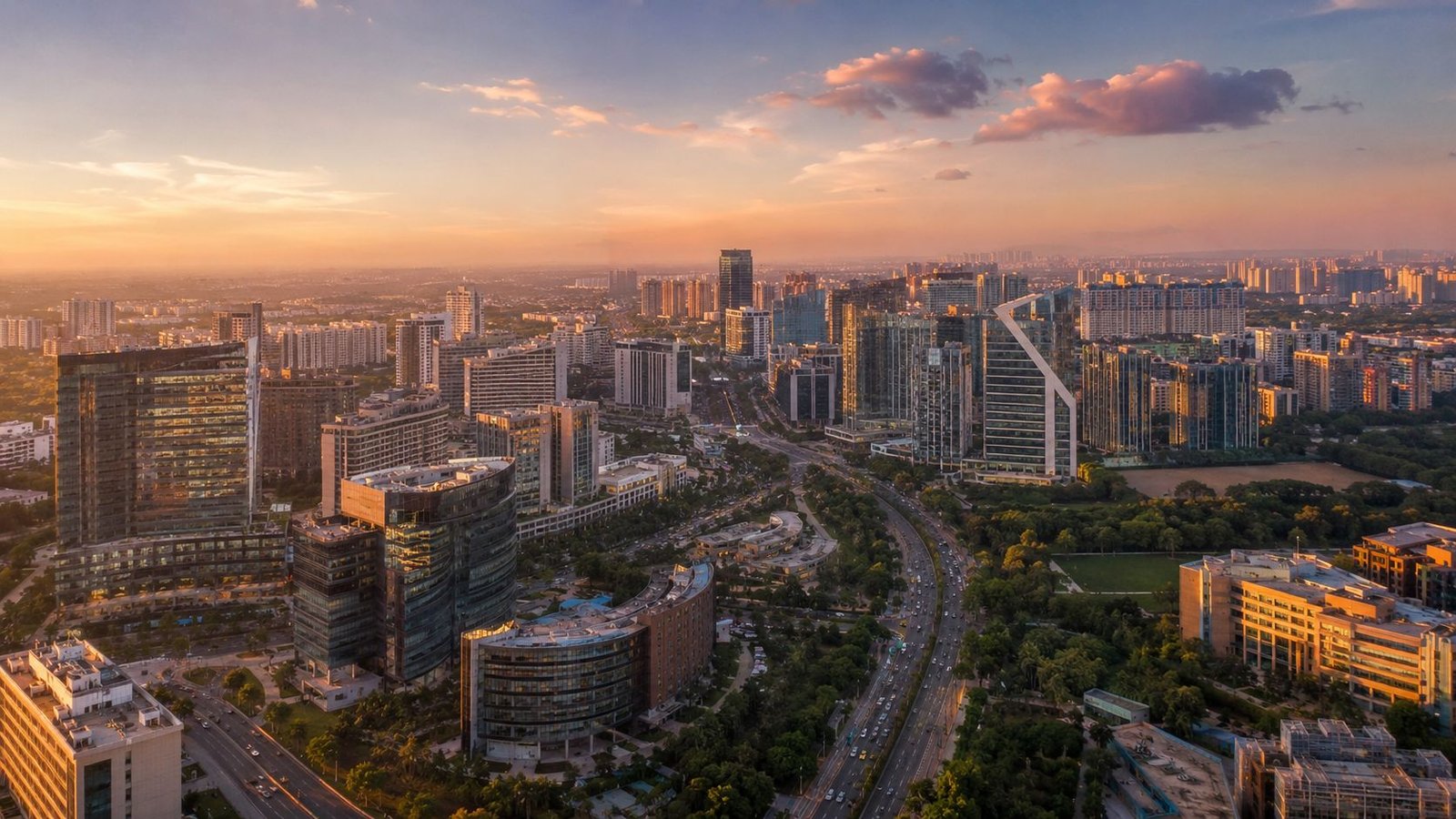
Last Updated: May 2026 | Market observations based on current Gurgaon leasing trends, commercial launches, investor activity, occupancy patterns, and corridor-level demand behavior.
Commercial property investment in Gurgaon has evolved far beyond speculative launch buying. Earlier, a large portion of the market was driven by brochure projections, assured return schemes, and expectations of rapid appreciation. In 2026, investor behavior is becoming noticeably more income-focused and operationally aware. Serious investors are increasingly prioritizing tenant quality, leasing sustainability, corridor maturity, and long-term commercial viability over short-term hype cycles.
This shift is important because Gurgaon’s commercial market is no longer a purely “future potential” story. Several micro-markets have already matured into functioning economic ecosystems supported by multinational companies, startup expansion, premium residential density, and large-scale office absorption. At the same time, not every commercial launch in Gurgaon is a strong investment. Certain sectors are witnessing rising supply pressure, some retail formats remain heavily speculative, and multiple projects still depend on future residential occupancy rather than present-day economic activity.
That is why commercial real estate investing in Gurgaon today requires much deeper market understanding than simply selecting a project from a launch brochure. The difference between a successful commercial investment and a struggling one often comes down to practical realities such as:
- surrounding population density
- frontage visibility
- parking convenience
- tenant mix quality
- leasing capability
- developer execution standards
- operational ecosystem maturity.
For investors who understand these realities, Gurgaon continues to remain one of NCR’s strongest long-term commercial real estate markets.
Why Gurgaon Dominates Commercial Real Estate Investment in NCR

Gurgaon’s commercial ecosystem behaves very differently from many emerging NCR investment markets because demand here is driven by actual economic activity rather than only speculative future expectations.
The city has evolved into one of India’s largest corporate and service-sector hubs, with strong office concentration across Cyber City, Golf Course Road, NH-48, Udyog Vihar, and Golf Course Extension Road. Multinational companies, consulting firms, technology businesses, startups, fintech firms, and global capability centers continue expanding operations in Gurgaon, creating sustained office demand and supporting a broader commercial economy around them.

This office ecosystem directly fuels:
- retail demand
- hospitality growth
- co-working expansion
- food consumption
- service-sector businesses
- neighborhood commercial activity.
Unlike speculative commercial belts where projects struggle after possession due to weak operational demand, many Gurgaon sectors already benefit from consistent movement of professionals and affluent residential communities.
Another major strength is spending power. Golf Course Road, Golf Course Extension Road, and several premium New Gurgaon sectors continue witnessing expansion in high-income residential catchments. Investors often evaluate these micro-markets through analyses of the top-performing sectors in Gurgaon before making commercial investment decisions. This creates stronger demand for organized retail, cafes, restaurants, clinics, salons, convenience stores, and fitness brands.
Infrastructure also remains a major growth driver. Gurgaon benefits from:
- direct Delhi connectivity
- proximity to IGI Airport
- Dwarka Expressway growth
- NH-48 access
- metro expansion
- SPR connectivity
- strong corporate mobility infrastructure.
These factors improve both office absorption and retail sustainability.
However, Gurgaon’s commercial market is not uniformly strong across every corridor. Some sectors are already operationally mature, while others still depend heavily on future occupancy growth. Investors who understand this distinction generally make far better long-term decisions.

Gurgaon Commercial Market Snapshot (2026)
The Gurgaon commercial market currently shows mixed but relatively healthy demand across major corridors.
| Corridor | Approx Retail Yield | Office Demand Strength | Approx Commercial Price Range | Risk Level | 2026 Market Observation |
|---|---|---|---|---|---|
| Golf Course Extension Road | 6–8% | Strong | ₹18,000 – ₹35,000/sq.ft | Medium | Premium residential catchment with improving retail maturity and stable leasing demand. |
| Dwarka Expressway | 5–9% | Emerging | ₹12,000 – ₹28,000/sq.ft | Medium-High | Strong long-term growth corridor, though several sectors still depend on future occupancy maturity. |
| Cyber City & NH-48 | 4–6% | Very Strong | ₹20,000 – ₹40,000+/sq.ft | Low | Corporate-driven demand with premium office leasing and lower vacancy pressure. |
| New Gurgaon (Sector 82–95) | 5–8% | Moderate | ₹10,000 – ₹22,000/sq.ft | Medium | Retail demand improving steadily as residential handovers and occupancy continue increasing. |
| SPR (Southern Peripheral Road) | 6–9% | Growing | ₹14,000 – ₹30,000/sq.ft | Medium | Mixed-use commercial activity rising with improving connectivity and premium residential growth. |
| Golf Course Road | 4–7% | Very Strong | ₹25,000 – ₹50,000+/sq.ft | Low | Mature premium commercial ecosystem with strong corporate presence and affluent spending power. |
Broad market observations across Gurgaon in 2026 indicate that:
- retail leasing activity remains strongest in sectors with already operational residential density
- Grade A office demand continues concentrating around mature corporate corridors
- compact office spaces below 1,000 sq.ft are witnessing stronger investor participation
- food court inventory supply is increasing faster than sustainable operator demand in some emerging projects
- retail vacancy pressure is gradually rising in aggressively launched low-density sectors.
Several commercial consultants and leasing brokers across Gurgaon also report that neighborhood retail linked to operational residential societies is stabilizing faster than destination-led speculative retail projects.
Commercial Leasing Trends & Market Observations (2026)
The Gurgaon commercial market is currently witnessing a clear separation between operationally mature commercial ecosystems and speculative investment-driven launches.
Retail leasing movement across Golf Course Extension Road and mature New Gurgaon pockets has improved steadily over the last few years as residential occupancy expanded and local spending ecosystems strengthened. This trend closely reflects the growing end-user demand highlighted in this comprehensive guide to buying residential property in Gurgaon. In comparison, several newer commercial launches along developing stretches of Dwarka Expressway are still in early absorption stages because surrounding residential movement remains uneven across sectors.
One of the clearest leasing patterns visible in Gurgaon today is that projects surrounded by already occupied residential communities generally activate faster than standalone commercial launches dependent entirely on future handovers.
This is especially important for SCO and high-street retail investments.
Commercial leasing consultants in Gurgaon also increasingly observe:
- stronger demand for convenience-driven retail
- growing preference for compact office inventory
- higher caution toward speculative food court investments
- better performance for frontage-focused retail units
- increasing tenant sensitivity toward parking access and operational maintenance quality.
Another important trend is vacancy behavior. Retail vacancy cycles in mature premium corridors generally remain lower because tenant replacement demand exists even during slower market phases. In contrast, speculative commercial projects in underdeveloped sectors can face longer vacancy periods if surrounding occupancy growth slows.
Understanding the Different Types of Commercial Property in Gurgaon
Commercial property in Gurgaon is no longer limited to office towers or large shopping malls. The market has diversified considerably, allowing investors to participate across different budgets and risk profiles.
However, each commercial category behaves differently in terms of:
- rental yield
- appreciation potential
- leasing risk
- vacancy cycles
- liquidity
- operational sustainability.
SCO plots remain one of Gurgaon’s most preferred long-term commercial formats because they combine retail flexibility with land ownership. Investors evaluating long-term land-backed commercial assets often compare multiple SCO Plots in Gurgaon based on frontage visibility, surrounding residential occupancy, future supply competition, and corridor maturity.
Traditional office spaces continue benefiting from Gurgaon’s corporate ecosystem, particularly across Cyber City, NH-48, Golf Course Road, and Sector 44. However, post-pandemic office demand has increasingly shifted toward flexible office formats and smaller divisible inventory. Investors researching this category often compare traditional office investments with newer compact workspace formats discussed in Small Office Spaces Gurgaon for New-Age Businesses.
Retail property remains one of Gurgaon’s strongest rental-income categories, especially when linked to operational residential catchments. Investors studying this segment frequently compare different retail formats through detailed guides like Retail Property in Gurgaon and SCO vs High Street Retail — Which Is Better for Brands?.
Food court investments and co-working-compatible office assets have also gained popularity, though both remain highly operator-dependent.
SCO Plots in Gurgaon — Why Experienced Investors Still Prefer Them

SCO plots continue attracting experienced commercial investors because they provide something conventional retail units usually do not: commercial land ownership combined with multi-format leasing flexibility.
Unlike fixed-format retail spaces, SCO developments allow investors to create multi-floor commercial buildings that can be leased across:
- restaurants
- clinics
- offices
- cafes
- salons
- banks
- service businesses.
This diversification often improves long-term rental stability.
However, SCO investing in Gurgaon requires strong understanding of sector maturity. One of the biggest mistakes investors make is buying commercial inventory in sectors where surrounding residential occupancy remains weak. Commercial projects cannot survive purely on future projections. They require actual population movement and daily economic activity.
This is why SCO developments near already operational residential sectors generally lease faster than projects dependent entirely on future handovers.
Several emerging sectors along Dwarka Expressway still hold strong long-term growth potential, but investors expecting immediate lease activation may face slower absorption timelines in certain pockets where occupancy maturity is still evolving.
Another important reality is oversupply risk. Some stretches of Dwarka Expressway are currently witnessing aggressive commercial launches across similar retail formats. While long-term fundamentals remain strong, short-term rental competition may increase as multiple projects become operational simultaneously.
In Gurgaon’s commercial market, frontage visibility and parking convenience heavily influence leasing quality. Corner SCO plots with direct accessibility often command significantly stronger rental demand than internally positioned inventory.
Office Space Investment in Gurgaon

Gurgaon remains one of India’s strongest office real estate markets because of sustained multinational and corporate demand.
Cyber City continues dominating premium office leasing activity due to:
- corporate concentration
- airport connectivity
- workforce density
- mature infrastructure ecosystem.
Golf Course Road and NH-48 also remain strong because of established office demand and business connectivity. Over the last few years, Golf Course Extension Road has emerged as an important secondary office corridor supported by premium residential growth and improving office absorption.
However, office investment behavior has evolved considerably after hybrid work adoption.
Investors are increasingly preferring:
- smaller office formats
- managed workspaces
- divisible inventory
- flexible leasing capability.
Compact office spaces below 1,000 sq.ft are witnessing stronger retail investor participation because they offer lower ticket sizes, broader tenant pools, and easier leasing flexibility.
Another major trend is the rise of co-working-compatible office inventory. Gurgaon’s startup ecosystem and hybrid work culture continue driving demand for flexible workspaces, especially across Golf Course Road, Cyber City, and Golf Course Extension Road.
Investors evaluating office-led commercial strategies often study both traditional and flexible office assets through Office Spaces in Gurgaon.
Retail Property in Gurgaon — What Actually Works

Retail investing in Gurgaon is often misunderstood because many investors focus excessively on launch visuals and projected footfall rather than actual commercial behavior.
In reality, successful retail ecosystems depend on:
- repeat consumption patterns
- accessibility
- parking convenience
- tenant quality
- operational catchments
- surrounding spending power.
High-street retail continues performing strongly in Gurgaon because consumers generally prefer convenience-driven retail environments over complicated mall circulation systems.
Retail spaces with direct frontage visibility and easy accessibility often outperform internally located units despite smaller project scale.
Another important commercial reality is that footfall alone does not guarantee sustainable retail performance. Some projects may generate visitor movement initially because of entertainment activity or launch excitement, but long-term retail sustainability depends on recurring spending from surrounding office and residential ecosystems.
This is why neighborhood retail linked to operational residential communities generally performs more consistently than speculative destination retail projects.
Projects located near already occupied sectors across Golf Course Extension Road, operational New Gurgaon pockets, and parts of Dwarka Expressway are generally witnessing stronger leasing stability compared to isolated commercial launches dependent entirely on future occupancy growth.
How Developer Quality Impacts Commercial ROI
Developer quality plays a much bigger role in commercial real estate than many investors initially realize.
In Gurgaon, long-term commercial performance depends not only on location but also on:
- maintenance quality
- leasing capability
- tenant curation
- project upkeep
- parking management
- operational discipline
- occupancy quality
- resale liquidity.
Poorly maintained commercial projects often struggle even in decent locations because declining upkeep eventually impacts customer experience and tenant sustainability.
Similarly, weak tenant mix can reduce repeat footfall and hurt overall project perception. Commercial projects filled with unstable businesses or inconsistent leasing quality frequently witness declining investor confidence over time.
Experienced investors therefore usually evaluate the developer’s operational commercial track record before investing.
This becomes even more important in Gurgaon’s competitive retail market, where multiple projects often compete for similar tenant categories within the same corridor.

Risk Analysis by Commercial Asset Type
| Corridor | Approx Retail Yield | Office Demand Strength | Approx Commercial Price Range | Risk Level | 2026 Market Observation |
|---|---|---|---|---|---|
| Golf Course Extension Road | 6–8% | Strong | ₹18,000 – ₹35,000/sq.ft | Medium | Premium residential catchment with improving retail maturity and stable leasing demand. |
| Dwarka Expressway | 5–9% | Emerging | ₹12,000 – ₹28,000/sq.ft | Medium-High | Strong long-term growth corridor, though several sectors still depend on future occupancy maturity. |
| Cyber City & NH-48 | 4–6% | Very Strong | ₹20,000 – ₹40,000+/sq.ft | Low | Corporate-driven demand with premium office leasing and lower vacancy pressure. |
| New Gurgaon (Sector 82–95) | 5–8% | Moderate | ₹10,000 – ₹22,000/sq.ft | Medium | Retail demand improving steadily as residential handovers and occupancy continue increasing. |
| SPR (Southern Peripheral Road) | 6–9% | Growing | ₹14,000 – ₹30,000/sq.ft | Medium | Mixed-use commercial activity rising with improving connectivity and premium residential growth. |
| Golf Course Road | 4–7% | Very Strong | ₹25,000 – ₹50,000+/sq.ft | Low | Mature premium commercial ecosystem with strong corporate presence and affluent spending power. |
Understanding these risks is critical because commercial property performance depends heavily on operational sustainability, not just launch pricing.

Example Commercial Investment Strategies
| Investor Goal | Possible Strategy | Recommended Asset Type | Typical Investment Horizon | Risk Level | Market Observation |
|---|---|---|---|---|---|
| Stable Rental Income | Buy ready leased retail in operational sectors | High-Street Retail | 5–10 Years | Medium | Retail near occupied residential catchments generally offers stronger recurring leasing stability. |
| Long-Term Appreciation | Invest early in growth corridors with improving infrastructure | SCO Plots | 7–15 Years | Medium-High | Land-backed commercial assets may benefit significantly as surrounding density matures. |
| Lower Entry Budget | Target smaller divisible commercial inventory | Compact Office Space | 4–8 Years | Medium | Smaller office formats often lease faster due to broader tenant demand. |
| Passive Income | Buy pre-leased commercial property with lock-in tenant | Pre-Leased Office / Retail | 5–12 Years | Low-Medium | Long lock-in leases may reduce vacancy uncertainty during slower cycles. |
| Business Expansion | Acquire self-use commercial asset with future flexibility | SCO Property | Long-Term | Medium | SCO assets allow mixed self-use and rental diversification over time. |
| Premium Corporate Exposure | Focus on mature corporate corridors | Grade A Office | 7–12 Years | Medium | Established office ecosystems generally offer stronger institutional tenant quality. |
| Higher Yield Seeking | Target frontage-focused retail with daily-needs demand | High-Street Retail | 5–10 Years | Medium-High | Convenience-driven retail often performs better than speculative destination retail. |
| Flexible Long-Term Holding | Diversify tenant categories within one asset | Mixed-Use SCO Asset | 10+ Years | Medium | Multi-floor commercial usage may improve long-term rental resilience. |
This type of strategy-based investing is becoming increasingly important in Gurgaon because different corridors and commercial formats behave very differently during market cycles.
Who Should Avoid Commercial Property Investment?
Commercial property is not suitable for every investor profile.
Investors requiring immediate liquidity may struggle because commercial resale cycles are usually slower than residential markets. Buyers relying entirely on loan EMIs without rental buffers should also approach commercial investing cautiously, particularly in under-construction projects where leasing activation may take longer than expected.
Short-term speculative investors expecting guaranteed appreciation within very short timelines may also face disappointment in sectors where supply competition is increasing rapidly.
Similarly, investors depending entirely on assured return promises without evaluating actual leasing demand are taking significant risk.
Commercial property generally rewards:
- longer holding periods
- realistic rental expectations
- corridor-level understanding
- operational market analysis.
Gurgaon Commercial Corridors — Where Demand Is Strongest

Dwarka Expressway remains Gurgaon’s largest emerging commercial growth corridor because of massive residential expansion and future infrastructure growth. The corridor is also witnessing significant residential development activity through several new and upcoming projects on Dwarka Expressway, which is expected to strengthen future commercial demand. However, different sectors within the corridor are maturing at different speeds.
Investors evaluating emerging commercial opportunities along this belt often compare multiple Commercial Projects on Dwarka Expressway based on operational density, frontage visibility, future competing supply, and surrounding residential handovers.
Golf Course Extension Road has evolved into one of Gurgaon’s strongest premium commercial corridors because the surrounding ecosystem is already operational. For a broader understanding of corridor-wise opportunities, investors can also explore this detailed Gurgaon location investment guide. Affluent residential communities and stronger spending power support more sustainable commercial demand here.
The NH-48 corridor continues benefiting from mature office demand and corporate concentration, while Cyber City remains Gurgaon’s strongest premium office ecosystem because of multinational presence and workforce density.
SPR is also witnessing increasing mixed-use commercial activity due to improving connectivity and surrounding residential growth.

Commercial Property ROI Comparison
| Commercial Asset Type | Approx Rental Yield | Appreciation Potential | Typical Entry Budget | Liquidity | Risk Level | 2026 Market Observation |
|---|---|---|---|---|---|---|
| SCO Plots | 6–10% | High | ₹2 Cr+ | Moderate | Medium | Land-backed commercial assets continue attracting long-term investors, especially in growth corridors. |
| High-Street Retail | 6–12% | High | ₹60 Lakh+ | Moderate-High | Medium | Retail near operational residential sectors is showing stronger leasing stability than speculative destination retail. |
| Grade A Office Space | 5–8% | Moderate-High | ₹75 Lakh+ | High | Medium | Corporate-driven office demand remains strongest across Cyber City, NH-48, and Golf Course Road. |
| Food Court Units | 7–12% (marketed) | Moderate | ₹35 Lakh+ | Low-Moderate | High | Operator dependency and tenant sustainability remain major risks in this segment. |
| Compact Office Spaces | 4–7% | Moderate | ₹25 Lakh+ | High | Medium | Smaller office formats are seeing stronger investor participation because of lower ticket sizes and flexible leasing demand. |
| Co-Working Compatible Offices | 5–9% | Moderate | ₹50 Lakh+ | Moderate | Medium-High | Hybrid work culture continues supporting flexible office demand, though operator quality remains critical. |
| Pre-Leased Commercial Assets | 5–8% | Moderate | ₹80 Lakh+ | High | Low-Medium | Pre-leased assets remain preferred among conservative investors seeking stable rental visibility. |
Actual rental performance depends heavily on:
- occupancy quality
- leasing sustainability
- maintenance standards
- tenant profile
- corridor maturity
- future competing supply.
Which Commercial Property Type Is Best for You?
| Investor Profile | Recommended Commercial Asset | Why It May Suit You | Typical Budget Range | Risk Level | 2026 Market Insight |
|---|---|---|---|---|---|
| First-Time Commercial Investor | Compact Office or Small Retail | Lower ticket size with relatively broader leasing flexibility. | ₹25 Lakh – ₹80 Lakh | Medium | Smaller commercial inventory is witnessing stronger investor participation due to affordability and easier leasing. |
| Rental Income-Focused Investor | High-Street Retail | Retail linked to operational residential sectors often generates recurring demand. | ₹60 Lakh – ₹3 Cr+ | Medium | Convenience-driven retail continues outperforming speculative destination retail in many Gurgaon sectors. |
| Long-Term Appreciation Investor | SCO Plots | Land-backed ownership and multi-floor flexibility may support stronger long-term value creation. | ₹2 Cr+ | Medium-High | Growth corridors with improving infrastructure continue attracting long-horizon SCO investors. |
| HNI / Premium Investor | Grade A Office Space | Premium office assets may provide stronger corporate tenant quality and long-term institutional demand. | ₹1 Cr – ₹10 Cr+ | Medium | Corporate demand remains concentrated around Cyber City, NH-48, and Golf Course Road. |
| Business Owner | SCO Self-Use Property | Allows operational flexibility along with future rental and expansion opportunities. | ₹2 Cr – ₹15 Cr+ | Medium | Many business owners now prefer mixed-use SCO assets over leased commercial dependency. |
| Conservative Investor | Ready Leased Retail or Office | Pre-leased assets may reduce early-stage vacancy uncertainty. | ₹80 Lakh – ₹5 Cr+ | Low-Medium | Investors increasingly prefer operational assets over speculative under-construction inventory. |
| Aggressive Growth Investor | Under-Construction SCO or Emerging Retail | Early-stage entry may provide stronger appreciation if corridor maturity improves. | ₹1 Cr – ₹5 Cr+ | High | Some emerging Gurgaon sectors still depend heavily on future occupancy and infrastructure timelines. |
| Low-Ticket Investor | Compact Office or Food Court Unit | Provides commercial market exposure with relatively lower capital requirement. | ₹25 Lakh – ₹60 Lakh | Medium-High | Investors should evaluate operator dependency carefully in lower-ticket commercial formats. |

Commercial Property FAQs
Is GST applicable on commercial property in Gurgaon?
Yes. Under-construction commercial property generally attracts GST, while completed projects with occupancy certificates may not.
What is the typical loan-to-value ratio for commercial property loans?
Commercial property loans usually offer lower LTV ratios than residential loans. Most banks finance roughly 60–75% depending on borrower profile and asset quality.
Is leased commercial property safer?
Pre-leased commercial assets generally reduce initial vacancy risk, especially when tenants have strong lock-in agreements and operational businesses.
What is a realistic rental yield in Gurgaon commercial property?
In established Gurgaon commercial markets, realistic rental yields generally range between 5% and 10% depending on asset category and location quality.
Are assured return schemes reliable?
Assured returns should never be treated as guaranteed long-term rental sustainability. Actual performance depends on real leasing demand and operational viability.
Can NRIs invest in Gurgaon commercial property?
Yes. NRIs can legally invest in Gurgaon commercial real estate subject to FEMA and RBI regulations.
What matters more — location or developer quality?
Both matter significantly. Strong locations can still underperform with poor maintenance and weak tenant curation, while experienced developers generally maintain better occupancy quality and stronger resale liquidity.
Is Gurgaon commercial property becoming oversupplied?
Certain micro-markets are witnessing rising commercial inventory supply, particularly across aggressively launched retail formats. Investors should evaluate operational demand carefully before investing.

Join The Discussion