
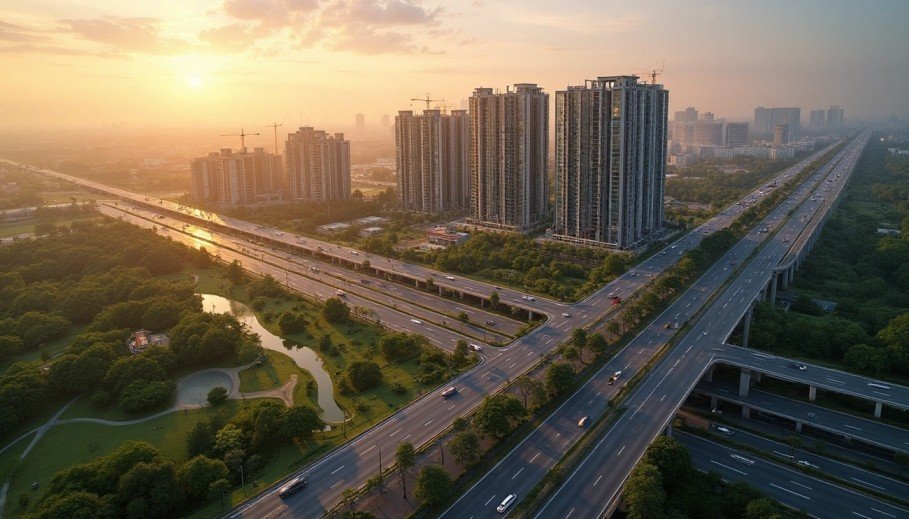
Choosing between Dwarka Expressway and Sohna Road is no longer a simple comparison—it is a strategic investment decision that depends on understanding growth stages, infrastructure readiness, and long-term positioning.
In 2026, both corridors are among the most discussed real estate destinations in Gurugram. They attract investor attention, deliver appreciation, and continue to evolve with infrastructure expansion. However, experienced investors rarely look at corridors in isolation. They begin by identifying the best sectors in Gurgaon for investment and studying a broader Gurgaon investment location guide before narrowing down opportunities.
This article goes beyond surface-level comparison and breaks down how location, infrastructure, and growth corridors shape real returns.
Growth Stage Defines Everything

The most important difference between Dwarka Expressway and Sohna Road lies in their stage of development.
Dwarka Expressway has moved past its uncertainty phase. What was once delayed infrastructure has now translated into a functional, well-connected corridor driven by end-user demand and possession-led activity. It represents a market that is stabilizing.
Sohna Road, in contrast, is still expanding. Development continues to push outward, creating new sectors, new supply, and new opportunities. This makes it a corridor where growth is still unfolding rather than consolidating.
Development continues to push outward, creating new sectors, new supply, and new opportunities, including rising demand for affordable housing projects in Sohna.
This distinction is crucial. One corridor is driven by present strength, while the other is driven by future potential.
Dwarka Expressway: Infrastructure-Led Maturity

Dwarka Expressway today stands as a reflection of how infrastructure transforms real estate markets. Improved connectivity to Delhi and proximity to IGI Airport have significantly enhanced its livability and rental demand.
Unlike earlier years, the corridor is no longer driven by speculation. It is supported by completed projects, occupied societies, and a growing ecosystem of schools, retail, and commercial spaces. This shift has repositioned Dwarka Expressway as a stability-focused investment zone.
From an investor’s perspective, the corridor now offers predictable performance. Rental yields remain relatively strong for Gurgaon standards, and price movements tend to follow steady, infrastructure-backed growth rather than sudden spikes.
However, this maturity also introduces a key challenge—entry price sensitivity. In several premium sectors, pricing has already factored in future growth, which means upside depends heavily on selecting the right micro-location rather than simply entering the corridor.
Sohna Road: Expansion-Led Growth Corridor

Sohna Road tells a different story—one of continuous expansion and evolving opportunity.
Earlier development was concentrated around established sectors like 47 and 48 along Sohna Road. Over time, growth has extended further south, creating a layered market where different sectors exist at different stages of maturity.
This is where the real opportunity lies. Investors who understand how to identify early-stage growth pockets often benefit the most. Investors who understand how to identify early-stage growth pockets often benefit the most, especially in emerging gated plotted townships in Sohna where land-led appreciation is still evolving. Many of these opportunities are linked to the broader transformation highlighted in the emerging growth hub Sohna Gurgaon, where infrastructure expansion is gradually unlocking new demand zones.
Unlike Dwarka Expressway, Sohna Road does not offer uniform performance. Some sectors are already well-developed and stable, while others are still dependent on upcoming infrastructure and population movement.
For long-term investors, this variability is not a risk—it is an opportunity, provided entry timing and sector selection are carefully planned.
Price and Yield Reality in 2026

The difference between both corridors becomes clearer when pricing and rental dynamics are evaluated together.
| Factor | Dwarka Expressway | Sohna Road |
|---|---|---|
| Avg Price (₹/sq ft) | ₹18,000–₹28,000 | ₹9,000–₹15,000 |
| Rental Yield | 3.5–4% | 2.5–3.2% |
| Growth Stage | Mature | Expanding |
| Supply Risk | Moderate | High in select pockets |
| Investor Profile | Stability + Rental | Long-term Growth |
Dwarka Expressway commands a premium because of its infrastructure readiness and occupancy levels. This translates into better rental consistency and lower volatility.
Sohna Road, with its lower entry price, offers higher percentage upside—but only for investors willing to wait through the development cycle.
Infrastructure: The Core Growth Driver
Infrastructure remains the single most important factor shaping real estate performance across both corridors.
Dwarka Expressway has already crossed the phase where infrastructure was a question mark. Roads are operational, connectivity is functional, and the ecosystem is actively supporting residential demand. This significantly reduces execution risk.
Sohna Road, however, is still influenced by future infrastructure delivery. Connectivity upgrades, planned expansions, and transit improvements will play a defining role in determining which sectors outperform.
The long-term impact of connectivity projects is already being analyzed through the metro expansion impact on Gurgaon real estate, which is expected to further strengthen both corridors—but at different speeds.
Where Most Investors Go Wrong
A common mistake investors make is treating both corridors as uniform markets.
In Dwarka Expressway, the biggest risk is overpaying at maturity. Entering at peak pricing without evaluating rental yield can compress returns significantly.
In Sohna Road, the risk is uneven development. This is why buyers increasingly prefer investing with trusted builders in Sohna Gurgaon that already have a proven delivery track record. While some sectors evolve into strong residential ecosystems, others may take years to reach the same level of livability and demand.
This is why serious investors focus on micro-markets rather than corridor headlines. Factors like occupancy levels, infrastructure status, and supply absorption matter far more than branding.
Sector Selection: The Real Game-Changer
At an advanced level of investing, corridor comparison becomes less important than sector-level analysis.
Two properties within the same corridor can deliver completely different returns depending on their location, surrounding infrastructure, and demand dynamics.
In Dwarka Expressway, certain sectors are already priced for stability, while others still offer limited upside linked to ongoing development.
In Sohna Road, the gap is even wider. Established sectors provide safety, while emerging pockets offer growth—but with higher holding periods.
Understanding this balance is what separates average investments from high-performing ones.
5–10 Year Outlook: Stability vs Scalability
Over the next decade, both corridors are expected to grow—but their trajectories will differ.
Dwarka Expressway is likely to deliver steady, predictable appreciation aligned with rental growth. It will continue to attract end-users, ensuring consistent demand.
Sohna Road is expected to evolve through multiple growth phases. As infrastructure expands, new sectors will emerge as investment hotspots, creating opportunities for higher percentage returns.
Investors looking for a long-term perspective should evaluate projections outlined in the 5-year property price forecast for Gurgaon, which highlights how these corridors may perform over the next cycle.
Final Verdict: Which Corridor Should You Choose?

The answer depends entirely on your investment strategy.
Dwarka Expressway suits investors who prioritize stability, rental income, and lower risk. It is a market where returns are more predictable and aligned with real demand.
Sohna Road suits investors who are comfortable with longer holding periods and are looking for scalable growth. It offers flexibility in entry price and the potential for higher appreciation over time.
In 2026, successful real estate investing is no longer about choosing the “better” corridor. It is about identifying the right opportunity within the right growth stage—and entering at the right time.
Frequently Asked Questions (Dwarka Expressway vs Sohna Road Investment 2026)
Is Dwarka Expressway a good investment in 2026?
Dwarka Expressway is considered a relatively lower-risk investment corridor in 2026 because major infrastructure has already been executed and possession levels have increased. It is now driven more by end-user demand and rental absorption rather than speculation. Investors seeking capital preservation with steady rental yield may find it attractive, but short-term explosive appreciation is less likely compared to its early growth years.
Is Sohna Road better than Dwarka Expressway for long-term investment?
Sohna Road can offer stronger percentage upside over a longer holding period, particularly in sectors where infrastructure is already functional but pricing remains moderate. However, it requires patience and sector-level selection. Dwarka Expressway offers more stability and rental predictability, while Sohna Road offers scalability and expansion-driven growth. The better choice depends on your time horizon and risk tolerance.
What is the price difference between Dwarka Expressway and Sohna Road in 2026?
In 2026, average transacting prices on Dwarka Expressway range roughly between ₹18,000–₹28,000 per sq ft depending on sector and project positioning. On Sohna Road, prices typically range between ₹9,000–₹15,000 per sq ft, with variation based on development maturity. This pricing gap reflects the difference between a maturing premium corridor and an expanding growth belt.
Which corridor offers better rental yield in 2026?
Dwarka Expressway currently offers stronger rental yields, typically in the range of 3.5–4%, supported by airport connectivity and corporate tenant demand. Sohna Road rental yields are generally slightly lower, averaging around 2.5–3.2%, but vacancy risk can be lower in established sectors with strong local ecosystem depth. Investors prioritizing rental income often prefer Dwarka Expressway in the current cycle.
What should investors consider before choosing between Dwarka Expressway and Sohna Road?
Investors should evaluate sector maturity, infrastructure execution, rental absorption, supply pipeline, and holding capacity before choosing a corridor. Dwarka Expressway suits investors looking for stability and rental compounding, while Sohna Road suits those willing to hold longer for capital appreciation. The right decision depends less on the corridor name and more on entry timing and micro-market selection.

Join The Discussion