
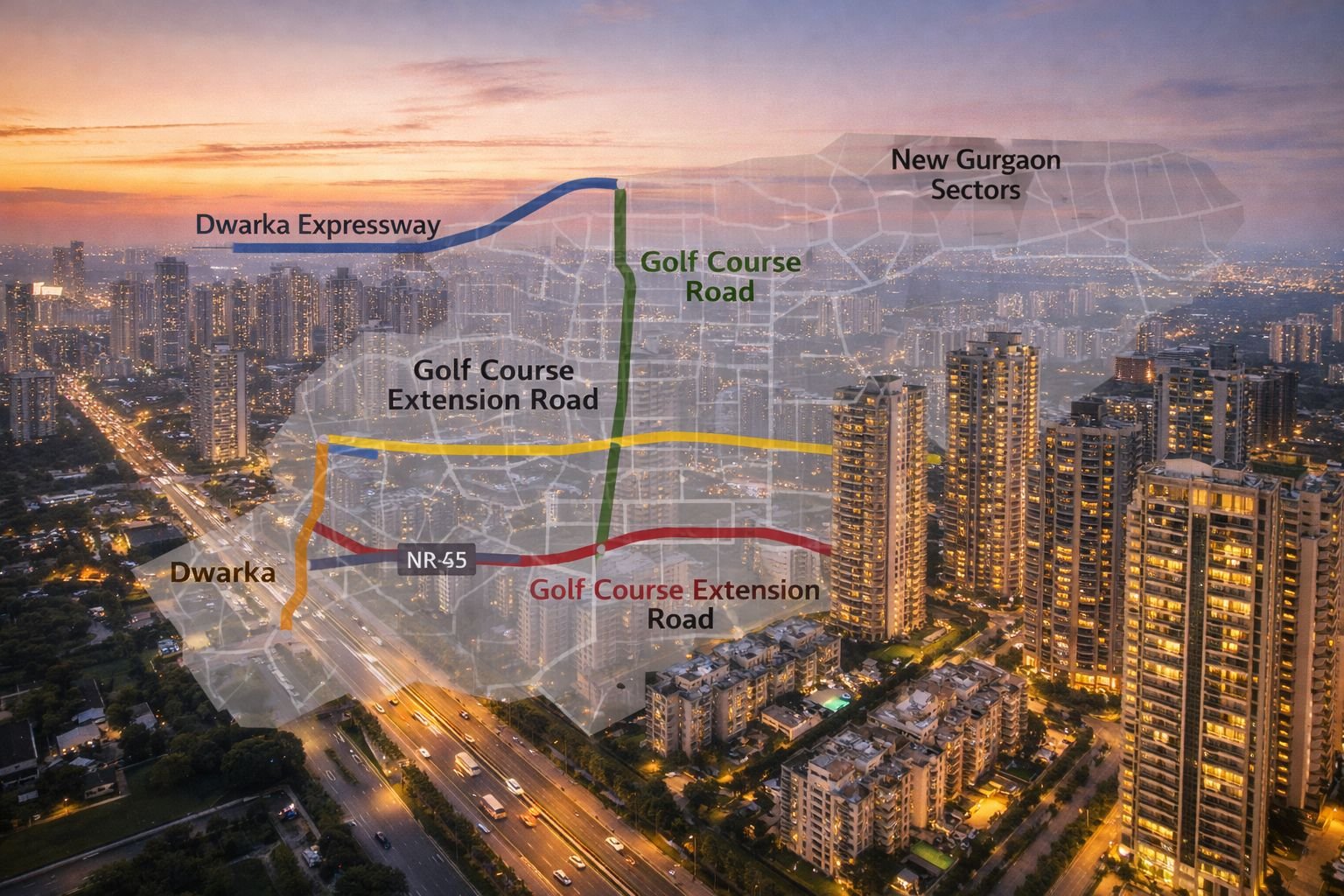
Buyers researching Gurgaon real estate often start by exploring individual sectors and the residential projects available in those locations. The following sector guides provide detailed information about property options, infrastructure connectivity, and investment potential across major Gurgaon sectors.
Introduction: Why Sector Selection Matters in Gurgaon
Gurgaon’s real estate market has evolved into one of the most structured and capital-intensive property markets in India. Over the past two decades, the city has transformed from a peripheral satellite town into a major financial and corporate hub with global companies, Grade-A office districts, and premium residential communities.
However, one important reality often surprises first-time buyers and even many investors: Gurgaon is not a single unified property market.
Instead, the city operates as a collection of micro-markets, each defined by its own infrastructure, price band, buyer profile, and long-term growth potential. Two sectors separated by only a few kilometres can behave very differently in terms of appreciation, rental demand, livability, and liquidity.
For example, sectors along Golf Course Road may function as mature luxury markets, while sectors on Dwarka Expressway may still be in early growth phases driven by infrastructure development.
Because of this fragmentation, sector selection becomes one of the most important decisions in Gurgaon real estate.
Choosing the right sector can determine:
- long-term property appreciation
- rental yield and tenant demand
- resale liquidity
- lifestyle convenience for end-users
- stability of the surrounding ecosystem
In contrast, choosing the wrong sector can lead to slow price growth, oversupply pressure, or weak rental demand despite the project itself appearing attractive.
This guide has been created to help buyers and investors navigate this complexity. Instead of focusing on individual projects, it focuses on how to evaluate and compare sectors across Gurgaon.
Inside this guide we will cover:
- how Gurgaon’s micro-market structure works
- how to compare sectors based on infrastructure and demand
- which sectors are best for end-users and livability
- which sectors offer stronger long-term investment potential
- how buyers can systematically choose the right sector for their goals
Understanding these factors allows buyers to move beyond marketing narratives and make location-driven real estate decisions.
Map of Major Gurgaon Real Estate Corridors
Gurgaon’s real estate development is organized around several major infrastructure corridors that shape residential growth, office districts, and investment activity. Understanding how these corridors are positioned relative to each other helps buyers evaluate which sectors may offer stronger connectivity, livability, or long-term appreciation potential.
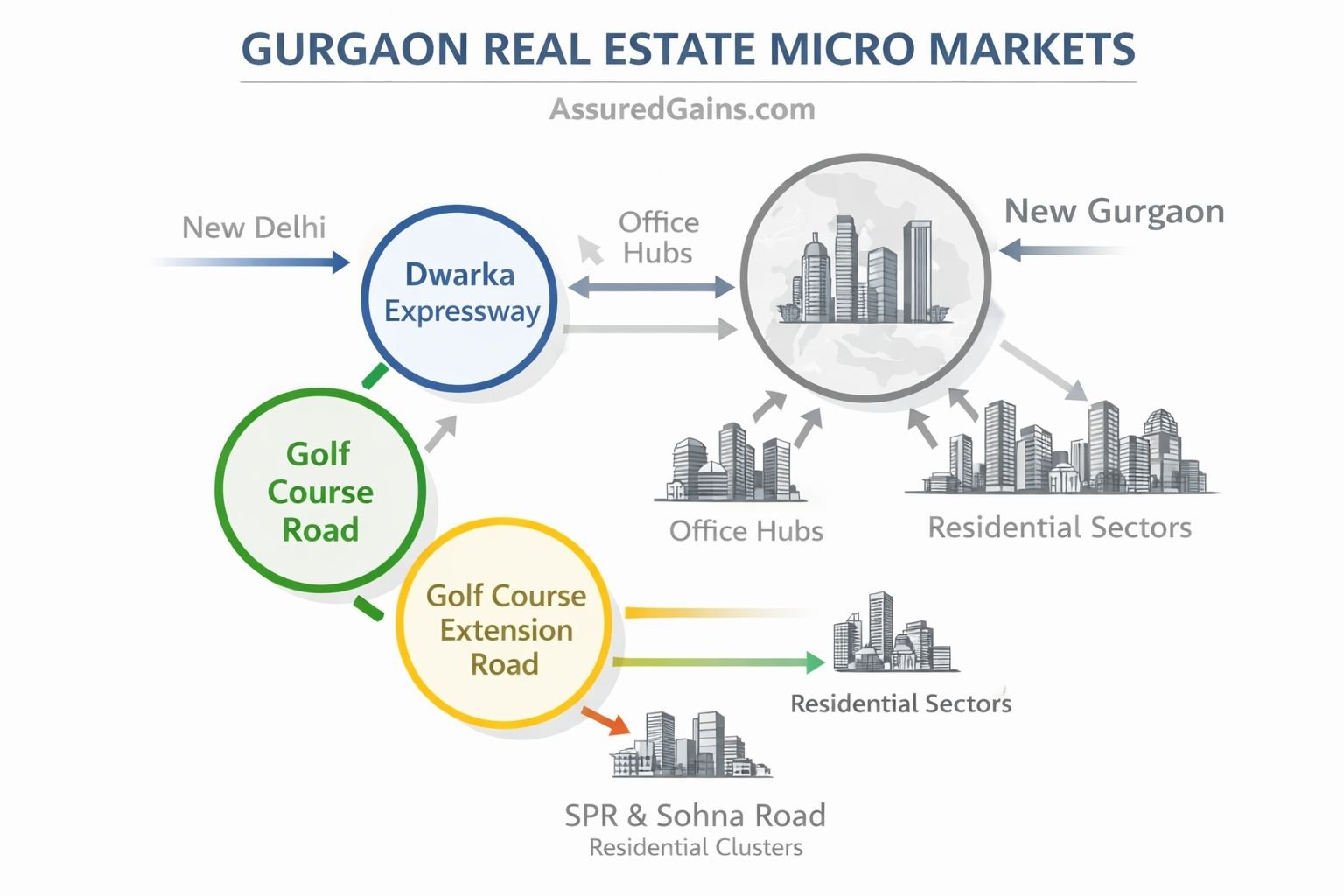
The map below highlights the primary real estate corridors that influence sector-level property markets across Gurgaon.
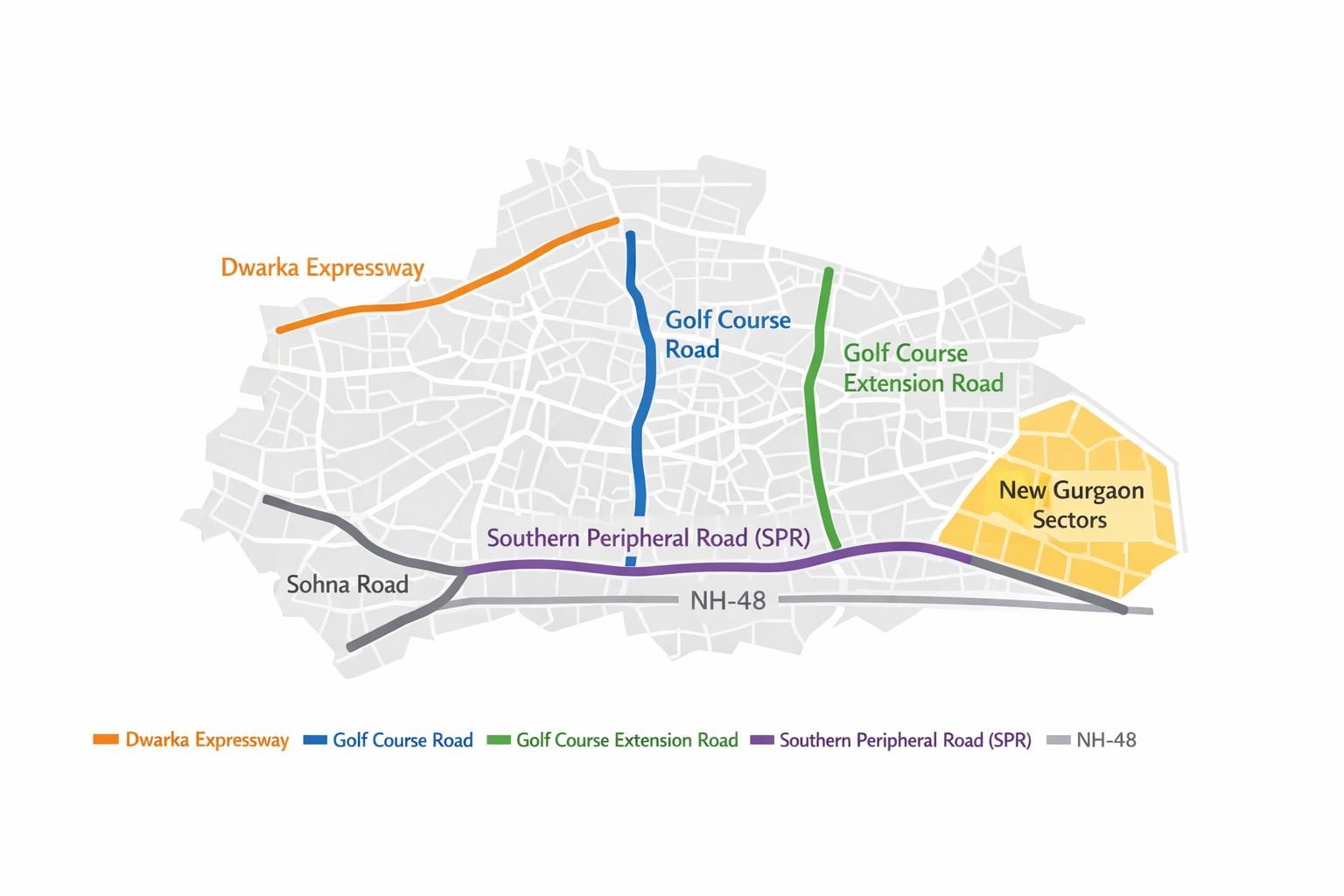
Each corridor includes multiple residential sectors such as Sector 65, Sector 67, Sector 82, Sector 102, and Sector 113 that form important micro-markets within Gurgaon’s property ecosystem.
Understanding Gurgaon’s Micro-Market Structure
To understand which sectors are best in Gurgaon, it is first necessary to understand how the city’s micro-markets are organized.
Unlike many cities where development expands evenly, Gurgaon’s growth has been shaped by specific infrastructure corridors. Each corridor created its own cluster of residential sectors, commercial hubs, and supporting social infrastructure.
Over time, these corridors developed into distinct real estate ecosystems.
Today, most Gurgaon sectors can broadly be grouped into five major micro-markets.
Golf Course Road
Golf Course Road represents one of the most mature and premium real estate corridors in Gurgaon. The area developed early and quickly became a preferred address for luxury residential developments and multinational corporate offices.
The corridor benefits from strong connectivity through Rapid Metro stations and proximity to established business districts.
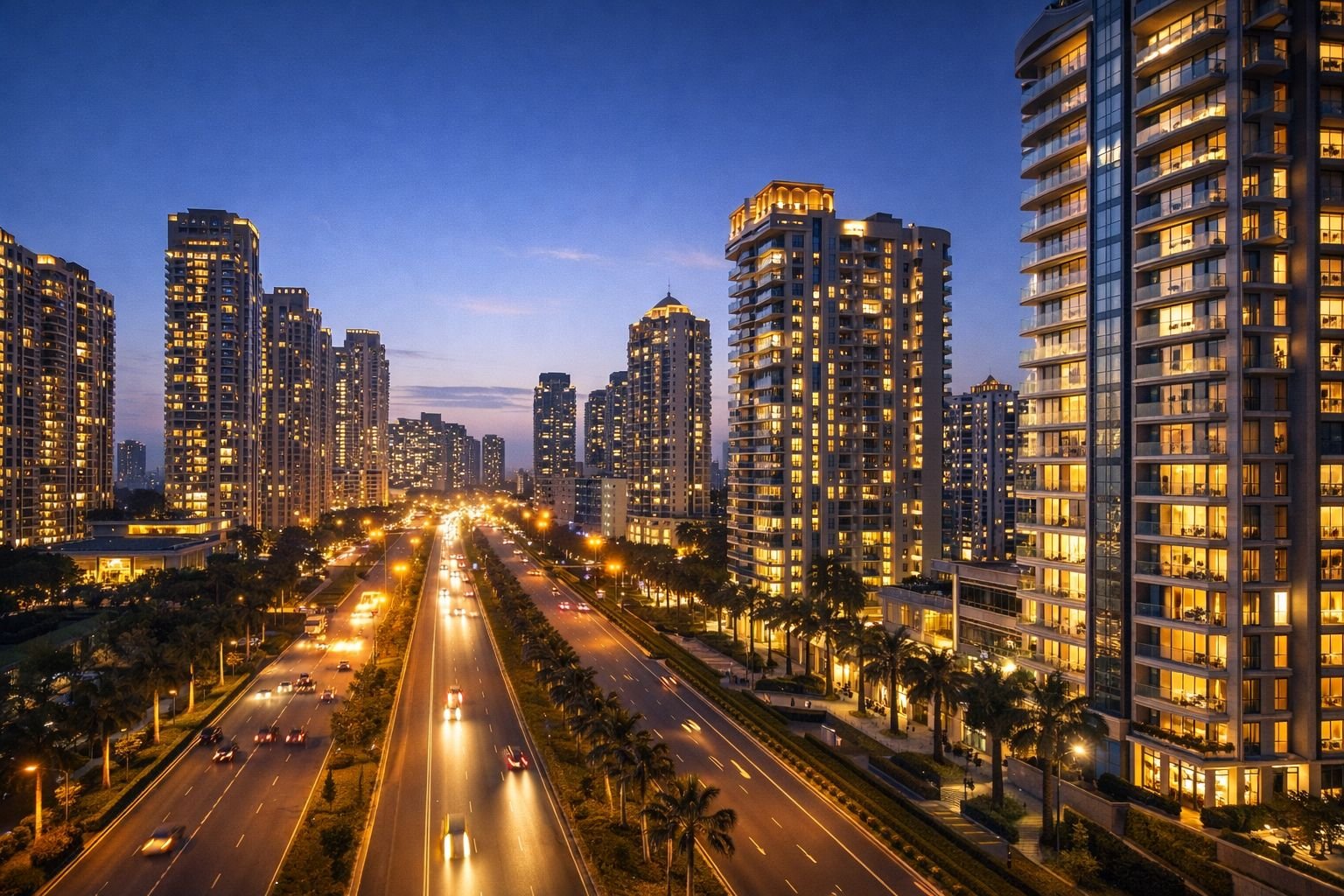
Typical characteristics of sectors in this corridor include:
- premium residential communities
- high-end apartment developments
- strong corporate rental demand
- established social infrastructure
Because the area is largely built out, price appreciation tends to be stable rather than explosive, but demand remains consistent due to its central positioning.
Established residential locations along this corridor include Sector 54 Gurgaon and nearby premium neighborhoods such as Sector 48 Gurgaon, where several high-end residential developments have shaped the luxury housing market.
Golf Course Extension Road
Golf Course Extension Road emerged as the natural expansion of the Golf Course Road corridor. Over the past decade, it has become one of the most active residential development zones in Gurgaon.
This micro-market includes several rapidly developing residential locations such as Sector 65 Gurgaon, Sector 67 Gurgaon, and Sector 63A Gurgaon, where multiple premium housing projects have been launched over the past decade.
Key characteristics of this corridor include:
- premium residential developments
- newer construction and modern layouts
- strong connectivity to Golf Course Road and Sohna Road
- growing social infrastructure
Compared to Golf Course Road, sectors here often offer better growth potential, as the ecosystem is still evolving.
Sohna Road Corridor
Sohna Road functions as a mixed residential and commercial corridor that connects central Gurgaon with the southern parts of the city.
Over time, this region developed a balanced mix of:
- residential apartment complexes
- office buildings and IT parks
- retail hubs and shopping centres
Residential pockets near Sohna Road also extend into nearby areas such as Sector 49 Gurgaon, where several premium residential communities have developed alongside the corridor’s commercial growth.
The corridor tends to attract mid-premium buyers and working professionals due to its proximity to office zones and relatively balanced price points.
Dwarka Expressway
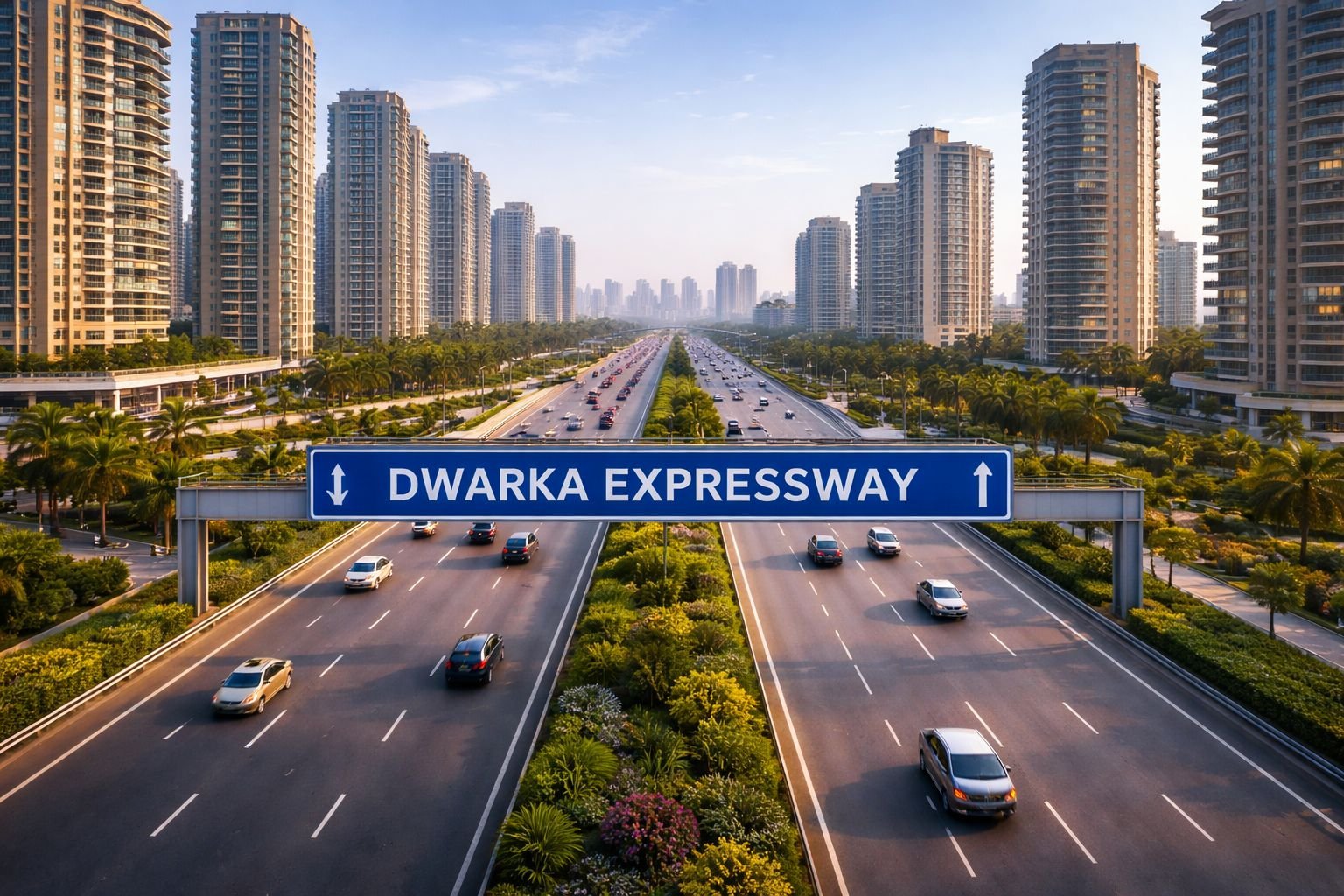
Dwarka Expressway is widely regarded as one of the most important infrastructure-driven real estate corridors in Gurgaon today.
The expressway connects Gurgaon directly with Dwarka in Delhi and provides improved access to the airport and other key transportation routes.
The corridor includes several fast-growing residential sectors such as Sector 102 Gurgaon, Sector 104 Gurgaon, Sector 113 Gurgaon, and Sector 37D Gurgaon, many of which have seen significant residential construction over the past few years.
Key characteristics include:
- large-scale residential development
- strong investor participation
- infrastructure-driven appreciation potential
- expanding road connectivity and planning
Because many sectors here are still evolving, the area often attracts long-term investors looking for growth potential.
New Gurgaon
New Gurgaon refers to the planned residential sectors located along the northern parts of the city, particularly near NH-48 and the Dwarka Expressway influence zone.
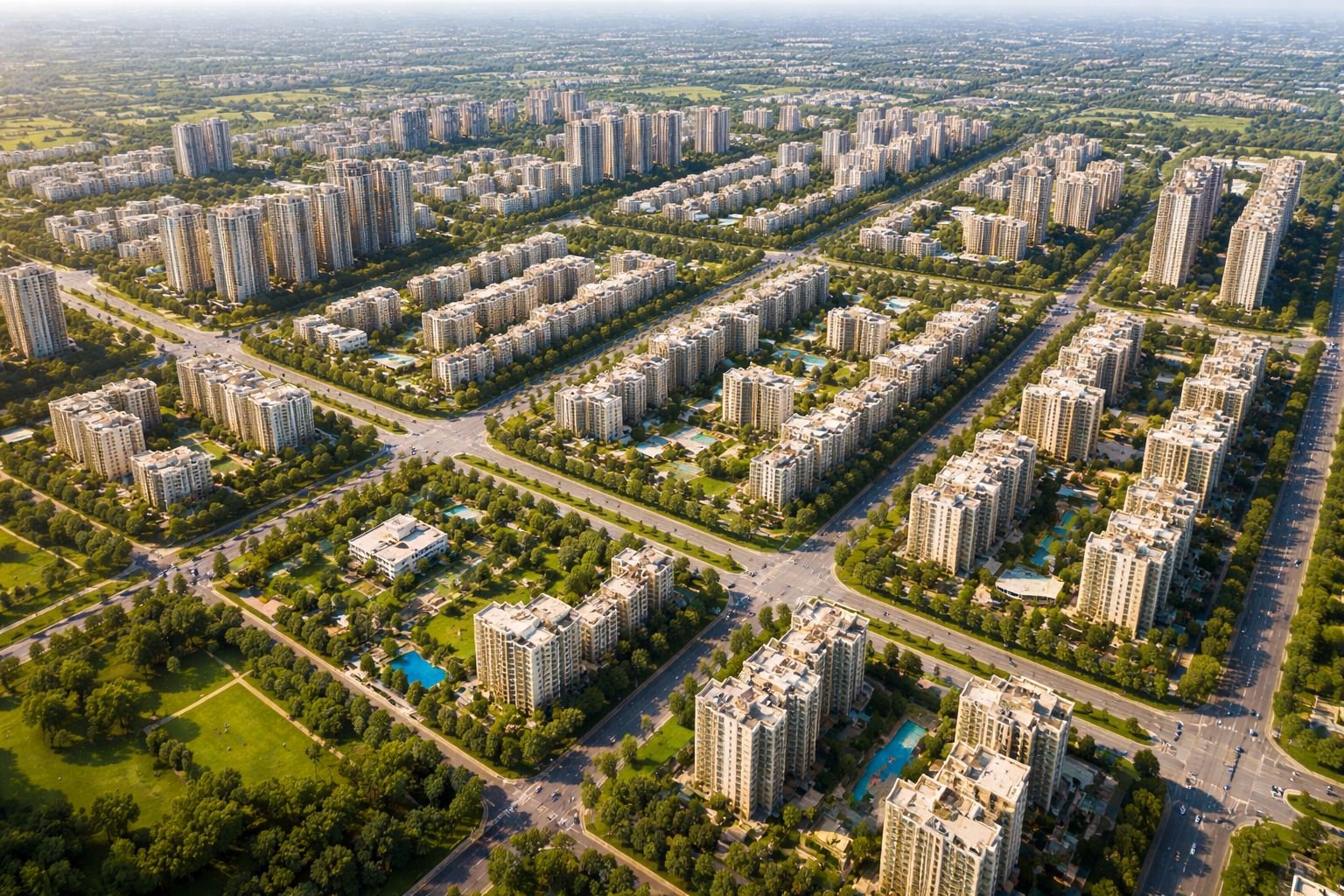
This micro-market was designed as a planned extension of Gurgaon with:
- wider roads
- organized sector layouts
- modern residential developments
The area offers a mix of mid-segment and premium residential options, with growing residential clusters in locations such as Sector 82 Gurgaon, Sector 83 Gurgaon, Sector 90 Gurgaon, and Sector 92 Gurgaon.
Many buyers are attracted to this region because it offers relatively modern planning compared to older Gurgaon sectors.
Southern Peripheral Road (SPR)
Southern Peripheral Road, commonly referred to as SPR, is emerging as one of Gurgaon’s most strategically positioned growth corridors. The road connects Golf Course Extension Road with NH-48 and provides access to several rapidly developing residential and commercial sectors.
Because SPR links multiple major corridors together, it is gradually evolving into an important urban connector within Gurgaon’s real estate map. Several residential sectors and commercial developments are being planned along this stretch, including emerging residential zones such as Sector 66 Gurgaon, Sector 68 Gurgaon, and Sector 69 Gurgaon, which may strengthen its long-term investment potential.
As infrastructure along the corridor continues to mature, SPR is increasingly attracting attention from both developers and investors looking for locations positioned between established micro-markets.
NH-48 Residential Corridor
The NH-48 corridor has historically played a critical role in Gurgaon’s real estate development. Many early residential sectors and commercial districts emerged along this highway due to its direct connectivity between Delhi and Jaipur.
Sectors located near NH-48 often benefit from strong road connectivity and proximity to major employment hubs such as Udyog Vihar and Cyber City. Because of this, residential areas along the corridor tend to attract professionals working in Gurgaon’s corporate districts.
Although some sectors near NH-48 are already mature, the corridor continues to influence residential demand due to its strategic transportation connectivity.
Why Micro-Markets Matter When Choosing a Sector
Understanding these micro-markets is important because sectors rarely function in isolation.
A sector’s performance is heavily influenced by the corridor it belongs to. Infrastructure development, office proximity, and demand patterns typically affect entire micro-markets rather than individual sectors alone.
For example:
- sectors within Golf Course Road benefit from mature corporate ecosystems
- sectors along Dwarka Expressway benefit from infrastructure expansion
- sectors in New Gurgaon benefit from planned residential layouts
Therefore, before choosing a specific sector, buyers should first identify which micro-market aligns best with their investment objective or lifestyle requirements.
Once the micro-market is selected, it becomes much easier to compare sectors within that corridor and narrow down the final location choice.
How to Evaluate a Sector Before Buying Property
Choosing the right sector in Gurgaon requires more than simply comparing property prices or looking at a specific project. Real estate performance is largely influenced by location fundamentals, and these fundamentals are often visible at the sector level.
A well-chosen sector can support long-term appreciation, steady rental demand, and strong resale liquidity. On the other hand, a sector with weak infrastructure planning or excessive supply can struggle even if individual projects appear attractive.
Before selecting a sector, buyers and investors should evaluate several key factors.
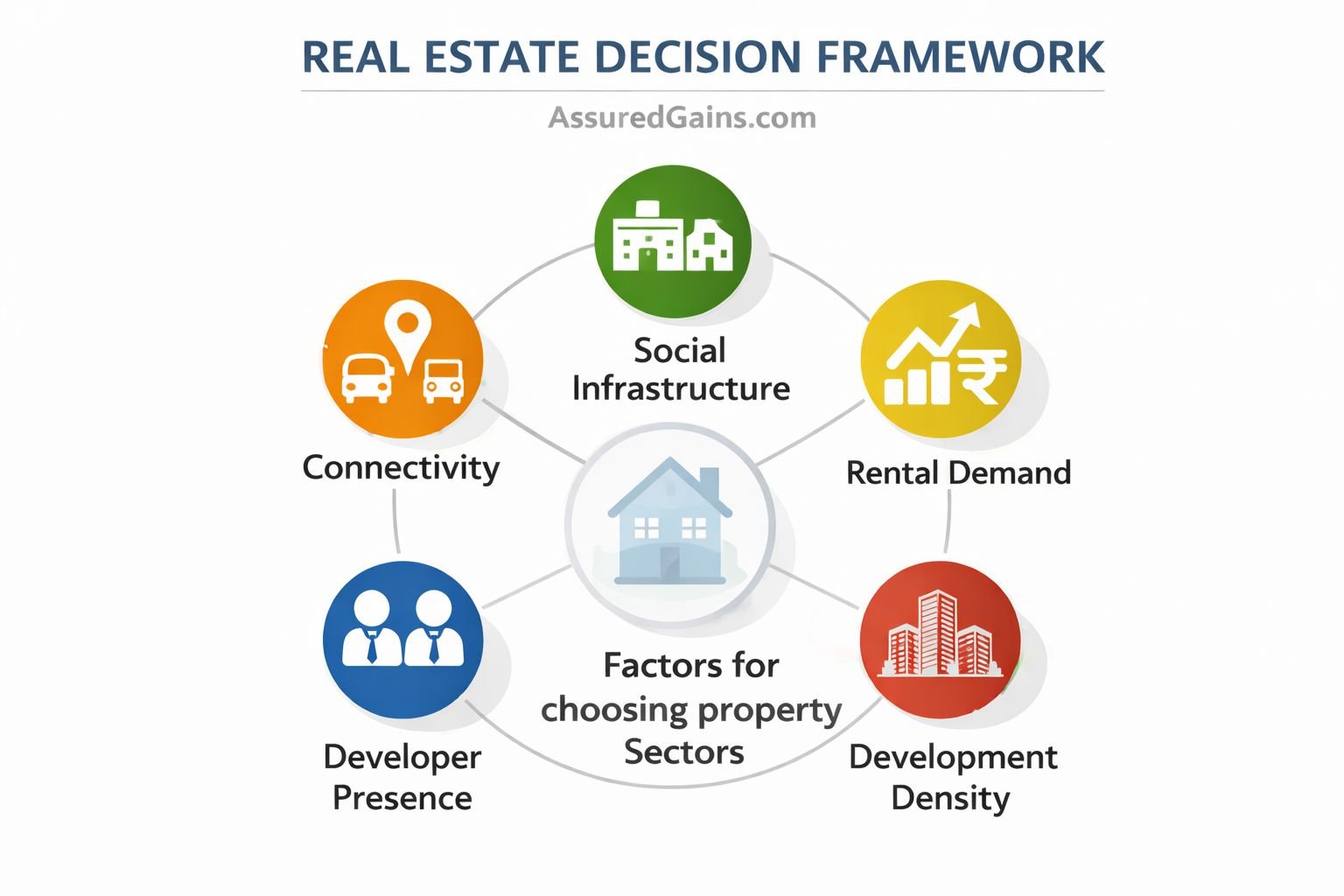
Connectivity and Accessibility
Connectivity is one of the most influential drivers of property demand in Gurgaon. Sectors that provide easy access to major roads, metro lines, and business districts tend to perform better over time.
When evaluating connectivity, buyers should consider how easily the sector connects to major corridors such as Golf Course Road, NH-48, Sohna Road, and Dwarka Expressway. Access to metro stations or rapid transit networks also plays an important role, particularly for professionals working in corporate districts.
A sector that offers convenient daily commuting options tends to attract both end-users and tenants, which strengthens long-term demand.
Social Infrastructure
Livability in a sector is heavily influenced by the availability of social infrastructure. Even well-designed residential projects can struggle if surrounding amenities are limited.
Key infrastructure elements to examine include schools, hospitals, retail centers, grocery stores, and everyday convenience services. Mature sectors typically develop a strong ecosystem of educational institutions, healthcare facilities, and local markets that support daily living.
When families evaluate sectors for long-term residence, the availability of such infrastructure often becomes a deciding factor.
Supply and Development Density
Another important consideration is the balance between housing supply and demand within the sector. Some sectors experience aggressive development cycles with multiple projects launching simultaneously. While this may increase available housing options, it can also create oversupply pressure.
Oversupply can slow down price appreciation and make resale transactions more competitive.
Sectors with a more balanced development pipeline often maintain stronger pricing stability and healthier resale markets.
Rental Ecosystem
Rental demand plays an important role in many Gurgaon sectors because the city has a large population of working professionals, expatriates, and corporate tenants.
Sectors located near major office hubs tend to benefit from consistent rental demand. Corporate leasing activity and proximity to employment zones can significantly improve rental yields and occupancy stability.
For investors who intend to generate rental income, evaluating the strength of the rental ecosystem in a sector is essential.
Developer Presence and Project Quality
The type of developers operating within a sector can also influence its long-term reputation. Sectors that host projects by established developers often develop stronger buyer confidence and better infrastructure planning.
Large townships and professionally managed residential communities can contribute to better maintenance standards, improved amenities, and more organized neighborhood environments.
Over time, these factors help create a stronger residential ecosystem that attracts long-term buyers and tenants.
Gurgaon Sector Comparison by Micro-Market
| Corridor | Market Position | Typical Buyer Segment |
|---|---|---|
| Golf Course Road | Ultra Luxury | HNIs, senior professionals |
| Golf Course Extension Road | Premium | Premium homebuyers |
| Dwarka Expressway | Emerging Growth | Long-term investors |
| New Gurgaon | Mid Segment | Families & mid-income buyers |
| Sohna Road | Mid-Premium | Working professionals |
Once buyers understand how to evaluate sectors, the next step is to compare sectors within Gurgaon’s major micro-markets. Each corridor offers a different combination of pricing levels, buyer profiles, and investment potential.
The table below provides a simplified overview of how sectors across major micro-markets typically compare.
| Micro-Market | Typical Sector Range | Buyer Profile | Market Characteristics |
|---|---|---|---|
| Golf Course Road | 42–56 | Luxury buyers, senior professionals | Mature luxury market with stable demand |
| Golf Course Extension Road | 58–67 | Premium homebuyers and investors | Growing premium residential corridor |
| Sohna Road | 47–49 | Mid-premium end users | Balanced residential and commercial ecosystem |
| Dwarka Expressway | 102–113 | Long-term investors and early buyers | Infrastructure-driven growth corridor |
| New Gurgaon | 82–95 | Mid-segment families | Planned residential expansion with modern layouts |
This comparison highlights an important pattern: different micro-markets serve different buyer segments.
Example sectors illustrate how these micro-markets behave differently. Premium residential demand along Golf Course Extension Road is visible in locations such as Sector 65 Gurgaon, Sector 67 Gurgaon, and Sector 62 Gurgaon, where several large residential developments have shaped the corridor’s premium housing supply.
Luxury buyers often gravitate toward established corridors such as Golf Course Road, where residential supply is limited and corporate proximity remains strong. Premium buyers seeking newer projects often prefer Golf Course Extension Road, which offers modern developments with growing infrastructure.
Meanwhile, investors looking for future appreciation frequently explore sectors along Dwarka Expressway, where large-scale infrastructure upgrades are still shaping the real estate landscape.
New Gurgaon has gradually become attractive for families seeking relatively organized residential planning and mid-segment housing options.
Because of these differences, the “best sector” in Gurgaon is not the same for every buyer. A sector that suits a luxury homeowner may not be ideal for an investor focused on capital appreciation, and vice versa.
Understanding how these micro-markets function allows buyers to narrow their search and focus on sectors that align with their specific objectives.
Best Sectors in Gurgaon for End-Users and Livability
When families choose a sector to live in, the priorities are different from those of investors. End-users typically focus on daily convenience, neighborhood stability, safety, and access to schools, healthcare, and retail.
Livability in Gurgaon is often determined by how mature a sector’s ecosystem is. Sectors that have developed over many years usually offer better road networks, functioning markets, and a wider range of social infrastructure.
While many sectors across Gurgaon offer residential options, a few stand out because they provide a more balanced living environment.
Sector 54
Among residential neighborhoods along Golf Course Road, Sector 54 has long been considered one of the most stable and established addresses in Gurgaon. The presence of Rapid Metro connectivity and proximity to major office districts such as Cyber City have historically supported strong residential demand in this area.
The sector’s proximity to the Rapid Metro corridor has historically supported strong rental demand from professionals working in Cyber City and nearby office districts. This maturity gives the sector a level of stability that many newer sectors are still developing.
Because of these factors, Sector 54 is often considered a reliable location for buyers seeking a stable residential environment with strong connectivity.
Sector 56
Sector 56 represents a slightly different residential environment compared to the luxury high-rise clusters along Golf Course Road. The area developed earlier and today includes a mix of independent housing, builder floors, and apartment communities that support a more traditional neighborhood structure.
The sector benefits from easy access to daily conveniences such as local markets, educational institutions, and healthcare facilities. It also provides relatively quick connectivity to corporate districts and major road corridors.
Many families prefer this sector because it offers a combination of accessibility and neighborhood stability, which is important for long-term residence.
Sector 57
Within the central Gurgaon residential belt, Sector 57 has gradually developed into a comfortable family-oriented neighborhood supported by local markets, parks, and daily convenience infrastructure.
Connectivity to Golf Course Extension Road and Sohna Road also improves accessibility for professionals working in nearby office zones.
For buyers seeking a residential ecosystem that feels established and functional, Sector 57 often appears on the shortlist.
Sector 65
Sector 65 represents a newer generation of premium residential sectors located along Golf Course Extension Road. Unlike older sectors, many developments here are modern gated communities with large residential complexes and contemporary amenities.
The sector benefits from its position within one of Gurgaon’s fastest-developing residential corridors. As infrastructure continues to expand in this area, Sector 65 has gradually become attractive for both end-users and investors.
Families choosing this sector typically prioritize modern residential developments and future infrastructure growth.
Sector 67
Sector 67 has emerged as an important residential zone within the Golf Course Extension Road corridor. Several premium projects have been developed in this sector, attracting buyers who prefer newer construction and organized residential communities.
The sector’s connectivity to major roads and nearby commercial zones makes it a practical choice for professionals working in Gurgaon’s office hubs.
Because the surrounding ecosystem is still evolving, the sector also offers potential for future appreciation alongside livability improvements.
Best Sectors in Gurgaon for Property Investment
While livability is important for end-users, investors often evaluate sectors through a different lens. Investment decisions typically focus on long-term appreciation potential, infrastructure development, demand growth, and future connectivity improvements.
Several Gurgaon sectors have gained attention among investors because they sit within corridors where infrastructure development is actively shaping property values.
Examples often discussed by investors include Sector 67 Gurgaon, Sector 102 Gurgaon, and Sector 83 Gurgaon, where large residential projects and infrastructure expansion have drawn significant buyer interest.
Dwarka Expressway Sectors (102–113)
Sectors along the Dwarka Expressway corridor have attracted significant investor interest over the past decade. The expressway itself has been a major infrastructure project designed to improve connectivity between Gurgaon and Delhi.
For example, residential sectors such as Sector 102 Gurgaon, Sector 104 Gurgaon, and Sector 113 Gurgaon have emerged as key locations along the expressway corridor as infrastructure development continues to reshape the surrounding real estate landscape.
As the road network and surrounding infrastructure continue to develop, residential sectors along this corridor are expected to benefit from improved accessibility and expanding urban activity.
Because many of these sectors are still in relatively early stages of development, investors often view them as long-term appreciation opportunities.
Sector 65–67 (Golf Course Extension Road)
The Golf Course Extension Road corridor has gradually become one of the most active premium residential zones in Gurgaon. Several national developers have launched large residential communities across sectors in this region.
Sectors such as 65 and 67 are particularly interesting for investors because they combine premium positioning with relatively newer infrastructure compared to older luxury areas.
As the corridor matures and supporting infrastructure expands, property values in these sectors may continue to strengthen.
New Gurgaon Sectors (82–95)
New Gurgaon has developed into an organized residential zone with a mix of mid-segment and premium housing options. The area benefits from relatively planned sector layouts and improving connectivity to major highways.
Several residential sectors including Sector 82 Gurgaon, Sector 83 Gurgaon, and Sector 90 Gurgaon form part of this expanding residential belt and continue to attract families seeking relatively planned urban layouts.
These sectors often attract investors looking for balanced opportunities, where both end-user demand and future appreciation potential exist.
Because the region is gradually building its own social infrastructure, many buyers see it as a long-term residential destination rather than purely an investor-driven market.
Best Sectors in Gurgaon Near Major Office Hubs
For many buyers working in Gurgaon’s corporate districts, proximity to employment centers plays a major role in sector selection.
Near Cyber City
Sectors located along Golf Course Road and surrounding areas often provide relatively quick connectivity to Cyber City and DLF Phase districts. Because of this proximity, these sectors tend to attract professionals working in multinational corporate offices.
Nearby premium residential sectors such as Sector 54 Gurgaon and Sector 65 Gurgaon are often preferred by professionals working in these corporate districts due to shorter commuting distances.
Near Udyog Vihar
Residential sectors with access to NH-48 often provide convenient commuting routes to Udyog Vihar, one of Gurgaon’s major industrial and office districts. These locations are particularly attractive for professionals working in technology and manufacturing companies located in the area.
Near Golf Course Road Office Belt
Several residential sectors located along Golf Course Road and Golf Course Extension Road benefit from proximity to office towers, corporate campuses, and commercial districts along these corridors.
This proximity supports both residential demand and rental activity.
Sector vs Sector: Understanding Location Trade-Offs
One of the most common questions buyers ask is whether one sector is better than another. In reality, sector comparisons often involve trade-offs between maturity, pricing, and growth potential.
For example, comparing a mature luxury sector with a developing premium corridor can reveal different advantages depending on the buyer’s objective.
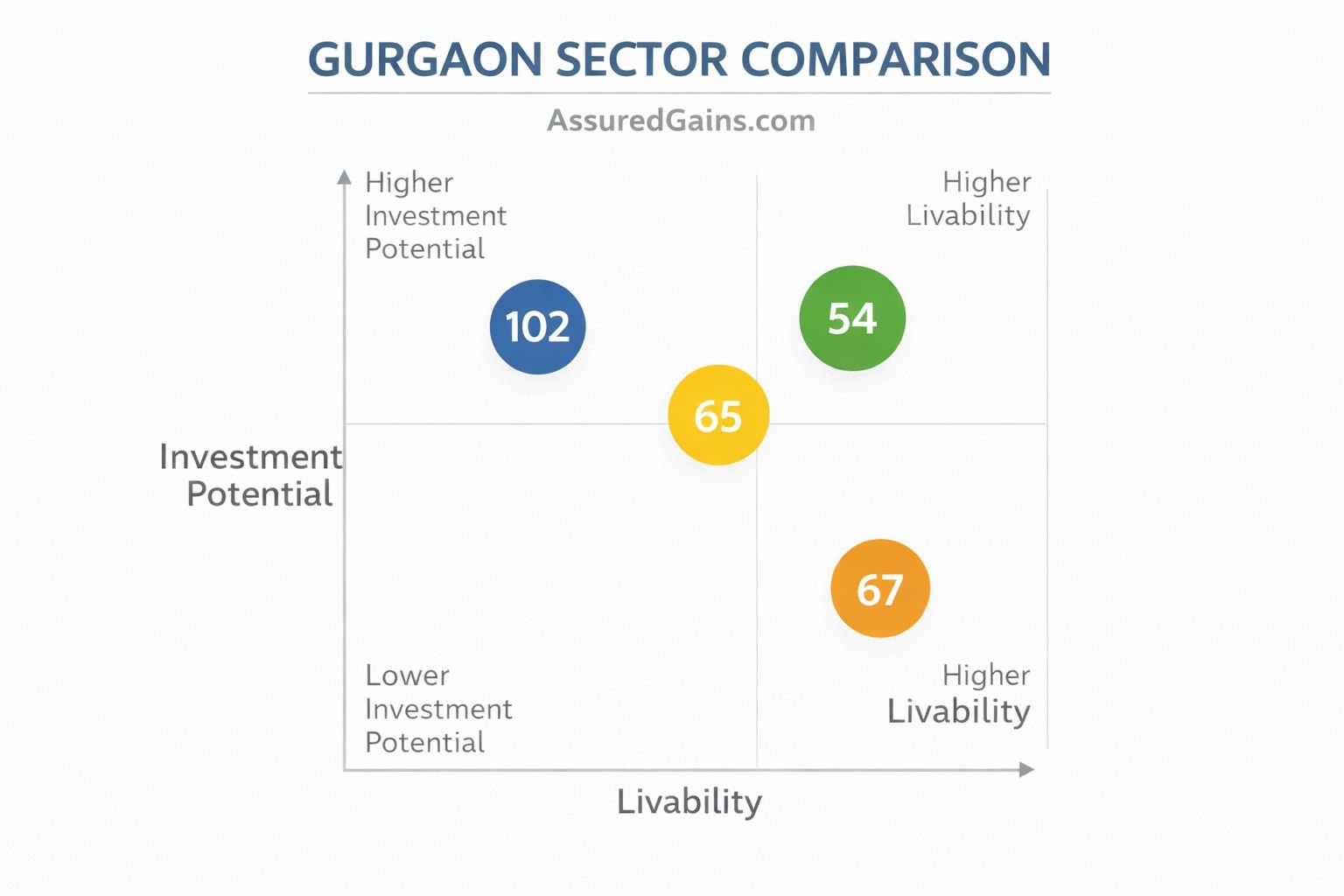
Livability vs Investment Potential (Indicative Comparison)
| Sector | Livability | Investment Potential |
|---|---|---|
| Sector 54 | High | Medium |
| Sector 56 | High | Medium |
| Sector 65 | High | High |
| Sector 67 | Medium | High |
| Sector 102 | Medium | High |
Sector 54 vs Sector 65
A comparison between Sector 54 Gurgaon and Sector 65 Gurgaon illustrates how mature luxury micro-markets differ from emerging premium corridors within the city.
Sector 65, on the other hand, sits within a newer premium corridor that is still expanding. While infrastructure continues to develop, the area offers modern residential projects and potential for future growth.
This comparison illustrates a common decision buyers face: established ecosystem versus growth corridor.
Sector 67 vs Sector 102
Sector 67 belongs to the Golf Course Extension Road corridor, which has already seen strong residential development and growing infrastructure.
Sector 102, located along Dwarka Expressway, represents a corridor where infrastructure expansion is still shaping the market.
Investors comparing these sectors often weigh near-term stability against long-term infrastructure-driven appreciation.
Sector 82 vs Sector 95
Both sectors belong to the New Gurgaon micro-market but differ in development stage and surrounding infrastructure.
Sector 82 is relatively more developed with a stronger residential ecosystem, while Sector 95 is still emerging as new projects and infrastructure expand in the area.
This type of comparison highlights how even sectors within the same micro-market can behave differently.
Gurgaon Sector Price Segmentation
Property prices across Gurgaon vary significantly depending on the corridor and level of infrastructure maturity. Understanding these price segments can help buyers quickly identify which sectors align with their budget and investment strategy.
Ultra Luxury Sectors
Ultra luxury housing in Gurgaon is primarily concentrated along the Golf Course Road corridor. These sectors typically host premium residential towers, penthouses, and luxury gated communities catering to high-income buyers.
Premium Residential Sectors
Premium sectors are usually located along Golf Course Extension Road and certain parts of central Gurgaon. These areas offer modern high-rise developments with strong amenities while still providing better growth potential compared to mature luxury markets.
Mid-Segment Residential Sectors
Mid-segment sectors are often located in New Gurgaon and parts of Sohna Road. These sectors attract working professionals and families looking for organized residential communities within relatively balanced price ranges.
Emerging Investment Sectors
Emerging sectors are typically found along infrastructure expansion corridors such as Dwarka Expressway. These sectors may still be developing but attract investors seeking long-term appreciation driven by infrastructure growth.
Gurgaon Sector Price Range Overview
Property prices across Gurgaon vary significantly depending on corridor maturity, infrastructure connectivity, and residential demand. While exact prices vary between individual projects, certain corridors are generally associated with specific price segments within the city’s real estate market.
The following overview provides a simplified comparison of how Gurgaon’s major corridors typically position themselves in the residential property market.
| Gurgaon Corridor | Typical Market Price Position | Buyer Segment |
|---|---|---|
| Golf Course Road | Ultra Luxury | High-net-worth buyers and senior professionals |
| Golf Course Extension Road | Premium | Premium homebuyers and investors |
| Southern Peripheral Road (SPR) | Upper Mid Segment | Upgraders and emerging premium buyers |
| Sohna Road | Mid Premium | Working professionals and families |
| New Gurgaon | Mid Segment | Mid-income families and long-term buyers |
| Dwarka Expressway | Emerging Growth | Investors and early-stage buyers |
Typical price positioning of major Gurgaon real estate corridors.
Understanding how these corridors differ in price positioning helps buyers shortlist sectors that align with their budget while still offering the infrastructure and lifestyle environment they are looking for.
For example, premium sectors such as Sector 65 and Sector 67 are typically positioned within the Golf Course Extension Road price segment, while sectors like Sector 102 and Sector 104 fall within the emerging Dwarka Expressway investment corridor.
Sector Selection Guide: How to Choose the Right Sector in Gurgaon
After understanding Gurgaon’s micro-markets and comparing major sectors, the next step for buyers is to narrow down the location choice in a structured way.
Many property decisions in Gurgaon fail because buyers start by comparing projects rather than locations. However, long-term real estate performance is primarily determined by the sector and corridor, not just the individual project.
A disciplined sector selection process can help buyers reduce hundreds of possible locations into a short list of sectors that match their financial goals and lifestyle priorities.
Step 1: Define Your Primary Objective
Before selecting a sector, buyers should clearly identify their main objective for purchasing property. In Gurgaon, the ideal sector for a rental investor may not be the same as the ideal sector for a family planning long-term residence.
Some buyers focus primarily on rental income, particularly in sectors close to major corporate districts where tenant demand is strong. Others focus on long-term capital appreciation and prefer sectors located in growth corridors where infrastructure development may drive future value.
End-users typically prioritize livability factors such as school access, neighborhood environment, and commuting convenience.
By defining the objective first, buyers can eliminate sectors that do not align with their priorities.
Step 2: Determine Your Budget Range
Budget plays a significant role in narrowing down potential sectors. Gurgaon’s property market spans a wide price spectrum, from mid-segment residential zones to ultra-luxury developments.
For example, premium corridors such as Golf Course Road typically cater to higher price bands, while other micro-markets may offer more mid-segment or emerging opportunities.
Instead of searching across the entire city, buyers should identify sectors where their budget aligns with the prevailing property segment.
This approach helps avoid unrealistic comparisons and ensures that shortlisted sectors remain financially viable.
Step 3: Choose the Right Micro-Market
Once the budget and objective are clear, the next step is to select the micro-market that best fits the buyer’s strategy.
Luxury buyers or senior professionals may prefer mature corridors with established infrastructure and strong corporate proximity. Investors looking for growth opportunities may focus on corridors where large infrastructure projects are still shaping the real estate landscape.
Families looking for long-term residence often prioritize sectors that already offer functioning social infrastructure and stable residential communities.
Choosing the right micro-market significantly reduces the complexity of sector selection.
Step 4: Shortlist a Few Sectors
After identifying the right corridor, buyers should narrow their options to three or four sectors within that micro-market. This focused shortlist allows a deeper evaluation of factors such as project availability, infrastructure development, and neighborhood environment.
At this stage, buyers can begin comparing projects within those sectors while keeping the broader location strategy intact.
By approaching sector selection in this structured way, buyers can avoid impulsive decisions and ensure that the final property purchase aligns with both financial goals and lifestyle needs.
Common Mistakes Buyers Make When Choosing a Sector
Even experienced buyers sometimes overlook important location factors when purchasing property in Gurgaon. Avoiding these common mistakes can significantly improve the chances of selecting a sector with strong long-term performance.
Choosing a Project Instead of Choosing a Sector
One of the most common mistakes is focusing entirely on a specific project while ignoring the surrounding sector dynamics. A well-marketed project may appear attractive, but if the sector suffers from oversupply or weak infrastructure, long-term appreciation may be limited.
Experienced investors usually start with sector analysis before evaluating individual developments.
Ignoring Future Supply
Some sectors experience rapid development cycles with multiple projects launching simultaneously. While this may initially create excitement in the market, excessive supply can put pressure on pricing and resale liquidity.
Understanding the future supply pipeline in a sector can help buyers avoid locations where inventory may remain high for long periods.
Overestimating Infrastructure Announcements
Infrastructure projects can significantly influence real estate markets, but timelines are not always predictable. Buyers sometimes assume immediate appreciation based on proposed infrastructure without evaluating how long the project may take to materialize.
A more balanced approach considers both current infrastructure and realistic development timelines.
Confusing Luxury Pricing With Long-Term Value
High property prices do not always guarantee strong appreciation. In some cases, sectors may already be fully priced because they are mature markets.
While such sectors may offer stability and strong livability, investors seeking aggressive growth often need to evaluate emerging corridors where infrastructure development is still underway.
Future Growth Corridors in Gurgaon
While several sectors in Gurgaon are already mature residential destinations, others are still evolving and may offer future growth opportunities.
Large infrastructure projects, expanding corporate districts, and new transportation links continue to shape the city’s real estate landscape.
One of the most closely watched growth corridors is the Dwarka Expressway region, where multiple residential sectors are being developed alongside improving connectivity to Delhi and the airport.
The Golf Course Extension Road corridor also continues to expand as new residential projects and commercial developments strengthen the surrounding ecosystem.
New Gurgaon has gradually matured into a residential zone with organized planning and improving infrastructure, attracting both end-users and long-term investors.
As Gurgaon continues to expand outward, these corridors are likely to remain important drivers of future real estate activity.
Sector Livability Checklist for Homebuyers
Before finalizing a sector in Gurgaon, buyers can evaluate a few practical livability indicators that often influence long-term residential satisfaction.
Important factors include proximity to quality schools, access to hospitals and healthcare facilities, availability of neighborhood markets, and distance from metro stations or major transportation corridors.
Parks, public spaces, and community infrastructure also play a significant role in creating a comfortable residential environment.
By evaluating these factors alongside investment considerations, buyers can select sectors that support both long-term lifestyle needs and property value stability.
Explore Detailed Sector Guides in Gurgaon
Buyers who want deeper insights into individual locations can explore detailed sector-level analyses across Gurgaon. These guides examine infrastructure, residential projects, price trends, and long-term investment outlook for specific locations such as Sector 65 Gurgaon, Sector 67 Gurgaon, Sector 82 Gurgaon, and Sector 102 Gurgaon.
Each sector guide provides a more focused evaluation of the local real estate ecosystem and development trajectory.
Conclusion: Sector Choice Is the Foundation of a Successful Property Investment
In Gurgaon’s complex real estate market, selecting the right sector is often more important than choosing the right project.
Each sector operates within its own micro-market ecosystem, influenced by infrastructure development, corporate proximity, supply patterns, and social infrastructure. Buyers who understand these dynamics are better positioned to identify locations that align with their investment objectives or lifestyle priorities.
By first identifying the appropriate micro-market, then comparing sectors within that corridor, buyers can narrow their options and make more informed decisions.
Whether the goal is long-term residence, rental income, or capital appreciation, a structured sector selection approach helps ensure that the final property purchase is supported by strong location fundamentals.
FAQs: Best Sectors in Gurgaon
Which sector is best in Gurgaon for living?
Sectors along Golf Course Road such as Sector 54, Sector 56, and Sector 57 are often considered among the best residential areas in Gurgaon.
These locations offer mature infrastructure, metro connectivity, and proximity to major corporate hubs like Cyber City. Because the neighborhoods have developed over many years, they typically provide better access to schools, hospitals, parks, and local markets compared to newly developing sectors.
Which sectors in Gurgaon are best for property investment?
Sectors located along Golf Course Extension Road, Dwarka Expressway, and parts of New Gurgaon are often considered attractive for property investment.
These corridors have seen significant residential development in recent years and continue to benefit from improving infrastructure. Sectors such as 65, 67, 102, and 104 are frequently discussed by investors because they sit within growth corridors where connectivity and commercial activity are expanding.
Is Dwarka Expressway a good location to invest in property?
Yes, Dwarka Expressway has become one of the most prominent real estate investment corridors in Gurgaon.
The expressway improves connectivity between Delhi and Gurgaon and has attracted multiple large residential developments across sectors like 102, 104, and 113. Because infrastructure in the area continues to evolve, many buyers consider it a corridor with long-term growth potential.
Which Gurgaon sectors have the best infrastructure?
Established sectors along Golf Course Road and Golf Course Extension Road typically offer the most developed infrastructure in Gurgaon.
These areas benefit from metro connectivity, corporate office proximity, and a well-developed ecosystem of schools, hospitals, retail centers, and residential communities. As a result, they are often preferred by professionals and families looking for convenient daily living.
What is the difference between Golf Course Road and Dwarka Expressway for investment?
Golf Course Road is considered a mature luxury corridor, while Dwarka Expressway is viewed as a developing growth corridor.
Golf Course Road offers established residential communities and stable property demand due to its proximity to major office hubs. Dwarka Expressway, on the other hand, attracts investors looking for future appreciation as infrastructure and residential development continue expanding in the area.
Which sectors in Gurgaon are good for families?
Families usually prefer sectors with established social infrastructure and stable residential communities.
Locations around Golf Course Road, Sohna Road, and central Gurgaon often provide better access to schools, healthcare facilities, parks, and neighborhood markets. These areas tend to offer a more comfortable residential environment for long-term living.
How do I choose the right sector in Gurgaon before buying property?
Choosing the right sector typically starts with identifying your primary goal—whether you are buying for end use or investment.
Buyers should evaluate factors such as connectivity to office hubs, proximity to social infrastructure, future development plans, and the balance between supply and demand in the area. Comparing sectors within the same micro-market often makes it easier to narrow down suitable locations.



Join The Discussion