
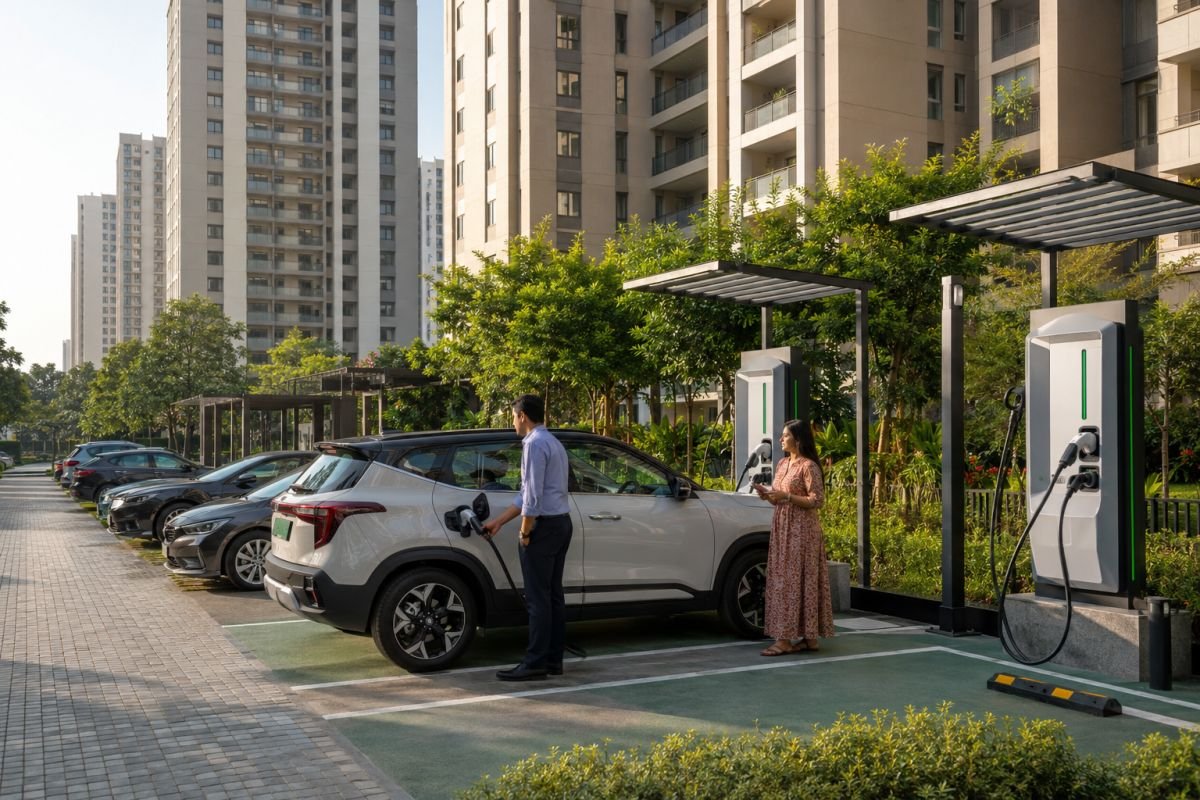
EV charging housing societies in Gurgaon are no longer a futuristic concept. As electric vehicle adoption accelerates across the NCR, the infrastructure these communities provide has moved from a niche amenity to a decisive factor for homebuyers. Whether you are evaluating a ready-to-move apartment on Golf Course Extension Road or a pre-launch tower along the Dwarka Expressway corridor, understanding the rules, costs, and safety standards around EV charging infrastructure is no longer optional. This guide breaks down the 2026 regulatory framework, ground realities in Gurugram’s premium residential pockets, and what buyers, residents, and RWAs need to know to stay compliant and future-ready.
EV Charging Housing Societies: The Regulatory Framework in 2026
Central Guidelines – MoP 2024
The Ministry of Power’s revised Guidelines for Installation and Operation of Electric Vehicle Charging Infrastructure (2024) form the national backbone for all residential charging. Key provisions for housing societies include:

- De-licensed activity: Any RWA, group housing society, or individual flat owner can install charging infrastructure without a power-sector licence.
- Separate metering: Residents can request a separate metered EV connection from the DISCOM—Dakshin Haryana Bijli Vitran Nigam (DHBVN) in Gurgaon—at a dedicated EV tariff, or charge via their existing domestic connection.
- Community charging: RWAs can install shared community chargers for residents and authorised visitors, with DISCOMs mandated to provide connections within 3 days for metro areas like Gurgaon.
- Tariff caps: Until March 31, 2028, electricity tariffs must remain below the DISCOM’s Average Cost of Supply (ACoS), with time-of-day differentials favouring solar hours (9 AM–4 PM).
Haryana’s Mandatory EV-Ready Building Code
In 2026, Haryana formally amended its building regulations to make EV charging infrastructure mandatory in new residential and commercial buildings. The notification requires one EV charging point for every five parking spaces in residential projects and exempts EV charging infrastructure from Floor Area Ratio (FAR) calculations. This means developers on the Dwarka Expressway corridor and Golf Course Extension Road can provision charging bays without sacrificing saleable area—a significant incentive that is already showing up in RERA-registered projects launched after the notification. Note: Verify specific RERA compliance on the official Haryana RERA (HARERA) portal before booking.
Basement Charging and Fire Safety
A critical development in 2026 was the Haryana Fire Department’s clarification on basement installations. Following incidents where RWAs were directed to remove private basement chargers due to Fire NOC concerns, the department issued a notification permitting EV charging in first basement levels and stilt parking, subject to strict compliance with electrical and fire safety norms. This includes maintaining minimum distance from combustible materials, using BIS-certified equipment (IS 17017 series), and ensuring adequate ventilation. Buyers should verify that their society’s basement charging setup meets these norms before installing private points.

Ev Charging Gurgaon Apartments: What Societies Are Actually Doing
Premium Projects Leading the Way
Forward-looking developers have already integrated EV charging into their master plans. Emaar’s projects across Golf Course Extension Road and New Gurgaon feature EV stations alongside solar PV and rainwater harvesting systems. DLF Cybercity has partnered with Fortum Charge & Drive to operate EV charging points for commercial and residential users. M3M 65 Avenue on Golf Course Road hosts Statiq-enabled fast charging. In integrated township developments along the Southern Peripheral Road (SPR) corridor, community charging hubs are becoming standard club-level amenities rather than afterthoughts.
The Basement Charger Controversy
Despite regulatory clarity, ground realities remain mixed. In early 2026, several Gurugram societies received notices from RWAs—acting on Fire Department and DTCP inputs—to remove privately installed basement chargers. The concerns were valid: ad-hoc installations using extension boards, inadequate load assessment, and lack of dedicated circuits created genuine fire risks. The Supreme Court of India also agreed in February 2026 to examine a plea seeking stricter implementation of the 2024 MoP guidelines across states. For buyers, the lesson is clear: private charging is your right under central law, but the installation must be safe, certified, and society-approved.
Electric Vehicle Infrastructure Housing: Costs, Tariffs, and Billing Models
For RWAs and residents, the economics are straightforward once the regulatory caps are understood.
| Parameter | AC Slow Charging | DC Fast Charging |
|---|---|---|
| Typical power output | 3.3 kW – 7.4 kW | 22 kW – 60 kW |
| Best suited for | Overnight home charging | Community/shared stations |
| Service charge cap (solar hours, 9 AM–4 PM) | ₹3.00/kWh | ₹11.00/kWh |
| Service charge cap (non-solar hours) | ₹4.00/kWh | ₹13.00/kWh |
| Electricity tariff | Below DISCOM ACoS | Below DISCOM ACoS |
| Estimated setup cost (individual) | ₹15,000–₹35,000 | ₹2–5 lakh per point |
| Estimated setup cost (community) | ₹50,000–₹1.5 lakh | ₹5–15 lakh per point |

At the individual level, a 7.4 kW single-phase wall box is sufficient for most apartment owners and can run on an upgraded domestic connection. For societies, a hybrid model—AC points in designated parking slots plus one or two DC fast chargers near the club or visitor area—offers the best balance of cost and utility.
A Practical Checklist for Buyers and RWAs
If you are buying a luxury apartment in Gurgaon—whether in a new launch or resale—use this checklist:
- Verify EV-ready parking: Does the project allocate at least 20% of parking for EV infrastructure per Model Building Bye-Laws?
- Check sanctioned load: Can the society’s power supply handle simultaneous charging without tripping?
- Ask about basement clearance: Has the RWA obtained Fire Department approval for basement charging points?
- Review the maintenance plan: Who pays for charger upkeep—the RWA, individual owners, or a third-party operator?
- Confirm metering: Is there provision for separate EV metering to avoid cross-subsidising domestic bills?
- Inspect certifications: Are chargers BIS-certified and installed by licensed electricians per CEA safety regulations?

For existing societies looking to retrofit, the process starts with a load study, followed by DISCOM consultation, RWA resolution, and phased installation beginning with high-usage areas.
Corridor-Wise EV Readiness in Gurugram
EV infrastructure maturity varies by corridor. On Golf Course Extension Road, most 2024–2026 deliveries include podium-level charging provisions. The Dwarka Expressway corridor is seeing rapid catch-up as integrated township developments scale up. New Gurgaon and the Southern Peripheral Road (SPR) corridor are designing EV hubs into their clubhouses from the master plan stage, given the larger plot sizes. Older established sectors (14, 15, 27, 56) face retrofitting challenges due to limited parking and older electrical systems. For end-user home buying, newer corridors offer plug-and-play convenience; for investment buyers, EV readiness is becoming a rental differentiator.

EV charging housing societies in Gurgaon are no longer a “nice-to-have”—they are a compliance requirement, a resale driver, and a lifestyle necessity. With Haryana’s mandatory building code, central de-licensing, and clarified fire safety norms, the framework is finally catching up with demand. Whether you are exploring a ready-to-move unit on Golf Course Extension Road or a pre-launch along the Dwarka Expressway corridor, verify the project’s EV credentials before signing. Speak with the AssuredGains advisory team for project-specific insights, or explore our corridor-wise guides to find an EV-ready home that matches your budget and lifestyle.
Frequently Asked Questions
Q1: Can a Gurgaon housing society refuse permission for a private EV charger?
No. Under the Ministry of Power’s 2024 guidelines, EV charging is a de-licensed activity. Societies cannot impose blanket bans if the installation meets electrical and fire safety norms, though they can mandate BIS-certified equipment and licensed electricians.
Q2: Is EV charging allowed in basement parking in Gurgaon apartments?
Yes, but with conditions. The Haryana Fire Department’s 2026 notification permits EV charging in first basement levels and stilt parking provided the setup complies with fire safety distance norms, uses IS 17017-certified equipment, and maintains adequate ventilation.
Q3: What is the cost of installing an EV charger in a Gurgaon housing society?
For individual apartment owners, a 3.3–7.4 kW AC wall box typically costs ₹15,000–₹35,000 including basic wiring. Community AC chargers range from ₹50,000–₹1.5 lakh per point, while DC fast chargers can cost ₹5–15 lakh per point depending on power output and civil works.
Q4: How many parking slots must be EV-ready in new Gurgaon residential projects?
Haryana’s 2026 building code amendment mandates one EV charging point for every five parking spaces in new residential buildings. Additionally, central Model Building Bye-Laws recommend making at least 20% of total parking EV-ready.
Q5: What tariffs apply for EV charging in housing societies?
Until March 31, 2028, the electricity tariff must remain below the DISCOM’s Average Cost of Supply (ACoS). RWAs can levy service charges capped at ₹3–4/kWh for AC slow charging and ₹11–13/kWh for DC fast charging, varying by time of day. GST and land costs are excluded from these caps.



Join The Discussion