
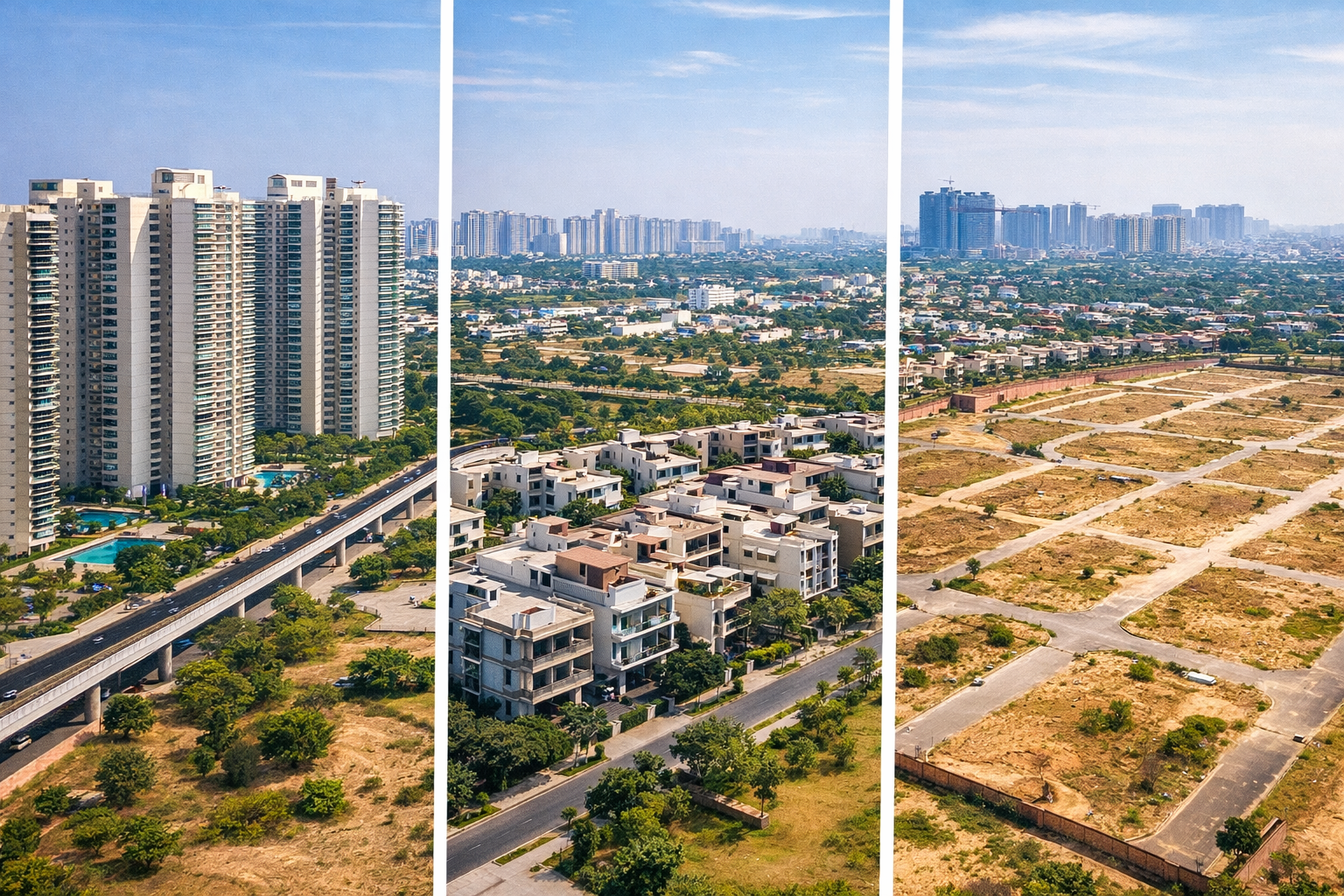
In Gurgaon, property format selection directly determines your return profile.
The same sector can produce completely different financial outcomes depending on whether you purchase:
- A high-rise apartment in Gurgaon
- A builder floor in Gurgaon
- DDJAY plots in Gurgaon under Deen Dayal Jan Awas Yojna Gurgaon
Serious investors evaluate property type through three lenses:
Rental yield potential
Capital appreciation in Gurgaon 2026
Exit liquidity
High-Rise Apartment in Gurgaon (Liquidity + Structured Rental Demand)
High-rise developments dominate corridors such as Dwarka Expressway and Golf Course Extension Road.
High-rise inventory in sectors like Sector 37D Gurgaon and Sector 62 Gurgaon has shown differentiated absorption patterns depending on commercial proximity, metro connectivity, and corporate leasing demand.
For investors targeting rental yield in Gurgaon, high-rise apartments near office clusters tend to deliver more predictable tenant turnover cycles.
However, appreciation depends on supply pressure. In supply-heavy sectors, even premium formats may experience delayed appreciation until inventory normalizes.
High-rise apartments typically offer:
- Stronger resale liquidity
- Wider buyer pool
- Professional maintenance ecosystems
- Corporate tenant acceptance
They are generally suitable for investors prioritizing stability over speculative upside.
Builder Floor in Gurgaon (Low-Density Premium Positioning)

A builder floor in Gurgaon appeals to buyers seeking:
- Independent floor ownership
- Lower density living
- Greater privacy
- Land-share component
Builder floors often perform strongly in established residential sectors such as Sector 67 Gurgaon, where fresh land supply is limited.
From a capital appreciation perspective, low-supply sectors historically demonstrate stronger pricing resilience.
However, regulatory diligence is critical.
Buyers must verify approvals through Haryana RERA and confirm license status issued by DTCP Haryana before committing to builder floor transactions. Title clarity, sanctioned building plans, and land-use compliance should always be independently verified.
Builder floors can outperform in appreciation cycles — but only when legally structured correctly.
DDJAY Plots in Gurgaon (Land-Led Growth Strategy)

DDJAY plots in Gurgaon under Deen Dayal Jan Awas Yojna Gurgaon attract investors seeking lower entry pricing and long-term land positioning.
In sectors like Sector 92 Gurgaon and Sector 95 Gurgaon, DDJAY plots in Gurgaon have drawn early-cycle investors anticipating infrastructure alignment with Dwarka Expressway and SPR connectivity.
These investments are less about immediate rental yield in Gurgaon and more about:
- Capital appreciation potential
- Infrastructure-led re-rating
- Flexible construction timelines
However, plot investments require patience. Development completion, utilities rollout, and surrounding absorption determine performance timelines.
Plot-led strategies typically suit investors with longer holding horizons.
Matching Property Type With Investment Objective
If your priority is:
- Stable rental yield in Gurgaon → High-rise apartments near commercial belts may be suitable.
- Capital appreciation in Gurgaon 2026 → Emerging but infrastructure-backed sectors along Dwarka Expressway may offer stronger upside.
- Land-based long-term strategy → Licensed plotted developments require structured due diligence.
Property format selection in Gurgaon is not a lifestyle decision.
It is a capital allocation decision.
Is Gurgaon a Good Place to Buy Property Today? (2026 Market Cycle Perspective)
Gurgaon in 2026 is no longer operating in a speculative expansion cycle.
Post-infrastructure completion along Dwarka Expressway and improved occupancy across SPR corridors, Gurgaon has entered a selective growth phase rather than broad-based speculation.
This distinction is critical.
The city remains economically strong — driven by multinational offices, startup growth, and proximity to Delhi — but micro-market selection now matters more than ever.
Capital Appreciation in Gurgaon 2026 (Growth Corridor Strategy)
Capital appreciation in Gurgaon 2026 is concentrated in infrastructure-backed micro-markets.
Investment property in Dwarka Expressway continues to attract appreciation-driven buyers, particularly in sectors transitioning from early-cycle to mid-cycle maturity.
Emerging sectors near Dwarka Expressway demonstrate stronger percentage upside when:
- Infrastructure reaches functional completion
- Commercial occupancy increases
- Supply absorption tightens
However, appreciation is not uniform. In supply-heavy belts, price growth may remain moderate until excess inventory reduces.
Disciplined entry price remains the biggest driver of return.
Rental Yield in Gurgaon (Income Corridor Strategy)
Rental yield in Gurgaon remains strongest in stabilized micro-markets around Golf Course Extension Road and established corporate catchments.
High-rise apartments in these zones attract:
- Senior corporate professionals
- Expatriate tenants
- Long-term leasing demand
Average gross rental yield in premium Gurgaon micro-markets typically ranges between 2.8% to 3.8%, making entry price discipline critical for income-focused investors.
Yield-focused buyers should prioritize:
- Ready-to-move inventory
- Established tenant ecosystems
- Transparent maintenance records
- Strong connectivity to employment hubs
Yield stability often outperforms speculative appreciation during shorter holding cycles.
Dwarka Expressway vs Golf Course Extension Road (Strategic Framing)

Dwarka Expressway represents an infrastructure-led growth corridor.
Golf Course Extension Road operates as a stabilized income corridor with mature tenant ecosystems.
Growth corridor vs income corridor.
Both strategies are valid — but they serve different investment psychology.
Final Market Intelligence Perspective
Gurgaon is not a single market.
It is a layered ecosystem of sectors at different maturity stages.
Success depends on:
- Entering the right sector cycle
- Selecting the appropriate property format
- Maintaining entry price discipline
- Conducting sector-level absorption analysis
Buyers evaluating property in Sector 67 Gurgaon, Sector 62 Gurgaon, or emerging sectors along Dwarka Expressway should conduct structured inventory and demand analysis before booking.
Frequently Asked Questions (FAQs)
How much extra money should I realistically keep aside beyond the quoted property price in Gurgaon?
In Gurgaon, the advertised base price is rarely the final amount you pay. Buyers must factor in stamp duty in Gurgaon 2026, registry charges in Gurgaon, GST on under-construction units, PLC (Preferential Location Charges), parking, club membership, maintenance deposits, and brokerage if applicable. The circle rate in Gurgaon can also impact stamp duty calculations if it is higher than the transaction value. In many sectors, the total acquisition cost can rise 8–18% above the quoted price. Keeping a liquidity buffer ensures smoother registry and possession.
Is it safer to buy a high-rise apartment or a builder floor in Gurgaon?
Both can be secure investments if due diligence is properly conducted. High-rise apartments in Gurgaon are typically registered under Haryana RERA and operate within structured group housing licenses. A builder floor in Gurgaon requires deeper verification of land title, sanctioned plans, and licensing details issued by DTCP Haryana. Buyers should independently verify approvals, ownership chain, and encumbrance status before committing funds. The safety depends less on format and more on documentation clarity.
Which areas in Gurgaon are better for rental income versus capital appreciation?
Micro-market maturity determines performance. Sectors near Golf Course Extension Road generally function as stabilized income corridors with stronger rental yield in Gurgaon due to corporate demand and established infrastructure. Average gross rental yield in premium Gurgaon micro-markets typically ranges between 2.8% and 3.8%, depending on entry price. Investment property in Dwarka Expressway, on the other hand, is often positioned for capital appreciation in Gurgaon 2026 as infrastructure completion and commercial occupancy improve. The right choice depends on whether you prioritize income stability or growth potential.
Are DDJAY plots in Gurgaon a better long-term investment than apartments?
DDJAY plots in Gurgaon under Deen Dayal Jan Awas Yojna Gurgaon are typically chosen for land-led capital appreciation rather than immediate rental yield. In sectors such as Sector 92 Gurgaon and developing belts near Dwarka Expressway, plots have attracted early-cycle investors anticipating infrastructure-driven growth. Apartments may provide quicker rental monetization, while plotted developments generally require longer holding periods and careful verification of licensing and development timelines.
How long does the property buying process usually take in Gurgaon from booking to registry?
For ready-to-move properties, the full process—from agreement drafting and home loan approval to payment of stamp duty in Gurgaon and final registry—typically takes three to six weeks if documentation is complete. Home loan approvals often take 7–15 working days depending on project legality and borrower profile. Under-construction purchases follow milestone-based payment schedules and extend over a longer period. Early verification of RERA registration, title documents, and financial eligibility helps prevent delays during registry.




Join The Discussion