

For salaried professionals, real estate investing is not about hype cycles, pre-launch speculation, or overnight flipping. It is about building stable long-term wealth while balancing EMIs, career growth, family responsibilities, and financial security.
In markets like Gurgaon — where corridor-level pricing, rental demand, and liquidity vary significantly by sector — salaried professionals need a structured investment strategy rather than generic advice. What works on Golf Course Extension Road may not work on Dwarka Expressway. What suits a ₹2.5 crore buyer may not suit someone targeting Gurgaon property under 1.5 crore.
This guide lays out a practical, low-risk investment framework designed specifically for salaried professionals investing in Gurgaon real estate in 2026.
Why Real Estate Still Makes Sense for Salaried Professionals
Despite the growth of equities and digital assets, real estate remains one of the most powerful wealth-building tools for salaried individuals — especially in structured markets like Gurgaon.
The biggest advantage is leverage.
Unlike most asset classes, property allows you to control a high-value asset using savings plus long-term home financing. Salaried professionals often enjoy:
- Strong income proof
- Better loan eligibility
- Competitive interest rates
- Longer tenure options
Used wisely, this becomes a wealth multiplier.
Real estate rewards discipline — and salaried professionals are naturally disciplined investors.
Step 1: Build a Strong Financial Base First
Before investing in Gurgaon property, stabilize your finances.
You should have:
- 6 months of emergency savings
- Health and life insurance
- No high-interest personal debt
- Clear EMI comfort threshold
As a rule, EMI should not exceed 30–35% of monthly take-home income.
In a market where sector wise property price Gurgaon 2026 trends show wide variation, stretching beyond comfort for a premium pin code can create long-term stress. Sustainability matters more than prestige.
Step 2: Define Your Investment Objective Clearly
Every property cannot serve every purpose.
Clarify your primary goal:
- Rental income
- Long-term capital appreciation
- Tax optimization
- Future self-use
- Retirement asset
A rental-focused investor should prioritize tenant demand and connectivity — not luxury branding.
Confused goals lead to underperforming assets.
Income Band Mapping for Gurgaon Property Investment (2026)
Align ticket size with income strength.
₹1–1.5 lakh monthly take-home
→ Target property range: ₹70 lakh – ₹1.2 crore
→ Focus: Emerging sectors, 2 BHK investment in Gurgaon, high-liquidity corridors
₹1.5–2.5 lakh monthly take-home
→ Target range: ₹1 crore – ₹1.8 crore
→ Focus: Balanced rental + appreciation corridors such as New Gurgaon or select Dwarka Expressway sectors
₹2.5 lakh+ monthly take-home
→ Target range: ₹1.8 crore – ₹3 crore+
→ Focus: Golf Course Extension Road, premium gated communities, long-term capital preservation
This prevents over-leveraging and protects financial flexibility.
Step 3: Choose the Right Property Type (What Works in Gurgaon)
Residential Apartments: The Safest Starting Point
For most salaried professionals, ready-to-move or near-completion apartments provide the best mix of safety, financing ease, and resale liquidity.
In emerging Gurgaon corridors, 2 BHK investment in Gurgaon continues to outperform larger configurations due to stronger tenant demand, lower ticket size, and easier resale flexibility.
Mid-sized units typically generate:
- Wider tenant pool
- Faster absorption
- More predictable exit
Builder Floor vs High Rise Gurgaon – What Should You Choose?

Many buyers compare builder floor vs high rise Gurgaon before investing.
Builder Floors
- Lower density living
- Higher land share component
- Limited amenities
- Sometimes lower entry price in developing sectors
High-Rise Communities
- Better rental scalability
- Larger tenant demand base
- Amenity-driven appeal
- Stronger resale liquidity
For salaried investors prioritizing flexibility and exit clarity, high-rise communities often provide more consistent demand.
Plots: High Reward, Higher Patience
Plots in Gurgaon can deliver strong long-term appreciation but:
- No rental income
- Longer holding cycles
- Higher speculation risk
Suitable only for salaried professionals with surplus capital and long time horizons.
Commercial Property: Not Ideal for First-Time Investors
Commercial assets offer higher yield potential but come with:
- Higher capital requirement
- Vacancy risk
- Complex leasing structures
Residential remains safer for first-generation salaried investors.
Step 4: Location Strategy Matters More Than the Property
In Gurgaon, location determines liquidity more than aesthetics.
Strong sectors typically offer:
- Proximity to job hubs
- Infrastructure visibility
- Active resale market
- Consistent rental demand
Avoid buying purely based on brochure-level future announcements.
Best Gurgaon Locations for Salaried Property Investors (2026)
Dwarka Expressway
Ideal for mid-income buyers targeting Gurgaon property under 1.5 crore.
Dwarka Expressway investment 2026 remains appreciation-focused, supported by infrastructure progress.
New Gurgaon
Stable employment-linked demand makes New Gurgaon rental demand consistent. Balanced growth + rental absorption.
Golf Course Extension Road
Premium corridor suited for higher-income salaried buyers prioritizing capital preservation and ecosystem maturity.
Sohna Road
Attractive for budget-conscious investors seeking lower entry ticket sizes with moderate appreciation potential.
Each corridor serves a different risk-return profile.
Gurgaon Corridor vs Buyer Profile Matching (2026 Framework)
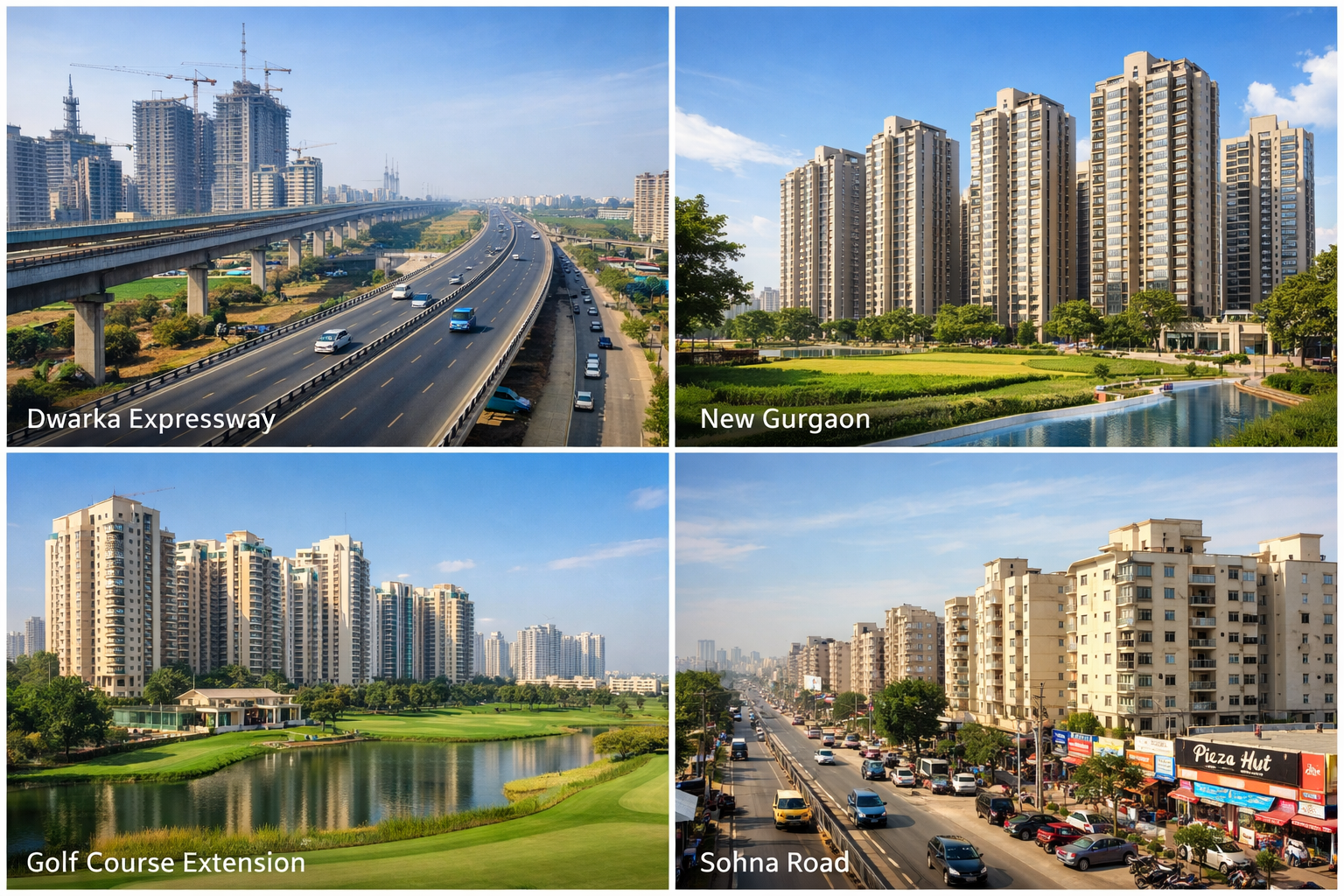
Appreciation-focused investors
→ Dwarka Expressway
Rental + growth balance seekers
→ New Gurgaon
Stability-focused professionals
→ Golf Course Extension Road
Budget-driven entry buyers
→ Sohna Road
Corridor selection and ticket sizing matter more than entry timing — especially for salaried professionals managing EMIs.
Step 5: Use Home Loans Strategically
Home loans are financial tools — not emotional burdens.
Longer tenures reduce EMI pressure. Prepayments should be calculated, not reactive.
Leverage:
- Section 80C principal benefits
- Section 24 interest deduction
Tax efficiency improves effective returns.
Rental Yield vs Capital Appreciation (2026 Gurgaon Data Lens)

When evaluating Gurgaon rental yield by sector:
- Golf Course Extension Road typically offers 2–3% gross yields
- Established New Gurgaon sectors often range between 2.5–3.2%
- Select Dwarka Expressway pockets may range between 2.5–3.5%, depending on configuration and entry price
Example:
A ₹1.2 crore 2 BHK generating ₹28,000–₹35,000 monthly rent significantly reduces EMI burden.
Rental stability increases holding power. Holding power enables appreciation.
Corridor Comparison Snapshot (2026)
| Corridor | Entry Budget | Yield Range | Risk Level | Ideal For |
|---|---|---|---|---|
| Dwarka Expressway | ₹80L – ₹1.6Cr | 2.5–3.5% | Moderate | Appreciation-focused |
| New Gurgaon | ₹90L – ₹1.8Cr | 2.5–3.2% | Moderate-Low | Rental + Growth |
| Golf Course Extension | ₹1.8Cr – ₹3Cr+ | 2–3% | Low | Stability Seekers |
| Sohna Road | ₹70L – ₹1.4Cr | 2.5–3% | Moderate | Budget Entry |
Step 7: Risk Management for Salaried Investors
Avoid:
- Over-leveraging based on expected salary hikes
- Heavy exposure to early-stage under-construction projects
- Investing without local demand understanding
For first-time buyers, ready to move flats in Gurgaon for investment reduce delivery risk and cash flow uncertainty compared to speculative launches.
Assume income stability — but plan for disruption.
Step 8: Timing the Market vs Time in the Market
Perfect timing rarely works.
Buying during stable cycles allows better negotiation and structured entry.
Time in quality assets beats timing hype phases.
Step 9: Exit Planning (Most Investors Ignore This)
Always ask:
- Who will buy this from me in 10–15 years?
- Will this configuration remain liquid?
- Is there broad end-user appeal?
Liquidity is safety.
Final Thoughts: Boring Strategy Builds Real Wealth
For salaried professionals in Gurgaon, the strongest real estate strategy is disciplined, corridor-aware, EMI-controlled, and goal-aligned.
Real estate should reduce stress — not create it.
When chosen wisely, property becomes a silent wealth builder while you focus on your career and family.




Join The Discussion