
In Gurgaon’s 2026 real estate market — whether you’re evaluating projects on Dwarka Expressway, Golf Course Extension Road, or New Gurgaon — understanding the carpet area vs super area difference is no longer optional.
It directly determines:
- How much usable space you actually receive
- Whether you’re overpaying by 10–25%
- How efficient the project truly is
- And whether the builder is fully compliant under RERA
Most buyers still compare projects using “saleable area.”
Serious investors compare using carpet efficiency ratio.
This guide explains everything — legally, financially, and strategically — for Gurgaon buyers.
1. What Is RERA Carpet Area? (Legal Definition)
Under the Real Estate (Regulation and Development) Act, 2016, carpet area is standardized nationwide and must be disclosed in all sale agreements.
Carpet area means:
The net usable floor area of an apartment, excluding external walls, service shafts, and exclusive balcony/terrace areas, but including internal partition walls.
In simple terms:
Carpet Area = The actual space inside your flat where you can place furniture.
Includes:
- Bedrooms
- Living & dining area
- Kitchen
- Bathrooms
- Passages
- Internal walls
Excludes:
- External wall thickness
- Service shafts
- Balconies & terraces
- Common areas
In Haryana, all projects must register with the Haryana Real Estate Regulatory Authority (HRERA) and disclose carpet area officially.
If delivered carpet area varies by more than 3%, price adjustment applies.
2. Built-Up Area – The Construction Definition
Built-Up Area = Carpet Area + Wall Thickness + Exclusive Balconies / Terraces
Example:
Carpet Area: 1,000 sq. ft.
Walls + Balcony: 150 sq. ft.
Built-Up Area: 1,150 sq. ft.
Important:
Built-up area is not standardized under RERA.
Different builders may calculate balcony inclusion or wall thickness differently.
In Gurgaon’s luxury towers, large balconies significantly increase built-up area without increasing interior usable space.
3. Super Built-Up Area (Saleable Area Meaning)
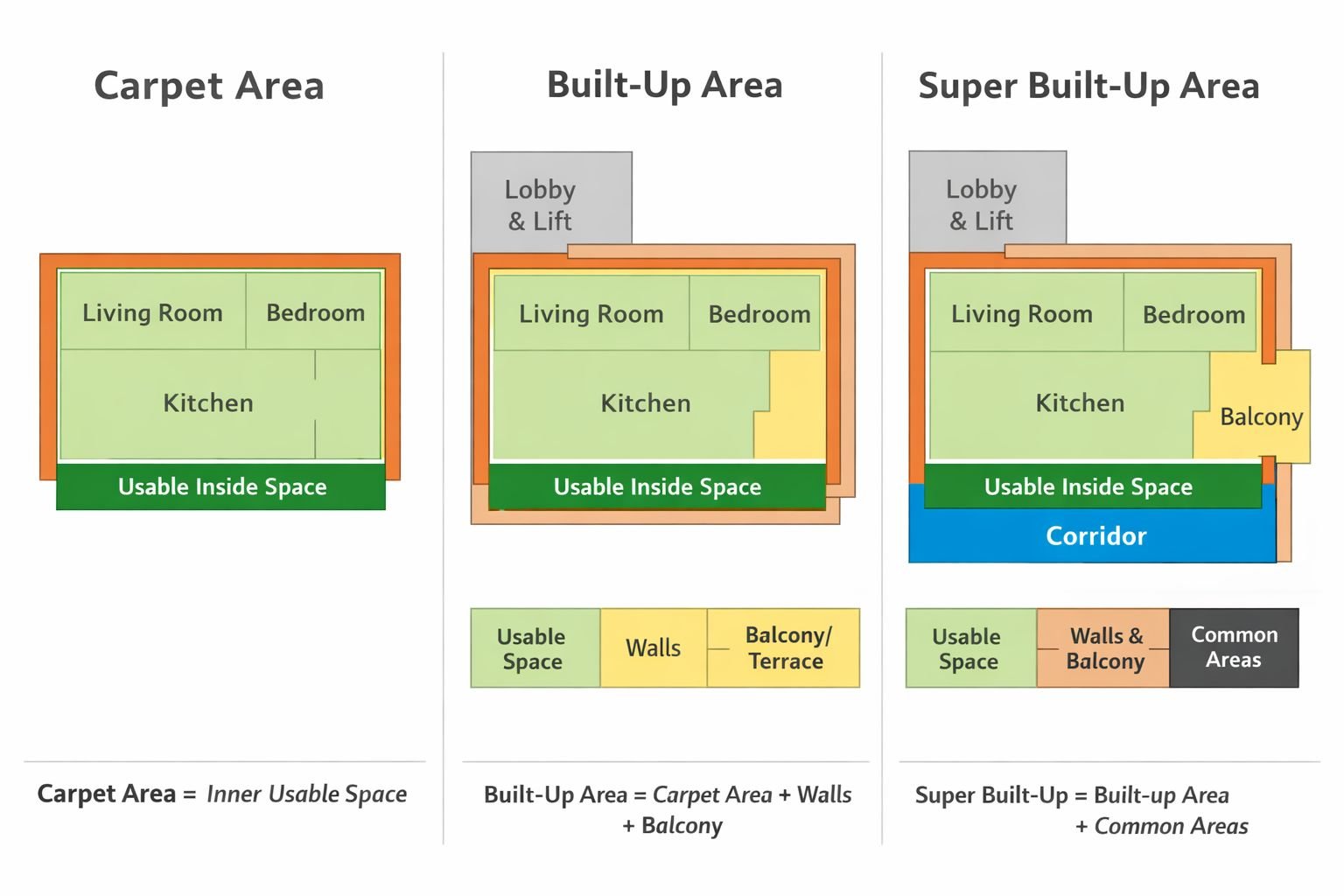
Super Built-Up Area — also called saleable area — includes:
Built-Up Area + Your proportionate share of common spaces.
Common spaces include:
- Lobbies & corridors
- Lift shafts
- Staircases
- Clubhouse
- Gym & pool
- Entrance foyers
- Driveways & landscaped podium
Example:
Carpet: 1,000 sq. ft.
Walls + Balcony: 150 sq. ft.
Common Share: 150 sq. ft.
Super Built-Up: 1,300 sq. ft.
You are paying for 300 sq. ft. beyond usable space.
This is where the loading factor in real estate comes in.
4. What Is Loading Factor in Real Estate?
Loading Factor = (Super Built-Up − Carpet Area) ÷ Carpet Area × 100
Example:
(1300 − 1000) ÷ 1000 = 30% loading
Higher loading = Lower efficiency.
5. Efficiency Ratio in Real Estate – The Smart Metric
Efficiency Ratio = Carpet Area ÷ Super Built-Up Area
This shows how efficient a project is.
| Carpet | Super | Efficiency |
|---|---|---|
| 1000 | 1300 | 77% |
| 1000 | 1500 | 66% |
| 1200 | 1700 | 70% |
In 2026 Gurgaon:
- 75–80% efficiency = Strong
- 70–75% = Acceptable
- Below 70% = Requires deeper evaluation
- Below 65% = Premium justification needed
Serious investors compare efficiency.
Smart buyers measure in carpet.
6. Gurgaon Loading & Efficiency Trends (2026)
| Micro-Market | Loading | Efficiency Range |
|---|---|---|
| Dwarka Expressway | 30–40% | 71–77% |
| Golf Course Extension | 35–45% | 69–74% |
| New Gurgaon | 25–35% | 74–80% |
| Luxury Branded Residences | 45–55% | 64–69% |
Observations:
Dwarka Expressway projects launched between 2023–2026 average 32–38% loading.
Golf Course Extension Road luxury towers often exceed 40% due to double-height lobbies, sky lounges, and amenity floors.
New Gurgaon mid-income projects remain more efficient due to simpler layouts.
Luxury branded residences command high loading because of low density and hospitality-grade amenities.
When evaluating what is the ideal loading factor in Gurgaon, 30–35% remains balanced in 2026.
7. Real Gurgaon Comparison (2026 Example)
| Metric | Project A | Project B |
|---|---|---|
| Super Area | 1,850 sq. ft. | 1,650 sq. ft. |
| Carpet Area | 1,250 sq. ft. | 1,250 sq. ft. |
| Efficiency | 67% | 75% |
| Price | ₹3.8 Cr | ₹3.8 Cr |
Both projects cost the same.
Project B delivers identical usable space with lower inflation through loading.
That difference can represent ₹40–50 lakh in effective value.
This is why carpet area vs super area difference matters financially.
8. Pre-RERA vs Post-RERA Transparency
Before 2016, many developers sold properties purely on super built-up area.
Loading of 50–60% was common in certain premium projects.
After RERA:
- Carpet area must be disclosed.
- Price agreements must align with carpet size.
- Variation beyond 3% requires compensation.
However, marketing brochures may still highlight larger saleable sizes.
Always verify carpet details on HRERA.
9. Quick Conversion Formula for Buyers
Carpet Area = Super Built-Up ÷ (1 + Loading)
Example:
Super = 1,400 sq. ft.
Loading = 40%
Carpet = 1,400 ÷ 1.4 = 1,000 sq. ft.
This single formula prevents costly misjudgment.
10. Gurgaon Buyer Checklist (2026)
Before booking:
- Verify HRERA registration
- Check carpet area disclosure
- Calculate loading percentage
- Compare efficiency ratio across projects
- Evaluate price per carpet sq. ft.
- Ensure agreement reflects carpet figures
- Confirm stamp duty calculation basis
11. Expert Advisory Note (2026 Market Reality)
In Gurgaon’s current cycle, efficiency has become a valuation metric.
Projects with efficiency below 70% require strong justification such as:
- Ultra-low density planning
- Large landscaped podium
- Hospitality-grade clubhouse
- Limited units per floor
Otherwise, high loading simply reduces value per rupee.
Frequently Asked Questions
What is the real difference between carpet area and super built-up area in Gurgaon projects?
Carpet area is the actual usable space inside your apartment, including bedrooms, living room, kitchen, bathrooms, and internal partition walls. It excludes balconies, external walls, and common areas. Super built-up area, also called saleable area, includes the carpet area plus wall thickness and your proportionate share of common spaces such as lobbies, lifts, clubhouse, corridors, and amenities. In Gurgaon projects, the super area is typically 25–45% higher than the carpet area, depending on the loading factor.
What is considered an ideal loading factor in Gurgaon in 2026?
In Gurgaon’s 2026 market, a loading factor between 30% and 35% is considered balanced and efficient. Projects on Dwarka Expressway and New Gurgaon usually fall within this range. Luxury projects on Golf Course Extension Road may have 35–45% loading due to larger lobbies and premium amenities. Anything above 45% should be evaluated carefully unless justified by low-density planning or branded luxury features.
Is balcony included in RERA carpet area?
No, balconies and terraces are not included in RERA carpet area. Under the Real Estate (Regulation and Development) Act, 2016, carpet area excludes exclusive balcony and terrace areas as well as external walls and service shafts. Only the net usable floor area inside the apartment, including internal partition walls, is counted as carpet area.
How do I calculate carpet area from super built-up area?
You can estimate carpet area using a simple formula: Carpet Area = Super Built-Up Area divided by (1 + Loading Factor). For example, if the super area is 1,400 sq. ft. and the loading is 40%, divide 1,400 by 1.4. The carpet area would be approximately 1,000 sq. ft. This calculation helps buyers understand the actual usable space before booking a property in Gurgaon.




Join The Discussion