

Gurgaon is not just a real estate market — it is a collection of micro-markets where corridor selection determines rental yield, appreciation potential, and long-term wealth creation.
In 2026, building passive income through real estate in Gurgaon requires more than buying a property and renting it out. It requires:
- Corridor-level strategy
- Asset-type selection
- Leverage discipline
- Yield benchmarking
- Risk management
- Structured scaling
This guide breaks down how serious investors are building ₹1 lakh+ monthly passive income in Gurgaon.
Why Gurgaon Is Ideal for Rental-Based Passive Income.
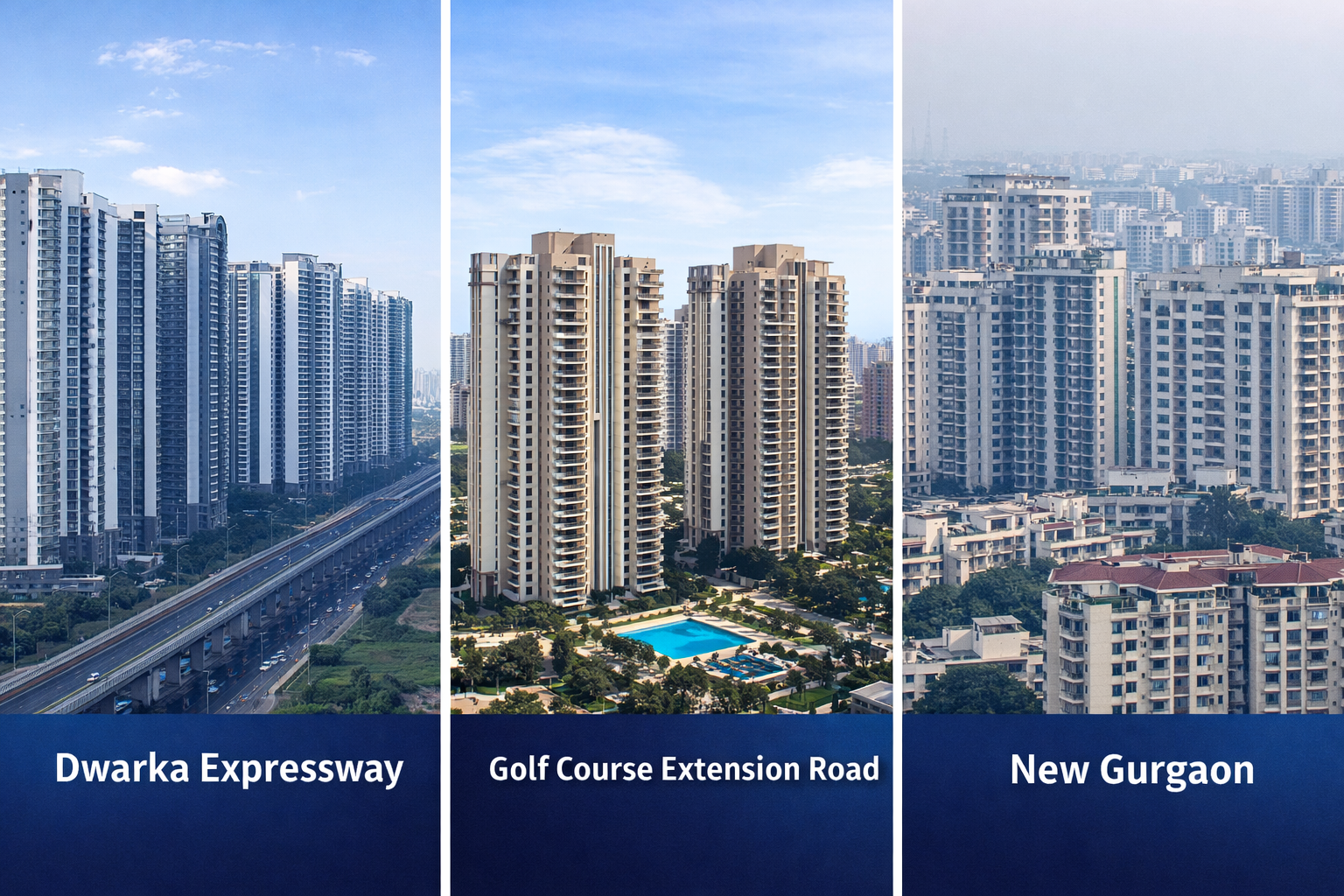
Unlike many Indian cities, Gurgaon operates as a corridor-driven rental ecosystem.
Each corridor behaves differently:
- Dwarka Expressway → Infrastructure-led appreciation + rising rental absorption
- Golf Course Extension Road → Premium tenant base, corporate professionals
- New Gurgaon (Sectors 82–95) → Strong mid-segment rental stability
- Sohna Road → Balanced rental + affordability mix
As of 2026:
- Residential rental yields: 2.8% – 4.5%
- Builder floors (mid-segment): 3.5% – 4%
- Premium high-rise apartments: 2.5% – 3.2%
- Pre-leased commercial assets: 6% – 8%
- REIT dividend yields: 5% – 7% range
Gurgaon offers something powerful:
Cash flow + appreciation + leverage compounding.
But only when asset selection aligns with corridor dynamics.
What Does ₹1 Lakh Monthly Passive Income Require?
Let’s ground this in reality.
In Gurgaon’s current environment, the average net monthly surplus per residential rental property is:
₹20,000 – ₹30,000 (after EMI, maintenance, vacancy buffer)
To reach ₹1 lakh per month:
- 3–5 well-structured residential assets
OR - 2 commercial + 1 residential hybrid model
OR - Residential + REIT + pre-leased combination
The model depends on capital strength and risk appetit.
Builder Floor vs High-Rise: Which Builds Income Faster?

Builder Floors (Mid-Segment Sectors)
- Yield: 3.5% – 4%
- Lower maintenance burden
- Lower entry ticket
- Strong for immediate rental cash flow
- Moderate appreciation trajectory
Best suited for:
Investors prioritizing yield over luxury branding.
High-Rise Apartments (Premium Corridors)
- Yield: 2.5% – 3.2%
- Strong tenant preference
- Higher liquidity in resale
- Appreciation stronger in infra-led corridors like Dwarka Expressway
Best suited for:
Investors balancing rental income with long-term capital growth.
Residential vs Commercial vs REIT: Strategic Allocation Model
Gurgaon Rental Yield Snapshot (2026)
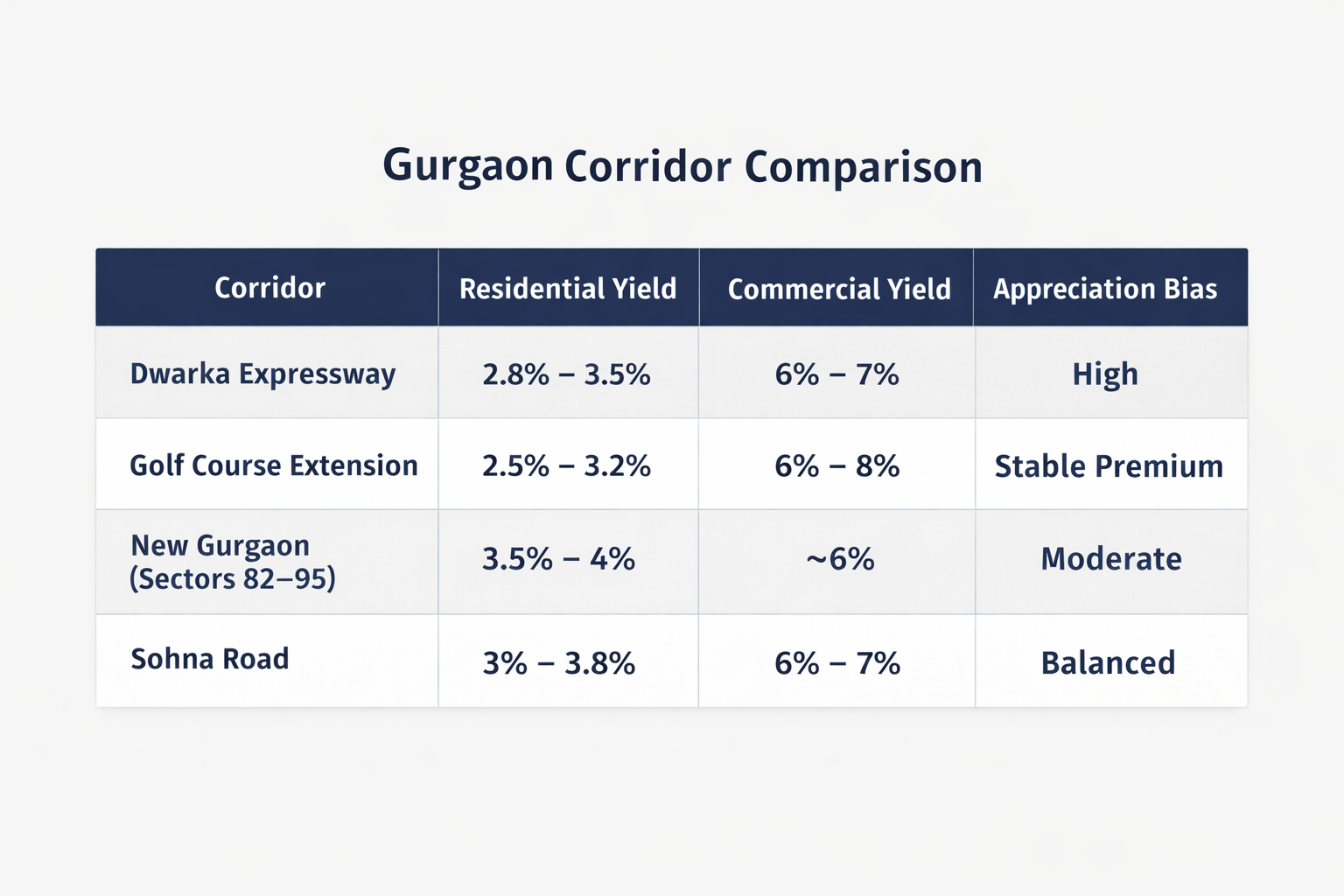
| Corridor | Residential Yield | Commercial Yield | Appreciation Bias |
|---|---|---|---|
| Dwarka Expressway | 2.8% – 3.5% | 6% – 7% | High |
| Golf Course Extension Road | 2.5% – 3.2% | 6% – 8% | Stable Premium |
| New Gurgaon (Sectors 82–95) | 3.5% – 4% | ~6% | Moderate |
| Sohna Road | 3% – 3.8% | 6% – 7% | Balanced |
Pre-Leased Commercial Strategy

Pre-leased office or retail assets:
- 6% – 8% yields
- 3–9 year lock-in structures
- Escalation clauses (typically 12–15% every 3 years)
However:
- Tenant concentration risk
- Higher capital requirement
- Economic cycle sensitivity
This suits investors seeking stronger monthly income with moderate risk appetite.
REIT Exposure for Liquidity
Investors with ₹25–30 lakh capital often begin with REIT exposure before buying physical property.
Listed vehicles such as Embassy Office Parks REIT provide exposure to Grade A commercial portfolios without direct management.
Advantages:
- Liquidity
- No tenant handling
- Regular dividend payouts
Limitations:
- Market volatility
- No leverage multiplier
- Limited control
A balanced portfolio may include 10–25% REIT allocation.
Advanced Rental Analysis: What Serious Investors Calculate
Most investors stop at rental yield.
Professionals go deeper.
Gross Rental Yield
(Annual Rent ÷ Property Price) × 100
Net Rental Yield
After:
- Maintenance
- Property tax
- Vacancy buffer (5–8%)
- EMI interest
Cash-on-Cash Return (Critical Metric)
(Net Annual Cash Flow ÷ Total Cash Invested) × 100
Example:
Property Cost: ₹60 lakh
Down Payment: ₹12 lakh
Rent: ₹25,000/month
If net annual surplus = ₹1,20,000
Cash-on-cash return = 10%
This is how leverage accelerates passive income.
Financing Strategy & EMI Stress Testing (2026 Context)
As of 2026, floating home loan rates in NCR typically range between 8%–9.5%, depending on borrower profile and loan-to-value ratio.
Smart investors:
- Keep EMI below 70–75% of expected rent
- Maintain 6 months EMI reserve
- Stress-test for 15% rent drop
Leverage builds wealth — over-leverage destroys it.
Corridor-Based Diversification Strategy
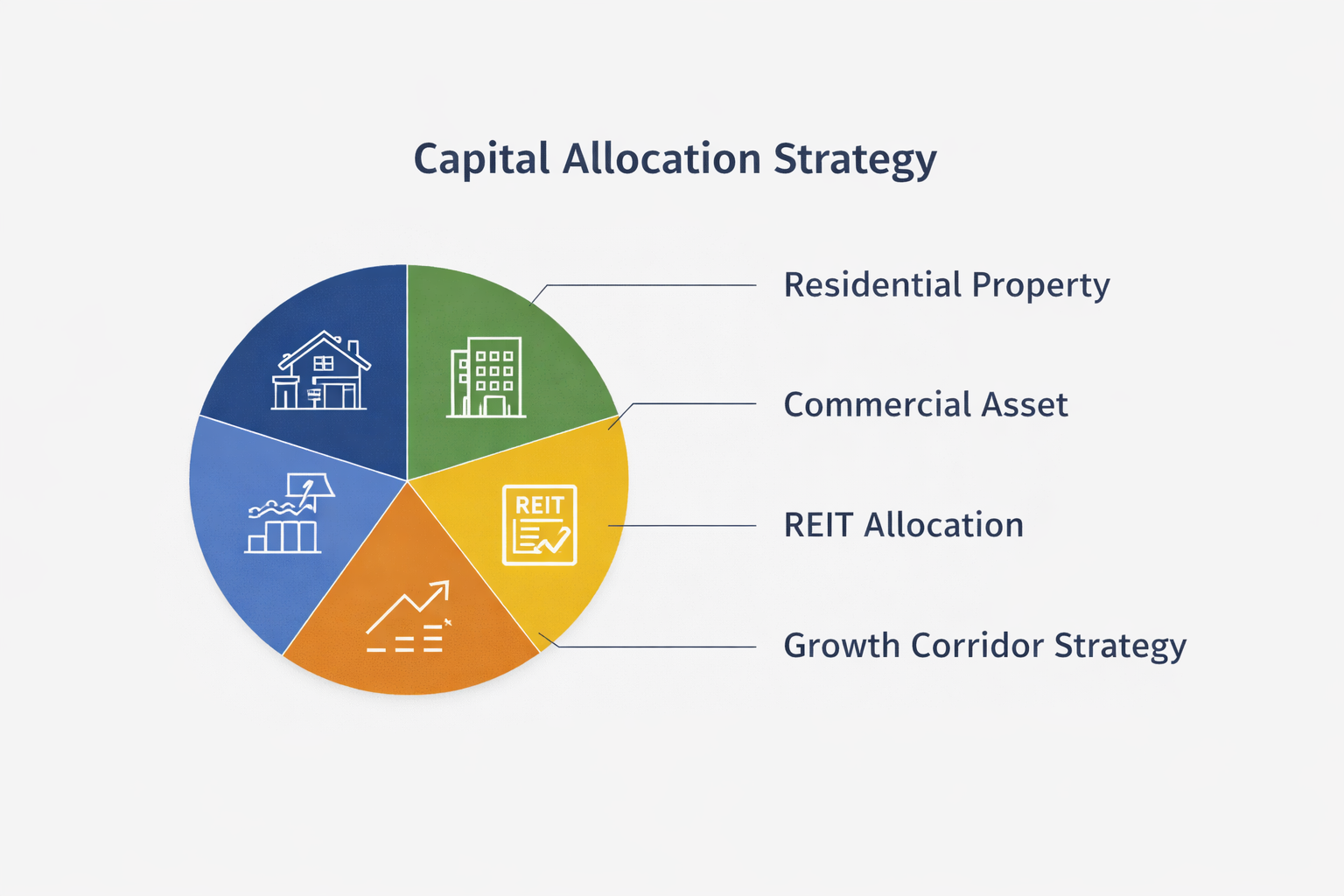
Instead of buying multiple properties in one sector, allocate smartly:
Example structure:
- 1 high-rise in Dwarka Expressway (growth play)
- 1 builder floor in New Gurgaon (cash flow play)
- 1 pre-leased commercial unit
- 1 REIT allocation for liquidity
This balances:
Cash flow
Appreciation
Liquidity
Risk spread
Key Risks Investors Must Consider
Even in Gurgaon’s strong market, passive income carries risk.
- Supply overhang in certain sectors
- Interest rate cycle dependency
- Tenant concentration risk in commercial
- Liquidity constraints during downturns
- Regulatory or policy changes
Balanced analysis strengthens long-term strategy.
Realistic Scaling Example (₹1.5 Cr Capital)
Phase 1:
₹70L high-rise → ₹28k rent
Phase 2:
₹50L builder floor → ₹22k rent
Phase 3:
₹30L REIT allocation
Blended monthly income: ₹85,000 – ₹1,05,000
After 4–5 years:
Refinance appreciated residential asset
Deploy equity into third rental unit
This is how ₹1 lakh/month becomes scalable to ₹2–3 lakh over time.
Who Should Invest in What?
Capital Under ₹50L
REIT + small rental unit strategy.
₹50L – ₹1.5Cr
Residential + partial REIT hybrid.
₹1.5Cr+
Residential + Commercial + structured refinance plan.
Want a Sector-Wise Rental ROI Breakdown?
Before investing in Gurgaon real estate, evaluate:
- Corridor-level yield data
- 5-year appreciation potential
- EMI stress model
- Asset allocation structure
Request a personalized rental income feasibility assessment.
In Gurgaon, micro-market selection determines more than 60% of long-term performance.
Final Thought
Passive income in Gurgaon real estate is not built through random buying.
It is built through:
- Corridor intelligence
- Yield realism
- Leverage discipline
- Diversified allocation
- Long-term scaling strategy
The investors who understand micro-market behavior build predictable rental income.
Frequently Asked Questions About Building Passive Income in Gurgaon Real Estate (2026)
How much capital do I realistically need to start building meaningful passive income in Gurgaon real estate?
Most investors underestimate this. In Gurgaon’s current 2026 environment, building serious monthly passive income typically requires deployable capital of at least ₹50–75 lakh if leverage is involved. If the goal is ₹1 lakh per month net income, you’re usually looking at ₹1.2–2 crore in structured allocation across residential and possibly commercial assets. The exact number depends on whether you prioritize yield-heavy builder floors, appreciation-led high-rises, or a hybrid model including REIT exposure. Passive income here is not about one property — it’s about capital structure.
Is rental income in Gurgaon stable enough to depend on long-term?
In well-selected corridors like Dwarka Expressway, Golf Course Extension Road, and established parts of New Gurgaon, rental demand has remained structurally supported by corporate migration, infrastructure expansion, and professional tenant bases. However, stability depends heavily on micro-market selection. Oversupplied sectors can experience temporary rental stagnation. Investors who choose strong connectivity corridors and maintain a vacancy buffer generally experience consistent income, but treating rental income as “guaranteed” without stress testing is risky.
What actually gives better long-term returns in Gurgaon — rental yield or appreciation?
In Gurgaon, appreciation often plays a bigger role than pure rental yield. Residential yields typically range between 2.8% and 4%, which alone may not look aggressive. However, infrastructure-led corridors such as Dwarka Expressway historically demonstrate stronger appreciation cycles once occupancy and connectivity stabilize. Investors who combine rental cash flow with 5–7 year appreciation cycles and refinance intelligently often outperform those chasing yield alone. The real power is in the combination of yield, leverage, and appreciation timing.
Is buying a pre-leased commercial unit safer than residential rental for passive income?
Pre-leased commercial assets can offer higher yields, often in the 6–8% range, but safety depends on tenant quality and lock-in structure. A long lock-in with a strong corporate tenant provides predictable income, but vacancy risk is more concentrated — losing one tenant can halt cash flow entirely. Residential rental, on the other hand, usually has lower yield but broader tenant depth. Commercial can generate stronger monthly income, but it requires stricter due diligence and risk tolerance.
If interest rates rise, does passive income from Gurgaon property become risky?
Interest rate sensitivity is one of the biggest overlooked factors. With floating home loan rates typically ranging between 8% and 9.5% in NCR during 2026, even a 1% rate increase can significantly reduce monthly surplus if EMIs are stretched. Investors who keep EMI below 70–75% of expected rent and maintain at least six months of reserve cushion generally remain stable even in tightening cycles. Passive income becomes risky only when leverage is aggressive and reserves are thin.




Join The Discussion