

Gurgaon’s housing market didn’t flip overnight. But if you’ve been watching it closely over the last few years, the shift is noticeable.
Earlier, most buyers were comparing apartments — layout, builder, price. That was the decision.
Now, especially across Dwarka Expressway and New Gurgaon (Sectors 79–95), the question has started changing:
What does everyday life look like outside the tower?
That’s usually where integrated townships enter the conversation.
What an Integrated Township Actually Means
Most project descriptions reduce it to amenities — clubhouse, retail, green space.
That’s not really where the difference sits.
You start noticing it in movement. Entry and exit don’t choke as quickly. Internal roads feel like they were designed with future traffic in mind, not just current occupancy.
A lot of this comes down to scale.
When a project controls a larger land parcel, it can plan things that smaller developments simply adjust to later — road hierarchy, zoning, how different parts of the development connect over time.

You don’t always pick this up in a short visit. It becomes clearer after spending time there… or after comparing two very different living experiences.
Why Buyers in Gurgaon Are Moving This Way
Spend time in older sectors and you’ll see a familiar pattern.
Inside the society, things work. Step outside — it’s less predictable.
Narrow approach roads, peak-hour build-ups, bits of retail spilling outward. None of this is unusual.
Standalone projects aren’t necessarily poorly designed. They’re just limited by what’s around them.
Townships try to take more control of that external layer.
It doesn’t solve everything. And in some locations, it still depends heavily on surrounding infrastructure catching up.
But in many cases, this is exactly where standalone projects start struggling.
Living Experience: What Actually Changes
This part is rarely obvious during the buying phase.
It shows up later.
In sectors like 84–90 or 79–86, where multiple township developments are taking shape, residents often describe a similar shift — daily movement feels easier to manage.
Not dramatically different. Just less effort.

- Kids cycling around without constant interruptions
- Walking to a nearby store instead of planning every small trip
- Open areas that actually connect, instead of feeling squeezed between towers
And then there’s space. Not just visual greenery, but layouts that don’t feel compressed once occupancy increases.
Of course, this won’t feel identical across every township. Some execute this far better than others.
Work-Life Impact: Subtle, But Noticeable
Distance to office is one part. The route and consistency of that commute matter just as much.
Dwarka Expressway changes access toward Delhi and Cyber City. SPR avoids certain high-pressure zones entirely.
It’s not always about saving time. It’s about avoiding unpredictability.

Inside some newer developments, you’re also starting to see:
- small co-working setups
- informal work-friendly spaces
- retail that reduces the need for longer drives
For hybrid work patterns, this starts influencing routines in ways people don’t always anticipate.
Still, not everyone prioritizes this. Some buyers are perfectly fine trading convenience for a more central location.
Investment Side: A Slight Reality Check
Townships don’t usually deliver sharp, early price jumps. That expectation tends to come from older investment cycles.
Here, movement is more layered — early phases, infrastructure progress, then occupancy.
Rental demand tells a clearer story.

In Gurgaon, especially among corporate tenants, preference often leans toward:
- better-managed environments
- fewer day-to-day disruptions
- easier movement within the area
Townships tend to align with that. Not perfectly, but more consistently.
That said, market cycles still apply. These aren’t insulated assets.
Where Standalone Projects Start Feeling Pressure
This usually becomes visible after possession.
The apartment itself works. The surroundings don’t always scale the same way.
Traffic builds up near entry points. Parking spills outward. Infrastructure starts stretching.
And since most of this sits outside the project boundary, control is limited.
Townships approach this differently — planning for higher density from the start.
It reduces some of these pressures. Not all.
Security and Governance
Security is easy to assess early on.
Governance takes time.
In larger developments, systems tend to be more layered — access control, surveillance coverage, maintenance processes. You don’t notice it daily, but you do notice when it’s missing.
Over time, this consistency starts influencing how the project is perceived.
Especially in resale.
What Buyers Often Miss
A lot of decisions still revolve around:
- price per sq. ft.
- layout efficiency
- builder reputation
For first-time homebuyers, following a structured flat-buying checklist for Gurgaon properties can make it easier to evaluate projects beyond marketing promises.
All valid.
What gets less attention is how the area behaves once everything fills up.
Visit sectors 84–90, and many first-time visitors notice the openness. Buyers comparing different locations often spend time researching the most sought-after residential sectors in Gurgaon before making a final decision. Fewer choke points, more breathing space between developments.
That’s partly planning, partly timing — these areas are still evolving.
Some buyers prefer fully established locations, even if that means tighter surroundings. That preference doesn’t really go away.
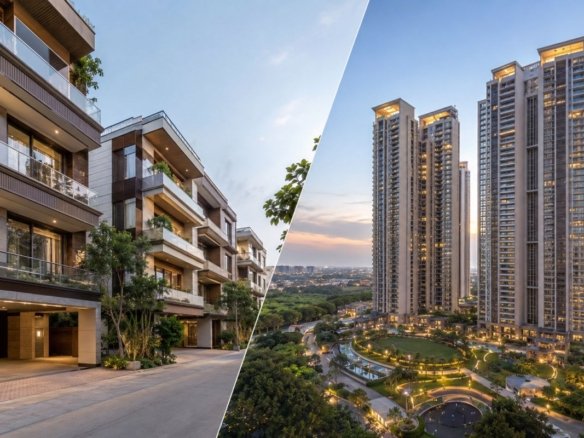
Township vs Standalone: What You’re Choosing
There isn’t a universal answer here.
Standalone projects can work well for:
- quicker possession timelines
- lower entry points in some cases
- access to already developed central areas
Townships lean toward:
- longer-term stability
- more controlled environments
- infrastructure that aligns better with future density
Different priorities. Different trade-offs.
Risks Worth Looking At Closely
Phasing is the obvious one.
Early phases don’t always feel complete. Retail may take time. Some infrastructure evolves gradually.
Execution matters more here than in smaller projects. Consistency over years becomes the real test.
So it helps to look beyond plans:
- how earlier phases have actually been delivered
- whether timelines held up
- how commercial zones are shaping on ground
Some projects get this balance right. Others take longer.
Who This Works For
Townships tend to suit:
- families planning longer stays
- professionals looking for more predictable routines
- investors focused on rental consistency
For short-term plays, the pace may feel slow.
And that’s fine. Not every format needs to serve the same goal.
Where Gurgaon Is Heading
Look at where infrastructure is expanding and where land is still available.
For buyers evaluating long-term growth corridors, understanding the city’s emerging micro-markets through a comprehensive Gurgaon investment location analysis can help identify areas with stronger future potential.
Dwarka Expressway, SPR, New Gurgaon — most township developments are clustering here.
Much of this demand is being driven by the growing pipeline of new residential launches along Dwarka Expressway, which continue to attract both end-users and investors.
Part necessity, part demand shift.
Whether this becomes the dominant format everywhere is still open. Older sectors will continue to hold relevance.
But the direction is becoming easier to read.
Final Thought
Integrated townships don’t always stand out on brochures.
Spend time in one — or talk to residents after a year or two — and the differences show up in small, practical ways.
It’s less about added features.

More about fewer interruptions in everyday life.
And depending on what you value, that difference can either feel marginal… or hard to ignore.
Frequently Asked Questions(FAQs)
What is the biggest advantage of integrated townships in Gurgaon?
They reduce everyday friction — better planning, easier access to essentials, and more predictable living conditions.
Are integrated townships more expensive?
Sometimes at the entry level, yes. Over time, the gap often aligns with livability and demand.
Do they give better returns?
Typically more stable rather than sharp. Rental demand tends to stay stronger in many cases.
How long do they take to develop fully?
Usually several years, depending on scale.
Are they good for families?
In most cases, yes — especially where space, safety, and convenience are priorities.

Join The Discussion