
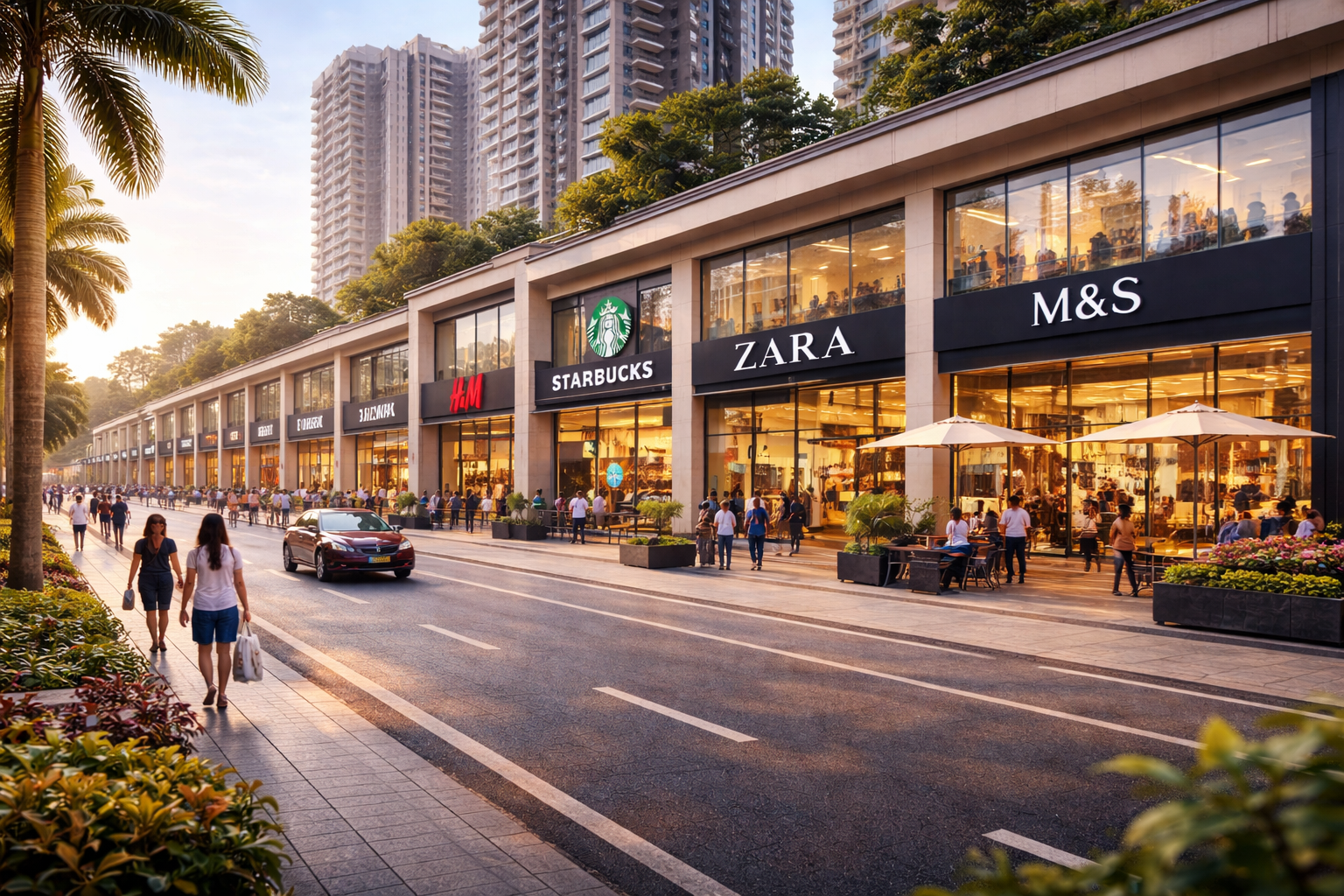
Pre-leased commercial shops for sale in Gurgaon have become one of the most searched commercial investment categories in NCR. Investors looking for commercial property with tenant Gurgaon options are increasingly drawn to assets that promise immediate rental income and lower vacancy risk.
But in 2026, not all pre leased commercial property in Gurgaon delivers stable returns. Rental yield depends on micro-location, tenant sustainability, lease structure, and exit liquidity — not brochure claims.
This guide explains how pre-leased retail really works in Gurgaon, what rental yield commercial property Gurgaon actually offers, how cap rate commercial Gurgaon impacts resale, and which sectors genuinely support long-term performance.
Why Pre-Leased Commercial Shops Are Popular in Gurgaon
Gurgaon is not a tourist-led retail market. It is a consumption-driven economy backed by:
- Corporate workforce concentration
- High-income residential clusters
- Dense gated communities
- Daily-use retail demand
Food outlets, pharmacies, clinics, salons, grocery formats, QSR brands and essential services dominate leasing activity.
For investors, pre-leased shops provide:
- Immediate cash flow
- Defined lease terms
- Reduced initial vacancy risk
- Predictable EMI offset
However, popularity has also created confusion. Many buyers equate “assured return” with sustainable return — which is not always true. Investors can also review the Gurgaon investment location guide to understand how location-level fundamentals affect commercial property decisions.
What “Pre-Leased” Really Means in 2026
A pre-leased commercial shop simply means the property is sold with an active tenant and registered lease agreement.
It does NOT automatically mean:
- Guaranteed long-term income
- High rental growth
- Zero tenant risk
In Gurgaon, many pre rented shops Gurgaon listings show attractive yields because:
- Rental may be temporarily inflated
- Lease lock-in may be short
- Developer may be subsidizing rent
- Tenant may lack operational history
Before investing in any commercial property with tenant Gurgaon, investors must examine:
- Lock-in period (minimum 3 years preferred)
- Escalation clause (12–15% every 3 years common in Gurgaon)
- Remaining lease tenure
- Exit clause conditions
- Security deposit structure
The lease deed matters more than the advertised yield.
Best Areas for Pre-Leased Shops in Gurgaon (2026 Sector Intelligence)

Location quality determines tenant durability and exit strength. In Gurgaon, corridor dynamics differ significantly.
Dwarka Expressway Retail
Dwarka Expressway Retail Strong upcoming residential density and new commercial towers. However, oversupply risk exists in recently delivered high-street projects. Yields may appear attractive but require tenant scrutiny.
Golf Course Extension Road
Golf Course Extension Road Better tenant quality, stronger catchment income levels, relatively stable leasing environment. Yields slightly compressed but exit liquidity stronger.
Southern Peripheral Road (SPR)
Strong residential base but uneven office density. Retail performance depends heavily on specific project visibility and ground-floor access.
New Gurgaon (Sectors 82–95)
Improving rental depth. Suitable for essential services. Still catchment-sensitive — speculative luxury retail struggles.
Sector 65–67 High Street Belts
Active high street shops Gurgaon clusters with steady daily consumption. Micro-location within the project is critical.
MG Road / Sector 29
Mature legacy retail market. Limited new entry options. Stable but lower growth upside.
Smart investors evaluate footfall drivers — not just sector names. A broader view of the best sectors in Gurgaon can help put individual commercial corridors into context.
Real Rental Yield in Commercial Property Gurgaon (2026 Cap Rate Reality)

Typical rental yield commercial property Gurgaon offers in quality pre-leased retail ranges between 5% and 7% net.
Higher yields (8%+) usually indicate:
- Higher tenant risk
- Weak catchment
- Short lease tenure
- Smaller unit sizes
- Upper-floor units
Rental Yield vs Cap Rate – Important Difference
Many investors confuse yield and cap rate.
- Rental yield = annual rent ÷ property price
- Cap rate commercial Gurgaon = net operating income ÷ current market value
Cap rates in Gurgaon retail typically range between 6%–8%, depending on asset quality.
If cap rates compress in future, resale improves. If they expand, valuations correct.
Understanding cap rate dynamics is critical for exit planning.
Tenant Risk Framework (2026)
Tenant quality is the single biggest determinant of performance.
Stronger Categories:
- Healthcare clinics
- Pharmacy chains
- Grocery anchors
- Established QSR brands
Higher Risk Categories:
- New startups
- Experimental retail formats
- Seasonal businesses
- Developer-created shell brands
Brand logo alone is not safety. Business viability within that micro-location matters.
Ground-floor visibility also impacts tenant sustainability and rental growth potential significantly more than upper-floor inventory.
Pre-Leased Shop vs SCO vs Grade A Office (Investor Comparison)

| Factor | Pre-Leased Shop | SCO | Grade A Office |
|---|---|---|---|
| Typical Yield | 5–7% | 6–8% | 7–9% |
| Liquidity | Medium | Medium-Low | Higher |
| Tenant Risk | Business dependent | Multi-tenant flexibility | Corporate lease stability |
| Appreciation Potential | Moderate | Higher (land component) | Moderate |
| Ticket Size | Lower | Higher | Higher |
| Exit Predictability | Lease-driven | Market cycle driven | Institutional demand supported |
When evaluating sco vs pre leased shop Gurgaon, remember:
- SCO offers land ownership advantage
- Pre-leased shops offer immediate income
- Offices offer institutional-grade leases
Investment suitability depends on risk appetite and capital size.
Exit Strategy & Liquidity Reality

Many investors ignore exit planning.
Resale strength depends on:
- Remaining lease tenure (less than 3 years reduces buyer interest)
- Tenant performance history
- Escalation already executed
- Market cap rate movement
If lease expiry approaches without renewal, valuation may face correction.
Liquidity is stronger in assets with:
- Established tenants
- Long lock-in
- Prime corridor presence
Investor Checklist for Pre-Leased Retail (2026)
Before buying any pre leased commercial property in Gurgaon, verify:
- Lock-in ≥ 3 years
- Escalation clause present
- Remaining lease tenure ≥ 5 years ideal
- Tenant category essential or necessity-based
- Ground-floor visibility
- Catchment density and residential occupancy
- Cap rate benchmarking vs corridor average
Red Flag Signals
- Artificially inflated rental
- Units below 300 sq ft in weak projects
- Developer-backed “guaranteed” return schemes
- Newly incorporated tenant without operating history
- Very short lock-in
These often signal yield masking underlying risk.
Who Should Invest in Pre-Leased Commercial Shops?
Pre-leased retail suits:
- Investors seeking passive income
- Capital preservation-focused buyers
- Long-term holders comfortable with lease cycles
It is less suitable for:
- Short-term speculative flippers
- Investors chasing double-digit yields without risk tolerance
2026 Outlook for Commercial Investment Gurgaon
Gurgaon’s consumption base continues expanding due to:
- Corporate hiring
- Residential densification
- Infrastructure upgrades
However, oversupply in certain new retail corridors may pressure weaker assets.
Pre-leased retail backed by:
- Real daily consumption
- Strong residential catchment
- Quality tenant mix
will continue to perform.
Investors evaluating commercial investment Gurgaon 2026 opportunities should benchmark micro-location fundamentals, lease tenure strength, and cap rate dynamics before closing any deal.
Frequently Asked Questions About Pre-Leased Commercial Shops for Sale in Gurgaon (2026)
Is buying a pre-leased commercial shop in Gurgaon really safer than vacant property?
Not automatically. A pre-leased commercial shop in Gurgaon reduces initial vacancy risk, but safety depends on tenant strength, lock-in period, and location fundamentals. If the tenant has a short lock-in or the rental is artificially inflated, the investment can become risky after lease expiry. Safety comes from lease quality — not just the word “pre-leased.”
What rental yield can I realistically expect from pre-leased retail property in Gurgaon in 2026?
For quality assets in strong corridors like Golf Course Extension or established high street clusters, realistic net rental yield commercial property Gurgaon offers is typically between 5% and 7%. If a deal promises 8–9%+, investors should evaluate tenant risk, lease tenure, and catchment strength carefully. Higher yield usually means higher risk.
How do I verify whether the tenant in a pre-leased shop is reliable?
Before buying any commercial property with tenant Gurgaon investors should:
Review the registered lease deed
Check lock-in period (minimum 3 years preferred)
Verify company financial stability
Assess business fit for that micro-location
Confirm security deposit terms
A strong national brand in a weak location can still fail. Tenant viability within that exact catchment is critical.
What is the difference between rental yield and cap rate in Gurgaon commercial property?
Rental yield is the annual rent divided by purchase price. Cap rate commercial Gurgaon refers to net operating income divided by current market value and reflects overall market pricing trends.
If cap rates compress (move lower), resale values improve. If they expand, valuations correct. Investors planning exit must understand cap rate movement — not just headline rental yield.
Is it better to invest in high street shops Gurgaon or in SCO plots?
High street shops Gurgaon provide immediate rental income when pre-leased, while SCO formats offer land ownership advantage and potentially higher long-term appreciation.
If the goal is passive income, pre-leased retail may be suitable.
If the goal is land-led capital growth with operational flexibility, SCO may offer stronger upside — but usually requires higher capital and more active management.



Join The Discussion