
Buying property in Gurgaon is no longer just about location and price — it is about legal enforceability, delivery discipline, and risk-adjusted returns.
HRERA (Haryana Real Estate Regulatory Authority – Gurugram Bench) has fundamentally changed how projects are launched, funded, and delivered. But understanding how HRERA works in practice — not just in theory — is what separates protected buyers from exposed investors.
This 2026 guide explains refund rights, delay compensation, complaint timelines, sector-level risks, and the due diligence framework serious Gurgaon buyers use before booking.
What Is HRERA and Why It Matters in Gurgaon
The Real Estate (Regulation and Development) Act, 2016 was introduced to bring transparency and accountability to India’s real estate sector.
In Gurgaon — once known for delayed possession, ambiguous approvals, and one-sided agreements — HRERA enforcement has created structural change.
Today, most residential projects must:
- Register before marketing or selling
- Declare legally binding possession timelines
- Maintain financial discipline through escrow rules
- Disclose progress updates regularly
But compliance alone does not eliminate investment risk. It reduces legal opacity — not execution uncertainty.
Mandatory Project Registration: Your First Safety Filter
A Gurgaon project must be registered with HRERA if:
- Land area exceeds 500 sq. meters, or
- The project has more than 8 apartments
Buyers should independently verify the registration number on the official HRERA Gurugram portal.
Registered projects must disclose:
- Approved layout plans
- Construction timelines
- Developer credentials
- Quarterly progress updates
Verification transforms marketing claims into documented data.
Clear Possession Timelines & Refund Rights
Under HRERA:
- Developers must declare a specific possession date
- That date becomes legally binding
- Unjustified delay attracts interest liability
If a project is delayed, buyers may:
- Continue and claim delay compensation, or
- Exit and seek full refund with interest
For those evaluating new Gurgaon launch projects in 2026 — particularly along Dwarka Expressway and Southern Peripheral Road (SPR) — understanding refund clauses is essential. Possession timelines vary significantly across sectors and micro-markets.
When analyzing possession delays in Dwarka Expressway projects, serious investors calculate not just legal eligibility — but impact on EMI burden, holding cost, rental assumptions, and exit timing.
HRERA Gurgaon Interest Rate on Delayed Possession (2026 Update)
Compensation under HRERA is generally calculated as:
SBI MCLR + 2%
This rate applies symmetrically to both buyer and builder.
Even a 12–18 month delay in premium corridors can materially impact:
- Projected IRR
- Rental yield expectations
- Loan servicing costs
- Liquidity planning
In multiple HRERA orders passed between 2023 and 2026, buyers in delayed Dwarka Expressway projects were granted refund with interest under the SBI MCLR + 2% provision. This reinforces that compensation clauses are actively enforced when properly documented.
Many investors comparing capital appreciation vs rental yield in Gurgaon underestimate legal delay risk. A stalled project can distort projected cash flow far beyond appreciation assumptions.
Understanding compensation is not just legal awareness — it is financial modeling.
70% Escrow Rule: Financial Discipline Mechanism
Under HRERA:
- 70% of buyer collections must be deposited into a project-specific escrow account
- Funds can only be used for that project
- Withdrawals must align with certified construction progress
This reduces fund diversion risk — historically one of Gurgaon’s biggest structural problems.
However, escrow protects allocation — not speed. Delivery capability still matters.
Carpet Area Transparency & Sector-Level Verification
RERA standardized the definition of carpet area.
In Gurgaon:
- Units must be sold based on carpet area
- Common areas and loading cannot inflate pricing
In sectors such as 67, 65 and 62 along Golf Course Extension Road — and 37D and 102 along Dwarka Expressway — buyers should verify whether declared carpet area matches HRERA filings, especially in premium launches.
Sector-level verification strengthens geographic due diligence.
How to Check HRERA Project Status Online
Before paying any booking amount:
Visit the HRERA Gurugram Bench portal and verify:
- Registration validity
- Possession timeline
- Construction progress updates
- Timeline extensions
- Unit inventory status
Marketing claims of “RERA approved” must be cross-verified.
Five minutes of verification can prevent years of litigation.
HRERA Complaint Process & Resolution Timeline
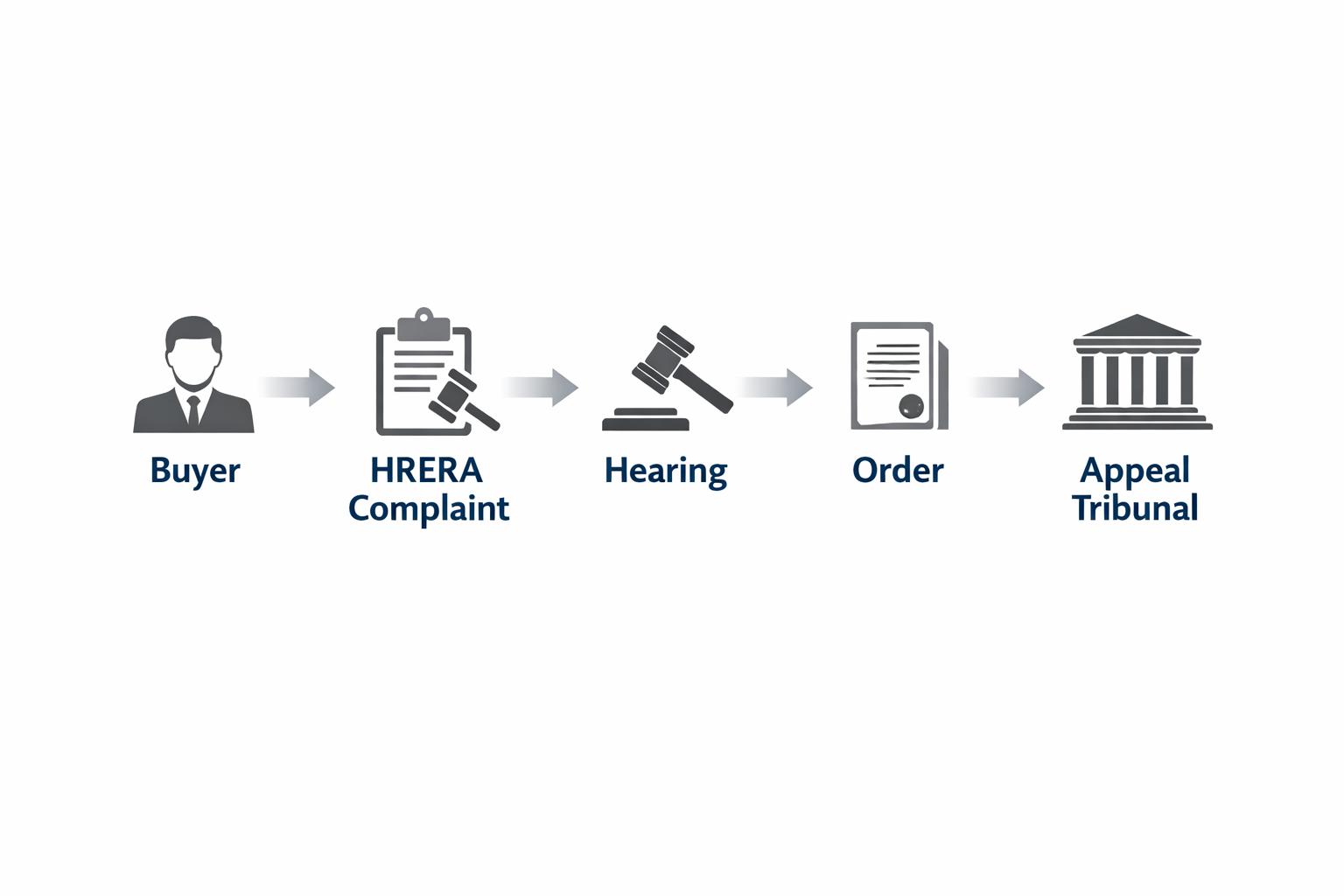
HRERA provides a structured dispute resolution mechanism for:
- Delay in possession
- Refund disputes
- Agreement violations
- False advertising
- Quality issues
In standard delay or refund cases, HRERA proceedings in Gurugram typically conclude within 6–12 months, depending on documentation quality and case complexity.
Compared to traditional civil courts, this significantly reduces legal uncertainty.
Common HRERA Complaints Filed by Gurgaon Buyers (2023–2026 Trends)
Recent complaint patterns include:
- Possession delay
- Refund disputes
- Super area misrepresentation
- OC delay despite construction completion
- Layout deviations
In emerging corridors like Dwarka Expressway, delay-related complaints remain dominant. In established sectors, disputes more often relate to pricing transparency and specification variances.
Understanding trend patterns strengthens pre-investment risk assessment.
Common Loopholes Buyers Still Overlook
Despite HRERA enforcement, buyers must remain cautious about:
Excessive Force Majeure Invocation
Developers may cite external factors to justify timeline extensions. Always verify whether such extensions are formally recorded.
Phased Possession vs Full Completion
Possession of one tower does not always mean full amenity delivery.
OC Delay vs Physical Possession
Physical handover without Occupation Certificate can create legal and utility complications.
Technical Compliance but Slow Construction Pace
A project may remain compliant on paper while actual construction lags behind realistic expectations.
HRERA reduces opacity — it does not eliminate execution gaps.
Is HRERA Registration Enough Before Booking in Gurgaon?
No.
Registration ensures regulatory oversight — not guaranteed returns.
Before booking, buyers should:
- Check OC status of delivered phases
- Verify payment plan structure (construction-linked vs subvention)
- Review developer’s past HRERA compliance history
- Compare entry pricing with nearby delivered inventory
- Stress-test 12–24 month delay scenarios on cash flow
In capital-intensive micro-markets, disciplined modeling outperforms blind optimism.
Defect Liability: 5-Year Structural Protection
If structural or workmanship defects arise within five years of possession:
- Builder must rectify within 30 days
- Repairs must be free of cost
This protects long-term quality across both mid-segment and luxury housing.
How Serious Gurgaon Investors Use HRERA Strategically
In 2026’s Gurgaon market, HRERA compliance is the minimum filter — not the final decision.
Disciplined investors typically:
- Verify registration before token payment
- Evaluate builder’s historical HRERA cases
- Compare entry pricing vs delivered inventory in adjacent sectors
- Model compensation provisions as downside protection
- Integrate legal delay risk into IRR calculations
Legal compliance reduces risk.
Financial discipline defines return.
Buyers who combine both make structurally stronger decisions.




Join The Discussion