

Golf-facing homes have been expensive for a long time.
That hasn’t really changed.
What has changed is how they behave when the market isn’t moving in a straight line.
Track a few transactions around Golf Course Road or DLF Phase 5 over a period of time and a pattern starts to show. Regular luxury units tend to see wider negotiation when demand slows. Golf-facing ones react differently. Sellers hold a bit longer. Buyers don’t push as aggressively in many cases.
It’s not dramatic in every deal. But it shows up often enough.
A few years back, most people looked at these homes as lifestyle upgrades.
Now they’re being evaluated more like long-term assets.
Why Buyers Still Stretch for Golf Views
It’s easy to assume the premium is only about the view.
That doesn’t fully explain it.
In Gurgaon, what you see outside your window can change. New construction, new towers, shifting density.
A golf course doesn’t behave like that.
The open stretch stays. The distance in front doesn’t suddenly shrink.
For someone putting significant money into a property, that kind of stability starts to matter more than expected.

Not Every “Golf View” Works the Same Way
This part gets misunderstood quite a bit.
Some units sit right against the course with a clean, uninterrupted view. Others are slightly angled — you see the greens, but not fully. And then there are units where the “view” exists, but only if you step out at a certain angle.
All of them get marketed under the same label.
Over time, the difference becomes clearer.
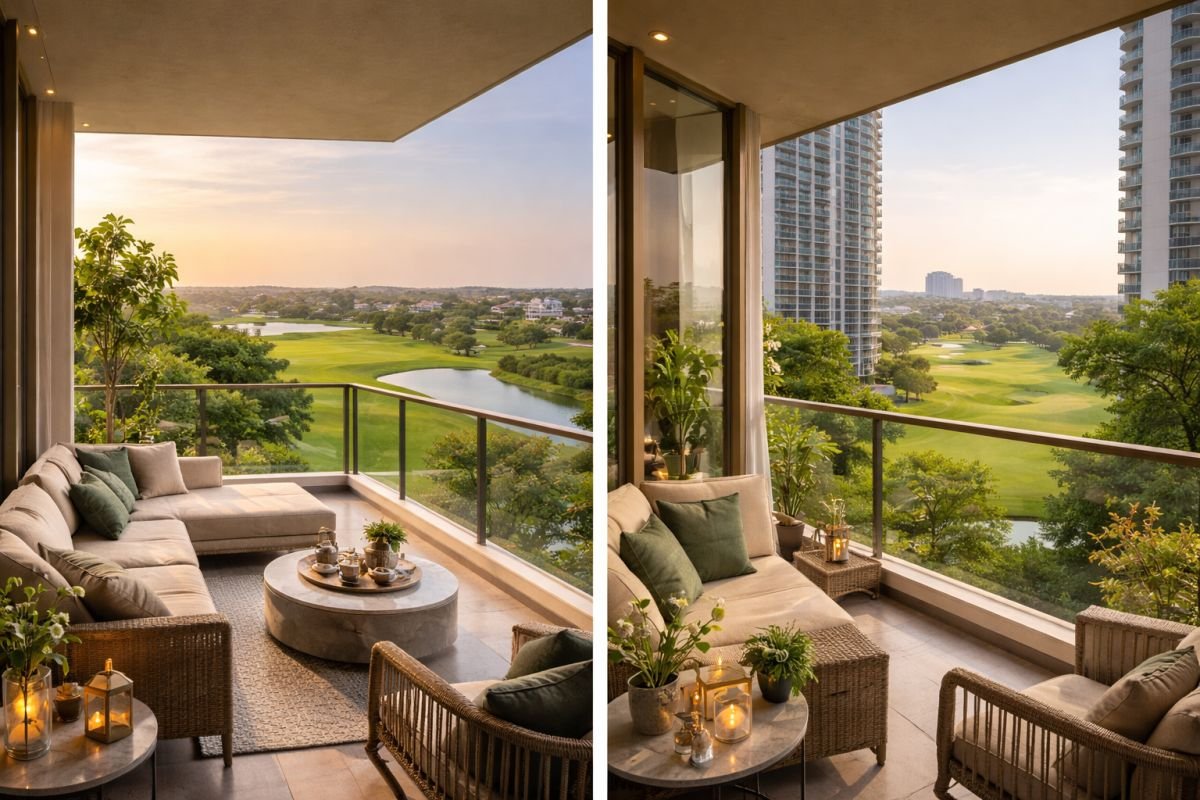
Front-facing units tend to behave differently. The rest depend more on overall project demand and timing.
What Happens When the Market Slows
On paper, golf view homes look like consistent outperformers.
In actual transactions, the difference shows up more during slower phases.
Standard luxury inventory usually sees more flexibility in pricing. Sellers start adjusting expectations faster.
Golf-facing units don’t escape corrections completely, but the shift is usually more contained.
Deals still take time. Buyers still negotiate.
Just not with the same urgency.
Rental Demand: Strong, But Not Everywhere
There is a rental advantage.
But it’s tied closely to where the property sits.
In core pockets like Golf Course Road and parts of DLF Phase 5, expats and senior professionals are willing to pay more for that combination of location and view.
Move slightly away from these zones, and the premium starts fading.
Tenants do value the view.
At the same time, commute, access, and daily convenience come into play.

Who Ends Up Buying These Homes
The buyer pool isn’t very broad.
You’ll usually see people who are comfortable holding for the long term. Some are running businesses, some are in senior corporate roles, a fair number are based overseas and want a strong asset back home.
Short-term flipping doesn’t show up much here.
That changes how the market behaves.
There’s less pressure to exit quickly. Fewer situations where someone has to sell at any price.

Things move, just at their own pace.
Are Buyers Overpaying at Times?
It does happen.
In strong cycles, the “golf view” tag gets stretched.
You’ll come across units where the view is average, but pricing assumes prime frontage. Or projects where the overall quality doesn’t quite match the premium being asked.
Buyers need to slow down a bit in those situations.
A strong unit in a well-positioned project usually justifies the premium.
Outside that, the margin for error increases.
Risks That Don’t Get Highlighted Enough
Golf view sounds like a safe category. It isn’t without gaps.
A few things matter more than they appear initially:
How secure is the view line over time?
Where exactly does the unit sit within the project?
Is pricing already ahead of nearby options?
Liquidity is better than average, but expectations still need to stay realistic.
Even premium assets can take time if pricing drifts too far.
Why These Properties Hold Over Time
Golf-facing homes don’t always show quick spikes.
What they tend to do is hold their ground better and move ahead steadily over longer cycles.
In a city that’s getting denser every year, permanent open green views become harder to find.
That contrast keeps building over time.
Where This Segment Is Moving
Gurgaon continues to expand — more companies, more high-income buyers, more demand at the top end.
At the same time, supply of true golf-facing inventory isn’t increasing.
That gap keeps interest intact.
But buyers are getting more selective now.
Not every unit marketed as “golf-facing” will command the same response going forward.

Final Take
If the goal is quick flipping, this isn’t the easiest segment.
If the focus is stability and long-term positioning, golf-facing homes tend to stand apart.
They’re not meant to be entry-level investments.
FAQs (How Buyers Actually Ask This)
Do golf-facing homes actually perform better?
In many cases, yes — especially over longer holding periods. But it depends a lot on the exact unit and location.
Is paying extra for the view worth it?
For proper front-facing units, it usually holds up. For partial views, the premium can feel stretched.
Do these homes rent out faster?
In core locations, they generally do. Outside those pockets, the difference is there but less noticeable.
Are they safer during downturns?
They tend to correct less aggressively, but they’re not insulated. Entry price still plays a big role.
What’s the biggest mistake buyers make here?
Assuming all golf-facing units behave the same. Small positioning differences can create big gaps later.




Join The Discussion