

Gurgaon’s rental market has changed quietly over the last few years.
Earlier, the playbook was simple—buy an apartment, put it on rent, hold for appreciation. That still exists, but the returns don’t excite most investors anymore, especially after maintenance, vacancy, and negotiation cycles.
That’s where co-living started getting attention.
Not suddenly. Not as a trend. More like something that kept working in the background while people were still thinking in traditional rental terms.
Now it’s visible.
But visibility doesn’t automatically mean viability.
What Co-Living Really Means on Ground
At a surface level, it’s easy to define—renting rooms instead of full apartments, fully furnished, managed setup.
In reality, it feels closer to a hybrid between a rental and a service business.
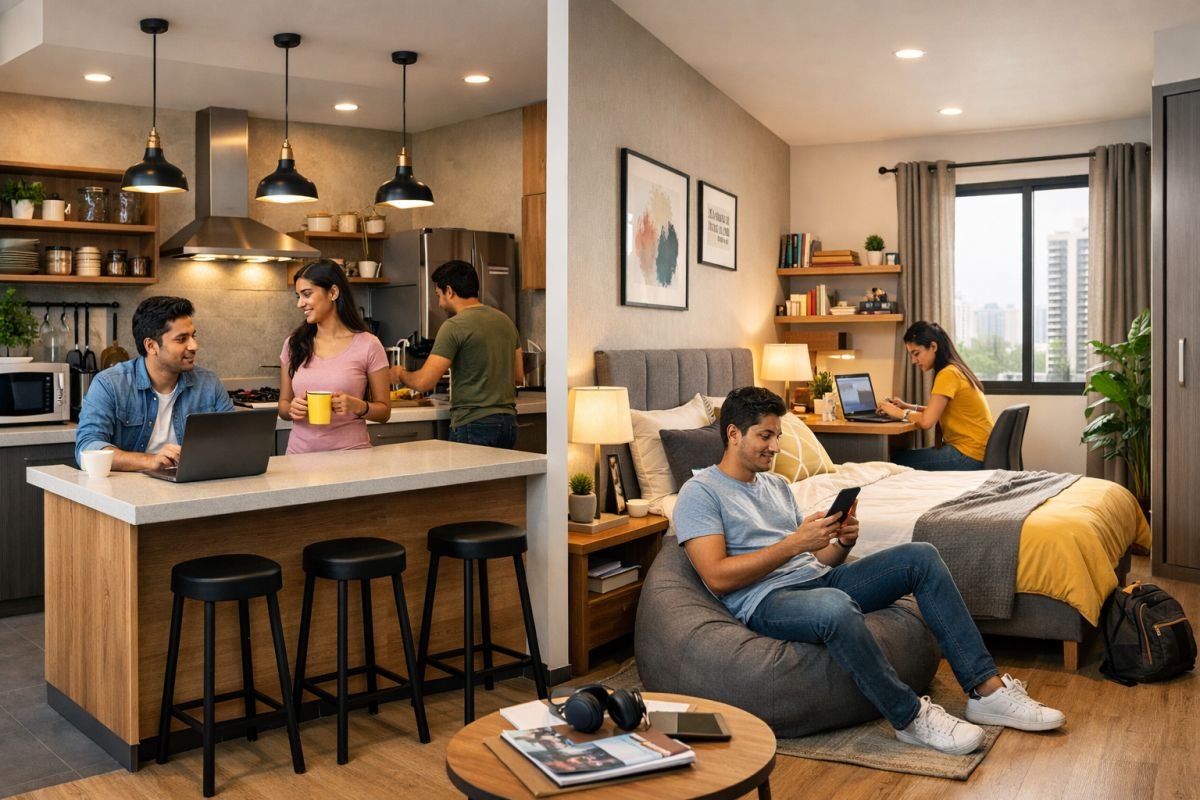
Tenants move in fast. They move out fast too.
There’s constant movement—cleaning, onboarding, small repairs, coordination. Even in well-run properties, things don’t stay stable for long stretches, and that part usually doesn’t show up in return projections.
Why Gurgaon Keeps Feeding This Model

Spend a week observing tenant movement in areas near Cyber City or Golf Course Road, and a pattern becomes obvious.
People are not planning their lives here long-term.
They come for roles, projects, switches. Stay durations are uncertain even for them.
So the usual rental friction—deposit, furniture, setup—starts feeling unnecessary.
Paying ₹18–22K for a managed room closer to work often makes more sense than stretching for a full apartment and then figuring everything else out.
And this isn’t a one-time demand cycle. It keeps refreshing.
Who’s Taking These Spaces (And Why That Matters)
It’s mostly working professionals, yes—but that doesn’t tell you much.
What matters more is behavior.
Short stays are normal. Six months is common. Sometimes less.
People upgrade, switch jobs, relocate within Gurgaon itself.
Which means your tenant isn’t stable—but your demand pool is.
Let’s Talk Numbers (Because This Is Where Assumptions Start)

A typical 3BHK in a decent sector might give you somewhere around ₹40–50K.
Convert the same into a co-living setup and you might see ₹70K, even ₹80K in some cases.
That’s the headline everyone focuses on.
But then you start subtracting things.
Operator share—often close to 20% depending on the agreement.
Furnishing costs that creep up as you keep adding things you didn’t initially plan.
Maintenance that doesn’t really settle into a fixed pattern.
And sometimes, even after getting most things right, the numbers still don’t line up the way you expected.
A lot depends on how consistently the property stays occupied.
This Is Where Things Usually Go Wrong
Most projections assume near-full occupancy.
In most cases I’ve seen, the gap between projected and actual returns comes down to occupancy swings.
A couple of rooms empty for a few weeks. Sometimes longer if timing is off.
And then there’s the operator side.
Not every operator delivers what they promise. Some are solid, some are average, and some just don’t manage properties tightly enough once onboarding is done.
If the operator slips, your numbers follow.
Investment Models — Not As Neat As They Look
You’ll hear about three common approaches.
Leasing to an operator, revenue sharing, or managing it yourself.
Sounds clean when listed like that.
In practice, it rarely stays that clean.
Even with a lease model, you still get involved when something breaks or tenants complain. Revenue share looks attractive until you hit a weak patch. Self-management works—but only if you’re willing to stay consistently involved.
It’s less about the model, more about how much unpredictability you’re okay with.
Location — People Still Try to Compromise Here

There’s a tendency to go slightly cheaper on location to improve entry price.
It usually backfires in co-living.
A property a bit away from office clusters might look fine during purchase, but tenants notice the difference immediately when commute becomes a daily problem.
Areas around Cyber City, DLF phases, Golf Course Road keep working because demand keeps flowing there.
Dwarka Expressway is improving, but it’s still uneven depending on the sector.
Anything disconnected from work hubs struggles. Pricing alone doesn’t fix that.
One Thing Most Articles Won’t Say Clearly
A good portion of co-living inventory in Gurgaon doesn’t perform the way it’s projected.
Not because the concept is broken.
Execution varies a lot.
Listings often assume ideal occupancy, ideal tenants, ideal management.
Reality is rarely that aligned.
Some properties do very well. Others stay partially filled longer than expected, even in decent locations. And you don’t always see that coming at the time of purchase.
Regulations — Easy to Ignore, Hard to Fix Later
This part usually gets brushed aside.
But compliance—fire safety, usage norms, society rules—can slow things down quickly if not handled upfront.
Most professional operators take care of this, but it’s still something you need visibility on.
Fixing it later is always more painful.
Risk Isn’t Just a Line Item Here
Turnover is high. That’s part of the model.
So is wear and tear.
And income fluctuation.
During strong hiring cycles, everything feels smooth. During slowdowns, exits happen faster and replacements take longer.
You notice it first in occupancy, then in cash flow.
So, Is It Worth Considering?
If you’re looking at co-living as just a higher-rent version of residential, expectations usually don’t match reality.
It behaves differently.
More movement, more dependency on management, more variability.
At the same time, when things align—location, operator, demand—it can outperform traditional rentals quite comfortably.
It’s not passive income in the usual sense.
FAQs: Co-Living Spaces in Gurgaon
Is co-living more profitable than a normal rental?
It can be—but only if occupancy holds. Otherwise, the difference narrows quickly.
Who usually rents these spaces?
Mostly young working professionals. Early career, frequent job switches, shorter stays.
Is it legally straightforward in Gurgaon?
Mostly workable, but not completely uniform across areas. Some sectors are smoother, some need more attention.
Is it riskier than renting to a family?
Yes, in terms of stability. Income moves more. That’s the trade-off.
Will demand actually sustain long-term?
As long as Gurgaon keeps attracting a mobile workforce, this demand doesn’t disappear. It may shift in format, but it won’t vanish.




Join The Discussion