

In 2026, the debate between capital appreciation and rental yield is no longer theoretical in Gurgaon.
It is sector-specific.
It is cycle-sensitive.
And it is capital-structure dependent.
From infrastructure-led corridors like Dwarka Expressway to premium belts such as Golf Course Extension Road, return profiles vary sharply.
For investors evaluating Gurgaon property investment 2026, the real question is:
Which micro-location aligns with your leverage, liquidity, and risk tolerance?
Gurgaon Market Evolution: 2023–2026 Cycle Context
Understanding return strategy requires understanding the cycle.
- 2023: Infrastructure completion momentum along Dwarka Expressway
- 2024–2025: Sharp price acceleration across select sectors
- 2026: Absorption-driven consolidation
The easy-money phase of blanket 15–20% annual appreciation has normalized into selective, sector-led performance.
In 2026, absorption strength is measured less by launch-day sales and more by sustained resale transactions and rental renewal stability.
Sectors with controlled new supply and strong resale velocity are showing more stable price behavior.
Corridors with aggressive upcoming supply pipelines may see temporary yield dilution and price stagnation — even when headline demand appears strong.
Investors entering purely on past appreciation charts often underestimate how quickly cycle dynamics shift once supply expands or leverage tightens.
Capital Appreciation in Gurgaon: Where It Still Works
Capital appreciation remains strongest in infrastructure-backed and re-rating corridors such as:
- Sector 37D
- Sector 102
Sector 37D price growth 2026 continues to reflect expressway connectivity maturity and improving end-user traction.
Dwarka Expressway investment potential 2026 is increasingly absorption-backed rather than speculative.
Capital appreciation works best when:
- Entry happens before peak price discovery
- Supply pipeline remains disciplined
- Holding period exceeds 5–8 years
- Investor is not EMI-dependent
Long term property investment Gurgaon strategies favor corridors where infrastructure completion has translated into sustained occupancy — not just launch hype.
Luxury Corridors & Yield Compression Reality

Premium micro-markets like Golf Course Extension Road attract capital-heavy investors focused on wealth preservation.
However, yield compression is visible.
As capital values have risen faster than rents, gross rental yield has compressed to roughly 3%–3.3% in 2026.
Vacancy periods in high-ticket luxury units can further reduce effective yield when tenant turnover slows.
Luxury property appreciation in Gurgaon remains viable — but requires stronger holding capacity and patience.
This is capital-intensive allocation, not cash-flow allocation.
Rental Yield in Gurgaon 2026: What Is Considered Strong?

Rental yield varies sharply by employment density, unit configuration, and ticket size.
In 2026:
- Sector 83 and Sector 89 show 4%–4.5% gross rental yield, supported by steady tenant absorption.
- Sector 102 rental yield typically ranges 3.8%–4.2%, reflecting balanced growth.
- Premium belts like Golf Course Extension Road remain near 3%–3.3%.
For investors analyzing residential rental returns Gurgaon, mid segment rental yield Gurgaon pockets are currently offering stronger risk-adjusted stability compared to late-cycle luxury entries.
Anything above 4% gross yield in an absorption-backed sector is considered healthy in 2026.
Note: Net yield — after maintenance, brokerage, taxes, and vacancy — may reduce gross returns by 0.5%–1% or more depending on tenant turnover cycles.
While residential rental yield in Gurgaon typically ranges between 3%–4.5%, selective commercial assets may offer higher headline yields — often accompanied by higher vacancy and tenant concentration risk.
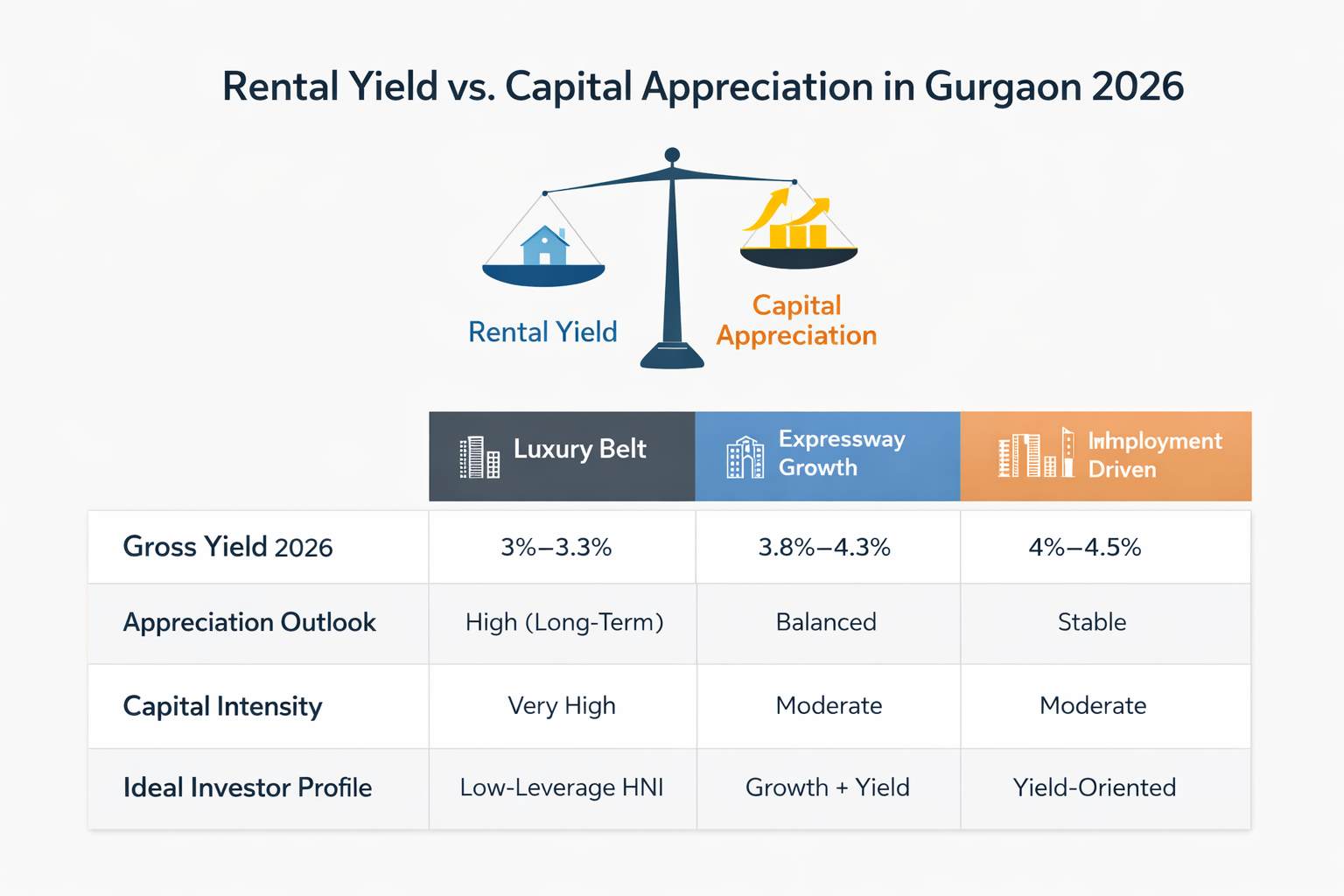
Sector-Level Comparison (2026 Snapshot)
| Corridor Type | Example Location | Gross Yield (2026) | Appreciation Outlook | Capital Intensity | Ideal Investor Profile |
|---|---|---|---|---|---|
| Luxury Belt | Golf Course Extension Road | 3%–3.3% | High (Long-Term) | Very High | Low-Leverage HNI |
| Expressway Growth | Sector 37D / Sector 102 | 3.8%–4.3% | Balanced | Moderate | Growth + Yield |
| Employment Driven | Sector 83 / Sector 89 | 4%–4.5% | Stable | Moderate | Yield-Oriented |
This is why “best sectors in Gurgaon for rental income” queries often point toward mid-segment employment corridors rather than ultra-luxury pockets.
Builder Floor vs Apartment Investment in Gurgaon
Asset type also impacts return structure.
Builder Floors
- Higher land share
- Lower density
- Potentially stronger land-driven appreciation
- Less vertical supply pressure
In low-density sectors with restricted vertical inventory, builder floors may benefit more directly from land-value appreciation cycles.
High-Rise Apartments
- Greater tenant liquidity
- Faster leasing turnover
- More predictable rental stability
Builder floor vs apartment investment Gurgaon decisions must consider corridor density, supply discipline, and tenant demand depth.
Numerical Stress Test: Yield Cushion vs Capital Upside
Scenario A – Luxury Corridor
₹1.6 Cr apartment on Golf Course Extension Road
Monthly rent: ₹45,000
Gross yield: ~3.3%
Scenario B – Expressway Growth Corridor
₹1.1 Cr apartment in Sector 37D
Monthly rent: ₹40,000
Gross yield: ~4.3%
In leveraged purchases, that 1% yield difference meaningfully reduces EMI stress.
During slower market phases, yield-backed assets provide both financial and psychological cushioning.
Capital Bandwidth Rule (2026 Allocation Framework)
If your EMI-to-income ratio exceeds 35%, prioritizing higher rental yield sectors reduces structural risk.
In leveraged purchases, yield is not optional — it is a risk control mechanism.
Investors with strong liquidity buffers can selectively allocate toward lower-yield, appreciation-heavy corridors.
The decision is not ideological. It is balance-sheet driven.
The Core Insight: Sector Selection Over Slogans
In 2026, ROI in Gurgaon real estate depends more on:
- Supply discipline
- Resale velocity
- Rental absorption
- Corridor maturity
Sector selection in Gurgaon today requires corridor-level analysis, not headline price tracking.
Markets now reward discipline — not optimism.
Final Verdict: What Should You Prioritize?
Capital appreciation multiplies wealth.
Rental yield protects it.
For most Gurgaon property investment 2026 strategies, the optimal approach is rental-backed appreciation in supply-controlled, absorption-supported sectors.
Extreme bets are cycle-sensitive.
Balanced allocation is cycle-resilient.
Smart investors don’t choose between yield and growth.
FAQs: Capital Appreciation vs Rental Yield in Gurgaon (2026)
Is 4% rental yield considered good in Gurgaon in 2026?
Yes, in 2026 a 4% gross rental yield in Gurgaon is considered strong, especially in mid-segment, employment-driven sectors. Premium corridors like Golf Course Extension Road typically operate closer to 3%–3.3%, while balanced expressway-linked sectors such as Sector 37D or Sector 102 may deliver between 3.8% and 4.3%. Anything sustainably above 4% in an absorption-backed micro-market is viewed as healthy, provided vacancy and maintenance costs are controlled.
Which sectors in Gurgaon offer both appreciation and rental income potential?
Sectors along Dwarka Expressway, particularly Sector 37D and Sector 102, are currently seen as balanced corridors in 2026. These areas benefit from infrastructure maturity, improving resale liquidity, and rising tenant demand. Unlike ultra-luxury belts that rely heavily on capital growth, these sectors offer rental-backed appreciation, making them suitable for investors seeking both cash flow stability and long-term upside.
Is capital appreciation slowing down in Gurgaon in 2026?
Capital appreciation has not stopped, but it has become more selective. The rapid price acceleration phase seen during 2024–2025 has transitioned into consolidation in 2026. Growth is now sector-specific rather than uniform across the city. Corridors with controlled supply and sustained resale activity continue to show healthy appreciation, while oversupplied pockets may experience temporary stagnation.
Should first-time investors in Gurgaon prioritize rental yield over appreciation?
For first-time or leveraged investors, rental yield often plays a crucial stabilizing role. If the EMI-to-income ratio is high, prioritizing sectors with 4% or near 4% rental yield can reduce financial stress and improve holding capacity. Appreciation is important, but without rental cushioning, holding through slower cycles can become difficult. Yield-backed assets typically offer greater resilience for new investors.
Are builder floors or apartments better for long-term investment in Gurgaon?
The answer depends on the sector and supply profile. Builder floors in low-density areas with limited vertical development may benefit more directly from land-value appreciation cycles. High-rise apartments, on the other hand, usually offer stronger rental liquidity and faster tenant turnover. In emerging expressway sectors, both formats can work, but the decision should align with capital structure, tenant demand depth, and long-term holding strategy.




Join The Discussion