
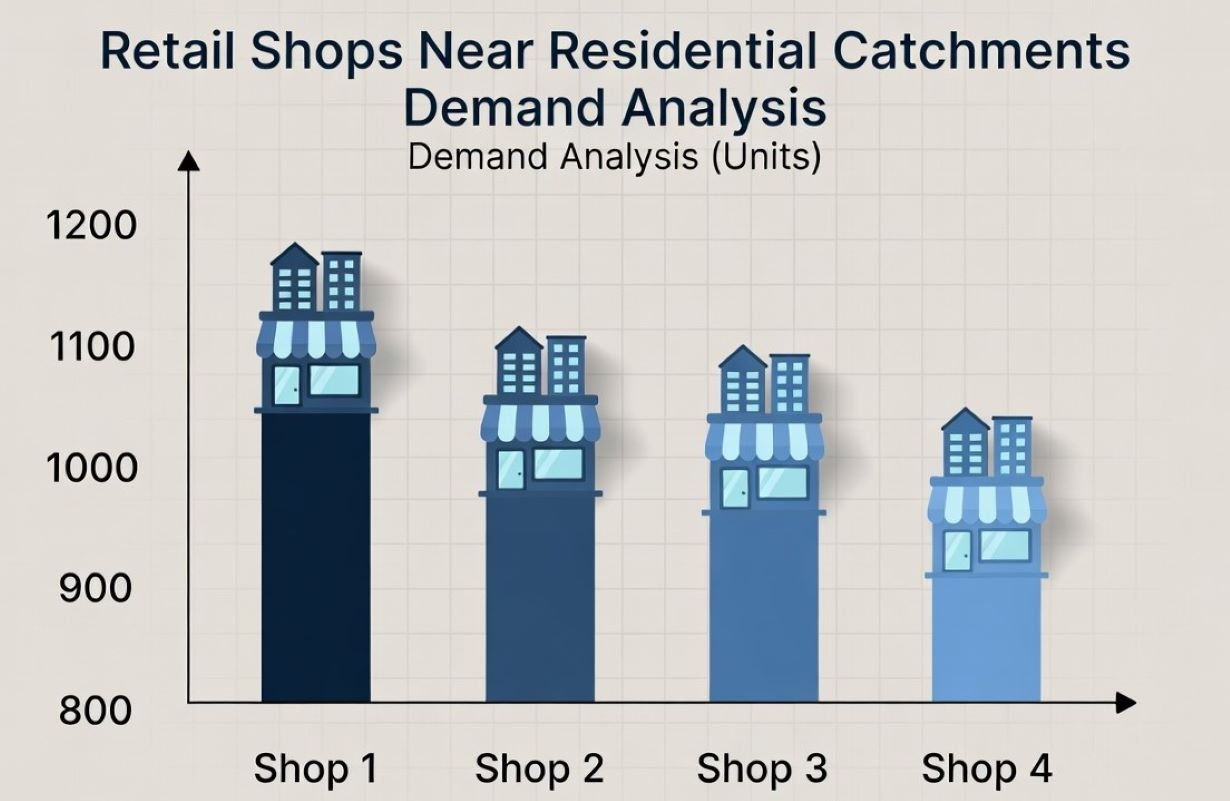
Retail demand in India has traditionally been associated with malls and well-known high streets. Yet across many cities, another format has been quietly strengthening—retail spaces located close to residential neighbourhoods.
This shift is closely connected to the ongoing debate around retail vs mall commercial property Gurgaon, where convenience-led retail is gaining importance.
These neighbourhood retail clusters rarely attract the same attention as large malls, but they often deliver something far more valuable: steady demand. From grocery stores and pharmacies to cafés and service outlets, retail located near residential catchments has become one of the most stable retail formats in urban and semi-urban markets.
Many discussions about this segment simplify the demand story by saying that “daily needs drive footfall.” While that explanation contains some truth, it overlooks several deeper factors. Lifestyle changes, time constraints, urban development patterns, and evolving consumer behaviour all influence how neighbourhood retail performs.
Understanding these forces helps explain why residential catchment retail continues to attract both retailers and investors.
Understanding Residential Catchment–Driven Retail
A residential catchment is essentially the surrounding neighbourhood whose residents form the primary customer base for nearby retail stores. Apartment complexes, gated communities, plotted developments, and integrated townships typically make up this local consumer base.

Retail businesses in these locations serve people who already live nearby. Many customers visit the same stores repeatedly during their weekly routines, creating consistent demand.
In practice, most customers come from the surrounding neighbourhood, returning regularly as part of their everyday shopping habits. This pattern makes catchment-driven retail fundamentally different from malls or destination retail corridors that rely on visitors travelling longer distances.
Why Demand Is Rising for Neighbourhood Retail
Time Scarcity Is a Major Demand Driver
Urban lifestyles have changed considerably over the past decade. Longer working hours, hybrid work patterns, and traffic congestion have made time a valuable resource for many households.
Because of this, convenience increasingly shapes purchasing decisions. A store located a few minutes from home often becomes the preferred option—even when larger shopping centres offer more variety.
Saving time frequently outweighs the benefit of travelling further for additional choices.

Daily-Use Consumption Creates Stability
Retail formats serving everyday needs tend to remain active regardless of broader economic cycles. Groceries, pharmacies, clinics, cafés, salons, and similar services depend on repeat consumption.
Even during slower economic periods, households continue spending on these necessities. Purchasing patterns may adjust, but people rarely stop buying essential goods and services.
For retailers, this steady demand helps maintain regular customer traffic.
The Changing Profile of Retailers in Residential Catchments
Neighbourhood retail was once dominated by small independent shops. Over the last few years, however, the tenant mix has started to change.

Organized brands increasingly look for locations near residential communities because these areas offer dependable repeat customers. Examples include:
- Quick commerce dark stores
- Café and bakery chains
- Cloud kitchen pickup points
- Diagnostic laboratories
- Boutique fitness studios
- Convenience retail brands
Many of these formats are now part of larger mixed use developments Gurgaon benefits, where residential and commercial demand work together.
Similar trends are becoming increasingly visible across emerging growth corridors, particularly in areas witnessing rapid infrastructure development and new residential launches, including several new developments along Dwarka Expressway.
These businesses rely on frequent local customers rather than occasional destination visitors. As a result, organized brands are becoming more visible in residential retail clusters.
In many locations, this shift has also improved tenant quality and strengthened rental benchmarks.
Location Quality Matters More Than Frontage
Not every residential area automatically creates strong retail demand. The quality of the catchment plays an important role.
Retail locations tend to perform better when several conditions are present:
Investors evaluating retail opportunities should also understand how surrounding residential growth influences long-term appreciation. Studying the complete Gurgaon investment location landscape can help identify catchments with stronger future demand and tenant sustainability.
- High population density
- Healthy household income levels
- Good pedestrian access and visibility
- Limited competing retail supply nearby
Retail units hidden within poorly designed complexes or positioned away from pedestrian movement often struggle, even when housing surrounds them.
In practice, micro-location planning can determine whether a retail space succeeds or fails.

Rental Performance and Absorption Trends
Retail spaces located near strong residential catchments often see faster tenant absorption compared with many traditional high-street locations.
Rental growth in these areas usually progresses gradually rather than dramatically. However, occupancy stability often makes these properties attractive for landlords and long-term investors.
Identifying the best locations for retail investment Gurgaon becomes crucial to maximize rental stability and long-term returns.
Understanding which neighborhoods consistently attract residents and businesses is equally important. Investors often begin by researching the most promising sectors in Gurgaon before evaluating retail opportunities within those micro-markets.
Retailers themselves frequently prefer slightly higher rent in a reliable catchment rather than cheaper space with unpredictable footfall.
Consumer Behaviour: Repeat Over Discovery
Neighbourhood retail works differently from destination shopping zones. The emphasis is less on discovery and more on routine.
Residents typically return to the same grocery store, pharmacy, café, or service outlet several times a week. These repeated visits gradually build consistent revenue streams for retailers.

Because customers live nearby, stores benefit from natural visibility and familiarity rather than heavy marketing campaigns.
Risks and Common Mistakes Investors Make
Despite its stability, residential catchment retail is not automatically successful.
A common mistake is assuming that a large number of housing units will always produce strong retail demand. Spending capacity, demographics, and lifestyle patterns also influence how much nearby residents actually spend.
Tenant mix is another important factor. When too many similar businesses operate in the same complex, they often compete for the same limited customer base.
Investors also sometimes underestimate the importance of practical factors such as parking availability, street visibility, and last-mile access.
Investor Perspective: Why Catchment Retail Attracts Interest
From an investment standpoint, retail located near residential catchments is often considered a relatively defensive asset.

Rental growth may be gradual, but consistent demand can support stable income over time. Institutional buyers and experienced investors often prioritise properties with reliable occupancy rather than unpredictable short-term gains.
Retail that serves essential local consumption—such as food, healthcare, and convenience services—also faces less direct competition from e-commerce.
What the Demand Analysis Shows
Retail demand near residential catchments is supported largely by long-term urban lifestyle trends.
As cities expand and daily routines become increasingly time-constrained, neighbourhood retail continues to play a practical role in meeting everyday consumer needs.
However, performance ultimately depends on micro-location quality, catchment demographics, and thoughtful tenant planning. When these factors align, residential catchment retail can deliver stable occupancy and predictable income over time.
For investors seeking immediate rental income, pre leased shops investment Gurgaon can also be considered within strong residential catchments.
Since residential density is a key driver of retail demand, many investors also explore opportunities in the housing market to better understand buyer preferences and population growth patterns. A detailed guide to purchasing residential property in Gurgaon can provide additional market insights.
FAQs: Retail Shops Near Residential Catchments
Why do retail shops near residential areas perform well?
They benefit from repeat demand generated by nearby residents who regularly purchase everyday goods and services.
Which retail categories perform best near residential catchments?
Grocery stores, pharmacies, cafés, clinics, salons, fitness studios, and convenience retail outlets typically perform strongly.
Are rents lower than high-street retail locations?
Not always. In strong residential catchments, rents can match or sometimes exceed nearby high-street levels due to consistent demand.
Is residential retail resilient during economic downturns?
Generally yes. Consumer spending often shifts toward nearby convenience retail rather than disappearing completely.
What should investors evaluate before buying such retail spaces?
Population density, income levels, visibility, accessibility, competing retail supply, and potential tenant mix should all be carefully assessed.

Join The Discussion