
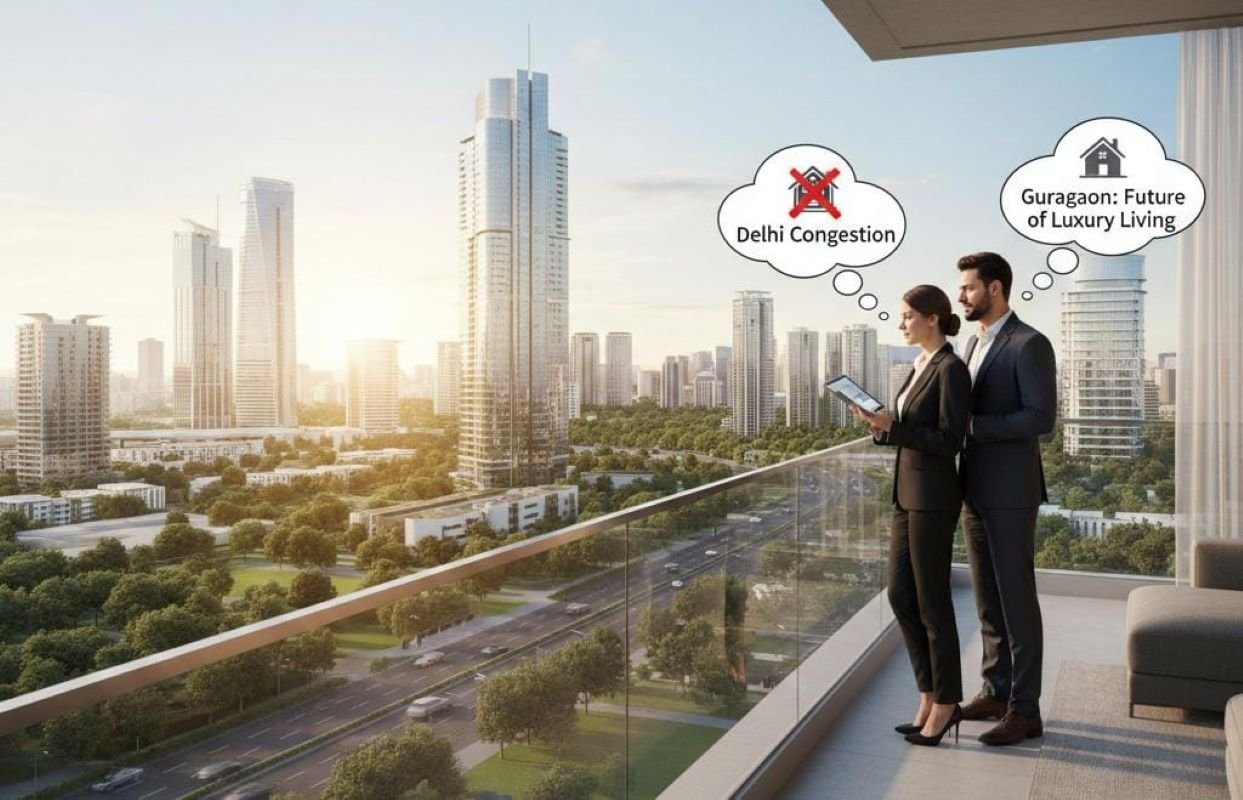
There was a time when this wasn’t even a discussion.
If you had serious money in Delhi, you stayed in Delhi. South Delhi if you were doing well, and Lutyens’ if you were operating at a different level altogether. Gurgaon, at best, was seen as an extension rather than a replacement.
That equation has started to shift.
Not abruptly, and not in a way that creates noise, but consistently enough that anyone tracking buyer behaviour can see it. Gurgaon is now part of the primary conversation among high-value buyers. And what makes this more interesting is that the shift is not being driven by cheaper pricing. In several premium pockets, Gurgaon is already at par with Delhi — sometimes even higher.
To understand this evolving demand, it also helps to look at how ultra luxury homes in Gurgaon are attracting a very different buyer profile today—one that is driven more by lifestyle alignment than traditional prestige.
To understand how this fits into the broader city structure, it helps to look at the Gurgaon investment location guide , where Gurgaon is no longer positioned as an emerging market but as a redefining one.
What Luxury Means Has Quietly Changed
Luxury used to be about address, land value, and legacy.
Today, it is being defined very differently.

Buyers now look at things that earlier didn’t dominate conversations — how many residences share a floor, whether lifts open directly into private foyers, how much spacing exists between towers, and how the project will feel several years down the line as surrounding development evolves.
This is also why conversations around whether luxury projects in Gurgaon are overpriced have become more nuanced. Pricing alone is no longer the deciding factor; experience, longevity, and usability are.
Gurgaon’s newer developments are being designed with this expectation in mind, while much of Delhi is trying to adapt older formats to new lifestyle demands.
Delhi Still Holds Value, But Living There Feels Different Now
Delhi continues to carry legacy, identity, and social positioning.
But the experience of living there, especially in builder floors or older colonies, has become heavier over time. Traffic density, parking challenges, redevelopment uncertainty, and approval delays collectively impact everyday convenience.

None of these issues individually push buyers away.
But together, they create friction.
And that friction is what Gurgaon quietly solves.
Gurgaon Fits the Way Life Is Structured Today
Gurgaon’s biggest advantage is not just new construction — it is how its ecosystems are built.
In several sectors, workspaces, schools, healthcare, and lifestyle infrastructure exist within the same stretch. This reduces commute dependency and simplifies daily routines.

For many buyers, especially those already working in Gurgaon, the move is less about upgrading a home and more about improving how life flows.
This is also why formats like compact luxury homes in Gurgaon have gained relevance. Buyers are not reducing expectations — they are refining them.
NRIs, in particular, connect with this model quickly because it mirrors global living standards based on managed communities and structured environments.
Price Bands: Where Gurgaon Actually Stands Today
There is still a perception that Gurgaon is a value alternative to Delhi. That perception is outdated.
Premium micro-markets in Gurgaon today broadly fall into structured pricing bands, depending on location, density, and product positioning. Established luxury corridors are already operating at levels comparable to Delhi, while emerging premium zones are closing the gap rapidly.
For buyers evaluating actual inventory across segments, new residential projects in Gurgaon give a clearer sense of how pricing aligns with product quality and positioning.
This shift in pricing behaviour also connects to how different micro-markets are evolving across the best sectors in Gurgaon, where demand is no longer evenly distributed.
For buyers comparing location performance, this becomes even clearer when evaluating golf course road vs extension road investment, where pricing differences reflect positioning rather than affordability.
The key shift is this: Gurgaon is no longer cheaper. It is competing on value delivery.

But pricing alone doesn’t explain the market — how each price band behaves is what actually matters.
Luxury Price Band & Buyer Positioning
| Price Band (₹/sq ft) | Micro-Market Type | Buyer Profile | What You Actually Get | Investment Positioning |
|---|---|---|---|---|
| ₹20,000 – ₹25,000+ | Established Luxury (Golf Course Road, Golf Course Ext.) | HNIs, Legacy Buyers | Prime location, mature ecosystem, limited supply | Capital preservation + stable appreciation |
| ₹16,000 – ₹20,000 | Emerging Premium (Dwarka Expressway) | HNIs, NRIs, Strategic Investors | Large layouts, newer inventory, low density | High upside (spread compression) |
| ₹13,000 – ₹16,000 | Upper Mid-Luxury (Sector 111, New Gurgaon) | Upgraders, Hybrid Buyers | Premium amenities, moderate density | Balanced growth + usability |
| ₹10,000 – ₹13,000 | Entry Luxury / Value | First-time luxury buyers | Higher supply, variable quality | Selective appreciation |
This is why two buyers with the same budget Gurgaon’s luxury developments focus on openness, light, and usability.ften end up making very different decisions.
Who Is Driving This Shift
The movement toward Gurgaon is being shaped by three distinct buyer groups, each approaching the market with a different objective.

HNIs are not moving out of compulsion but out of preference. For them, Gurgaon offers privacy, scale, and predictability that is becoming harder to achieve in Delhi. Many continue to hold their Delhi properties but are allocating new capital into Gurgaon for both lifestyle and long-term positioning.
NRIs form another strong segment. Their expectations are shaped by global standards, and they tend to prioritise structured living, transparency, and managed environments. Gurgaon aligns naturally with these expectations, which explains the growing NRI participation.This demand pattern is also visible in the growing luxury rental market in Gurgaon driven by CXO and expat demand, particularly across premium managed communities. This behaviour is also discussed in the broader trend of HNI shift from Delhi to Gurgaon luxury real estate.
End-users upgrading from mid-segment housing represent the third category. For them, Gurgaon offers a clearer upgrade in lifestyle compared to Delhi, where improvements are often constrained by legacy infrastructure.
Design, Space, and the Experience Shift
Gurgaon’s luxury developments focus on openness, light, and usability.

Balconies are functional, layouts are practical, and shared spaces are designed for daily living—not just visual appeal.
This is one reason why demand is consolidating around luxury projects with strong resale demand in Gurgaon, where design quality directly impacts long-term performance.
In contrast, many Delhi properties are constrained by structural limitations that restrict flexibility.
Security and Managed Living
Security has evolved from a feature into a baseline expectation.

Buyers today evaluate access control systems, surveillance infrastructure, and movement within the property with much greater scrutiny. Gurgaon’s luxury projects are designed with these elements integrated from the ground up.
In Delhi, even high-value homes often rely on external arrangements, which creates a different level of dependency.
For families, this difference is often significant enough to influence the final decision.
Where Premium Buyers Are Looking Today
While Gurgaon has multiple evolving zones, certain micro-markets are clearly positioning themselves as premium clusters.

Established corridors such as Golf Course Extension Road continue to attract high-value buyers due to their mature ecosystem and consistent demand. For those evaluating this segment, Luxury Apartments on Golf Course Extension Road offer one of the most stable luxury environments in the city.
At the same time, emerging luxury corridors such as Dwarka Expressway are attracting strategic investors who are positioning themselves ahead of full price convergence.
What This Shift Really Means
This is not a simple Delhi versus Gurgaon comparison.
It is a reflection of how luxury is being redefined.
Earlier, the address was enough. Today, buyers look at how a home fits into their daily life, how it evolves over time, and how it performs as an asset.
Right now, Gurgaon aligns more closely with that mindset.
Where Does This Go Next
This shift is likely to become more structured over time.
Certain micro-markets will continue strengthening and begin to resemble established luxury zones similar to those identified among the best sectors in Gurgaon, while others will evolve based on infrastructure and supply dynamics.

For buyers evaluating opportunities across these segments, exploring Best Upcoming Projects in Gurgaon provides a broader comparison of how different micro-markets are positioning themselves.
Final Takeaway
HNIs are not moving away from Delhi because it has lost value.
They are reallocating toward Gurgaon because it aligns better with how luxury is experienced today.
It offers structure, scale, and predictability — all of which are becoming central to modern high-end living.
And that, more than pricing, is what is driving this shift.
FAQs (How These Questions Actually Come Up)
Are people actually moving out of Delhi or just buying additionally?
Mostly adding. A lot of buyers keep their Delhi property and pick up something in Gurgaon for lifestyle or rental. Some shift gradually once their daily routine is already centered there.
Has Gurgaon already peaked, or is there still room?
Some micro-markets have moved quickly. Others are still evolving. It’s not one straight answer — depends heavily on where you’re looking and what kind of project.
Do luxury rentals really work here or is it overhyped?
In the right pockets, they work. Especially where corporate demand exists. Outside those zones, it can be slower.
What do buyers usually misjudge?
They rely too much on brand names or marketing. The exact location, surroundings, and future development around the project tend to matter more than expected.
If someone already owns in Delhi, does Gurgaon still make sense?
For many buyers, yes — especially if they’re looking at usability or income. Delhi still holds value, but the role it plays in a portfolio is changing.



Join The Discussion